
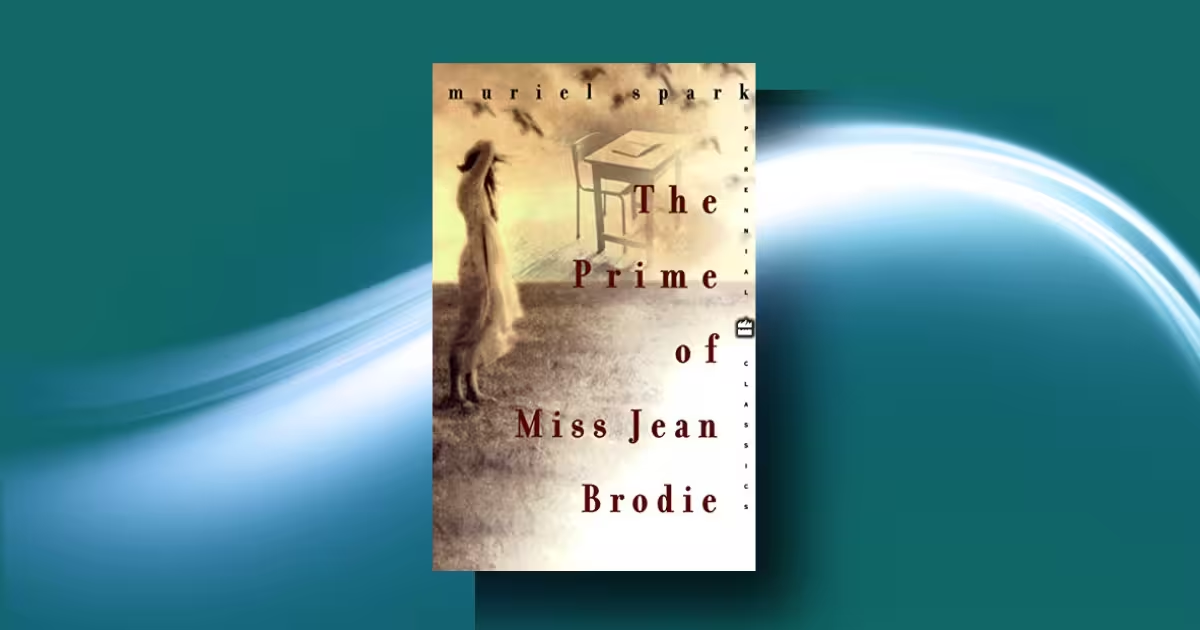
Ever find yourself haunted by a teacher who shaped your entire worldview—for better or worse? I certainly felt that unsettling tug while reading Muriel Spark’s masterpiece, The Prime of Miss Jean Brodie. Did you know that one powerful, flawed mentor could simultaneously be your greatest inspiration and your most dangerous puppet master?
I’ve discovered that this novel isn’t just about a schoolteacher; it’s a psychological blueprint for how charisma can override morality.
Muriel Spark’s The Prime of Miss Jean Brodie brilliantly argues that influence without insight—whether in a classroom or a cult—creates chaos, showing that the difference between “education” and “intrusion” is the razor’s edge between liberation and manipulation.
The Prime of Miss Jean Brodie is best for readers who love darkly witty character studies, psychological dramas about cults of personality, fans of Dead Poets Society or The History Boys who want to see the dark side of “carpe diem” teachers, and anyone interested in 1930s Edinburgh or the psychology of betrayal.
Not for: Those seeking a fast-paced action novel, straightforward heroines, or a tidy moral lesson. If you’re uncomfortable with morally ambiguous anti-heroes or non-linear timelines, you might find yourself more frustrated than fascinated.
Table of Contents
1. Introduction
We have all encountered that one unforgettable teacher. For the six girls of the “Brodie set,” Jean Brodie is not just a teacher; she is a cult leader, a muse, and a self-appointed goddess of taste.
Title and Author Information: Written by the razor-sharp Muriel Spark and published in 1961, The Prime of Miss Jean Brodie is a slim volume that packs a massive punch. It is frequently ranked among the 100 best novels of all time. Typically, a novel about a teacher-student relationship might lean toward sentimentality; yet, surprisingly, Spark does the opposite.
2. Background
The novel is set in the 1930s at the Marcia Blaine School for Girls, a conservative day school in Edinburgh. Historical Context: As noted earlier, this is the era of the rise of fascism in Europe. Mussolini is in power in Italy, and Hitler is rising in Germany.
Significantly, it is also the period of the Spanish Civil War. Spark herself was born in Edinburgh, and her own experiences as a teacher inform the precise detail of the book. She is also a convert to Catholicism, a fact that profoundly influences the novel’s themes of sin, betrayal, and redemption.
3. The Prime of Miss Jean Brodie Summary
So, here is the story.
Initially, it may seem like a quaint tale of schoolgirls and their eccentric teacher. We meet the “Brodie set”: six ten-year-old girls—Sandy Stranger, Rose Stanley, Jenny Gray, Mary Macgregor, Eunice Gardiner, and Monica Douglas.
They are the hand-picked elite. Their teacher, Miss Jean Brodie, stands in her prime, delivering lessons on Italian art, the love life of Charlotte Brontë, Mussolini’s fascisti, and her own dead fiancé, Hugh.
What makes Miss Brodie unique isn’t what she teaches, but how she teaches it. She tells the girls, “Where there is no vision, the people perish”. She famously declares, “Give me a girl at an impressionable age, and she is mine for life”. She rejects the headmistress Miss Mackay’s “Safety First” poster, instead proclaiming “Goodness, Truth and Beauty come first”.
The narrative leaps forward in time. As the girls age, we learn about the three men in Miss Brodie’s life: the dead Hugh (a hero of World War I), the shy singing master Mr. Gordon Lowther (a man of substance with short legs), and the passionate one-armed art master, Teddy Lloyd. In contrast to Miss Mackay’s rigid traditionalism, Miss Brodie’s world seems thrilling.
However, there are darker currents beneath the surface. Miss Brodie tells the girls about her “prime,” teaching them: “One’s prime is the moment one was born for”. She sees herself as a force of nature. The girls, meanwhile, lead double lives. Sandy, in particular, is fascinated by the cracks in Miss Brodie’s facade. She listens to Miss Brodie mislead the girls about her relationship with Lowther, all while pining for the married Teddy Lloyd. Consequently, the reader realizes that the “prime” Miss Brodie speaks of is a fantasy.
The story shifts gears when the girls turn sixteen. Miss Brodie decides to orchestrate the lives of her pupils to live vicariously through them. She wants Sandy (who has “insight”) to be her spy, and Rose (who has “instinct”) to become Teddy Lloyd’s lover—essentially, to be her proxy in a sexual relationship she herself has renounced. She tells Sandy, “Rose will be a great lover. She is above the common moral code”.
The plan backfires. Rose is merely a good model; she has no interest in Lloyd. It is Sandy—the spying, analytical one—who ends up sleeping with Teddy Lloyd. This leads to a profound shift in Sandy’s character. She becomes absorbed not in Lloyd himself, but in the man’s obsession with Miss Brodie. She sees how all of Lloyd’s portraits of Rose resemble Miss Brodie. “We’d look like one big Miss Brodie, I suppose,” she says.
In parallel, Miss Brodie commits her most egregious act. She encourages the troubled, rejected girl Joyce Emily Hammond to run away to Spain to fight for Franco. Joyce Emily is killed, an act that Miss Brodie barely registers as a tragedy.
Meanwhile, Sandy has absorbed Teddy Lloyd’s Catholicism. She begins to see Miss Brodie’s actions through a moral lens. Sandy realizes that Miss Brodie is not a goddess but a tyrant. “She thinks she is Providence,” Sandy thinks, “she thinks she is the God of Calvin”.
And so, Sandy commits the act that defines the novel’s ending: she betrays Miss Brodie to the headmistress. Therefore, Miss Brodie is forced to retire before the war, not for sexual immorality, but for teaching fascism (her admiration for Mussolini). The irony is that the political charge is merely an excuse, a “weapon”.
The novel ends on an incredibly poignant note. Many years later, Miss Brodie is dead. Sandy has become Sister Helena of the Transfiguration, a nun. In her convent, she receives visitors from the Brodie set.
Miss Brodie, in her final, bitter years, never knew who betrayed her. She had suspected Mary (who died in a hotel fire), Monica, or Rose. But in the final interview with a visitor, Sandy offers the most perplexing line: “If you did not betray us it is impossible that you could have been betrayed by us. The word betrayed does not apply”.
For Sandy, true loyalty had ceased when Miss Brodie began to treat them as pawns.
Thus, the novel closes with the haunting line, “There was a Miss Jean Brodie in her prime”—a phrase that is both a tribute and an epitaph.
4. The Prime of Miss Jean Brodie Analysis
4.1. Characters
A major trait of Spark’s genius is how she creates a cast of characters who are archetypes that constantly subvert expectations.
Miss Jean Brodie (The Goddess/God): She is a fascinating paradox. A major trait is her genuine passion for art and culture. Yet, this passion curdles into fascism. She claims to “lead out” education, but she is an intruder, a manipulator.
Sandy later notes she is “an Edinburgh spinster of the deepest dye”, yet she sleeps with Lowther out of a sense of “duty”. She is both magnificent and pathetic.
Sandy Stranger (The Watcher): Initially, Sandy is merely a follower with tiny, pig-like eyes that miss nothing. She evolves from a co-creator of silly romantic stories into a serious psychological observer. She has “insight” but lacks “instinct”. Her betrayal of Miss Brodie is not an act of malice but of cold, calculated morality.
Rose Stanley (The Id): Rose has “instinct” but no “insight”. She is famed for sex without any genuine curiosity about it, making her a blank slate for Miss Brodie’s fantasies. She is famously called “you with the profile” by Teddy Lloyd.
Mary Macgregor (The Scapegoat): She is the “silent lump”. Her tragedy is that she is too stupid to be a true participant, yet she is blamed for everything. Miss Brodie laments, “Perhaps I should have been nicer to Mary” after the girl dies running “hither and thither” through a hotel fire.
Teddy Lloyd (The Artist): He is forever in love with Miss Brodie. His paintings transfigure all his subjects (especially Rose) into her image. Sandy falls for his mind and religion, not him.
4.2. The Prime of Miss Jean Brodie Themes and Symbolism
Spark weaves themes with the skill of a poet rather than a lecturer.
The Dangers of “Prime”: This is the central metaphor. Miss Brodie believes her life is a series of highlights. Yet, her prime is an illusion. She is unaware that her prime is a time of moral decay. The title is thus ironic.
Fascism and Aesthetics: This is the most chilling theme. Miss Brodie loves Mussolini because his fascisti look good marching. For this reason, she equates political order with aesthetic beauty. Consequently, she fails to see the inherent violence.
Betrayal vs. Loyalty: The novel reframes betrayal. Typically, betraying a teacher is wrong. However, Spark argues that loyalty cannot be given to a tyrant. Sandy betrays Miss Brodie to save others from her influence. “One’s prime is the moment one was born for” —Miss Brodie’s prime leads her to ruin.
Art and Reality: Lloyd’s portraits symbolize the distortion of reality. Every painting of Rose looks like Miss Brodie, proving that the artist is so in love with his Muse that he cannot see anyone else.
5. Evaluation
Frankly, The Prime of Miss Jean Brodie is a small, terrifying marvel. It is a masterpiece of compression. Spark does not waste a single word. The prose is witty, precise, and devastating.
For instance, the description of Mary Macgregor’s death—running “hither and thither” as the smoke chokes her—is more heartbreaking than a page of descriptive prose. Spark is toying with the reader: we want to love Miss Brodie, but we are forced to see her as a monster.
5.1. Strengths/Pleasant Experiences
The dialogue is supreme. Every line Miss Brodie utters is quotable. She is a tour de force of personality.
The non-linear structure is brilliant. Jumping back and forth in time keeps the mystery alive about who will “betray” whom.
The dark humor. The book is extremely funny despite its grim themes. The scene where the girls write a fake “love letter” from Miss Brodie to Lowther is hilarious.
5.2. Weaknesses
- The thinness of some characters. Eunice and Monica never quite get the psychological depth of Sandy. They serve the plot, but we don’t feel their interiority.
- The 1978 TV series arguably has room to breathe, whereas the novel is almost too brisk.
5.3. Impact and Controversy
The Prime of Miss Jean Brodie was controversial upon release for its frank depiction of a teacher’s sexuality and its sympathetic portrayal of a fascist-leaning character. It also resonated deeply with readers who had experienced the “cult of personality” in schools. The “Brodie set” became a shorthand for any elite group shaped by a charismatic leader.
Comparison with Similar Works: In many ways, this is the dark, Scottish cousin to Dead Poets Society (1989). Mr. Keating is beloved; Jean Brodie is dangerous. It also prefigures The History Boys (2004), where an inspirational teacher crosses moral lines.
Nonetheless, no other novel captures the sheer narcissism of the pedagogue as well as Spark does.
5.4. Adaptations
The 1969 Film (Directed by Ronald Neame, Starring Maggie Smith): This is the most famous adaptation.
Box Office: The film had a budget of roughly $2.76 million and earned $3 million in rentals. Consequently, it was a modest commercial disappointment.
Reception: Maggie Smith won the Academy Award for Best Actress for her performance. Celia Johnson plays Miss Mackay.
Novel vs. Film Differences:
In the novel, Sandy is the betrayer. In the film, because of the focus on Maggie Smith’s charisma, Miss Brodie is made more sympathetic.
The film compresses time, merging minor characters.
The film includes a confrontation between Miss Brodie and Sandy that is not in the novel. In the book, the betrayal is intellectual and cold.
A 2018 Stage Adaptation (Donmar Warehouse): Starring Lia Williams, this version restored the novel’s focus on Sandy’s tortured psychology and explicitly linked Brodie’s methods to grooming.
6. Personal Insight with Contemporary Educational Relevance
Why does this book still feel so dangerous today?
In an era of “influencers,” “life coaches,” and “gurus,” Miss Brodie is the original blueprint. Statistically, 1 in 5 young people in the UK have experienced manipulation by a peer or authority figure. Spark’s novel acts as a warning about the blurry line between mentorship and control.
5 Terrifying Lessons from Miss Brodie:
“Crème de la crème” is a cult signal: If a leader tells you you’re the elite, they are isolating you.
“Art comes first” is an excuse: Miss Brodie uses art to justify sleeping with Lowther and pimping out Rose. Culture can be a mask for abuse.
Silence is compliance: The Brodie set never tells their parents the truth. Consequently, Miss Brodie gets away with her scheme for years.
Politics as an aesthetic: Miss Brodie liked Mussolini because he “stopped unemployment and there was no litter in the streets”. Sound familiar? This is the aestheticization of totalitarianism.
Betrayal is sometimes the most moral act: Sandy is the hero because she had the courage to destroy what she loved for the sake of truth.
7. The Prime of Miss Jean Brodie Quotes
Here are the lines that stick with you like a splinter in your brain:
- On Influence: “Give me a girl at an impressionable age and she is mine for life.”
- On Prime: “One’s prime is elusive. You little girls, when you grow up, must be on the alert to recognise your prime… You must then live it to the full.”
- On Education: “To me, education is a leading out of what is already there in the pupil’s soul. To Miss Mackay it is a putting in of something that is not there.”
- On God:
- On the Ending: “There was a Miss Jean Brodie in her prime.”
8. Conclusion
Ultimately, The Prime of Miss Jean Brodie is a magnificent, chilling novel. It is a psychological portrait of a woman who mistakes her vanity for destiny. Spark’s prose is as sharp as a surgical blade, cutting to the heart of loyalty, morality, and the act of growing up.
I highly recommend this book to: fans of Ian McEwan, students of psychology or education, and anyone who has ever felt the seductive pull of a strong personality. In conclusion, this is not just a book about a teacher; it is a book about why we need to question authority even when it is beautiful.







