
Last updated on May 24th, 2026 at 09:34 am
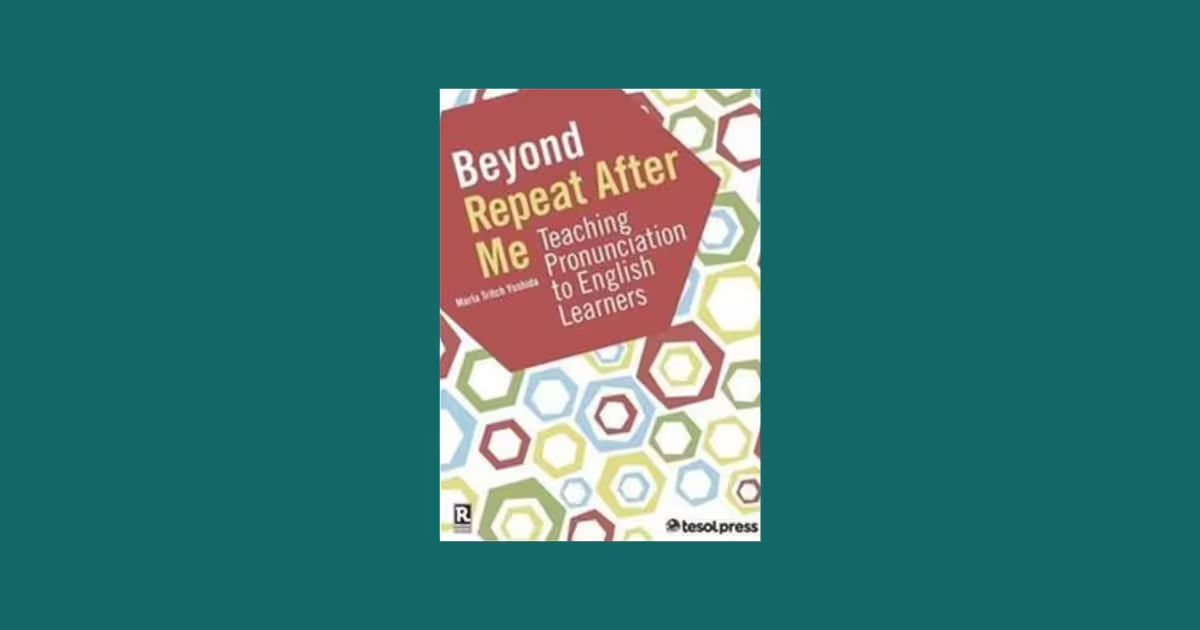
Beyond Repeat After Me: Teaching Pronunciation to English Learners by Marla Tritch Yoshida is a practical guide for teachers who want to teach English pronunciation more effectively.
Published by TESOL Press, the book moves beyond the traditional “listen and repeat” approach and shows teachers how to explain, demonstrate, practise, and correct pronunciation in meaningful classroom contexts.
The book is especially useful for ESL and EFL teachers, including non-native English-speaking teachers who may feel unsure about teaching pronunciation. Yoshida recognises that pronunciation teaching requires more than a good accent.
It requires knowledge of phonology, awareness of learner difficulties, and a practical set of classroom techniques.
Table of Contents
What the book is about
The central message of Beyond Repeat After Me is clear: pronunciation teaching should not be limited to mechanical repetition. Repetition has value, but it is not enough.
Teachers also need to help learners notice sounds, understand how speech is produced, practise through different senses, receive useful feedback, and gradually use pronunciation features in real communication.
The book covers both segmental features, such as consonants and vowels, and suprasegmental features, such as word stress, rhythm, thought groups, prominence, intonation, and connected speech.
This balance is one of the strongest parts of the book. Many pronunciation lessons focus only on individual sounds, but Yoshida shows that stress, rhythm, and intonation are just as important for intelligible communication.
Chapter coverage
The book is organised into fifteen main chapters. It begins with an introduction to pronunciation teaching, then explains basic phonology, the articulatory system, American English consonants and vowels, word endings, syllables, word stress, rhythm, intonation, connected speech, learner differences, spelling, sounds, and phonics. It also includes resources, a glossary, and references.
This structure makes the book useful both as a teacher-training text and as a reference book. Teachers can read it from beginning to end, or they can return to specific chapters when preparing lessons on sounds, stress, rhythm, or intonation.
Key strength: intelligibility over native-like pronunciation
One of the most valuable ideas in the book is its focus on intelligible pronunciation rather than native-like pronunciation. Yoshida explains that trying to sound exactly like a native speaker is often unrealistic, especially for adult learners. A more useful goal is pronunciation that listeners can understand without too much effort.
This makes the book modern and teacher-friendly. It does not promote accent elimination. Instead, it encourages teachers to help learners speak clearly, confidently, and understandably.
Key strength: practical classroom teaching
The book’s title is accurate because it really does go beyond “repeat after me.” Yoshida recommends using visual, auditory, and kinesthetic techniques so that students can see, hear, feel, and practise pronunciation.
For example, the book suggests using mirrors, dental models, gestures, diagrams, listening discrimination, minimal pairs, controlled practice, guided practice, and communicative activities.
The section on correcting pronunciation errors is also helpful. Yoshida does not recommend correcting every mistake. Instead, the book suggests focusing on errors that affect communication, occur repeatedly, or relate to the pronunciation point currently being taught. This is a realistic approach for busy teachers because constant correction can discourage learners.
Key strength: attention to stress, rhythm, and intonation
Another major strength is the book’s treatment of the “musical” aspects of pronunciation. Yoshida gives serious attention to rhythm, thought groups, prominence, intonation, and connected speech. These features are often ignored in pronunciation classes, but they strongly affect how natural and understandable a speaker sounds.
The book also includes creative teaching ideas, such as using gestures, intonation blocks, human intonation models, kazoos, humming, dialogues, skits, and shadowing. These activities make pronunciation less abstract and more memorable for learners.
Who should read this book?
This book is best for:
- ESL and EFL teachers
- TESOL trainees
- English pronunciation teachers
- Non-native English-speaking teachers
- Teacher trainers
- Applied linguistics students
- Teachers who want practical pronunciation activities
It is particularly useful for teachers who know pronunciation is important but do not know how to teach it systematically.
Limitations of the book
The main limitation is that the book is based primarily on standard American English pronunciation. Yoshida clearly states this in the preface and explains that this is the variety she speaks and has taught, not because it is superior to other English varieties.
For teachers focused on British English, Received Pronunciation, or English as a Lingua Franca, the book is still valuable, but some sound examples and pronunciation models will need to be adapted. Teachers using British English should be careful with vowel symbols, /r/ pronunciation, flap /t/, and connected speech examples.
Final verdict
Beyond Repeat After Me is one of the most useful pronunciation teaching guides for English teachers because it combines phonological knowledge with classroom practice. It explains difficult concepts in accessible language and gives teachers realistic ways to help learners improve their pronunciation.
The book’s greatest value is its balanced approach. It does not treat pronunciation as simple imitation, and it does not turn it into abstract theory. Instead, it shows that effective pronunciation teaching requires explanation, listening, physical awareness, practice, feedback, review, and communication.
For teachers who want to make pronunciation lessons clearer, more practical, and more engaging, Beyond Repeat After Me is highly recommended.
FAQ
Is Beyond Repeat After Me good for English teachers?
Yes. Beyond Repeat After Me is useful for English teachers because it explains pronunciation teaching in a practical way and gives classroom techniques for teaching sounds, stress, rhythm, intonation, and connected speech.
Is the book based on British or American English?
The book is based mainly on standard American English pronunciation. However, many of its teaching principles can also be adapted for British English or other English varieties.
What is the main message of Beyond Repeat After Me?
The main message is that pronunciation teaching should go beyond simple repetition. Teachers should use explanation, demonstration, listening practice, physical awareness, communicative activities, and feedback.
Who wrote Beyond Repeat After Me?
The book was written by Marla Tritch Yoshida and published by TESOL Press.
Is this book suitable for non-native English teachers?
Yes. The book was written with special attention to non-native English-speaking teachers and EFL teaching contexts, where students may have limited exposure to spoken English outside the classroom.







