
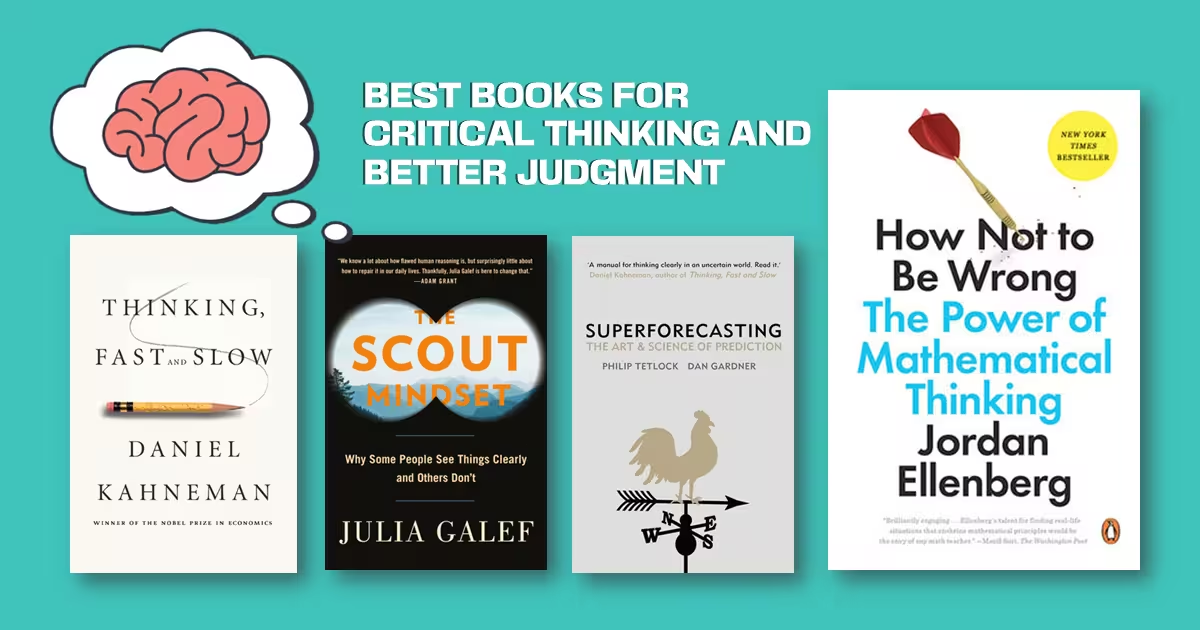
Best books for critical thinking and better judgment are not just books about thinking more clearly; they are practical guides for spotting bias, questioning weak evidence, understanding uncertainty, and making wiser decisions.
This curated list brings together essential reads on cognitive bias, logic, statistics, skepticism, forecasting, and decision-making so you can build sharper judgment in work, study, and everyday life.
Whether you make high-stakes decisions at work, want to stop falling for misleading statistics, or simply want to think more clearly — this list covers the 15 best books on critical thinking and judgment, chosen to eliminate overlap and cover every dimension of rational thought.
Best Books for Critical Thinking and Better Judgment
| # | Book | Author | Category |
|---|---|---|---|
| 1 | Thinking, Fast and Slow | Daniel Kahneman | Cognitive bias |
| 2 | The Scout Mindset | Julia Galef | Cognitive bias |
| 3 | Mistakes Were Made (But Not by Me) | Carol Tavris & Elliot Aronson | Cognitive bias |
| 4 | Noise: A Flaw in Human Judgment | Kahneman, Sibony & Sunstein | Cognitive bias |
| 5 | Superforecasting | Philip Tetlock & Dan Gardner | Probabilistic thinking |
| 6 | Thinking in Bets | Annie Duke | Probabilistic thinking |
| 7 | The Signal and the Noise | Nate Silver | Probabilistic thinking |
| 8 | How Not to Be Wrong | Jordan Ellenberg | Logic & statistics |
| 9 | Calling Bullshit | Bergstrom & West | Logic & statistics |
| 10 | How to Lie with Statistics | Darrell Huff | Logic & statistics |
| 11 | The Demon-Haunted World | Carl Sagan | Scientific skepticism |
| 12 | Factfulness | Hans Rosling et al. | Scientific skepticism |
| 13 | Rationality | Steven Pinker | Scientific skepticism |
| 14 | Decisive | Chip Heath & Dan Heath | Decision-making |
| 15 | Clear Thinking | Shane Parrish | Decision-making |
Table of Contents
What Makes a Great Critical Thinking Book?
Not every popular “thinking book” actually improves your judgment. Many simply catalogue biases without offering tools to counter them. A genuinely useful book on critical thinking must do at least one of the following:
- Explain the mechanism behind a thinking error, not just name it
- Offer a framework or repeatable practice for better decisions
- Be grounded in evidence — research, data, real-world forecasting tournaments, or controlled experiments
- Build transferable skill, not just awareness
The 15 books below were selected because each clears all four bars. They also cover five distinct areas of rational thought — cognitive bias, probabilistic thinking, logic and statistics, scientific skepticism, and practical decision-making — so reading the full list gives you a complete, non-redundant education.
Part 1: Cognitive Bias — How Your Mind Misleads You
Understanding cognitive bias is the entry point to all critical thinking. These four books form the most rigorous treatment available, progressing from the foundational science to its practical and social consequences.
1. Thinking, Fast and Slow by Daniel Kahneman
Best for: Anyone beginning to study judgment and decision-making
The core idea: Nobel laureate Daniel Kahneman divides the mind into two systems. System 1 is fast, automatic, and emotional — it handles most of daily life.
System 2 is slow, deliberate, and effortful — it handles complex reasoning. The problem is that System 1 often takes control of situations that require System 2, producing systematic and predictable errors.
What you’ll learn:
- Why we are overconfident in our own judgments
- How the framing of a question changes the answer we give
- Why we mistake luck for skill in domains like investing and management
- The difference between experiencing wellbeing and remembering it — and why they diverge
Key concept — availability heuristic: We judge the likelihood of an event by how easily examples come to mind. Plane crashes feel more dangerous than car accidents partly because they receive more media coverage. This single bias distorts risk assessment, policy decisions, and personal choices across entire populations.
Why it tops every list: Kahneman spent decades studying judgment under uncertainty with his late collaborator Amos Tversky. The book synthesises that body of work — including the research that won the 2002 Nobel Prize in Economics — into a single, accessible volume. It is the closest thing to a foundational text that this field has.
Who should read it: Everyone. It is the starting point. Read this before anything else on this list. To me, it is undoubtedly one of the best books for critical thinking.
Limitation to know: At nearly 500 pages and written in 2011, some of the underlying studies have since faced replication challenges. Kahneman himself has publicly acknowledged this in some cases. The core framework of System 1 and System 2, however, remains well-supported.
2. The Scout Mindset by Julia Galef
Best for: Readers who want to act on what they know about bias, not just understand it
The core idea: Galef, co-founder of the Center for Applied Rationality, argues that knowing about cognitive bias is not enough. The real challenge is motivation. She distinguishes two orientations: the Soldier Mindset (defending your beliefs against threatening evidence) and the Scout Mindset (surveying reality to map it accurately, even when the findings are uncomfortable).
What you’ll learn:
- Why we engage in motivated reasoning — and why it feels completely rational when we do it
- Practical techniques for updating your beliefs when new evidence arrives
- How to hold strong views without clinging to them
- Why intellectual courage — being willing to be wrong — is a learnable habit, not a personality trait
Key concept — motivated reasoning: Our unconscious tendency to fit data to our pre-existing beliefs rather than the other way around. Galef shows that this is not stupidity or malice — it is a deeply human drive for emotional comfort and social belonging. The Scout Mindset is about building systems and habits that override it.
Why it stands out: Most books on bias stop at diagnosis. Galef offers a genuinely different approach by focusing on the identity-level change required to think more clearly. She argues — convincingly — that you have to want to know the truth more than you want to be right.
Who should read it: Anyone who has read about cognitive bias and still finds themselves making the same mistakes. This is the “what to do about it” book.
3. Mistakes Were Made (But Not by Me) by Carol Tavris & Elliot Aronson
Best for: Understanding why intelligent, educated people hold wrong beliefs with complete conviction
The core idea: Social psychologists Carol Tavris and Elliot Aronson explore cognitive dissonance — the discomfort we feel when our beliefs, actions, or self-image conflict.
Rather than sit with that discomfort, our minds resolve it through self-justification: unconsciously rewriting memory, dismissing evidence, and constructing post-hoc rationalisations.
What you’ll learn:
- How memory is not a recording but a reconstruction — and how it changes to protect our self-image
- Why the hardest errors to correct are the ones we made ourselves
- How therapists, judges, police officers, and doctors make and entrench consequential errors without realising it
- The pyramid of choice: how small initial decisions commit us to increasingly extreme positions
Key concept — the pyramid of choice: Two people start with slightly different views on a question. Each makes small decisions that align with their initial lean.
Over time, these decisions compound — and the two people end up at opposite poles, each convinced the other is acting in bad faith. This model explains political polarisation, failed relationships, and entrenched institutional errors.
Why it’s essential: Where Kahneman explains how we make errors, Tavris and Aronson explain why we refuse to correct them. This is the missing link in most treatments of cognitive bias. Understanding self-justification is crucial for anyone in leadership, medicine, law, or any field where errors have real consequences.
4. Noise: A Flaw in Human Judgment by Daniel Kahneman, Olivier Sibony & Cass R. Sunstein
Best for: Professionals in organisations who want to improve institutional decision quality
The core idea: Thinking, Fast and Slow is about bias — systematic, directional error. Noise is about something different and equally damaging: random variability in judgment.
If two doctors examine the same patient and give different diagnoses, that inconsistency is noise. If two judges sentence identical crimes to wildly different prison terms depending on whether their football team won the previous day, that is noise.
What you’ll learn:
- How to distinguish bias (systematic) from noise (random), and why both undermine accuracy
- Why noise is pervasive in medical diagnosis, legal sentencing, financial forecasting, and hiring — and largely invisible
- Practical “decision hygiene” strategies: structured processes, independent assessments, and calibrated scoring that reduce random variability
- Why we systematically underestimate how much noise exists in our own judgments
Key concept — decision hygiene: Just as physical hygiene prevents disease without targeting specific pathogens, decision hygiene reduces noise without identifying specific errors. It includes: making independent judgments before group discussion, using rubrics and checklists, and separating the intuitive from the analytical phases of a decision.
Why it’s essential reading alongside Kahneman’s earlier work: Noise is not a repeat of Thinking, Fast and Slow. It addresses a completely separate failure mode. Correcting for bias does not reduce noise, and vice versa. Both books together give a complete picture of human judgment failure.
Part 2: Probabilistic Thinking — Reasoning Under Uncertainty
Most decisions in real life involve incomplete information, unknown probabilities, and genuine uncertainty. These three books teach the core skill of thinking in probabilities rather than certainties.
5. Superforecasting: The Art and Science of Prediction by Philip Tetlock & Dan Gardner
Best for: Anyone who wants to improve their ability to predict outcomes and update beliefs
The core idea: For two decades, political scientist Philip Tetlock ran a massive, real-world forecasting tournament — eventually funded by the US intelligence community — asking thousands of ordinary people to make probabilistic predictions about geopolitical and economic events.
His finding: a small group of “superforecasters” dramatically outperformed not just average participants, but highly credentialed expert analysts.
What you’ll learn:
- The specific habits of thought that distinguish superforecasters: granularity, active belief-updating, intellectual humility, and a love of base rates
- Why TV pundits and expert analysts often perform no better than chance
- How to break complex problems into smaller, tractable sub-questions
- The difference between the “inside view” (focusing on your specific situation) and the “outside view” (starting with base rates for comparable situations)
Key concept — the outside view: When estimating how long a project will take or whether a business will succeed, we naturally focus on the specific details of our case (inside view).
But we should start with: what is the typical outcome for projects or businesses like this? (outside view). The outside view is almost always more accurate, and we almost always neglect it.
Why it’s exceptional: This is one of the few books in this genre built on an actual empirical research programme rather than selected anecdotes and lab experiments.
The findings are specific, replicable, and actionable. Tetlock also gives readers concrete exercises for improving their own calibration.
6. Thinking in Bets: Making Smarter Decisions When You Don’t Have All the Facts by Annie Duke
Best for: Readers who struggle to separate good process from good outcomes
The core idea: Former professional poker champion Annie Duke argues that life is far more like poker than chess. In chess, all information is visible and the better player wins.
In poker — and in most of life — information is incomplete, luck plays a significant role, and the quality of your decision cannot be read off the outcome alone.
What you’ll learn:
- How to evaluate the quality of a decision independently of how it turns out
- The concept of resulting — the cognitive error of judging decisions by outcomes rather than process
- Techniques for thinking in probabilities: assigning explicit likelihood estimates to your beliefs
- How to build a “truth-seeking tribe” — a group that holds you accountable to honest thinking rather than comfortable agreement
Key concept — resulting: A drunk driver runs a red light and arrives home safely. Was it a good decision? Obviously not — the outcome was lucky, not earned. Yet we routinely make this error in reverse: when good outcomes follow bad processes, we credit skill; when bad outcomes follow good processes, we assign blame.
Fixing this error is central to improving long-term judgment.
Why it complements Superforecasting: Tetlock gives you the method for probabilistic thinking; Duke gives you the mindset shift for embracing uncertainty without being paralysed by it. The books work together.
7. The Signal and the Noise: Why So Many Predictions Fail by but Some Don’t — Nate Silver
Best for: Building statistical intuition across different real-world domains
The core idea: Statistician and polling analyst Nate Silver examines why predictions fail so reliably in fields like economics, earthquake forecasting, and political punditry — and why they occasionally succeed in fields like weather forecasting, baseball analytics, and poker.
The answer comes down to how clearly practitioners distinguish signal (real information) from noise (random variation and misleading patterns).
What you’ll learn:
- How Bayes’ theorem should govern belief updating in practice — not just in theory
- Why economic models failed to predict the 2008 financial crisis
- Why weather forecasters have improved dramatically while earthquake forecasters have not — and what that difference teaches us about epistemic humility
- How to build models that genuinely predict rather than merely describe historical data
Key concept — overfitting: A model that is too closely fitted to past data will perform badly on new data, because it has learned the noise rather than the signal. This is one of the most pervasive errors in data science, economic modelling, and strategic planning — and Silver’s treatment of it is the clearest available for a general reader.
Part 3: Logic and Statistics — Defending Yourself from Misleading Claims
You cannot think critically about the world if you cannot evaluate the numbers and arguments used to describe it. These three books — spanning mathematics, modern data science, and classic statistical deception — form an essential literacy toolkit.
8. How Not to Be Wrong: The Power of Mathematical Thinking by Jordan Ellenberg
Best for: Readers who think maths is not for them — but especially for them
The core idea: University of Wisconsin mathematician Jordan Ellenberg argues that mathematical thinking is not about calculation — it is about not making certain categories of mistake. His book uses vivid real-world examples to show how the reasoning tools of mathematics — linearity, expected value, regression to the mean, statistical significance — apply directly to everyday judgment.
What you’ll learn:
- Why regression to the mean explains most “miracle cures” and business turnarounds
- Why statistical significance does not mean what most people — including scientists — think it means
- How to think correctly about lotteries, risk, and randomness
- Why the most dangerous words in analysis are “if current trends continue”
Key concept — the Baltimore stockbroker: Imagine receiving a stock tip in the mail. The tipster correctly predicts the market direction for five weeks in a row. You are ready to hand over your savings. What you don’t know is that 320 people received the same letter — with different predictions.
Roughly 10 will have seen five correct calls by chance alone. This is survivor bias, regression to the mean, and misreading randomness all in one story. Ellenberg unpacks it with precision.
Why it’s essential: Most people treat mathematical arguments as automatically authoritative. Ellenberg shows exactly where and how mathematical-sounding reasoning can mislead — and what correct reasoning looks like in its place.
9. Calling Bullshit: The Art of Skepticism in a Data-Driven World by Carl T. Bergstrom & Jevin D. West
Best for: Navigating misleading statistics, data visualisations, and scientific claims in the news
The core idea: University of Washington professors Carl Bergstrom (evolutionary biologist) and Jevin West (data scientist) created a university course — and then a book — on how to detect the specific varieties of statistical and rhetorical nonsense that circulate in media, politics, and even peer-reviewed science.
What you’ll learn:
- How misleading data visualisations work and what to look for
- Why correlation appears in almost every large dataset — and why it almost never implies causation
- How to evaluate scientific claims made in headlines without reading the paper
- The specific techniques used in propaganda, advertising, and policy arguments to make weak evidence look strong
Key concept — selection effects: Media, social platforms, and academic journals all filter for the interesting and the dramatic. What you see is not a random sample of reality — it is a highly selected subset.
Every statistic you encounter arrived through a filter, and that filter shapes what the number means. Bergstrom and West give readers the tools to ask: “what did the filter leave out?”
Why it’s timely: This is the most up-to-date book on the list for the current media environment. It directly addresses machine learning hype, social media misinformation, and the misuse of AI-generated analysis — topics that earlier books on logic and statistics could not anticipate.
10. How to Lie with Statistics by Darrell Huff
Best for: A fast, entertaining, and permanently useful primer on statistical manipulation
The core idea: First published in 1954, this short, illustrated book by journalist Darrell Huff remains one of the clearest guides to how statistics are routinely used to mislead — through selective samples, misleading graphs, spurious precision, and the confusion of correlation with cause.
What you’ll learn:
- The five most common ways statistics deceive: biased samples, misleading averages, truncated graphs, meaningless comparisons, and confounded causation
- Why “the average American” is almost always a misleading figure — and which average (mean, median, mode) is being hidden
- How to ask the five key questions: Who says so? How do they know? What’s missing? Did somebody change the subject? Does it make sense?
Key concept — the gee-whiz graph: By truncating the y-axis of a bar chart — starting at 97 instead of 0 — a tiny change can be made to look enormous. This technique is used daily in financial reports, political graphics, and health journalism. Once you see it, you cannot unsee it.
Why it’s still on this list: Its age is a feature, not a bug. The manipulations Huff identified in 1954 are identical to those used today. Its brevity — under 150 pages — means there is no excuse not to read it. Pair it with Calling Bullshit for complete modern coverage.
Part 4: Scientific Skepticism — Thinking Clearly About the World
Critical thinking is not only an individual cognitive skill. It is also a social and epistemic practice — a way of relating to evidence, expertise, and the claims that circulate in public life. These three books are the finest available guides to that practice.
11. The Demon-Haunted World: Science as a Candle in the Dark by Carl Sagan
Best for: Anyone who wants to understand what separates good evidence from compelling nonsense
The core idea: Written in 1995, astronomer and science communicator Carl Sagan’s masterwork argues that science is not primarily a body of knowledge — it is a method for testing claims against reality. At its heart is the “baloney detection kit”: a set of cognitive tools for evaluating evidence and exposing fraud.
What you’ll learn:
- How to distinguish genuine scientific claims from pseudoscience, conspiracy, and wishful thinking
- The full baloney detection toolkit: independent confirmation, debate with adversaries, quantification, falsifiability, calibration
- Why humans are so prone to seeing patterns, faces, and intent where none exist — and how science corrects for this
- Why scepticism and wonder are not opposites — genuine curiosity requires the discipline to question
Key concept — the dragon in the garage: Sagan asks: what if someone tells you there is a dragon in their garage? You go to look, but the dragon is invisible, floats, breathes heatless fire, and cannot be detected by any instrument.
At what point, Sagan asks, does the dragon differ from no dragon at all? This thought experiment is one of the finest illustrations of the concept of falsifiability ever written.
Why it endures: The specific examples Sagan uses — alien abductions, faith healing, astrology — may feel dated. The underlying logic applies with equal force to modern misinformation, health pseudoscience, and politically motivated science denial.
This book is the gold standard for scientific skepticism, the very reason to be placed as one of the best books for critical thinking.
12. Factfulness by Hans Rosling, Ola Rosling & Anna Rosling Rönnlund
Best for: Correcting systematic distortions in how we see global reality
The core idea: Swedish global health physician Hans Rosling — along with his son and daughter-in-law — demonstrates that most educated people, including doctors, academics, and journalists, consistently hold dramatically wrong beliefs about global poverty, health, education, and population. Not slightly wrong: systematically, wildly wrong in ways that a chimpanzee picking answers randomly would not be.
What you’ll learn:
- The ten instincts that distort our worldview: the gap instinct, the negativity instinct, the straight-line instinct, the fear instinct, the size instinct, the generalisation instinct, the destiny instinct, the single-perspective instinct, the blame instinct, and the urgency instinct
- How to think about data trends rather than snapshots
- Why the mainstream media’s coverage of the world systematically overstates danger, catastrophe, and stagnation
- How to replace dramatic, emotional narratives with fact-based frameworks
Key concept — the negativity instinct: Bad events are usually reported; gradual improvements rarely are. This means our mental image of the world is composed almost entirely of discrete disasters and crises, with no representation of slow, continuous progress. Rosling shows how to correct for this filter using publicly available data.
Why it complements the other books: Most critical thinking books focus on reasoning errors in individual decisions. Rosling demonstrates that we hold systematically incorrect factual beliefs about the world — and that correcting them requires deliberate effort, not just better logic.
Data literacy and worldview accuracy are as much part of critical thinking as logical inference.
13. Rationality: What It Is, Why It Seems Scarce, Why It Matters by Steven Pinker
Best for: Readers who want a comprehensive, single-volume toolkit of rational thought
The core idea: I have to include Rationality by Harvard psychologist Steven Pinker among the best books for critical thinking. Pinker offers a systematic tour of the major tools of rational thinking: logic, probability theory, Bayesian reasoning, causal inference, game theory, and cost-benefit analysis.
He argues that irrationality is not humanity’s natural state but rather a collection of specific failures that can be understood, diagnosed, and corrected.
What you’ll learn:
- How formal logic works and where informal reasoning violates it
- How Bayesian updating works in practice — not just in theory
- Why correlation does not establish causation, and what causal inference actually requires
- How to reason about risk, expected value, and uncertain outcomes in everyday life
Key concept — Bayesian reasoning: We should not ask “is this claim true or false?” but rather “how much should I update my existing belief given this new evidence, and in which direction?” Pinker’s explanation of Bayesian reasoning is one of the clearest available for a non-specialist audience, and it underlies superforecasting, scientific method, and rational decision-making alike.
Why it belongs here: No other book on this list covers the full breadth of rational toolkit — from formal logic to game theory — in a single accessible volume. Rationality is the most comprehensive overview available, and it provides intellectual grounding for many of the concepts introduced more narrowly in the other books.
Part 5: Decision-Making — Applying Better Thinking in Practice
Understanding bias, probability, logic, and evidence is necessary but not sufficient. Good judgment must also translate into better actual decisions. These two books — one a research-backed process framework, one a habits-focused practical guide — complete the picture.
14. Decisive: How to Make Better Choices in Life and Work by Chip Heath & Dan Heath
Best for: Anyone who wants a practical, step-by-step decision-making process
The core idea: Brothers and researchers Chip and Dan Heath identify four recurring villains of decision-making: narrow framing (defining your options too narrowly), confirmation bias (seeking only information that supports your existing preference), short-term emotion (letting present feelings override long-term judgment), and overconfidence (failing to account for how wrong you might be). Their WRAP framework counters each villain in turn.
What you’ll learn:
- How to widen your options by generating alternatives systematically, not just deliberating between the ones already on the table
- How to reality-test your assumptions by seeking disconfirming evidence, not just confirming it
- How to attain distance from short-term emotions by projecting your decision into the future: “What would I think of this choice in ten years?”
- How to prepare to be wrong by using pre-mortem analysis: “Assume this decision failed. What probably caused it?”
Key concept — the pre-mortem: Before committing to a decision, imagine that it is twelve months later and the choice was a disaster. Now explain why it failed. This exercise — developed by psychologist Gary Klein and cited by Kahneman — surfaces hidden risks, overcomes groupthink, and makes overconfidence visible before it causes damage.
Why it completes the list: The earlier books build understanding and diagnosis. Decisive gives you the operating procedure. It is the most practically applicable book on this list, with concrete exercises for every stage of the decision process.
15. Clear Thinking: Turning Ordinary Moments into Extraordinary Results by Shane Parrish
Best for: Building daily habits of better judgment rather than just knowing the theory
The core idea: Falling on the list of the best books for critical thinking is Clear Thinking by Shane Parrish. Shane Parrish, founder of the Farnam Street blog and the Knowledge Project podcast, argues that most failures of judgment do not happen in dramatic high-stakes moments — they happen in ordinary, seemingly low-stakes moments when we are not paying attention.
The key to better thinking is not just knowing about bias but building systems and habits that produce better defaults.
What you’ll learn:
- The four default “biological” modes that override rational thinking: the emotion default, the ego default, the social default, and the inertia default
- How to strengthen your judgment by putting yourself in positions where good defaults are easy and bad ones are costly
- The importance of creating space — literal time and cognitive room — before responding to difficult situations
- Why your environment and your habits matter more than your knowledge of reasoning
Key concept — the four defaults: We do not make decisions with the rational, deliberate mind we imagine we use. We make them with four hardwired tendencies: to react emotionally, to protect our ego, to follow social cues, and to keep doing what we have always done. Parrish’s framework names these defaults clearly, making them visible and therefore manageable.
Why it closes the list: Where most books in this genre speak to the analytical mind, Clear Thinking speaks to the practical person who must make decisions every day under time pressure, emotional load, and social influence. It bridges the gap between knowing what rational thinking requires and actually doing it.
How to Read This List
If you are completely new to this topic
Start with books 1 and 2 (Thinking, Fast and Slow and The Scout Mindset), then move to 14 (Decisive). You will have a complete foundation in bias, mindset, and applied decision-making in three books.
If you are a professional who makes institutional decisions
Prioritise books 1, 4, 5, and 14 (Thinking, Fast and Slow, Noise, Superforecasting, and Decisive). Together, they cover the most consequential judgment errors in organisational settings and offer the most rigorous corrective frameworks.
If you work with data or consume research
Books 7, 8, 9, and 10 (The Signal and the Noise, How Not to Be Wrong, Calling Bullshit, and How to Lie with Statistics) form a complete statistical literacy curriculum. Book 12 (Factfulness) is also essential for data-driven worldview accuracy.
If you want the full curriculum
Read in order. The list is sequenced so each book builds on what precedes it — from the mechanism of bias, through the tools of probabilistic and logical reasoning, to the practice of better daily judgment.
FAQs
1. What is the single best book on critical thinking?
Thinking, Fast and Slow by Daniel Kahneman is the most foundational and widely recommended. It provides the conceptual vocabulary — System 1, System 2, heuristics, biases — that all subsequent books in this field build upon.
2. What is the best book on decision-making under uncertainty?
Superforecasting by Philip Tetlock and Thinking in Bets by Annie Duke address this most directly. Superforecasting is more rigorous and empirically grounded; Thinking in Bets is more immediately applicable to everyday decisions.
3. Is there a short book on critical thinking for beginners?
How to Lie with Statistics by Darrell Huff (under 150 pages) and The Scout Mindset by Julia Galef are both accessible, relatively short, and highly practical starting points.
4. What is the best book on scientific skepticism?
The Demon-Haunted World by Carl Sagan is the gold standard. Factfulness by Hans Rosling is the best companion for applying skeptical thinking to real-world data and global trends.
5. Do I need a maths background to read these books?
No. How Not to Be Wrong and The Signal and the Noise are written explicitly for readers without a technical background. The goal of both is to build intuition, not mathematical skill.
6. What is the difference between critical thinking and skepticism?
Critical thinking is the broader practice of evaluating claims and reasoning carefully.
Skepticism is one component: the disposition to require evidence before accepting claims. All genuine skeptics are critical thinkers, but critical thinking also includes constructive reasoning, decision-making, and argument evaluation — not just doubt.
Conclusion
The books on this list, as the best books for critical thinking, share a common conviction: that clear thinking is a skill, not a personality trait. It can be learned, practised, and improved — not through willpower, but through understanding the mechanisms of error and building the habits and processes that correct for them.
The field has a well-documented problem with readers who understand cognitive bias intellectually but continue making the same errors in practice. That gap — between knowing and doing — is exactly what The Scout Mindset, Decisive, and Clear Thinking exist to close.
Read broadly. Read critically. And when you disagree with an author, ask yourself: is this the scout in me, or the soldier?







