
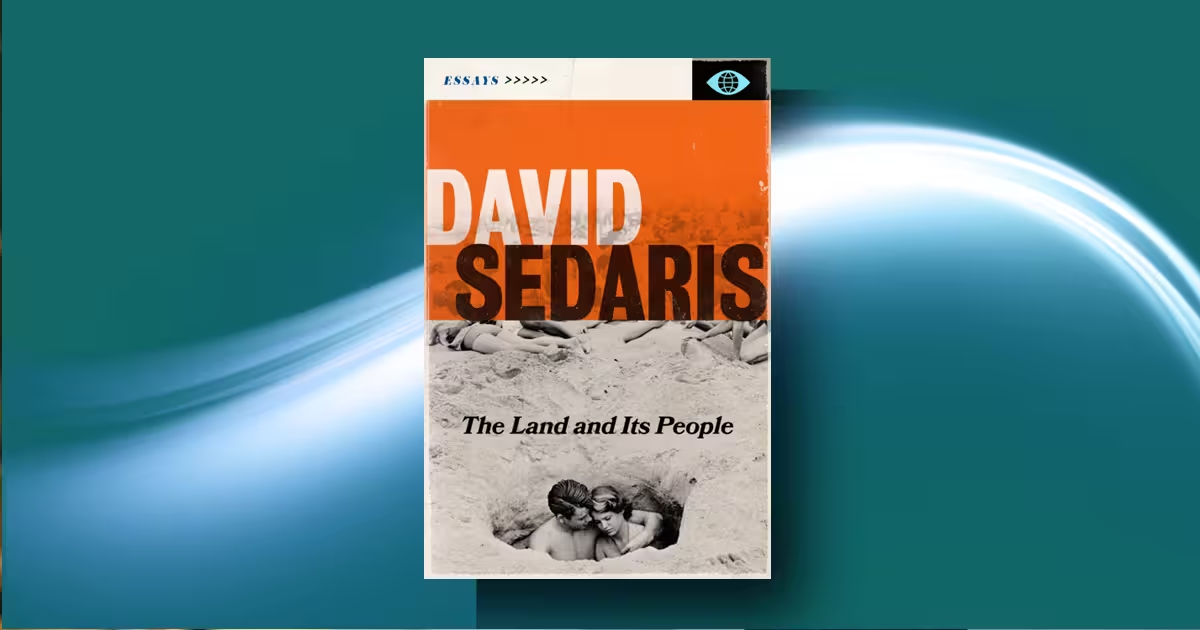
Why does David Sedaris make our pettiest thoughts feel less shameful, more human, and strangely useful? The Land and Its People is not only a funny essay collection; it is a sharp education in how aging, travel, marriage, family, money, politics, illness, and irritation reveal who we really are.
The Land and Its People is best for readers who love literary nonfiction, comic essays, memoir-in-fragments, aging-and-marriage stories, sharp social observation, travel misadventures, New Yorker-style essays, and books like Calypso, Happy-Go-Lucky, Me Talk Pretty One Day, Nora Ephron, Fran Lebowitz, or Augusten Burroughs.
Table of Contents
Introduction
The Land and Its People: Essays is a 2026 essay collection by David Sedaris, published by Little, Brown and Company. The collection contains 28 essays, several of which first appeared in The New Yorker, The Free Press, and Wealthsimple.
That matters because The Land and Its People feels both freshly arranged and already road-tested: part magazine essay, part live-reading material, part diary-polished observation.
David Sedaris is an American humorist and essayist whose public career began in the early 1990s, especially after the radio success of “Santaland Diaries.”
He is known for autobiographical humor, family stories, travel essays, comic cruelty, and a voice that can turn a tiny irritation into a moral x-ray. Recent profiles around The Land and Its People describe the book as moving through Pope Francis, Duolingo, marriage, aging, West Sussex, Hugh Hamrick, siblings, and the difficulty of being funny without becoming cheap.
Briefly, The Land and Its People is about people in places: Sedaris in New York, Sussex, Guatemala, Portland, Amsterdam, Australia, Ohio, Maine, Italy, North Carolina, and memory itself. But to put it in another way, the true subject is not geography. The true subject is how a person’s personality travels with him everywhere.
Wherever Sedaris goes, he notices language, class performance, illness, ugliness, dogs, service greetings, politics, cash, clothes, old friends, family roles, and the absurd choreography of being alive in public.
The central thesis, as I read it, is this: we do not become wiser simply by aging; we become more ourselves, and comedy is one of the few honest ways to admit what that self looks like.
Sedaris does not pretend to be kinder than he is. In fact, he often does the opposite. Accordingly, the book becomes an education in self-knowledge. He shows how irritation, vanity, fear, resentment, tenderness, and grief can sit in the same paragraph without cancelling one another.
Background
Traditionally, readers come to David Sedaris for the laugh, but they stay because the joke usually exposes something more serious.
Calypso turned family, death, suicide, and middle age into comedy with an undertow. Happy-Go-Lucky pushed further into family history and his father’s decline. The Land and Its People feels like the next stage: less a single family reckoning than a roaming late-life inventory.
The timing is important. Sedaris is approaching seventy in this collection’s publication year, and the essays are full of age-markers: Hugh’s hip replacement, Medicare, old friends dying, siblings growing older, the body becoming unreliable, travel becoming both glamorous and punishing, and ordinary public life feeling more deranged than before. Vogue’s 2026 profile notes that the book gathers themes of “legacy, mortality” and bodily limitation, even though Sedaris himself resists grand thematic explanations.
Harper’s Bazaar, meanwhile, frames the collection around being “a stranger in a strange land,” his life in West Sussex, and his relationships with Hugh and his siblings.
A major trait of The Land and Its People is that Sedaris refuses the inspirational arc. Initially, it may seem like these are small pieces: a hip surgery, a hotel, a Pope visit, a tick, a dog complaint, a phrase like “Welcome in.” Nevertheless, the smallness is the method.
Sedaris builds meaning through accumulation. A phrase becomes a diagnosis. A stranger becomes a symptom. A trip becomes a referendum on class, fear, manners, and mortality.
The Land and Its People Summary
The Land and Its People opens with “Care and Feeding,” one of the strongest essays in the collection. Hugh has a hip replacement, Amy is invited to play Mrs. Claus in the Macy’s Thanksgiving Day Parade, and Sedaris hosts French friends in New York while privately resenting the interruption of his work schedule.
The comedy begins with logistics but deepens into care. Hugh, normally the cook, becomes temporarily dependent. Sedaris, who is not naturally self-sacrificing in a sentimental way, has to become useful.
One short line captures the domestic argument perfectly: “They don’t hand out medals for needless suffering.” The essay is funny because Sedaris is honest about love as inconvenience. In truth, the tenderness comes not from noble declarations, but from irritation that remains loyal.
“Little America” moves to Salt Lake City and a beloved hotel. Sedaris begins with affection for a place that feels preserved, cared for, and slightly old-fashioned.
The hotel becomes an argument about hospitality and standards. Generally, Sedaris is not nostalgic in a soft way; he loves places that maintain their identity without apologizing for it.
The essay’s pleasure comes from watching him admire order, service, and eccentric local authority.
“Goodyear” follows Sedaris and his friend Dawn in Montrose, Colorado, where they pass a discarded tire. A dare escalates into an absurd test of friendship and appetite.
This is classic Sedaris: a grotesque object becomes a social experiment. The title points to the tire, but the essay is really about how far people will go to amuse one another, shock one another, or prove loyalty. The comedy is bodily, nasty, and affectionate.
“Enough Is Enough” is a short civic rant about New York scaffolding. Sedaris notices that Manhattan has roughly “three hundred miles’ worth” of scaffolds, and he compares New York’s visual decay with cities that seem less dominated by temporary structures.
This leads to a broader complaint about urban tolerance: how residents normalize ugliness because it has been there too long. In contrast to the travel pieces, this essay is rooted in exasperated citizenship.
“Friendly Face” turns suspicion in public into a comic meditation on memory and witness. Sedaris notices someone he thinks he may need to remember, then thinks about how hard it is to describe a face accurately.
The piece becomes a study of fear, prejudice, observation, and the unreliability of the mind. Notably, it shows how Sedaris can make even a private moment of suspicion morally uncomfortable. He does not let himself off easily.
“Trophy Room” begins with Christmas parties and literary-social encounters, then moves toward safari, animals, status, and moral inconsistency. Sedaris is fascinated by the way sophisticated people arrange their ethics.
The essay asks, indirectly, why some forms of looking at animals feel noble and others vulgar. Besides that, it examines the performance of taste: what we say at parties, what we admire, what we pretend not to admire.
“My Finances, in Brief” is one of the funniest title jokes in The Land and Its People because it is not really a finance essay in the normal sense. It begins with underwear: Sedaris’s discomfort with Hugh wearing boxers instead of briefs. From there, money and intimacy become intertwined.
The essay suggests that personal finance is never only about numbers; it is about habits, aesthetics, control, class, and the tiny private customs that couples negotiate for decades. The title’s pun—briefs as underwear and “in brief” as summary—is very Sedaris.
“The Doctor Is In” starts with Sedaris eating alone in a restaurant and reading terms like “emotional incest” and “non-contact sexual abuse.”
The essay explores therapeutic language, diagnosis, and the way contemporary labels can reframe ordinary family dynamics. Importantly, Sedaris is not simply mocking therapy-speak.
He is asking what happens when language expands so much that experience becomes medicalized. However, there are drawbacks to his skepticism: some readers may feel he underestimates the usefulness of naming harm. Still, the essay is valuable because it captures a real cultural tension around trauma vocabulary.
“The Hem of His Garment” is the Pope Francis essay. Sedaris says that, given a choice between being in a room with comedians or the pope, he would usually pick the comedians.
Yet he ends up meeting the pope and visiting Gammarelli, the papal tailor, with Julia Louis-Dreyfus. The cassock becomes costume, temptation, and social experiment.
According to recent interviews, Sedaris later wore the cassock onstage and even on errands. In the essay, religion, celebrity, clothing, and performance blur together. That is to say, Sedaris is less interested in holiness than in the strange power of garments to change how strangers treat you.
“Punching Down” directly addresses comedy ethics. Sedaris recalls taking a “Writing Funny” class after moving to New York in 1990 and offering the familiar rule that one should not mock people with less power.
The teacher’s reaction unsettles that easy rule. The essay does not give a simple permission slip for cruelty. Instead, it argues that comedy is more complicated than slogans.
Who has power? In what situation? Who is the real target of the joke? This is one of the book’s most important craft essays. It also helps explain why Sedaris’s best jokes often implicate himself even when they begin with someone else.
“In Lieu of My Biography” is a meditation on biographies, diaries, reputations, and what future readers deserve to know. Sedaris imagines the problem of being written about after death.
Furthermore, he thinks about what gets preserved and what gets skimmed. The essay is quietly important because Sedaris has always been a collector of daily material.
His life’s work depends on notes, overheard lines, and remembered irritations. Here, he asks what that archive becomes when the person who made it is gone.
“Cool Mom” uses an airport sweatshirt—“I’m Not a Regular Mom, I’m a Cool Mom”—to remember Sedaris’s mother. The essay criticizes self-advertised coolness, then shows what real coolness looked like in his childhood: not constant attendance, not motivational cheerleading, but presence when it mattered.
The emotional center comes when his mother visits him after a breakup and gives him the dignity of looking away while he cries. It is brief, but powerful. Unlike a sentimental tribute, it lands because Sedaris has resisted easy praise.
“A Long Way Home” takes place during a visit to a remote island house in Maine, where phones and laptops are banned on the ground floor.
Sedaris, initially horrified, discovers the shock of uninterrupted conversation. The essay is about aging, memory, artistic status, and dependence on devices. Surprisingly, the absence of screens becomes both liberating and inconvenient: without phones, older guests cannot easily retrieve the names they are forgetting.
This leads to one of The Land and Its People’s best quiet jokes about technology: we hate what we need.
“The Violence of the Rams” is a Sussex animal essay about rams, especially Igor. Sedaris insists that rams are “assholes,” a blunt phrase that captures the essay’s mock-epic tone.
The animals become comic villains: beautiful, stupid, aggressive, and weirdly symbolic. In contrast to sentimental nature writing, this is anti-pastoral. Living near animals does not make Sedaris gentler; it gives him better enemies.
“Say It Like You Mean It” begins with a tick in a rental car on the way to Emerald Isle, North Carolina, and turns into a drive through heat, traffic, radio compromises, Bojangles, political banners, and marital irritation.
The essay is about regional atmosphere as much as dialogue. “Support for him was in the air,” Sedaris writes of Trump country, making politics feel less like a sign than a weather system. As a result, the road trip becomes a study of America’s invisible pressures.
“Forget Me Not” is a short essay about family and couple-language: mispronounced “leprechaun” as “lu-pree-shun,” “fjords” as “fudge-ords,” and the private phrases that become permanent.
Briefly, this is one of the collection’s sweetest ideas: intimacy is partly a shared dictionary of mistakes. The point is not the joke itself but the repetition that keeps a relationship alive.
“And Your Little Dog, Too” is one of the longest and sharpest pieces. It begins in Portland, Oregon, with a stranger accusing Sedaris of following him, then expands into homelessness, mental illness, public disorder, dogs, moral fatigue, and urban decline. This is where Sedaris may divide readers.
His irritation is vivid, but the subject is socially complex. Due to insufficient evidence inside one comic essay, a comprehensive view of homelessness cannot be formed from this piece alone.
Nevertheless, as a personal account of discomfort in a changing city, it is forceful. The essay’s title invokes The Wizard of Oz, but the real subject is how sympathy wears down when public spaces feel unstable.
“Good Grief” is listed in the contents, but in the uploaded text extraction it appears only in the contents area, not as a clearly extractable standalone essay body. I cannot verify its full content from the extraction I was able to inspect, so I will not invent a summary.
“A Little Kick” takes place in Northern Italy during a literary festival. Sedaris expects political questions, especially about Trump, Bush, and Clinton, from European interviewers.
The essay turns on the fatigue of being asked to represent America abroad. It is also about appetite, performance, and the strange role of the touring American writer: part artist, part national explainer, part dinner guest.
“I Did” is the secret-marriage essay. Sedaris and Hugh are in Amsterdam with Gretchen nearby, and the story moves toward the revelation that Sedaris and Hugh married in 2016, though they kept it private for years.
The title is perfect: not “I do,” the ceremonial phrase, but “I did,” the after-the-fact admission. What’s more, the essay complicates Sedaris’s long public resistance to marriage.
He does not turn it into a triumphal romance plot. He makes it awkward, practical, hidden, and therefore believable.
“Yes, Vote” is a political road essay set two weeks before a midterm election, during a drive from Cleveland to Columbus. The driver has quit smoking, and the trip becomes an encounter with class, health, civic duty, and the atmosphere of American politics. The title sounds simple, almost like a slogan, but the essay is more textured than that.
It understands voting not as a glamorous act, but as one more behavior inside a country full of exhaustion, resentment, and habit.
“The Land and Its People,” the title essay, places Sedaris in Guatemala, riding a horse named Tequila up a volcano with people he met at a breakfast buffet in Tanzania.
The repeated mental keywords—horse, volcano, Guatemala, breakfast buffet—show how absurdly travel stories assemble themselves.
The essay is about fear and the comedy of privilege: the kind of person who finds himself in danger because he agreed to an adventure that already sounded like a bad idea.
Hence the title of the book: land matters, but people make the land ridiculous.
“Welcome In” is a language rant about the American service phrase “Welcome in.” Sedaris notices that Australia does not seem infected by this greeting.
The essay is small but thematically central. It shows his ear for verbal clutter, especially phrases that sound friendly but become irritating through repetition.
Likewise, it shows how language can reveal national habits: forced warmth, scripted hospitality, and corporate casualness.
“The Godfather” is about Sedaris’s godson Tommy, pancakes, adolescence, awkward adult questioning, and the difficulty of connecting with a teenager.
The essay is tender because Sedaris knows he is not naturally suited to the role. He wants to be interesting, useful, or at least not embarrassing. In addition, the essay explores how adulthood looks from the other side: adults ask questions that feel like interrogations because silence makes them panic.
“Unzipped” begins when a woman tells Sedaris his backpack is open and he realizes his headphones are missing. From there, he thinks about civic correction: telling strangers their bag is open, their tag is out, their shoe has toilet paper attached. The essay asks why doing the helpful thing can feel intrusive.
The world depends on these small interventions, yet everyone fears embarrassment.
“Friends” is one of the collection’s most moving essays. Sedaris learns that Dan Thompson has died of throat cancer.
The essay reflects on old friendship, memory, the shock of seeing people age in photographs, and the way death makes the past feel both intimate and unreachable. In contrast to the lighter language pieces, this essay carries real grief.
Still, Sedaris avoids grand elegy. His method is detailed: the text message, the photograph, the child-sized mouth, the disbelief.
“My Cousin Melvin” is about resemblance and the horror of being compared to someone unattractive, unfashionable, or simply not the person one wants to be. Sedaris makes a universal point: no one wants an unflattering comparison, even if the comparison is accurate.
This leads to vanity, body image, clothes, and the absurd social violence of “You know who you look like?”
“Cash and Carry” closes the collection with Sedaris helping a woman carry a found cabinet in New York.
The essay becomes a city story about usefulness, money, physical effort, and temporary intimacy between strangers. It is a fitting ending because it shows Sedaris doing something generous while still narrating it with suspicion, comedy, and self-awareness. The final effect is not sainthood.
It is better: a realistic portrait of a person who can be vain, irritated, observant, and helpful at the same time.
The Land and Its People Analysis
The Land and Its People is a marvelous, prickly, late-style David Sedaris book: not his most beginner-friendly collection, but one of his most revealing. I felt, while reading it, that Sedaris has become less interested in proving he is funny and more interested in testing what comedy can still get away with when the body is aging, politics is sour, cities are tense, and private life is full of obligations.
The Land and Its People succeeds because it understands that everyday life is not morally neat. A person can love his husband and resent caregiving. A person can feel compassion for strangers and still be exhausted by public disorder. A person can criticize empty therapy language while still carrying real wounds.
A person can mock religious costume and still recognize its power. A person can be generous and self-flattering in the same moment.
Evaluation of content: Sedaris does not “argue” like an academic writer, but his essays support their claims through scene, dialogue, repetition, and comic patterning.
For example, “Punching Down” is not a formal theory of comedy, yet it offers a useful framework: the target of a joke is not always the obvious person in the sentence.
Similarly, “The Doctor Is In” does not settle debates about trauma vocabulary, but it dramatizes the cultural unease around over-diagnosis and moral labeling.
Does the book fulfill its purpose? Yes, provided we understand its purpose correctly. It is not a policy book, a memoir of redemption, or a clean travel narrative.
It contributes meaningfully to contemporary literary nonfiction because it preserves a difficult comic mode: unsentimental, self-implicating, observant, and sometimes abrasive.
Above all, it reminds me that the personal essay is not just confession. It is arrangement. Sedaris arranges irritations until they become a worldview.
Strengths and Weaknesses
The greatest strength of The Land and Its People is its sentence-level comic intelligence. Sedaris can begin with a throwaway detail—boxer shorts, a cassock, a tire, a service greeting—and widen it into character. Another key strength is emotional restraint.
In “Cool Mom” and “Friends,” he proves that grief often works better when the writer does not beg us to feel it.
Furthermore, the book is thematically coherent without feeling over-designed. People and places recur: Hugh, Amy, Gretchen, New York, Sussex, North Carolina, public performance, travel, age, bodies, money, language. Consequently, the title grows more meaningful as the essays accumulate.
The weaknesses are real. Some essays, especially those about public disorder, homelessness, dogs, or political atmosphere, may feel harsh to readers who want more structural analysis. Sedaris writes from personal experience, not from social research.
Because of this, his impressions can be brilliant as literature but limited as evidence. Also, a few shorter pieces feel like polished diary entries rather than fully developed essays. They are enjoyable, but not equally substantial.
Still, I did not experience those unevennesses as fatal. Sedaris’s books have always worked by rhythm: long essays, short irritations, emotional turns, travel fragments, family memories. The weaker pieces often serve as palate cleansers between the major ones.
Comparison: Books Like The Land and Its People
Readers who loved Calypso will recognize the late-life preoccupations: death, family, the body, beach-house North Carolina, and the cruelty of time. However, The Land and Its People is less family-centered than Calypso and more outward-facing.
Compared with Happy-Go-Lucky, this collection feels less dominated by the father-son relationship and more dispersed across travel, marriage, language, and public life. Compared with Me Talk Pretty One Day, it is older, darker, and less driven by outsider-in-France comedy.
Compared with Dress Your Family in Corduroy and Denim, it is less childhood-centered and more concerned with what happens after a comic persona has aged in public.
For similar reading, I would place it beside Nora Ephron’s I Feel Bad About My Neck for aging and comic self-scrutiny, Fran Lebowitz’s essays for urban irritation and aphoristic complaint, Augusten Burroughs for comic discomfort, and Samantha Irby for body-honest, self-lacerating nonfiction.
Nevertheless, Sedaris remains distinct because of his live-performance ear. His essays often feel like they have been tested against actual laughter.
Conclusion
Yes, especially if you already like David Sedaris or want a smart, funny, uncomfortable essay collection about aging, marriage, travel, language, and the moral mess of everyday life.
It is suitable for general readers, not specialists, but it will especially reward readers interested in comic nonfiction, memoir, humor writing, literary essays, and contemporary American culture.
I would not recommend it as someone’s very first Sedaris book if they are sensitive to abrasive humor. For newcomers, Me Talk Pretty One Day or Calypso may be easier entry points.
However, for readers who already understand his tone, The Land and Its People offers exactly what the title promises: places, people, and the strange emotional weather that forms when David Sedaris walks into a room and starts judging.







