
Last updated on November 6th, 2026 at 11:39 am
Do you ever wonder why some political ideas feel noble at first, yet slowly ask ordinary people to surrender their freedom? The Open Society and Its Enemies helped me see that the most dangerous politics often begins with a beautiful promise: certainty, unity, destiny, and a world finally made perfect.
The Open Society and Its Enemies is best for readers who care about democracy, political philosophy, critical thinking, totalitarianism, free speech, the paradox of tolerance, and the long fight between open societies and closed tribal systems. It is also ideal for readers who want to understand why Plato, Hegel, and Marx still matter in modern debates about power.
Not for readers looking for a quick, neutral, gentle overview of Western philosophy. Popper is brilliant, but he is not mild. He argues like a man writing in a world on fire. If you want a calm textbook summary of Plato, Hegel, and Marx, this book may feel too polemical.
Nevertheless, if you want a book that forces you to examine the emotional roots of authoritarian thinking, it is difficult to replace.
Table of Contents
1. Introduction
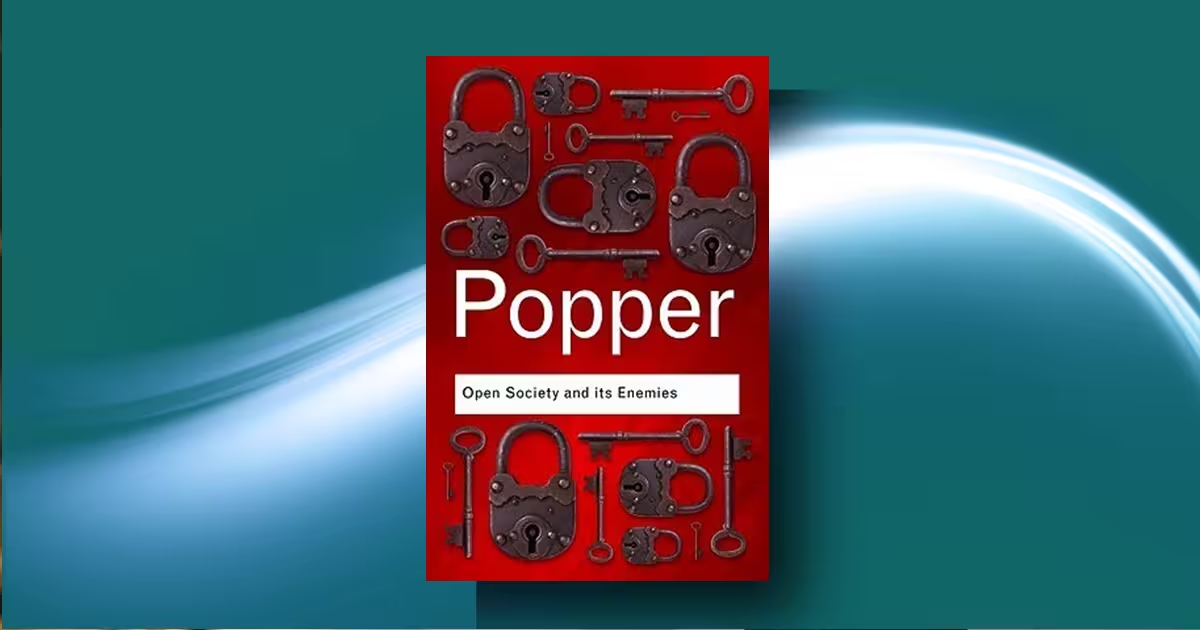
The Open Society and Its Enemies is a major work of political philosophy by Karl Raimund Popper, the Austrian-born philosopher of science who lived from 1902 to 1994. The Open Society and Its Enemies was first published in two volumes in 1945 by Routledge & Kegan Paul. The Routledge Classics edition appeared in 2011, and the edition I used presents the work in one large volume with a preface by Václav Havel.
Popper was born in Vienna, studied at the University of Vienna, and became one of the twentieth century’s most influential philosophers of science. His work on falsifiability shaped modern discussions of scientific knowledge, but The Open Society and Its Enemies applies the same anti-authoritarian spirit to politics.
In other words, Popper does not merely ask how scientific theories should be tested; he asks how societies can be built so that rulers, ideologies, and political prophecies can also be criticized, corrected, and removed.
The Open Society and Its Enemies was completed while Popper was working in Christchurch, New Zealand, after leaving Europe in the shadow of National Socialism. According to Popper’s own later account, his final decision to write it came in March 1938, when he heard of the invasion of Austria.
The writing continued into 1943, and The Open Society and Its Enemies appeared in 1945, at the end of the Second World War and at the beginning of a new ideological age.
Briefly, The Open Society and Its Enemies is about the moral and intellectual roots of totalitarianism. Traditionally, many readers describe it as Popper’s attack on Plato, Hegel, and Marx. That is true, but incomplete.
More deeply, it is a book about a temptation: the temptation to believe that history has a secret plan, that society can be remade from above, and that human beings may be sacrificed in order to fulfil a grand design.
The Open Society and Its Enemies context
The Open Society and Its Enemies’s central contrast is between the closed society and the open society. A closed society is tribal, magical, hierarchical, and obedient to inherited taboos. An open society, in contrast, is critical, individualistic, rational, self-correcting, and willing to let people question authority.
Popper’s purpose is to defend the open society against intellectual systems that promise certainty at the cost of freedom. His special target is historicism: the belief that history moves according to discoverable laws and that the future can be politically prophesied. He calls this the “dangerous habit of historical prophecy.”
That phrase matters. Popper is not merely objecting to bad predictions. He is objecting to a whole style of political thinking. Once a leader, class, party, priesthood, philosopher, or intellectual elite claims to know the destination of history, individual people become obstacles, tools, or raw material.
This leads to the ugliest paradox in politics: the dream of collective salvation can become a machine for crushing actual human beings.
As a reader, I found The Open Society and Its Enemies outstanding, disturbing, and sometimes exhausting. It is not always fair in tone, especially toward Plato and Hegel. Yet, as a warning against the intoxication of certainty, it remains one of the most important political books I have read.
Popper’s great personal appeal is that he asks us to “break with the habit of deference to great men.” That line alone explains the courage of the book. He is saying: admire genius, but do not kneel before it.
2. Background
Initially, it may seem that a 1945 book about Plato, Hegel, and Marx belongs mainly to academic philosophy. Surprisingly, it often feels like a manual for reading today’s political language.
Whenever someone says that democracy is too slow, that a crisis requires obedience, that history is on their side, that dissenters are enemies of the people, or that freedom must be temporarily suspended for a perfect future, Popper’s argument becomes relevant again.
A major trait of The Open Society and Its Enemies is its refusal to romanticize power. Popper does not believe the main political question is simply who should rule. The deeper question is how institutions can be organized so that bad rulers cannot do too much damage.
This is the Popperian heart of democracy: not the worship of the majority, not blind faith in voters, and not sentimental optimism about leaders, but the peaceful correction of political mistakes.
This is why I read The Open Society and Its Enemies less as a museum piece and more as a survival text for democratic life. Popper is asking us to love institutions not because they are glamorous, but because they prevent politics from becoming a blood ritual.
3. The Open Society and Its Enemies Summary: Volume I and Volume II
Karl Popper wrote The Open Society and Its Enemies during the darkest years of the Second World War — completing it in 1943 while stationed in New Zealand, far from the European catastrophe he was trying to understand.
He called it his “war work.” The book is not a conventional piece of philosophy. It is a long, passionate, and rigorously argued answer to one urgent question: Why does civilization keep producing movements that seek to destroy it?
Popper’s answer is that the enemies of open, democratic society are not random or accidental. They draw from a long, distinguished philosophical tradition — one that begins with Plato, passes through Aristotle, floods back into the modern world through Hegel, and reaches its most powerful and dangerous expression in Karl Marx.
The common thread running through all of them is what Popper calls historicism: the belief that history moves according to fixed laws toward a predetermined destination, and that those who know those laws are entitled — even obligated — to reshape society accordingly, regardless of the suffering that reshaping requires.
The Open Society and Its Enemies is therefore both a diagnosis and a defence. It diagnoses the intellectual roots of totalitarianism, and it defends the open society — a society in which institutions can be reformed peacefully, in which no person or party holds ultimate truth, and in which criticism is protected rather than punished.
Volume I: The Spell of Plato
Part One: The Closed Society and Its Foundations
Chapter 1 — Historicism and the Myth of Destiny
Popper opens Volume I not with Plato, but with a problem of method. He wants to know whether social science can make the kind of prophecies that Plato, Marx, and Hegel all claimed to make — sweeping predictions about where history is going, what is “inevitable,” and what forms of society are destined to collapse.
His answer is no, and the reasons are fundamental. Scientific prediction works by testing isolated hypotheses against observable data under controlled conditions. Historical prophecy works by claiming to read the whole direction of human events — an enormously complex, open-ended, interactive process that cannot be replicated or controlled. The difference, Popper insists, is not one of degree but of kind.
A meteorologist predicts tomorrow’s weather; a historian cannot predict the next century with the same authority, because the next century depends on what people do, what they discover, what they decide, and none of that is predetermined.
The word Popper gives to the mistake of treating history as though it were science — as though it had knowable laws pointing toward a predictable destination — is historicism. This is not merely an intellectual error. It is a dangerous one, because historicism gives its holders a sense of certainty that licenses ruthlessness.
If history is on your side, every obstacle to it is reactionary, every reform that works against the tide is futile, and every act of violence in history’s service is justified by the outcome. Popper’s entire project is to show that this certainty is false, and that the philosophers who generated it bear a real responsibility for the political movements that claimed their authority.
Chapter 2 — Heraclitus and the Philosophy of Change
Before arriving at Plato, Popper traces the roots of historicism backward to Heraclitus, the pre-Socratic philosopher who declared that everything is flux, that all things change, and that conflict is the father of all things.
Heraclitus taught that there is a hidden logos — a reason or pattern — beneath all apparent change; that war, competition, and opposition are not accidents but the deep engine of reality; and that the many who believe in stability are simply blind to what is really happening.
Popper points out that this philosophy, however brilliant as cosmology, carries a political danger. If change is the law of the universe and conflict is its mechanism, then the appropriate response to social life is not to build stable institutions but to understand and align with the forces of change. The wise ruler, on this view, is not the one who builds fair laws but the one who rides history’s current. This is already the seed of what becomes, in Plato’s hands, a full programme of political authoritarianism.
Heraclitus also contributed another idea that matters enormously: the idea that the world is divided between the wise few who understand the logos and the ignorant many who do not. This division — between those who know where history is going and those who do not — will be the justification for every form of political authoritarianism that Popper examines in The Open Society and Its Enemies.
Chapter 3 — Plato’s Theory of Forms
To understand why Plato’s politics are what they are, Popper argues, we must first understand his metaphysics — specifically his Theory of Forms, or Ideas.
Plato’s theory holds that the world we perceive with our senses is not the real world. It is a world of imperfect, decaying, constantly changing copies of eternal, perfect, unchanging originals called Forms or Ideas. The Form of a horse is the perfect, eternal horse; every horse we see is a degraded imitation of that Form. The Form of justice is perfect justice; every human law is at best an imperfect approximation of it.
This theory has enormous consequences. It means that true knowledge is not knowledge of the changing world of appearances but knowledge of the unchanging world of Forms. It means that only philosophers — those who have trained themselves to contemplate the Forms — can genuinely know anything. And it means that change, in the sensible world, is always change away from the original perfect Form — always deterioration, always a Fall.
Popper identifies this as essentialism: the belief that behind every changing thing there is an unchanging essence, and that the task of knowledge is to grasp that essence. He argues that essentialist thinking — looking for the “true nature” or “real meaning” behind appearances — is one of the sources of bad social science.
Instead of asking “What does this institution do? What problems does it solve? How could it be improved?” essentialist thinking asks “What is the essence of the State? What is the true nature of Justice?” These questions lead to metaphysics, not reform.
Furthermore, the theory of Forms is directly tied to Plato’s politics. If the perfect Form of the state exists and can be known, then the task of politics is not to improve imperfect institutions gradually but to build the perfect state — to impose the Form on the raw material of society. This is the intellectual root of what Popper calls Utopian engineering: the attempt to rebuild society from scratch according to a master plan.
Chapter 4 — Change and Rest
Popper now turns to Plato’s sociology — his analysis of how societies work, how they change, and how they decay. This analysis is presented most fully in the Republic, where Plato offers a history of political decline moving from the best state (aristocracy, rule by the wise) through timocracy (rule by the honour-seeking), oligarchy (rule by the rich), democracy (rule by the many), and finally tyranny (rule by the one).
What Popper emphasizes is that this is not simply a typology but a theory of decline. For Plato, the direction of change in history is always downward. The best state — the one closest to the perfect Form — is an ideal society ruled by philosopher-kings. Every departure from it is corruption.
Democracy, on this account, is not progress but degeneration: the point at which the worst elements of society gain power, when freedom becomes license, when equality becomes leveling, and when the pursuit of pleasure overwhelms the pursuit of wisdom.
Accordingly, Plato’s programme is not reform but arrest. Since change always means decline, the best thing that can be done for society is to stop it from changing. Popper calls Plato’s ideal state an “arrested” society — one in which the ruling class breeds itself carefully, controls education rigidly, censors art and literature, and prevents all innovation in order to hold the line against decay.
Plato admired Sparta precisely because Sparta, with its rigid military caste system, its communal meals, its discouragement of trade and travel, and its severe controls on culture, seemed to approximate this arrested ideal. Sparta had achieved, however imperfectly, what Athens had lost: social stasis in service of collective strength.
Chapter 5 — Nature and Convention
A crucial distinction runs through all ancient Greek social philosophy: the distinction between what is natural (physis) and what is conventional (nomos). Natural things are the way they are because of an inherent necessity; conventional things are the way they are because human beings agreed to make them that way.
Popper traces several different responses to this distinction. The Sophists — particularly Protagoras and Antiphon — used it in a humanist and egalitarian direction. If laws are conventional, they argued, then laws can be changed. The hierarchies of Greek society — the domination of Greeks over barbarians, of masters over slaves, of men over women — are not in nature; they are in convention, and they can be challenged. Antiphon explicitly argued that all human beings are equal in their natural endowments, and that legal distinctions between them are artificial impositions.
Plato’s response to this humanism was his most important intellectual move. He did not simply deny the nature-convention distinction; he redefined it. For Plato, what is “natural” in the deepest sense is not the physical world, but the world of Forms — the permanent, eternal, perfect essences. True nature is not observable biology but spiritual essence.
And the natural hierarchy of human beings is determined not by what they appear to be but by what their souls essentially are: philosopher natures, warrior natures, or artisan natures.
This “spiritual naturalism,” as Popper calls it, is designed to have it both ways — to claim the authority of natural law while actually installing an ideological hierarchy. The ruling class rules not because it is conventionally privileged but because its members have philosophic natures. Nature and hierarchy are reunited, but the nature invoked is metaphysical, not observable.
Part Two: Plato’s Political Programme
Chapter 6 — Totalitarian Justice
Popper now sets out what he considers the most important and most disturbing thesis of The Open Society and Its Enemies: that Plato’s political philosophy is not, as it has almost universally been presented, a noble ideal of justice, but a carefully developed programme of totalitarian control.
The conventional view of Plato is that the Republic presents a vision of justice in which each part of the soul and each class of society performs its proper function — wisdom rules, courage defends, and appetite produces. Justice is defined as this harmonious specialization.
Popper insists this is exactly backwards. Plato’s definition of justice is designed to prevent exactly the kind of social mobility, individual initiative, and questioning of authority that characterized Athenian democracy.
To perform one’s “proper function” in Plato’s state means to stay in the class you were born into, to do the work assigned to that class, and to leave political decisions to those above you. The tradesman who aspires to be a guardian, the guardian who questions the philosopher-king — these are examples of injustice, according to Plato. Justice, in this reading, is obedience.
Moreover, the “just state” that Plato envisions requires: the abolition of private property for the guardian class; communal rearing of children to break family bonds; strict control of education and art; the use of deliberate deception — what Plato calls the “noble lie” — to convince the lower classes that their subordinate position is natural and divinely ordained; and eugenic breeding to ensure that the quality of the ruling class does not degenerate.
Popper compares this programme, point by point, with the features of twentieth-century totalitarianism, and the parallels are precise. The noble lie corresponds to state propaganda. The abolition of family bonds among rulers corresponds to the party’s demand for total loyalty. The eugenic programme corresponds to racial ideology.
The censorship of art and music corresponds to the control of culture. Plato’s state is, Popper argues, not a historical curiosity but a blueprint.
Furthermore, the “justice” Plato defends is specifically collective utility rather than individual rights. The state is a super-organism; the individual parts exist for the whole, not the other way around. This collectivism is, Popper argues, the defining moral characteristic of closed-society thinking, and it directly licenses the sacrifice of individuals for the perceived good of the collective.
Chapter 7 — The Principle of Leadership
A central institution of Plato’s ideal state is the rule of the philosopher-king: the wisest human being, the one who has ascended from the Cave to contemplate the Forms, who returns to rule the polis. This is typically presented as one of Plato’s most attractive ideas — the vision of reason governing politics.
Popper will have none of it. He argues, first, that the principle of rule by the wisest is not a principle at all, because wisdom cannot be tested. In Plato’s state, the philosopher-king’s claim to wisdom is precisely what cannot be challenged — to challenge it would be to demonstrate your own lack of wisdom. The principle therefore amounts to: whoever is already in power is wise. This is circular, and it is dangerous.
Second, the principle of leadership — rule by the best individual — is incompatible with democratic institutions precisely because those institutions are designed to make government accountable. Popper’s democratic alternative is not “let the wisest rule” but a different question altogether: “How can we design institutions that allow us to remove bad rulers without violence?” This is what distinguishes democracy from other forms of government — not who rules, but how we prevent the abuse of rule.
Third, Popper points out that the test of who is wisest in Plato’s state is determined by Plato’s own educational system, and that system is designed to produce uncritical acceptance of received truth, not independent rational thinkers. The “education” in the Republic is, by modern standards, closer to indoctrination.
Chapter 8 — The Philosopher King
This chapter deepens the critique by examining Plato’s treatment of knowledge and truth in the political context. Plato famously distinguishes between knowledge (episteme), which is certain and deals with the Forms, and opinion (doxa), which is uncertain and deals with the world of appearances. Only the philosopher, who has genuine knowledge, is fit to rule; the rest of the population has at best opinions.
Popper points out that this distinction is used to disqualify the population from political participation. Democracy, on Plato’s account, is simply the rule of opinion over knowledge — the rule of the ignorant many over the wise few. But the distinction between knowledge and opinion, when applied to politics, is bogus. Political questions — What laws should we have? How should resources be distributed? What kind of society do we want to live in? — are not the kinds of questions that admit of certain, expert answers.
They are questions that require judgements, compromises, and the balancing of competing interests and values. The claim to political wisdom — to knowing the answer with the certainty that Plato claims — is precisely the kind of claim that democratic institutions are designed to resist.
Moreover, Plato’s distinction between knowledge and opinion contains a terrible social consequence: it divides humanity into two permanent classes — those whose views count and those whose views do not. In Plato’s state, the philosopher-king’s beliefs are knowledge; the tradesman’s beliefs are mere opinion.
This is not a neutral epistemic distinction; it is a political one, and it is used to justify permanent, unchallengeable hierarchical rule.
Chapter 9 — Aestheticism, Perfectionism, Utopianism
Popper here identifies three related intellectual tendencies that he sees as dangerous when applied to politics, and that he finds fully developed in Plato.
Aestheticism in politics is the tendency to judge political arrangements by their beauty, harmony, or perfection rather than by their practical effects on human welfare. Plato constantly describes his ideal state in aesthetic terms — it is a beautiful city, a harmonious organism, a perfect work of art.
This aestheticism is seductive, but it is dangerous, because it makes political arguments that ought to be empirical (Does this policy reduce suffering? Does this institution function well?) into arguments about ideal form. When a political programme is presented as beautiful, its opponents can be dismissed as ugly; when it is presented as harmonious, dissent becomes discord.
Perfectionism is the demand that reform must be total and ideal rather than partial and practical. Plato dismisses “piecemeal tinkering” with existing institutions as useless — you cannot improve a rotten state by adjusting its laws. Only a total reconstruction, a “clean canvas,” will do. Popper contrasts this with piecemeal social engineering: the democratic alternative in which changes are made step by step, each step tested against its actual effects, each error correctable before it becomes catastrophic.
Utopianism combines aestheticism and perfectionism into a programme: design the ideal state in advance, clear away existing institutions, and impose the design. The problem with this, Popper argues, is not just practical but logical.
To implement a Utopian plan, you must concentrate power enormously — you need the authority to override existing institutions, traditions, and the resistance of those who prefer things as they are. That concentration of power is itself the greatest threat to freedom, and it cannot be justified by the beauty of the plan it serves, because plans can be mistaken, and there is no mechanism for correcting the mistakes of those who hold absolute power in the service of a Utopian vision.
The contrast Popper wants to establish is between Utopian engineering (total reconstruction according to an ideal plan) and piecemeal social engineering (incremental reform guided by the identification of specific problems and tested by its actual results). The first requires tyranny to implement and has no mechanism for correcting errors.
The second is compatible with democracy, preserves the ability to learn from mistakes, and does not require that anyone claim to know in advance what the ideal society looks like.
Part Three: The Background of Plato’s Attack
Chapter 10 — The Open Society and Its Enemies
This is the chapter for which The Open Society and Its Enemies is named, and it is the most directly political. Here Popper describes what he calls “the Great Generation” — the remarkable group of thinkers and public figures in Athens in the fifth century BCE who articulated, for the first time, the ideals of the open society: individual freedom, equality before the law, the right to criticize authority, the dignity of the human being regardless of class or origin.
Foremost among these figures is Pericles, whose Funeral Oration (as reconstructed by Thucydides) is one of the clearest statements of democratic values in all of ancient literature. Pericles praised Athens for its openness, its tolerance of difference, its willingness to let individuals live as they chose, its reliance on reason and persuasion rather than fear. Popper regards this oration as a genuine philosophical manifesto, a statement of the principles of the open society.
Socrates, in Popper’s reading, is the greatest embodiment of these principles. Socrates taught that no one has certain knowledge, that all claims must be examined critically, that the examined life alone is worth living, and that the individual conscience must be respected even when it contradicts authority. He died defending these principles. Popper regards him as a hero and a democrat.
Plato, by contrast — Socrates’ most gifted student — is, in Popper’s assessment, a traitor to his teacher’s legacy. Plato took Socrates’ concern with wisdom and redefined it as a license for authoritarian rule. He took Socrates’ method of questioning and transformed it into a system of closed answers. He used Socrates as the primary speaker of the Republic, giving the impression that Socrates endorsed a programme of totalitarian control that Socrates’ own life directly contradicted.
Popper’s analysis here is not just intellectual; it is biographical.
He sees Plato as a man of genuine passion, intelligence, and moral concern — someone who was deeply troubled by the chaos, injustice, and conflict of Athenian democracy — and who turned that concern in exactly the wrong direction. Instead of concluding, as Socrates did, that the right response to imperfection is patient, critical, piecemeal improvement, Plato concluded that the open society itself was the problem.
His programme was not to make Athens better but to make it different in kind — to reverse the transition from tribal, closed society to open, critical society.
Popper also traces in this chapter what he calls the “strain of civilization” — the psychological discomfort that accompanies the open society’s demands. An open society asks its members to be individuals, to exercise personal responsibility, to make rational choices without the comfort of tribal custom or divine authority. This is psychologically demanding, and many people — in all ages — experience it as alienating.
The nostalgia for the closed society, for the security of tradition and the warmth of collective identity, is real and understandable. Plato gave that nostalgia its most sophisticated philosophical expression, and this is why he has remained so influential and so dangerous.
The Spell of Plato and What It Means
Popper concludes Volume I with a stark warning. He argues that Plato’s philosophy has been so influential precisely because it is so seductive. Its vision of a harmonious, just, beautiful society governed by wisdom seems to offer everything that Athenian democracy seemed unable to provide — stability, certainty, and moral purpose. The open society, by contrast, seems chaotic, uncertain, and spiritually empty.
But this is an illusion, and a deadly one. The harmony of the closed society is purchased at the price of the individual’s freedom, dignity, and capacity for rational self-determination. The certainty of the philosopher-king’s rule is purchased at the price of the mechanisms that allow rulers to be corrected and replaced.
The moral purpose of the ideal state is purchased at the price of the truth — because the ideal state requires the noble lie, the censorship of dissent, the permanent subordination of most human beings to the will of the few who claim to know better.
The “spell” of Plato is the spell of the closed society itself — the promise that if we give up freedom, we will gain security; if we give up criticism, we will gain certainty; if we give up the individual, we will gain the collective good. Popper’s response is that we cannot return to the closed society.
The transition from tribe to open society, from magical authority to rational criticism, is not reversible without catastrophic cost. “We must go on into the unknown, the uncertain and insecure,” he writes, “using what reason we may have to plan as well as we can for both security and freedom.”
Volume II: TheHIgh Tide of Prophecy- Hegel and Marx
Part One: The Aristotelian Roots and Hegel’s Method
Chapter 11 — The Aristotelian Roots of Hegelianism
Volume II begins not with Hegel but with Aristotle, because Popper argues that Hegel’s philosophy is essentially a modernization of Aristotelian essentialism filtered through the special circumstances of German nationalism. To understand what Hegel was doing and why it mattered, we need to understand what he inherited.
Aristotle took Plato’s theory of Forms and modified it significantly. Where Plato placed the Forms in a separate, transcendent realm, Aristotle brought the essence inside the thing itself.
The Form of a horse is not a separate, eternal, ideal horse; it is the inner principle of development and activity in any actual horse. Every living thing has a “final cause” — a goal or purpose immanent in its own nature — and its development is the actualization of that potential.
This Aristotelian framework was enormously important for Hegel because it gave him a way to talk about development and change without giving up on essences.
Plato’s static Forms could not explain historical change; Aristotle’s dynamic essences could. For Hegel, the universe is not a collection of static things striving to resemble eternal models; it is a single developing process in which an absolute Spirit (Geist) unfolds itself through history, coming to self-consciousness through the succession of world civilizations.
The method Hegel used to describe this development is the famous dialectic: thesis, antithesis, synthesis. Every stage of Spirit contains a contradiction; that contradiction drives development to a higher stage that preserves and transcends both opposites. History is therefore not random but rational — it has a direction, a logic, an end toward which it is moving.
Popper’s critique of this is devastating.
He argues that Hegel’s dialectic is not a method of inquiry but a method of escape from the requirements of empirical testing. If every contradiction is eventually “overcome” in a synthesis, and if apparent defeats are really moments in a higher development, then the theory can absorb any evidence. Nothing can falsify a view that claims all opposition is secretly agreement at a higher level.
This is not reasoning; it is verbal juggling.
More importantly, Popper argues that Hegel deliberately cultivated obscurity as a political tool.
By making his philosophy genuinely difficult to understand, he could claim depth that was actually vacuity, and he could discourage the kind of clear, critical examination that might reveal his arguments to be empty. The jargon of “dialectical negation,” “sublation,” and “the Absolute” does not illuminate political reality; it mystifies it, and that mystification serves those who want to prevent rational scrutiny of political arrangements.
Chapter 12 — Hegel and the New Tribalism
This is one of the most powerful chapters in The Open Society and Its Enemies, and the one most directly relevant to the political events of the twentieth century. Popper argues that Hegel’s philosophy is, in its entirety, a philosophical defence of the Prussian state and a philosophical tool for the revival of tribal, closed-society thinking.
Hegel was appointed to the chair of philosophy at the University of Berlin in 1818, at a critical moment in Prussian history. The Napoleonic wars had humiliated Prussia; the Restoration had re-established the Hohenzollern monarchy; the liberal and nationalist movement was threatening to challenge absolutist rule. Hegel’s task, Popper argues — whether consciously or not — was to provide a philosophical framework that would justify the Prussian state, neutralize liberalism, and redirect nationalist sentiment in a safe direction.
He did this through several moves:
The deification of the State. For Hegel, the State is not simply an institution created by human beings to serve human purposes; it is the actualization of the Absolute, the visible form of ethical life, the embodiment of Spirit at a particular historical moment.
The individual exists for the State, not the other way around. The State’s laws are not human conventions that can be criticized and reformed; they are expressions of a deeper rational necessity.
The nationalization of Spirit. Each nation-state, for Hegel, embodies a particular National Spirit — a unique essence that expresses itself in the nation’s history, culture, and institutions.
This National Spirit is not something that individuals freely create; it is something they belong to, are shaped by, and must serve. At any given moment in history, one particular nation-state is the vehicle of the World Spirit — the leading actor on the stage of history — and other nations must defer to it.
This is the philosophical apparatus of what Popper calls “the new tribalism”: the substitution of the nation for the tribe, with all the same absolute claims on loyalty and the same hostility to individual reason and conscience.
The glorification of war. Because nations are essentially defined by their opposition to other nations, because the National Spirit can only actualize itself by asserting itself against other spirits, war is not merely a necessary evil for Hegel but a positive good. It is the crucible in which national character is formed, the test by which historical greatness is demonstrated.
Eternal peace, Hegel suggests, would lead to spiritual corruption. War is ethically necessary. This is the philosophical foundation for everything that followed.
The exaltation of historical success. For Hegel, history is the “world court of justice” — the only valid tribunal for judging the worth of any state or action. Whatever succeeds historically is right; whatever is defeated is wrong. This means that no moral standard independent of historical success can be applied to the actions of states.
There are no war crimes; there is no illegitimate conquest; there is no violation of justice that could, in principle, be condemned on universal moral grounds. Power is right.
Popper traces the lineage from these doctrines to the specific ideological formations of twentieth-century fascism and Nazism. The substitution of “Blood” for Hegel’s “Spirit,” the replacement of National Genius with Racial Genius, the transformation of historical success into racial triumph — these are modifications, not departures. The architecture is Hegel’s.
He is careful to distinguish between Hegel’s direct influence and the broader intellectual culture that Hegel helped create. It is not that Nazi leaders read Hegel carefully and derived their programme from him. It is that Hegel — over three generations — trained the German intelligentsia to think in certain ways: to worship power, to mistrust individual conscience, to dismiss humanitarian ideals as naive, to see history as the only moral authority.
This intellectual formation made certain forms of political life thinkable, and therefore possible.
Part Two: Marx’s Method
Chapter 13 — Marx’s Sociological Determinism
With Hegel established as the intellectual progenitor, Popper turns to Marx — the thinker he treats at much greater length, with much more respect, and with much more regret.
Marx, in Popper’s assessment, was a brilliant sociologist who genuinely cared about human suffering, who made lasting contributions to our understanding of how economies work and how class interests shape political life, and who nevertheless erected these contributions on a methodological foundation that was fatally flawed.
The foundation is what Popper calls Marx’s sociological determinism: the view that the behaviour of human beings is ultimately determined by the economic conditions of their existence, that ideas — philosophical, moral, religious, legal — are “superstructures” built on an “economic base,” and that the direction of history is determined by the development of the means of production.
This is stated most famously in Marx’s preface to A Contribution to the Critique of Political Economy: “It is not the consciousness of men that determines their existence — rather, it is their social existence that determines their consciousness.”
The implication is that political and philosophical arguments — including arguments for reform, for justice, for freedom — are not to be taken at face value. They are expressions of class interest. The liberal who argues for free markets is expressing the interest of the bourgeoisie.
The conservative who defends tradition is expressing the interest of the landed aristocracy. The revolutionary who demands workers’ rights is expressing the inevitable movement of the working class toward its historical destiny.
Popper criticizes this in two related ways. First, he argues that the claim that consciousness is determined by social existence is too strong — it is falsified by the history of ideas, which shows again and again that individual thinkers have broken with the interests of their class, that ideas have changed conditions rather than being caused by them.
Lenin’s revolution provides a particularly ironic example: it was driven by ideas that preceded the economic conditions Marx said were necessary for socialism, and it succeeded in transforming those conditions through political action — exactly the opposite of what Marx’s theory predicted.
Second, Popper identifies the doctrine as a version of historicism: the claim that history has a predetermined direction driven by material forces, and that this direction can be known.
This claim makes Marxism “unfalsifiable” in the relevant sense. Any evidence against it can be explained away as an ideological distortion; any setback can be described as a stage in the larger development; any deviation from the prediction can be attributed to contingent factors that do not affect the long-term trend. A theory that can absorb all evidence is not a scientific theory — it is a metaphysics dressed in scientific language.
Chapter 14 — The Autonomy of Sociology
Here Popper makes an important positive contribution that is often overlooked in discussions of The Open Society and Its Enemies‘s critical argument. He defends what he calls the autonomy of sociology: the claim that social institutions have consequences that were not intended by the people who created them, and that social science can study those unintended consequences independently of the psychological motives of individuals.
This is valuable because it allows for a sociology that is genuinely explanatory without being reductive to psychology. We do not need to know what individuals want or intend in order to understand, for example, how a price system works, how a language evolves, how a legal system generates its own internal logic. Social institutions have their own dynamics, and studying those dynamics is a legitimate and important scientific activity.
Popper uses this to distinguish his own position from both psychologism (which reduces all social phenomena to individual psychology) and collectivism (which treats society as a super-organism with its own interests independent of the individuals who compose it).
His alternative is what he calls methodological individualism: the view that social phenomena must ultimately be explained in terms of individuals and their actions and situations, but that the situations individuals find themselves in are shaped by institutions — by laws, markets, traditions, organizations — that no individual fully controls or intended.
This means that the appropriate target of social reform is not individuals (you cannot change the world by changing hearts and minds) but institutions (you can change the world by changing the rules and structures within which individuals operate). This is the methodological basis of piecemeal social engineering: identify the specific institutional source of a specific problem, and change that institution while monitoring the effects.
Chapter 15 — Economic Historicism
Popper now examines Marx’s specific historical prophecies — the predictions that are the core of the Marxist project.
These are: that the capitalist system will inevitably produce increasing misery for the working class; that this increasing misery will generate class consciousness and revolutionary action; that the revolution will bring about the dictatorship of the proletariat; and that the dictatorship of the proletariat will eventually give way to a classless society in which the state “withers away.”
The most important of these for Popper’s analysis is the law of increasing misery. This is Marx’s claim that the mechanism of capitalist accumulation structurally requires the capitalist class to extract ever more surplus value from the working class, driving real wages toward subsistence level, generating chronic unemployment (the “industrial reserve army”), and making the material conditions of the working class worse over time.
Popper acknowledges that this claim had genuine descriptive accuracy for the capitalism of Marx’s time — the Manchester capitalism of the 1840s that Engels described in The Condition of the Working Class in England.
The early phases of industrial capitalism were indeed marked by appalling exploitation, brutal working conditions, child labour, and extreme poverty alongside growing wealth for the capitalist class.
However, Popper argues that Marx’s claim was not merely descriptive but prophetic — a statement about the necessary, inevitable direction of capitalism — and as a prophecy, it has been falsified.
The history of the twentieth century showed that capitalism could be reformed: trade unions could raise wages, governments could legislate working conditions, social insurance could reduce the insecurity of the working class, and democratic political action could redistribute wealth. The conditions Marx described were not the inevitable outcome of the capitalist mechanism but the outcome of a particular, historically specific, unreformed capitalism.
The crucial point is that Marx’s own analysis showed why this was possible.
If increasing misery was caused by the power of capital to depress wages, then the obvious countermeasure was to equalize the power relationship — through unionization, collective bargaining, and political action. Marx himself recognized this in his call “Workers of all countries, unite!”
But once workers united, once they acquired political power, once the state began to intervene in markets to protect workers’ interests, the conditions for the prophecy had been changed. The law of increasing misery was a law for unreformed, unrestrained capitalism, not a law for all possible forms of capitalism.
Chapter 16 — The Classes
Popper’s analysis of Marx’s theory of class and class struggle is characteristically balanced: he praises what is valuable, identifies what is mistaken, and traces the consequences of the mistakes.
What is valuable: Marx’s insight that class interests — the economic position and power of different groups in society — shape political institutions, legal systems, and ideological formations is genuinely illuminating. Political history cannot be understood without understanding who benefits from existing arrangements and who is disadvantaged by them.
Plato had made a similar analysis of Greek city-state politics; Marx extended and systematized it.
What is mistaken: the claim that all history is a history of class struggle — that class interest is always the fundamental determinant of political events — is an oversimplification.
It ignores conflicts within classes (the great medieval struggle between popes and emperors was a struggle within the ruling class), conflicts based on nationality and religion that cut across class lines, and the genuine role of moral and intellectual commitments in shaping political action.
The consequence of the mistake: when Marxism rigidly applies the formula that all political conflicts are really class conflicts in disguise, it makes itself resistant to learning from experience. Events that contradict the formula are explained away as ideological deceptions; people who act contrary to their supposed class interests are said to have “false consciousness.”
This unfalsifiability is not a sign of theoretical strength; it is a sign that the theory has been insulated from the kind of critical testing that genuine science requires.
Chapter 17 — The Legal and the Social System
Marx’s theory of the state is, Popper argues, one of the most consequential and most dangerous elements of his thought. The theory holds that the state — the legal and political system, the apparatus of courts, laws, police, and administration — is nothing but an instrument of class domination.
It is the “organized power of one class for oppressing the other.” It has no independent moral standing; it serves the interests of the capitalist class and cannot serve any other interests until the class structure itself is abolished.
This theory has an immediate political implication: the impotence of political action. If the state is simply the executive committee of the ruling class, then parliamentary reform, democratic legislation, and legal change cannot address the fundamental problem. The problem is the economic base — the class structure — and only a revolution that changes the economic base can produce real change.
This is what Popper calls “the most crucial point” in the analysis of Marxism.
Popper’s critique is that this theory was falsified by history. Democratic governments, under pressure from organized workers and reformist politicians, did use the legal and political system to change the conditions of economic life — establishing labour rights, social insurance, public education, progressive taxation, and welfare states. These changes did not require a revolution, did not require the abolition of the capitalist class, and did produce real improvements in the material conditions of the working class.
Marx’s theory predicted this was impossible; history showed it was not only possible but was already happening in his own lifetime.
The deeper problem is that Marx’s view of the state, by treating it as necessarily an instrument of class domination, discouraged the working class from using the democratic institutions available to them in favour of a revolution that, when it came in Russia, produced not the withering away of the state but its catastrophic expansion into totalitarianism.
Part Three: Marx’s Prophecy
Chapter 18 — The Coming of Socialism
Marx’s historical prophecy, as Popper presents it, has a specific logical structure. It begins with an economic analysis that purports to show that capitalism, by its own internal mechanism, necessarily generates increasing misery.
This increasing misery creates the social conditions for revolutionary action — a proletariat so large, so unified, so desperate, and so class-conscious that it will inevitably rise to seize power.
The seizure of power is the “dictatorship of the proletariat” — a transitional period of working-class rule that will dismantle the capitalist state and class structure. After this transition, the state will “wither away” and a classless, communist society will emerge.
This is a remarkable prophecy in its ambition — it claims to predict the fundamental direction of world history. Popper’s criticism focuses on several interconnected points.
First, the economic analysis is wrong. The law of increasing misery, as discussed above, was not a universal law but a description of an unreformed capitalism that was already being modified even as Marx wrote.
Second, the sociological analysis is wrong. Marx expected capitalism to produce a small, increasingly wealthy capitalist class and a large, increasingly impoverished proletariat. Instead, the middle class grew; real wages rose; the diversity of economic interests fragmented rather than unified the working class. The revolution did not come in the industrialized countries Marx expected.
Third, the philosophical analysis is wrong. The idea that a temporary dictatorship of the proletariat would give way to a classless, stateless society has no theoretical basis. History provides no example of a ruling party voluntarily dissolving itself and the state it controls. The Russian experience showed, as Popper writes, that the instruments of dictatorship, once created, tend to be used by whoever holds them.
Chapter 19 — The Social Revolution
Popper examines Marx’s theory of revolutionary change and identifies what he considers its most dangerous feature: the claim that social revolution must precede political freedom rather than the other way around.
On Marx’s account, liberal democracy is a fraud — a form of bourgeois freedom that exists precisely to prevent the working class from achieving real freedom. Real freedom requires the abolition of class, and that requires revolution. Until the revolution succeeds, parliamentary democracy is merely a legitimating cover for class domination.
This view has two catastrophic consequences. First, it encourages the revolutionary left to treat democratic institutions as enemies rather than tools — to undermine, discredit, and where possible destroy the very mechanisms that allow non-violent change.
The history of European social democracy shows the damage this attitude caused: communist parties, following the Marxist line that social democracy was merely a tool of capitalist stabilization, contributed to the destruction of Weimar Germany by refusing to cooperate with socialist parties against fascism.
Second, it provides a theoretical justification for any degree of violence and oppression in the service of the revolution, on the grounds that such measures are necessary to achieve the historical conditions for genuine freedom.
Since freedom requires the abolition of class, and since the abolition of class requires revolution, and since revolution requires the defeat of the class enemy, any action that serves the revolution can be justified. Popper traces this logic directly to the terror of Stalinist Russia.
Chapter 20 — Capitalism and Its Fate
Popper now turns to the detailed economic analysis in Capital — specifically to Marx’s theory of value, theory of surplus value, and theory of the trade cycle.
On the labour theory of value: Marx defined the value of a commodity as the average amount of socially necessary labour time required to produce it. Popper’s assessment is nuanced.
He argues that the theory of value is actually redundant in Marx’s own system — that everything Marx wanted to say about exploitation and the distribution of wealth can be said more clearly without it, using only the theory of supply and demand and the theory of differential power in the labour market.
The labour theory of value adds nothing explanatory; it only adds confusion. Its ultimate effect is to make Marxist economics impervious to the kind of testing by market prices that actual economic theories must face.
On the theory of surplus value: Marx argued that since commodities are sold at their value (determined by labour time), and since workers are paid the value of their labour power (determined by the labour time required to reproduce their subsistence), all the value produced beyond subsistence is surplus value appropriated by the capitalist. This is elegant, but Popper argues it is ultimately circular and metaphysical — it depends on the labour theory of value, which itself is not empirically testable.
On the trade cycle: Marx’s theory of how capitalism generates periodic crises through the mechanism of accumulation, technological unemployment, and falling rates of profit is, in Popper’s view, his most genuinely insightful economic contribution.
The idea that capitalist competition drives investment in labour-saving machinery, which creates temporary unemployment, which depresses demand, which creates crises of overproduction — this is a real contribution to economic analysis. It is also wrong as a prophecy, because it ignores the capacity of democratic governments to use fiscal and monetary policy to moderate the cycle.
Chapter 21 — An Evaluation of the Prophecy
Having analysed the specific content of Marx’s predictions, Popper arrives at his overall assessment. Marx’s predictions were:
- That real wages would fall: they have risen dramatically.
- That the middle class would disappear: it has grown.
- That the working class would become progressively more unified and class-conscious: it has become more fragmented and diversified.
- That capitalism could not be reformed within its own framework: it has been substantially reformed.
- That revolution would come first in the most industrialized countries: it came in the least industrialized.
- That revolution would produce a classless society: it produced new and more brutal class structures.
Each of these predictions has been falsified. Popper does not conclude from this that Marx was simply wrong in all his insights — his analysis of the mechanisms of early capitalism, his identification of class interests as politically important, his critique of the limitations of formal political freedom when economic power is unequally distributed, these retain value.
What failed was the prophetic framework: the claim that history is governed by iron laws pointing toward a predetermined destination.
Part Four: Marx’s Ethics
Chapter 22 — The Moral Theory of Historicism
Perhaps the most important chapter of Volume II, and the one most relevant to understanding Marxism’s relationship to violence. Popper argues that Marx’s historicism had a specific and corrupting effect on his moral thinking.
Marx was, Popper insists, a genuinely moral man — one who was outraged by the suffering of the working class and motivated by a sincere desire for justice. His early writings show a humanist concern for the dignity and freedom of every individual. But his mature system of historical materialism was incompatible with these moral commitments, and the tension was resolved in a way that corrupted the movement he founded.
The resolution was this: since morality, like all ideology, is determined by economic conditions — since what any class calls “just” is simply what serves its interests — there is no moral standard that transcends class interest.
Bourgeois morality serves the bourgeoisie; proletarian morality serves the proletariat. The revolution is not justified because it is just; it is justified because it is historically inevitable and historically progressive.
This is what Popper calls the moral theory of historicism: the view that moral values are historically relative, that history itself is the only moral authority, and that what history requires is therefore what must be done. The consequences are devastating.
If the revolution is justified not by moral standards but by historical necessity, then acts of violence, deception, and oppression that serve the revolution cannot be judged by moral standards either. “The history of the world is the world’s court of justice” — this Hegelian dictum, adopted by Marxism, means that success vindicates everything.
Popper traces the direct line from this doctrine to the practices of Stalinist Russia, where any atrocity could be justified as necessary for the construction of socialism, and where the only measure of right and wrong was whether it served or hindered the historical process.
The moral corruption of Communism was not an accident or a deviation from Marx’s true intent; it was a direct consequence of the moral theory his historicism implied.
Part Five: The Aftermath
Chapter 23 — The Sociology of Knowledge
The final theoretical chapters of Volume II deal with what Popper calls “the sociology of knowledge” — the doctrine, most associated with Karl Mannheim, that all human knowledge is socially determined, that there are no objective truths accessible to all human beings, only perspectives shaped by class, historical position, and social location.
Popper is sharply critical of this doctrine, for reasons that connect directly to his defence of the open society. The sociology of knowledge, taken seriously, destroys the possibility of rational criticism.
If every view is simply an expression of a social position, then no view can be criticized on rational grounds — it can only be “unmasked” as the expression of a particular interest. But if that is true, then the sociology of knowledge is itself merely the expression of a social position, and its claim to truth undermines itself.
More importantly, the sociology of knowledge is politically dangerous. It eliminates the standard by which democratic discourse can function — the standard of truth and rational argument that all parties must in principle accept.
When this standard disappears, all that is left is power. The party that can silence criticism by declaring it ideologically compromised, and that can claim its own position is the expression of historical truth rather than particular interest, has removed the last obstacle to totalitarianism.
Popper defends the idea that truth is objective and that rational argument is genuinely possible, not because any individual is free from bias or perspective, but because rational criticism is a social, institutional process.
Science, democratic discourse, and legal procedure are all institutions designed to allow for the correction of individual bias through the confrontation of different perspectives and the testing of claims against evidence and argument.
The open society is defined by its commitment to these institutions and its protection of the freedom that makes them function.
Chapter 24 — Oracular Philosophy and the Revolt Against Reason
This penultimate chapter is a sweeping critique of what Popper calls “the revolt against reason” — the tendency in modern philosophy to retreat from the standards of rational argument into mysticism, intuition, or the authority of historical destiny.
He traces this revolt through Bergson’s “creative evolution,” through existentialism, through Heideggerian obscurantism, and back to its philosophical roots in Hegel. What these movements share is a distrust of the kind of clear, falsifiable, publicly testable reasoning that characterizes science, and a preference for a “deeper” form of insight that transcends ordinary rational standards. This preference is, Popper argues, intellectually dishonest and politically dangerous.
It is intellectually dishonest because the obscurity of oracular philosophy is not a sign of depth but a protection against criticism. A doctrine that cannot be clearly stated cannot be clearly refuted. The philosopher who writes in deliberate obscurity is not communicating insight that exceeds ordinary language; he is exploiting the appearance of profundity to avoid the demands of argument.
It is politically dangerous because the retreat from reason is the retreat from the only standard by which power can be criticized and corrected. When reason is replaced by historical inevitability, national spirit, creative evolution, or the insight of the leader, the last check on tyranny has been removed.
The Conclusion
Chapter 25 — Has History Any Meaning?
The final chapter addresses the deepest philosophical question The Open Society and Its Enemies raises: if historicism is false — if history has no predetermined direction, no inevitable destination, no laws that allow prophetic certainty — does history have any meaning at all?
Popper’s answer is characteristically clear-headed. History, as a process, does not have meaning. It is not a story with a plot, a drama with a protagonist, or a march toward a goal. It is simply the totality of human events, shaped by human choices, accidents, natural forces, and unpredictable interactions.
The idea that history itself has a meaning — that it points somewhere, that it progresses toward something — is a confusion between the events of history and our interpretation of those events.
But this does not mean that we cannot have purposes in history, or that our actions cannot be meaningful. We give history its meaning by deciding what we care about and working to bring it about. The transition from the closed to the open society — the long, incomplete, frequently reversed movement toward individual freedom, democratic government, and critical rationality — is not a law of history but a human achievement, and it requires constant effort to maintain and extend.
Popper’s conclusion is not pessimistic — it is demanding. We cannot rely on history to deliver progress; we must make it ourselves. We cannot trust to the inevitable movement of material forces; we must use our reason to identify specific problems and design specific solutions. We cannot appeal to the authority of Plato’s philosopher-king, Hegel’s World Spirit, or Marx’s proletariat; we must build and defend the institutions — democratic elections, free courts, free press, free inquiry — that allow us to be corrected when we are wrong and to remove rulers when they abuse their power.
“The future depends on ourselves,” Popper writes, “and we do not depend on any historical necessity.”
4. The Open Society and Its Enemies Analysis
Popper begins by diagnosing a wound in civilization. Human beings left the old tribal world, but the open society made life psychologically harder. In a tribe, identity is given. Rules are sacred. Duties are inherited. The individual does not have to carry the full burden of choice. In an open society, however, we must think, criticize, choose, tolerate, compromise, and accept responsibility.
This leads to one of Popper’s most humane insights: many enemies of freedom are not cartoon villains. They are often frightened people trying to escape uncertainty. Because of this, authoritarian ideas frequently appear as medicine. They promise belonging. They promise destiny. They promise a return to wholeness.
Yet, this medicine poisons the patient.
Plato: The Beautiful Dream of a Frozen Society
Popper’s first great target is Plato. In Volume I, titled The Spell of Plato, he argues that Plato’s political philosophy is not simply a noble search for justice. Instead, Popper sees it as a reaction against democratic Athens and the instability of social change.
According to Popper, Plato wants to stop history. He imagines an ideal state ruled by philosopher-kings, divided into rigid classes, protected by censorship, selective education, political myth, and communal discipline among the guardian class. Whereas Socrates represents intellectual humility and questioning, Popper’s Plato represents intellectual authority and control.
This is one of the most controversial parts of The Open Society and Its Enemies. Many Plato scholars would say Popper is too harsh, too modern in his accusations, or too eager to connect Plato with twentieth-century totalitarianism. I understand that criticism.
Still, Popper’s reading is powerful because it makes us ask a question that polite admiration often avoids: what happens when a theory of justice gives rulers permission to shape the souls of citizens?
In contrast to readers who treat Plato’s ideal state as a harmless philosophical exercise, Popper reads it as a warning. He sees in Plato a deep fear of freedom, a longing for hierarchy, and a belief that the wise may deceive the many for the supposed good of the whole.
My own reaction was mixed but intense. I still think Plato is far richer than Popper’s indictment allows. Nevertheless, Popper made me unable to read political perfectionism innocently. The dream of a perfectly ordered society may be beautiful on paper; in practice, it often requires someone to silence the untidy voices of living people.
Hegel: The Fog Machine of the State
Next, Popper turns to Hegel, and here his tone becomes even sharper. His criticism is that Hegel turns history, the state, and national destiny into objects of near-religious reverence. Hegelian language, in Popper’s account, gives political power a metaphysical costume.
The state is no longer merely an institution that must be limited and judged; it becomes the march of history, the carrier of spirit, the judge of morality.
Generally, this is the section where modern readers may struggle most. Popper’s attack on Hegel is fierce, sometimes almost prosecutorial. Still, the underlying warning is clear and valuable: obscure language can protect bad politics. When political speech becomes too grand, too abstract, and too immune to ordinary criticism, it can hide domination behind depth.
In truth, this is one of The Open Society and Its Enemies’s most useful lessons for contemporary readers. If a political theory cannot explain how real people will retain rights, criticize rulers, and remove governments peacefully, then its beautiful vocabulary should not impress us too quickly.
Marx: The Moral Fire and the Prophetic Trap
Popper’s treatment of Marx is more balanced than many people expect. He does not present Marx as a monster. In fact, he recognizes Marx’s moral seriousness, his outrage at exploitation, and his sympathy for workers. This matters because Popper’s criticism is not built on laziness or caricature. He grants Marx’s humanitarian impulse, then argues that Marx’s historicism damages it.
Marx, in Popper’s reading, turns social criticism into prophecy. Capitalism is not merely unjust; it is historically doomed. The proletariat is not merely oppressed; it is the chosen agent of the future. Revolution is not merely possible; it becomes part of the predicted logic of history.
This leads to a dangerous political psychology.
If history guarantees the final victory of one class, then democratic compromise can look weak, reform can look superficial, and institutions can look like masks for class power. Consequently, people may become willing to damage democracy in the name of a supposedly deeper liberation.
Popper’s answer is not complacency. He does not say that poverty, exploitation, and economic power are imaginary. In fact, he takes institutional reform seriously. But he rejects the idea that justice requires a total blueprint.
For Popper, we should fight concrete evils through corrigible reforms, not gamble whole societies on a prophecy.
The most convincing part of The Open Society and Its Enemies is Popper’s democratic theory. He shifts politics away from the search for perfect rulers and toward the design of institutions that can expose, limit, and correct power. This is not romantic. It is almost deliberately unromantic. But that is why it feels trustworthy.
Moreover, Popper’s idea of piecemeal social engineering is one of the book’s most practical contributions. Instead of redesigning society from a master blueprint, he argues for reforms that can be tested, criticized, adjusted, and reversed. The method is humble: identify concrete suffering, try a remedy, watch the consequences, admit mistakes, and revise.
In politics, he argues, the scientific spirit appears not as technocratic arrogance but as a readiness to learn from error.
This leads to a major lesson for modern democracies: the best political systems are not those that never fail; they are those that can correct failure without civil war.
5. The Most Important Ideas Readers Should Take Away
1. Democracy Is a Method of Correction, Not a Cult of Majority Rule
Popper does not worship majority opinion. He knows majorities can be foolish, frightened, manipulated, or cruel. Therefore, democracy matters because it provides a non-violent way to dismiss governments. This is a more modest view of democracy, but also a more durable one.
In other words, democracy is not valuable because voters are always wise. It is valuable because rulers are always dangerous.
2. The Open Society Is Emotionally Difficult
The open society asks people to live with uncertainty. It asks them to tolerate disagreement, accept criticism, and bear responsibility. That is hard. Because of this, the closed society always remains tempting. It offers identity without doubt, authority without argument, and belonging without loneliness.
This emotional dimension made The Open Society and Its Enemies feel surprisingly personal to me. Popper helped me understand why people may run toward authoritarian certainty even when they speak the language of justice, faith, nation, science, or equality.
3. Utopian Politics Can Become Cruel
Popper’s criticism of utopianism is not that we should stop improving the world. Quite the opposite. He wants reform. But he fears political projects that try to remake society as a whole. The larger the blueprint, the more likely rulers are to suppress criticism, because criticism threatens the plan.
As a result, the utopian reformer may become impatient with ordinary people. Their complaints become selfish. Their suffering becomes temporary. Their rights become obstacles. Because of this, a paradise project can produce a prison.
4. Freedom and Security Need Each Other
One of Popper’s sharpest warnings is about state power. He accepts that intervention may be necessary to protect people from exploitation and aggression. Nevertheless, he insists that state power must remain institutionally controlled. His memorable line is: “Only freedom can make security secure.”
That sentence stayed with me. Security without freedom depends on the mercy of rulers. Freedom without institutions can collapse into domination by the strong. Therefore, the open society must protect both, carefully and continuously.
5. Tolerance Is Not a Suicide Pact
Popper’s famous paradox of tolerance is often quoted online, sometimes too casually. His point is not that every offensive opinion should be suppressed.
He explicitly allows rational argument and public criticism wherever possible. But he argues that a tolerant society may need to defend itself against movements that reject argument and use coercion, intimidation, or violence to destroy tolerance itself.
This is why Popper remains relevant in debates about extremism, hate movements, free speech, and democratic self-defense. The key is balance: an open society must be open enough to permit criticism, but not so defenseless that organized intolerance can abolish openness.
6. Politics Should Fight Suffering Before It Imposes Happiness
Another key thing to remember is Popper’s moral priority. He distrusts political projects that aim to make everyone happy according to one grand vision. Happiness is too personal, too plural, too intimate. Pain, suffering, injustice, and preventable cruelty are more suitable public problems. [10]
This is a deeply humane idea. It means the state should not become a priest, therapist, parent, or philosopher-king. Its first task is more limited and more urgent: reduce avoidable suffering, protect rights, and keep peaceful correction possible.
6. Strengths and Weaknesses
Strengths
First and foremost, The Open Society and Its Enemies is morally courageous.
Popper attacks revered thinkers not because he enjoys disrespect, but because he believes intellectual greatness does not excuse political danger. This is refreshing. It reminds us that philosophy is not harmless simply because it is difficult.
Secondly, The Open Society and Its Enemies gives one of the strongest defenses of liberal democracy ever written. Not sentimental democracy, not flag-waving democracy, but institutional democracy: the difficult art of controlling power.
Moreover, Popper’s criticism of historicism remains powerful. Any ideology that claims to know the inevitable future should make us nervous. Whether the promised future is national glory, classless society, civilizational rebirth, religious purity, or technological salvation, the pattern is similar: destiny speaks, and individuals are told to obey.
Finally, The Open Society and Its Enemies is educational in the deepest sense.
It teaches readers how to recognize closed-society thinking: leader worship, tribal nostalgia, contempt for debate, moral permission to lie, obsession with unity, fear of change, and the dream of total planning.
Weaknesses
However, there are drawbacks to Popper’s method. His polemical energy sometimes narrows his readings. Plato, for example, is not only a proto-totalitarian thinker; he is also a dramatist of philosophical uncertainty, a metaphysician, a moral psychologist, and one of the most fertile minds in world literature. Popper’s Plato is powerful, but not complete.
Similarly, his attack on Hegel can feel so hostile that readers unfamiliar with Hegel may struggle to separate fair criticism from rhetorical overkill. Due to this issue, The Open Society and Its Enemies should not be treated as the final word on every philosopher it discusses.
Also, The Open Society and Its Enemies is long, dense, and sometimes repetitive. It demands patience. Readers who want a clean modern structure may find the notes and historical detours difficult.
Still, these weaknesses do not destroy the book’s value. In fact, they make it more human. This is a passionate argument, not a polished museum label. Its flaws are part of its urgency.
7. Comparison with Similar Works
If On Liberty by John Stuart Mill is the classic defense of individual freedom against social and majority pressure, Popper’s book is a broader defense of the institutions that make such freedom politically possible. Mill is more elegant and intimate; Popper is more combative and historical.
In comparison with Hayek’s The Road to Serfdom, Popper is less focused on economic planning alone and more focused on the philosophical roots of authoritarianism. Hayek warns against centralized control; Popper asks why intellectuals keep falling in love with systems that justify centralized control. [13]
Compared with George Orwell’s Nineteen Eighty-Four, Popper is less literary but more analytical. Orwell shows what total domination feels like from inside the human soul; Popper explains the philosophical habits that can prepare the road to such domination. [13]
Compared with Hannah Arendt’s work on totalitarianism, Popper is more interested in the long intellectual ancestry of anti-democratic thought. Arendt gives us political anatomy; Popper gives us philosophical genealogy.
Thus, readers interested in books like The Open Society and Its Enemies should also read On Liberty, The Road to Serfdom, Nineteen Eighty-Four, The Origins of Totalitarianism, and Popper’s own The Poverty of Historicism.
8. Conclusion
Yes, but with the right expectation.
Do not read The Open Society and Its Enemies as a simple history of Plato, Hegel, and Marx. Read it as a defense of the fragile habits that keep human beings free: criticism, reform, institutional restraint, tolerance, and the courage to live without historical guarantees.
The Open Society and Its Enemies is best for serious general readers, students of philosophy and politics, democracy defenders, writers, educators, and anyone trying to understand why civilized societies can still be seduced by authoritarian dreams. It is not easy, and it is not always balanced. Nevertheless, it is unforgettable.
Ultimately, Popper’s message is not that the open society is safe. It is that the open society is worth the strain. We do not get certainty. We do not get a final blueprint. We do not get perfect rulers. What we get, if we are careful, is something better: the right to correct our mistakes without surrendering our humanity.







