
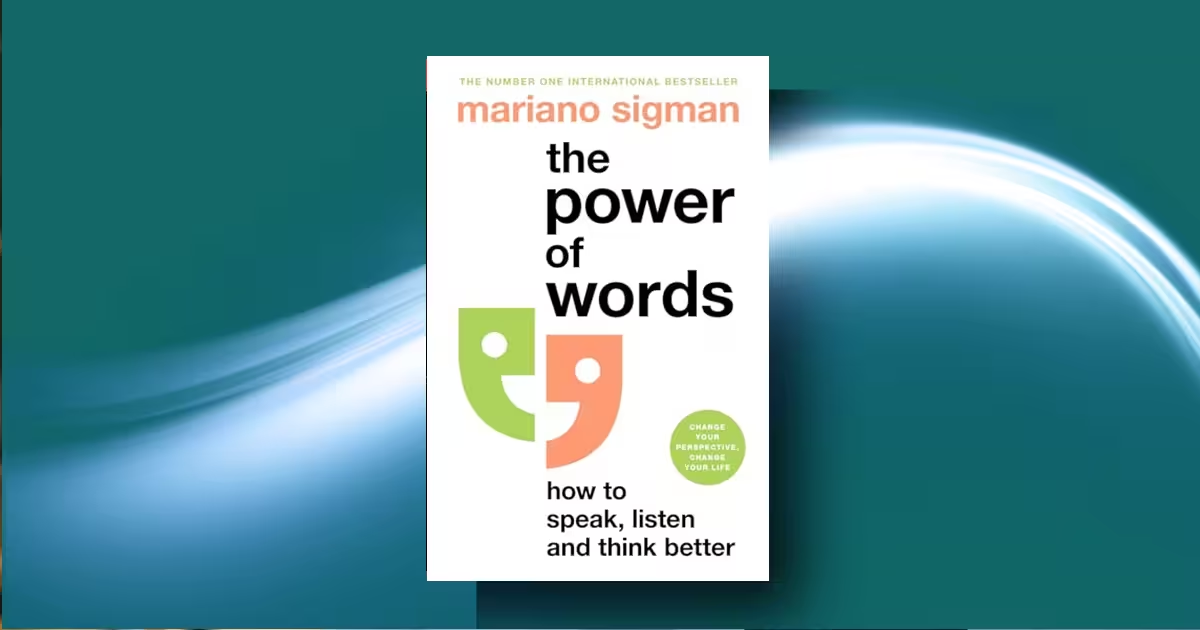
Ever wonder why a single sentence can ruin your day—or, just as powerfully, rewrite an entire childhood memory? That is the central question Argentine neuroscientist Mariano Sigman confronts in his international bestseller, The Power of Words: How to Speak, Listen and Think Better.
According to a 2022 interview with El País, loneliness is “toxic,” and having someone to talk to is “tremendously important for our health”.
Yet, as Sigman points out, most of us never stop to examine the words we use most frequently. Drawing on decades of research as one of the directors of the Human Brain Project, Sigman demonstrates that dialogue is not just a soft skill; it is a neurological tool.
This book will show you how to break free from the limiting beliefs you didn’t even know you had programmed into your own brain.
The Power of Words is best For / Not For
| Best For | Not For |
|---|---|
| Anyone who feels trapped by self-limiting beliefs like “I’m bad at math” or “I can’t control my temper.” | Readers looking for a quick, surface-level self-help “hack.” |
| Leaders, parents, and couples who want to turn heated arguments into constructive dialogue. | Those who prefer rigid, step-by-step scripts rather than philosophical, science-based exploration. |
| Fans of Thinking, Fast and Slow by Daniel Kahneman looking for practical applications of cognitive bias research. | Skeptics who believe that human behavior is entirely genetic and cannot be reshaped by conversation. |
Table of Contents
1. Introduction
The Power of Words is not a typical communication manual. Published in English by Macmillan Business in 2024 (and originally in Spanish in 2022), this 304-page guide is a fusion of cognitive neuroscience, philosophy, and personal memoir.
Mariano Sigman, a physicist turned neuroscientist who trained at The Rockefeller University (New York) and the College de France (Paris), served as a director of the Human Brain Project, the world’s largest effort to map the human mind.
The book’s central thesis is radical yet simple: Conversation is the most underutilized tool for changing our brains. Sigman argues that we live as “amphibious creatures,” constantly swimming between reality and fiction.
The stories we tell ourselves about who we are—“I’m no good at sports”—are a form of internal “fake news” that shapes our neural pathways.
This review will explore why Sigman believes that the ability to have a good conversation with others is the prerequisite for having a good conversation with oneself, ultimately leading to better decision-making, emotional health, and self-compassion.
2. Book Background: The Neuroscience of Dialogue
To understand the book, one must understand its author’s unique background. Sigman holds a Bachelor’s in Physics from the University of Buenos Aires and a PhD in Neuroscience from Rockefeller University.
This dual background in the hard sciences and the cognitive arts allows him to explain complex neurological processes (like memory reconsolidation) through the lens of physics and mathematics.
The book was born from a specific personal crisis. Sigman recalls having a heart scare while jogging, which led him to buy a bike. Despite believing for forty years that he was “no good at sports,” he climbed Puerto de La Morcuera in 32 minutes and 43 seconds, crushing his previous time.
He writes: “It took me forty years and thirty-two minutes to understand how wrong I’d been. …I apologized for not having honored the effort that he’d made, for not having understood it”. This anecdote sets the stage: our minds are malleable, but we must learn the language to edit them.
3. The Power of Words Summary
Chapter 1: The Stories We Tell Ourselves (Fallibility and Reflexivity)
Sigman opens with a fascinating concept borrowed from investor George Soros: Fallibility and Reflexivity. Fallibility is the idea that our view of the world is always distorted. Reflexivity is the loop where those distorted beliefs change reality.
For example, if you think, “I am sad,” that label does not just describe a state; it creates a psychological bubble. The author cites the Boston Marathon bombing (2013) to show how false news spreads faster than truth. He references Soroush Vosoughi’s MIT study, which found that lies travel “farther, broader, and faster” because they are not bound by circumstantial limits.
The Key Takeaway: “Our irrefutable explanations of today may seem absurdly exaggerated in the future… remember that, especially when you’re intoxicated by an emotion”. To combat this, Sigman suggests we measure our words like a scientist measuring data.
Chapter 2: The Art of Conversation (The Wisdom of Crowds)
This chapter pivots from internal monologue to group dynamics. Sigman analyzes historical failures like the Bay of Pigs Invasion (1961) , where JFK’s advisors unanimously recommended a bad plan due to groupthink. He contrasts it with the Cuban Missile Crisis (1962) , where JFK broke the cabinet into small groups and abstained from attending to allow dissenting voices to be heard.
In one of the book’s most staggering experiments, Sigman assembled 10,000 people in a theater to play a trivia game. He discovered that a brief, three-minute conversation in groups of five produced a “wisdom of crowds” effect that outperformed the simple average of individual guesses.
The Critical Distinction: Social networks usually produce the Madness of Crowds. Sigman cites Charles Mackay’s 1841 work to show that large, anonymous groups polarize.
However, small groups with open minds lead to reason. He writes: “Conversations work in certain arenas… When all of the participants have the time and the right to speak and be heard, the conversation takes on its full force”.
Chapter 3: Our Life Stories (Editing Memory)
Here, Sigman enters the realm of memory hacking. He explains the neurological process of reconsolidation. Every time you recall a memory, it becomes “labile” (malleable) and is saved again as a new version.
Using the philosophical riddle of Theseus’s Ship (if all planks are replaced, is it the same ship?), Sigman argues that we are constantly editing our past to fit our present identity. He references Paul McCartney’s dream composition of “Yesterday”—a melody that felt like a memory but was actually a novel creation of his own mind.
Practical Insight: The author suggests the “First Times” exercise. Asking someone “Tell me about your first kiss” triggers a vivid memory station, whereas “How was your day?” triggers a blank wall. “For a small child, crossing the ocean is like going to Mars. Tell them… that in the new place there are also trees and cars”.
This is how we build a coherent identity.
Chapter 4: The Atoms of the Mind (Clarifying Thought)
Sigman tackles the grammar of emotion using the famous Bouba/Kiki experiment (developed by Vilayanur Ramachandran and Edward Hubbard). In this test, 95% of humans worldwide assign the rounded shape to “Bouba” and the spiky shape to “Kiki.” This demonstrates that sound and shape are neurologically linked—our words are not arbitrary; they are physical sensations.
The Maniq People: Sigman uses the Maniq hunter-gatherers of southern Thailand as a case study. Unlike Westerners who describe smells by their source (“smells like coffee”), the Maniq have fifteen abstract words for scents.
This proves that the absence of a word creates the absence of perception. “When they disappear, even our most intense perception becomes confused and disorganized”.
Chapter 5: Governing Our Emotions (The Hulk and Reappraisal)
This is the most actionable chapter. Sigman defines three types of emotional regulation: Distraction, Induction, and Resignification. He argues that suppression (trying not to think of a pink elephant) fails neurologically because inhibition causes an excitation rebound.
The “Roller Coaster” Strategy: During a flight turbulence scare, Sigman’s nephews shouted “Roller coaster!” transforming fear into excitement. The bodily sensation (heart racing, stomach dropping) was identical; only the story changed. Sigman calls this reappraisal. It is not about turning off the emotion, but reinterpreting the signal.
He references the famous Strack & Stepper (1988) experiment where holding a pencil in your teeth (forcing a smile) makes cartoons funnier. “The world seems more fun when seen through a muscle filter that widens the mouth”.
Chapter 6: Learning to Talk to Ourselves (The Compassion Protocol)
The final chapter closes the loop. If we can talk to others, we can learn to talk to ourselves. Sigman introduces the concept of Self-Compassion (citing Kristin Neff’s 2003 scale). He notes that we are often harsher to our children and ourselves than we are to strangers.
The Helen Keller Analogy: He retells the story of Helen Keller’s breakthrough at the water pump—the moment she understood that the sign for “water” symbolized the liquid itself. That is the power of naming an emotion.
Sigman provides a step-by-step meditation exercise (the “Waking Up” project by Sam Harris) to practice this. “Self-compassionate people are protected… They treat themselves without flattery or contempt, in an even-handed and, moreover, kindly way”.
4. The Power of Words Analysis
The Guardian & NYT Perspective:
If I were to borrow the tone of The New York Times, I would call this book a pragmatic masterpiece. In a world dominated by the noise of Twitter (X), Sigman offers a quiet, scientific counter-revolution.
His strength is his vulnerability. Unlike stoic neuroscientists who lecture from a distance, Sigman becomes the subject of his own experiment. He admits to yelling at his children, failing at sports, and struggling with anxiety.
Why not 5 stars? At times, the sheer volume of cited studies (from 1907 to 2018) can overwhelm the narrative flow for casual readers. However, for the intellectually curious, this density is a virtue.
As noted in a user review on Amazon, “This book synthesizes various specialized knowledge into digestible chapters”.
5. Strengths and Weaknesses
Strengths:
Scientific Rigor: Sigman uses real data. For example, he cites the 2018 replication crisis regarding Strack’s pencil experiment to show how science self-corrects (something most self-help books ignore).
The “Confident Gray” Concept: This is the book’s most innovative idea. The “confident grays” are people who see good arguments on both sides of a debate. Sigman argues they are the true catalysts of consensus, not the extremists.
Practical Tools: The chapter summaries are excellent. Advice like “Don’t ask ‘How was your day?’ but ‘What was your last class of the day?’” is immediately usable.
Weaknesses:
Western Bias: While he touches on the Aymara and Maniq people, much of the core data relies on WEIRD (Western, Educated, Industrialized, Rich, Democratic) populations.
The Self-Help Crossover: Some readers (as seen in an Audible review) felt the book “divaga tanto” (digresses too much). The philosophical tangents, while beautiful, require patience.
6. Comparison with Similar Works
| Book | Author | Primary Focus | Difference from Sigman |
|---|---|---|---|
| Thinking, Fast and Slow | Daniel Kahneman | Cognitive biases (System 1 vs System 2) | More economic and statistical; less practical advice on listening. |
| Supercommunicators | Charles Duhigg | Identifying neural matching in conversations | More anecdotal; less focus on the neuroscience of self-talk. |
| The Art of Communicating | Thich Nhat Hanh | Mindfulness in speech | Spiritual/metaphysical; Sigman is strictly biological and empirical. |
| .The Power of Words | Mariano Sigman | Neuroplasticity through dialogue | Unique focus on reflexivity (how words change the speaker). |
How Sigman Stands Out: While Duhigg focuses on matching, Sigman focuses on reflexivity. He borrows from Soros’s financial theory to argue that the statement “I am sad” creates the sadness. No other book on the shelf tackles the physics of self-fulfilling prophecies quite like this.
7. Conclusion
.The Power of Words by Mariano Sigman is more than a book; it is a neuroscientific manual for the soul. It is for the person who is tired of their own internal monologue running on a toxic loop. It is for the parent who yelled at their toddler for spilling milk and felt immediate remorse.
Final Recommendation:
If you are willing to sit with complex ideas—about memory palaces, about the phantom fundamental of sound, about the liget of headhunters—this book will change your brain. Buy it. Read it. But most importantly, talk about it.
As Sigman quotes Richard Feynman: “I thought clearly because I taught well.” By sharing what you learn, you consolidate the lesson.







