
Last updated on June 8th, 2026 at 02:35 pm
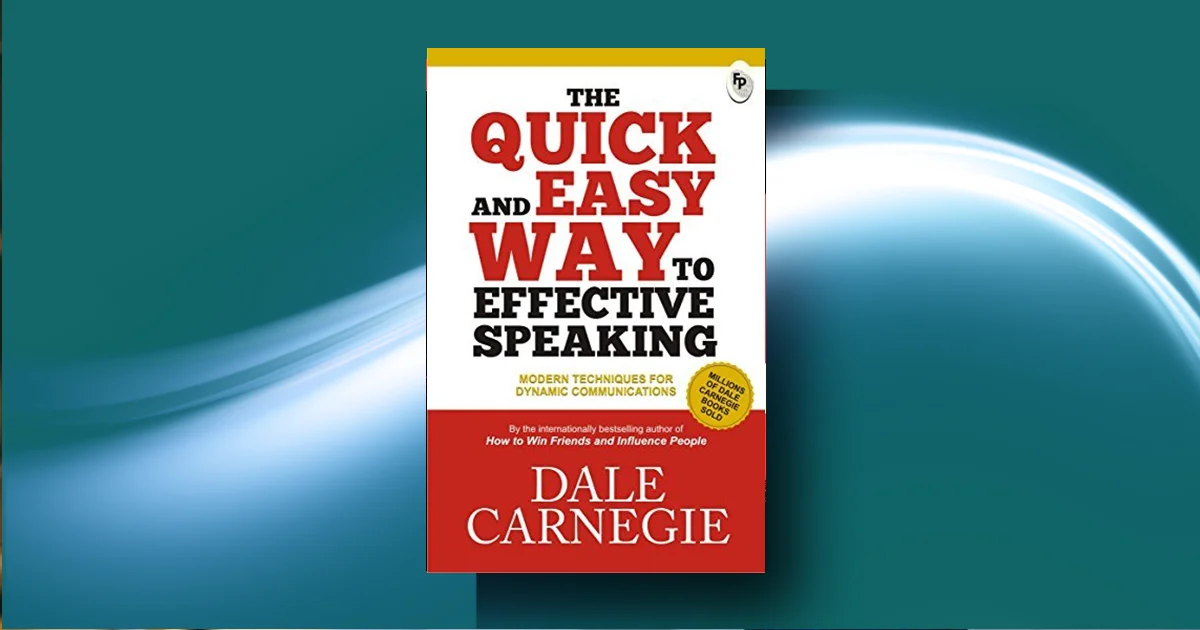
Why do we freeze when we know exactly what we want to say, yet feel our voice disappear the moment people look at us? The Quick and Easy Way to Effective Speaking feels valuable because it treats public speaking not as performance, but as a trainable human skill.
The Quick and Easy Way to Effective Speaking is best for readers afraid of public speaking, students, teachers, managers, business professionals, shy readers, new presenters, content creators, community leaders, salespeople, and anyone who wants to speak with more confidence without sounding fake.
Not for readers looking for academic rhetoric theory, advanced debate strategy, modern slide-deck design, clinical treatment for severe anxiety, or a highly research-heavy communication textbook. This book is practical, old-fashioned in places, and deeply focused on confidence through action.
Table of Contents
Introduction
The Quick and Easy Way to Effective Speaking is a public speaking and self-improvement book associated with Dale Carnegie, revised by Dorothy Carnegie from Dale Carnegie’s earlier work Public Speaking and Influencing Men in Business.
The edition I read lists copyright as 1962 by Dorothy Carnegie, published by Association Press in New York, with the first printing in March 1962 and later printings through November 1966.
Briefly, this is a book about learning how to speak clearly, confidently, vividly, and persuasively in front of other people. Traditionally, public speaking books taught voice, posture, rhetoric, gestures, and grand oratory. Carnegie’s method takes another path. It says: stop trying to become a “born speaker”; instead, become a sincere person with something real to say.
That is the reason I consider The Quick and Easy Way to Effective Speaking one of the best public speaking books for ordinary readers.
It does not begin with the fantasy of stage brilliance. It begins with fear, trembling, self-consciousness, dry throat, forgotten points, and the strange humiliation of standing up and feeling smaller than oneself.
Background
Dale Carnegie began teaching public speaking in 1912 at the YMCA on 125th Street in New York City. That date matters because the book’s method comes from classroom repetition, not just theory. Carnegie had spent decades watching ordinary people become more confident by standing up, speaking, failing a little, trying again, and discovering that the roof did not fall in.
Initially, it may seem that a 1962 public speaking guide should feel dated. Surprisingly, much of it feels modern because the fear itself has not changed.
Today, people may not always give speeches at banquets or Rotary clubs, but they still speak in Zoom meetings, interviews, classrooms, podcasts, team updates, wedding toasts, live streams, panels, and short-form videos. The room has changed; the body’s reaction has not.
Modern sources still describe fear of public speaking as widespread.
Verywell Mind reports that some experts estimate up to 77% of people experience some level of anxiety about public speaking. The Guardian, citing a 2023 YouGov survey, reported that half of Britons experience a phobia, fear, or anxiety around public speaking. These figures should not be treated as one universal clinical prevalence number, but they show why Carnegie’s subject remains urgent.
In truth, this book is not only about speeches. It is about self-possession. This means it is also about leadership, job performance, social ease, personal courage, and the ability to stand behind one’s own thoughts.
The Quick and Easy Way to Effective Speaking summary
1. Public speaking is a skill, not a birthright
A major trait of The Quick and Easy Way to Effective Speaking is its attack on the myth of the “born speaker.” Carnegie’s view is democratic: people are not divided into speakers and non-speakers by fate. They are divided by practice, preparation, and willingness.
One of The Quick and Easy Way to Effective Speaking’s most memorable ideas is that public speaking is like “enlarged conversation.” That phrase matters. It changes the whole emotional frame. If a speech is enlarged conversation, then the speaker does not need to become theatrical, artificial, or grand. The speaker needs to be clear, alive, and directed toward listeners.
Carnegie’s first promise is emotional before it is technical: you are not uniquely broken because you fear speaking. Many people have felt the same. Many have overcome it. Consequently, shame is a poor teacher; experience is a better one.
2. Keep the goal in front of you
The Quick and Easy Way to Effective Speaking repeatedly asks the reader to imagine what confidence would make possible. This is not merely motivational decoration. Carnegie understands that most people will not endure the discomfort of public speaking practice unless they attach the practice to a future self they want to become.
The goal may be professional: giving reports, leading meetings, selling an idea, teaching a method, persuading a committee, or addressing a convention. It may also be social: speaking at a club, introducing a guest, accepting an award, or simply telling a story at a gathering without shrinking.
Accordingly, The Quick and Easy Way to Effective Speaking frames public speaking as a path toward leadership. A person who can stand up, organize thought, and speak with sincerity becomes more visible. In business and community life, that visibility often becomes opportunity.
3. Predetermine your mind to success
Carnegie’s language here is old-fashioned, yet the underlying idea is recognizable: mindset affects performance. He asks the reader to stop feeding negative pictures of failure and begin rehearsing success mentally.
This does not mean pretending preparation is unnecessary. In contrast, Carnegie’s optimism is not lazy optimism. It is will joined to practice. The Quick and Easy Way to Effective Speaking says that the speaker should expect improvement, act toward improvement, and refuse to treat one awkward speech as destiny.
This leads to a key emotional lesson: confidence often follows action. We usually want courage before we speak. Carnegie suggests that we speak, prepare, and act confidently until courage catches up.
4. Practice every chance you get
The book’s most practical message may be the simplest: no one learns public speaking by reading alone. You learn it by speaking.
Carnegie compares public speaking to swimming. You cannot learn to swim without getting into water; likewise, you cannot learn to speak in public without speaking in public. This is obvious, yet it is the truth most frightened speakers avoid.
For this reason, he urges readers to join organizations, volunteer for roles, second motions, teach classes, lead meetings, and find small chances to stand up. The first talks may be clumsy. Nevertheless, each attempt creates a memory of survival. Over time, survival becomes competence, and competence becomes pleasure.
5. Understand fear instead of worshipping it
One of the strongest chapters is “Developing Confidence.” Carnegie does not deny stage fright. He normalizes it. He says many professional speakers still feel nervous before speaking. In fact, a limited amount of stage fright may sharpen energy.
This point is important because many speakers think fear means they are unqualified. Carnegie says fear often means the situation matters. The problem is not every heartbeat or tremor; the problem is unfamiliarity. Therefore, the solution is repeated successful experience.
The book’s practical advice is to stop interpreting fear as a prophecy. A racing pulse does not mean disaster. It may simply mean the body is preparing to act.
6. Prepare properly, but do not memorize word for word
This is one of the most useful lessons in the whole book. Carnegie is merciless about poor preparation. He writes that “only the prepared speaker deserves to be confident.” That line stayed with me because it removes the mystery from confidence. Confidence is not a mood; it is earned security.
Yet he also warns against memorizing a talk word for word. A memorized speech can become brittle. If one phrase disappears, the whole structure collapses. Moreover, memorized delivery often sounds mechanical because it comes from memory rather than living thought.
Instead, Carnegie recommends assembling ideas, arranging them, thinking deeply about the subject, and rehearsing the material conversationally. Talk it through with friends. Test stories in real life. Notice what makes people lean in. In other words, prepare ideas, not a corpse of perfect sentences.
7. Speak from earned experience
Carnegie’s quick and easy way rests on three primary rules: speak about something you have earned the right to discuss through experience or study; be excited about your subject; and be eager to share it with listeners.
This is where the book becomes almost moral. It does not ask, “How can I impress?” It asks, “What have I lived, learned, studied, or suffered enough to speak about honestly?”
Generally, audiences forgive imperfect grammar faster than they forgive emptiness. A person with real experience, concrete details, and sincere feeling can hold attention even without polish. In contrast, a speaker who borrows vague abstractions from articles and quotation books quickly becomes forgettable.
Carnegie’s advice is: tell us what life has taught you. That sentence could be the book’s secret doorway. The speaker’s authority begins not in decoration, but in lived contact with the subject.
8. Limit the subject and build reserve power
The Quick and Easy Way to Effective Speaking argues that many speeches fail because the subject is too broad. A short talk cannot cover “democracy,” “success,” “leadership,” or “education” in any meaningful way. It must narrow the field.
Next, Carnegie asks speakers to develop “reserve power.” That means knowing more than you use. If you speak for five minutes, you should have enough examples, facts, and reflections behind the talk to make those five minutes feel solid. Briefly, a speaker should not empty a shallow cup; the speaker should pour from a full reservoir.
This lesson is especially useful for modern creators and professionals. A strong presentation is not made by cramming everything into slides. It is made by selecting a few ideas from a much deeper preparation.
9. Use illustrations, examples, and concrete words
The Quick and Easy Way to Effective Speaking repeatedly favors the concrete over the abstract. It tells speakers to use incidents, names, dialogue, images, and familiar words that create pictures in the listener’s mind.
A case in point: if you say “freedom is important,” listeners may nod but not feel much. If you describe walking down a street without fear of identification papers, police harassment, or arrest, freedom becomes visible. That is Carnegie’s method: turn ideas into human scenes.
The book’s 5-W formula—when, where, who, what, why—is especially useful. It reminds the speaker that an example without details is only a claim wearing a thin coat.
10. Vitality comes from earnestness
Carnegie is almost impatient with lifeless speaking. He believes enthusiasm is contagious. If the speaker does not care, why should the audience?
However, there is a danger here. Enthusiasm without truth can manipulate. Carnegie himself gives examples showing how strong conviction can persuade people even when the claim is weak. Therefore, the best reading of the book is not “be enthusiastic about anything.” It is: choose a worthy subject, understand it, believe it, and then speak with the energy it deserves.
Importantly, this is why The Quick and Easy Way to Effective Speaking is more than a book on technique. It keeps returning to character. What you are comes through what you say.
11. Share the talk with the audience
The book’s audience advice is still valuable. Carnegie tells speakers to talk in terms of listeners’ interests, give sincere appreciation, identify with the audience, make the audience a partner, and play themselves down.
This is classic Carnegie. The speaker should not stand above listeners. The speaker should build a bridge. Whereas some public speaking advice focuses on dominance, Carnegie focuses on rapport.
This is especially relevant in the age of answer engines, short attention spans, and endless content. People do not want a speech thrown at them. They want relevance. They want to feel seen. They want the speaker to answer the quiet question in their minds: “Why should this matter to me?”
12. The short talk to get action
For persuasive speaking, Carnegie emphasizes a simple structure: give an example from your life, state the point or action clearly, and give the reason or benefit the audience may expect.
This is a powerful formula because it begins with human experience rather than command. Instead of opening with “You must donate,” “You must change,” or “You must agree,” the speaker begins with a story that prepares the audience emotionally.
Thus, the action request feels earned rather than imposed. The listener understands not only what to do, but why it matters.
13. The talk to inform
For informative talks, Carnegie recommends restricting the subject to fit the time, arranging ideas in sequence, enumerating points, comparing the strange with the familiar, and using visual aids.
This chapter is useful because it recognizes a common speaker mistake: confusing information with communication. To inform does not mean dumping facts. It means arranging facts so the audience can receive them.
To put it another way, a speaker is not a warehouse. A speaker is a guide.
14. The talk to convince
To convince, Carnegie says the speaker must deserve confidence, get a “yes-response,” speak with contagious enthusiasm, show respect and affection for the audience, and begin in a friendly way.
Some modern readers may find the “yes-response” language sales-like. Still, the deeper principle is sound: agreement often grows from trust, not pressure. If listeners feel attacked, they defend themselves. If they feel respected, they may reconsider.
In addition, Carnegie’s insistence on deserving confidence is crucial. Persuasion without trust becomes manipulation. Persuasion with trust becomes leadership.
15. Impromptu speaking is prepared living
The impromptu chapter is one of the most practical sections. Carnegie does not pretend that spontaneous speaking comes from nowhere. He argues that good impromptu speakers are mentally ready. They pay attention in meetings. They ask themselves what they would say if called upon. They carry examples and opinions in an active state.
This means impromptu speaking is not magic. It is general preparation meeting a sudden occasion.
The advice “get into an example immediately” is excellent. When caught off guard, many people begin with apology, fog, or throat-clearing. Carnegie says: start with a concrete example, speak plainly, and sit down. That is to say, do not “talk impromptu”; give an impromptu talk.
16. Delivery should sound like you
Part Four, “The Art of Communicating,” rejects artificial delivery. Carnegie does not want the speaker to imitate others. He wants the speaker to converse with the audience, put the heart into the message, and develop a strong, flexible voice through use.
This is one reason I enjoyed the book. It does not worship polish at the expense of personality. Certainly, polish matters. Yet over-polish can sterilize a talk. Carnegie would rather have living speech than dead perfection.
17. Special occasions: introductions, awards, longer talks
The later chapters apply the principles to introductions, presentations, acceptance speeches, and longer talks. The T-I-S formula for introducing a speaker—topic, importance, speaker—is clean and memorable. It prevents the introducer from rambling.
For longer talks, Carnegie recommends getting attention immediately, avoiding unfavorable attention, supporting main ideas, and appealing for action. The openings he recommends include incidents, suspense, arresting facts, a show of hands, a promise of benefit, or an exhibit.
What he warns against is equally useful: do not begin with apology, and do not rely on a weak “funny story” opening. Notably, this advice still applies to blog posts, YouTube videos, lectures, sermons, and podcasts. Attention is not owed. It is earned.
18. Apply speaking skills every day
The final chapter argues that speaking techniques are not only for formal speeches. They belong in everyday conversation, jobs, meetings, and leadership. Use specific detail. Speak clearly at work. Seek opportunities. Persist. Keep the reward before you.
This is the book’s most lasting message. Public speaking is not a separate performance skill locked on a stage. It is a daily expression of thought, personality, and courage.
Analysis: My opinion on the book
The Quick and Easy Way to Effective Speaking is an important, warm, practical, and surprisingly moving public speaking book. It is not flawless, and it is certainly dated in examples and style, but at its best it feels like a patient teacher standing beside a frightened reader and saying: “You can do this—now stand up and try.”
My pleasant experience with the book came from its emotional generosity. Carnegie does not mock fear. He understands it. He has seen executives, clerks, housewives, students, salespeople, and professionals tremble before an audience. Nevertheless, he refuses to let fear become identity.
A major trait of the book is that it connects speech with personality. The introduction says effective speaking is more than “saying a few words”; it is the revealing expression of a human personality. I think that is the book’s real heart. Carnegie is not merely teaching people how to impress a room. He is teaching them how not to be blocked off from other people.
Does the author support the argument effectively? Mostly, yes. The support is not scientific in the modern academic sense. The evidence is anecdotal, classroom-based, experience-heavy, and full of stories from Carnegie courses. But because the book is a practical manual, those stories often work. They demonstrate transformation: fear to practice, practice to confidence, confidence to opportunity.
Still, there are drawbacks. Due to insufficient evidence by contemporary research standards, some claims should be read cautiously. For example, the book’s claim that surveys in speech classes showed 80–90% of students had stage fright is interesting, but it is presented broadly and without modern methodological detail. Likewise, the claim that more than 85% of knowledge comes through visual impressions is a familiar communication-statistic style claim, but the book does not document it in a way I would rely on academically.
Nevertheless, the book succeeds because its main method is not dependent on one fragile statistic. Its core is practical exposure: prepare, speak, receive experience, speak again. Modern anxiety treatment also often values exposure, practice, and cognitive reframing, although clinical fear may require professional support.
Evalusion
Strengths
First and foremost, the book is compassionate. It begins where frightened readers actually are. It talks about butterflies, trembling, mental blanks, and self-consciousness without contempt.
Second, The Quick and Easy Way to Effective Speaking is concrete. It gives formulas, guideposts, and repeatable actions: limit the subject, use examples, arrange ideas, rehearse with friends, begin with incidents, get into an example during impromptu speaking, and ask for action clearly.
Third, it is deeply human. Carnegie prefers lived experience over borrowed abstraction. This is why the book still works for bloggers, teachers, leaders, and reviewers. It teaches that the most persuasive thing you can bring to a speech is not ornament, but earned truth.
Fourth, it broadens public speaking beyond the stage. The reader learns that effective speaking improves meetings, conversations, leadership, teaching, persuasion, and even one’s sense of self.
Weaknesses and criticism
The most obvious weakness is age. Some examples, gender assumptions, institutional settings, and business references belong to another era. A modern reader may need to translate banquets, clubs, and civic gatherings into meetings, webinars, classrooms, and digital platforms.
Another weakness is the heavy reliance on anecdote. The stories are memorable, but they are not controlled evidence. Since the evidence was not validated in a modern research style, readers should not treat every numerical claim as settled science.
Also, the book gives less attention to structural inequalities, accent bias, neurodivergence, trauma, and clinical social anxiety than a contemporary guide might. Some readers need more than practice and positive self-talk. They may need coaching, therapy, accommodations, or safer speaking environments.
However, there are drawbacks to almost every classic self-help book. The better question is whether the central advice remains useful. Here, I think it does.
Comparison with similar books
Compared with How to Win Friends and Influence People, this book is more focused. How to Win Friends teaches human relations, likeability, influence, and social tact. The Quick and Easy Way to Effective Speaking teaches the spoken expression of those qualities in front of listeners.
Compared with Talk Like TED by Carmine Gallo, Carnegie’s book is less modern and less stage-production oriented. Talk Like TED is useful for presentation design and high-impact storytelling, whereas Carnegie is more useful for raw confidence and beginner courage.
Compared with The Art of Public Speaking by Dale Carnegie and J. Berg Esenwein, this book feels simpler and more psychologically accessible. It is less formal and more focused on ordinary adults who need practical results.
Compared with Toastmasters-style manuals, Carnegie’s book is warmer and more philosophical. Toastmasters gives a practice environment; Carnegie gives the emotional logic behind why practice works.
Compared with modern anxiety resources, Carnegie is less clinical but still aligned with the basic wisdom that avoidance feeds fear and practice builds confidence.
Key lessons readers can take without rereading the whole book
- You are not uniquely afraid; fear of public speaking is common.
- Public speaking is learned by speaking, not by reading alone.
- Do not memorize speeches word for word.
- Prepare ideas deeply and arrange them clearly.
- Speak from experience or serious study.
- Use specific examples, names, dialogue, and details.
- Limit your subject.
- Know more than you use.
- Be genuinely excited about your topic.
- Think about the audience’s interests.
- Begin with an incident, fact, question, promise, or exhibit.
- Avoid apologetic openings.
- For action talks, use example, point, and benefit.
- For informative talks, sequence ideas and make the unfamiliar familiar.
- For convincing talks, deserve trust and begin in a friendly way.
- For impromptu talks, prepare mentally before you are called.
- Do not imitate other speakers.
- Speak like a living human being.
- Use speaking skills in daily life.
- Persist through plateaus.
Conclusion
Yes. The Quick and Easy Way to Effective Speaking is worth reading, especially if you fear public speaking or want a practical, human, confidence-building guide. It is one of the best public speaking books because it does not treat speaking as decoration. It treats speaking as courage made audible.
I would recommend it to general readers, students, professionals, teachers, managers, leaders, shy people, and anyone who has stayed silent while wishing they could speak. Specialists in rhetoric or communication research may find it too anecdotal and dated, but beginners and anxious speakers may find it liberating.
Ultimately, the book’s promise is not that you will become a theatrical genius. Its promise is better: you can become clear, sincere, prepared, and brave enough to share what you know. For most of us, that is already a revolution.







