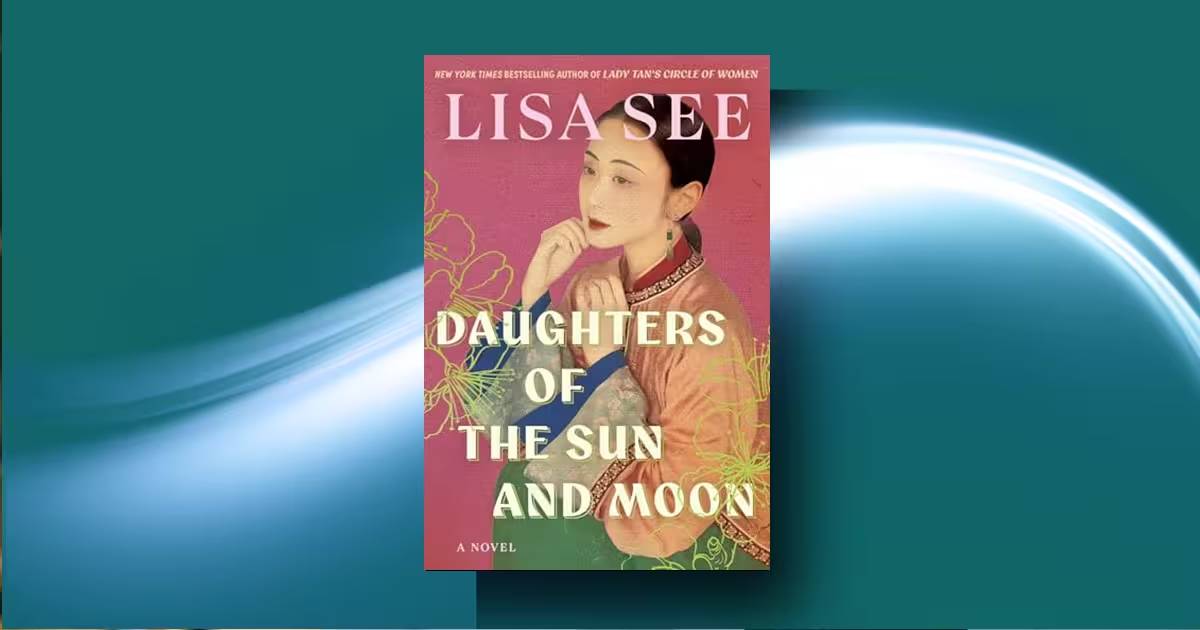

Did you know that one of the largest mass lynchings in U.S. history took place not in the Deep South, but in Los Angeles in 1871, and that its primary victims were Chinese immigrants? Lisa See’s monumental new novel, Daughters of the Sun and Moon, dives headfirst into this erased history, transforming a dusty footnote into a visceral, heartbreaking, and ultimately triumphant story of three women caught in the crossfire of racial hatred and gang violence.
If you think you know the history of the American West, prepare to have your perspective shattered.
Daughters of the Sun and Moon reveals how three Chinese women—a sheltered child bride, a peasant sold into sexual slavery, and a doctor’s educated wife—are brought together by fate in the violent cauldron of 1870s Los Angeles, and through their courage and friendship, manage to survive a horrific massacre and build new lives from its ashes.
Daughters of the Sun and Moon is best for readers who love meticulously researched historical fiction, stories of deep female friendship and resilience, and fans of authors like Amy Tan or Min Jin Lee. It’s also perfect for anyone interested in the hidden history of Los Angeles, the Chinese-American experience, or the struggles of women in the 19th century.
But it’s not a good read for readers who are looking for a light, fast-paced beach read. This novel is emotionally heavy, deals with graphic violence and sexual assault, and its deliberate pace mirrors the oppressive confinement its characters experience. Those uncomfortable with detailed depictions of racism, misogyny, and human trafficking may find it challenging.
1. Introduction: The Silence of History
More than fifty years after the horrific events she witnessed, the narrator, a woman we come to know as Moon (Yue), sits down to write. She is eighty-two years old, her body frail, but her mind is sharp with the urgency of memory. “The palest ink is better than the best memory,” she reflects, opening her story.
This is the framing device for Lisa See’s latest masterpiece, Daughters of the Sun and Moon (Scribner, June 2026). See, a New York Times bestselling author known for her deeply researched explorations of Chinese culture in novels like Snow Flower and the Secret Fan and The Island of Sea Women, here turns her gaze to a forgotten chapter of American history.
The book is inspired by real women and real events, specifically the Los Angeles Chinese Massacre of 1871, which saw a mob of over 500 people kill eighteen Chinese men and boys.
Through the intertwined fates of Moon, Dove, and Petal, See not only resurrects the dead but gives voice to the voiceless, creating a poignant and powerful testament to survival.
2. Historical Context: A Violent Pueblo
To understand the world Dove, Petal, and Moon step into, we must first understand Los Angeles in 1870. It was not the sprawling metropolis of today. As Moon remembers, it was “a tiny, dirty, and violent town of just over five thousand people, of whom 180 were Chinese”.
This was the Wild West in its rawest form. Of the 285 businesses in the pueblo, 110 were saloons, and there were no laws regulating gambling or prostitution.
As Moon notes from her reading of the Los Angeles Gazette, the city had the dubious distinction of being “one of the most violent and wickedest not only in the state but in the West”. Most critically, Chinese residents were denied basic rights.
They could not own land, marry a white person, vote, or, most devastatingly, “testify in court against a white American”. This legal invisibility made them perfect targets for exploitation and violence.
3. Daughters of the Sun and Moon Summary: Three Women, One Fate
The novel’s structure weaves between the historical past (1870-1872) and Moon’s retrospective narration from 1926, creating a sense of tragic inevitability. The story is told in five parts, opening with the parallel arrivals of its three heroines.
Part I: Arrivals and First Meetings
We first meet Dove (Yut Ho) , a beautiful, innocent seventeen-year-old from a once-scholarly family in Canton. Her father, seeing a financial opportunity, has arranged for her to become the second wife of “Old Man Sing,” a 60-year-old merchant living in Los Angeles.
Throughout her journey, Dove is filled with romantic notions of love, likening her fate to the legend of the Spinning Maid and the Cowherd, who are separated by the Milky Way.
In stark contrast, Petal (Sing Yee) , an 18-year-old peasant from the drought-stricken Moon Pond Village, is tricked by her father. Believing she is going to sell vegetables with him, she is instead sold to the Hip Yee Tong for forty Mexican dollars.
Her voyage to America is a nightmare of degradation. Upon arrival in San Francisco, she is stripped naked in the “Queen’s Room” and auctioned off like livestock to the highest bidder: Headman Sam Yuen, leader of the Nin Yung Tong.
The third woman, Moon (Tong Yu) , is the most established of the three. She is the intelligent, educated wife of Doctor Chee Long “Gene” Tong, a respected practitioner of traditional Chinese medicine.
Moon’s narrative voice dominates the novel, offering a wise, observant, and heartbreaking perspective. Moon suffers from a deformed foot due to a botched binding as a child, a source of deep personal pain. She longs for a baby, keeping a figurine of the goddess Kuan Yin under her bed, but remains childless.
The three paths cross for the first time when Old Man Sing brings Dove to Moon’s apartment to have the doctor verify that she is still a virgin. At the same time, Headman Sam arrives with a beaten, unconscious Petal—the same peasant girl from the ship. In a small, dusty apartment on the notorious Calle de los Negros (Negro Alley), the “Daughters of the Sun and Moon” are brought together by the brutal commodification of their lives.
Part II and III: The Mechanics of Misery and a Glimmer of Hope
The middle sections of the novel immerse the reader in the grim realities of their separate lives. Dove is a prized possession, displayed in her husband’s shop like a beautiful vase. She is bored, lonely, and yearns for the love she dreamed of.
Her attempts to socialize are shut down. When she meets the eyes of a visitor, Three-Finger Lee, Headman Yo’s hatchet man, her husband accuses her of encouragement.
Soon after, she is kidnapped by Three-Finger Lee on orders from Headman Yo and forced into a sham Western marriage as part of an escalating tong war. For Dove, this is a new circle of hell; she is held captive in a house on Poundcake Hill, a pawn in a game of masculine pride and power.
Meanwhile, Petal’s life is one of relentless degradation as a “hundred men’s wife” in Headman Sam’s bawdy house. She endures torture, multiple escape attempts, and kidnappings.
During one failed escape, her captors beat her, tear off her clothes, tie her to a tree, and burn her with cigarettes. Yet, Petal’s spirit is unbreakable. She clings to a connection to the earth, secretly growing medicinal herbs in a tin can on her windowsill for Doctor Tong, a deal brokered by Moon. This simple act of nurturing life is her anchor.
Moon lives a life of relative comfort and intellectual stimulation, but her childlessness is a consuming sorrow. Her world is shattered when Robert Thompson, a white rancher, is killed during a Tong shootout, sparking the powder keg of racial hatred in the city. What follows is the novel’s devastating centerpiece: the “Night of Horrors” on October 24, 1871.
Part IV: The Night of Horrors (Full Spoilers)
This section is a masterclass in suspense and horror. As the mob, whipped into a frenzy by the killing of a white man, descends on the Calle de los Negros, See pulls no punches. We see the events unfold through the eyes of all three women.
A mob of over 500 white, Mexican, and mixed-race men, armed with pistols, knives, hatchets, and ropes, begin their rampage. They drag Chinese men from their homes and businesses. Ah Wing is the first to be hanged from the crossbeam at Tomlinson’s Corral.
Hiding in the Forever Prosperous store, Petal witnesses her 14-year-old brother, Ah Loo, who only just arrived from China, being dragged away by the mob.
Her desperate screams are useless.
The man who pulls her from the mob is none other than Justice of the Peace Robert Widney (a real historical figure who helped rescue Chinese survivors). But it’s too late for her brother. Later, at the inquest, Moon has to help identify Ah Loo’s body.
The worst is reserved for Moon. She sees a woman she recognizes, Mrs. Grascy, the Southern patient who always brought her bratty son, Jack, to Gene’s clinic.
In a moment of pure evil, Mrs. Grascy steps forward with a clothesline and offers it to the mob. “You’re welcome to use my clothesline, boys,” she says. They use it to hang Chang Wan, Gene’s assistant. Then they turn on Gene. After brutally beating him and humiliating him by tearing off his pants to search for hidden money, a rioter shoves his revolver into Gene’s mouth and pulls the trigger, blowing half his face off.
They hang him anyway, to “make sure.” Moon is forced to watch her husband’s murder.
In the chaos, the sign advertising Dr. Tong’s practice is still outside. He was the most respected Chinese man in the city, and See’s depiction of his senseless, brutal death is a gut-wrenching indictment of the mob’s bloodlust.
Part V: Aftermath and Rebirth
The massacre ends. The final death toll, as noted by Moon, is eighteen, but the true number is likely higher. The city, eager to promote a land boom, tries to erase the event. But the women will not forget. Moon is broken but not defeated. Petal, in an act of astonishing bravery, goes back to the garden where she hid the stolen money from Headman Sam’s store, retrieves it, and uses it to buy her freedom and fund their new life.
Most incredibly, in the midst of her grief, Moon discovers she is pregnant. “The last thing Gene told me was to protect the baby,” she realizes, touching her belly.
This revelation gives her a new purpose.
Meanwhile, Dove, still held captive by Headman Yo and Silver Shimmer (Yo’s wife), is discovered to be pregnant. While she miscarries, she is later rescued by Moon and Petal in a tense scene.
The novel’s final act is one of healing and rebirth. The three women move to a small shack on the property of the kind Cayetano Apablasa, where they live as a family, raising Moon’s son, Gene Jr. , and Dove’s daughter, Pearl. The trials that follow the massacre are a farce. Though a few men are initially found guilty, the California Supreme Court overturns the verdicts, and all cases are dismissed.
None of the ringleaders, including Mrs. Grascy, are ever punished.
See then leaps forward to 1926, with Moon as an old, blind woman. She tells us of the lives they built. Petal, despite her disease, lived for forty years and was a beloved aunt to the children.
Dove found her independence and happiness. And Moon became a respected businesswoman and pillar of the new Chinatown that grew on the Apablasa land after a mysterious fire erased the Calle de los Negros for good. In the end, Moon offers a final reflection on the triumph of community over hatred and the enduring power of their bond.
4. Analysis
4.1. Characters
The novel’s greatest strength is its three-dimensional, unforgettable central trio.
Moon (Yue): As the narrator, Moon is the heart and soul of the book. She is the strategist, the scholar, and the observer. Her physical limp, a result of her failed foot binding, is a constant reminder of the physical constraints placed on women.
Yet, intellectually, she is a giant, capable of navigating the white man’s world. Her grief is the novel’s emotional core. The way she steels herself to watch her husband die and then finds the will to live for his child is profoundly moving.
Petal (Sing Yee): Petal is the novel’s indomitable spirit. She begins as a naive peasant girl and is forced to learn the darkest lessons of humanity. Despite being beaten, sold, and sexually exploited, she retains her core of integrity.
She is the “woman of the earth,” whose connection to growing things is her salvation. Her quiet dignity in the face of her Plum-Blossom Sickness (syphilis) diagnosis is heartbreakingly heroic. As Moon says at her death, she was a woman who had started out “worthless” but ended “esteemed and loved”.
Dove (Yut Ho): Of the three, Dove is the most tragic figure. She is the classic “beautiful woman” whose beauty is a curse. She is passed from man to man like a piece of property.
Her romantic idealism is shattered repeatedly. Her arc is the most passive, yet she is a survivor. In a beautiful act of irony, she, who was born to be an ornament, finds her strength in the domestic arts and in motherhood, becoming the family’s caretaker.
Antagonists: The villains are not just the rioters but the entire system. Headman Sam and Headman Yo are not cackling monsters; they are brutal capitalists for whom women are just another line item. The most chilling villain is the seemingly ordinary Mrs. Grascy, a woman who, in her desperation and racism, casually offers a clothesline to a lynch mob. Her presence underscores See’s point that evil is often banal.
4.2. Themes and Symbolism
The book is a rich tapestry of themes.
Female Solidarity: This is the central theme. Dove, Petal, and Moon are of different classes and circumstances, but their shared vulnerability as Chinese women in a hostile land forges an unbreakable bond. They teach each other, rescue each other, and build a life together. As Moon concludes, “If not for Petal and Dove, I would not be the woman I am today”.
Trafficking and Commodification: The novel unflinchingly shows that for Chinese women in 19th-century California, freedom was an illusion. They are bought, sold, traded, kidnapped, and married off against their will as part of business deals. Petal’s auction and the farcical Western marriage of Dove lay bare the reality that, as Moon puts it, a more honest word for “indentured servitude” is “slavery”.
The Erasure of History: Moon’s narrative is an act of defiance against forgetting. The city literally tears down the buildings on the Calle de los Negros to try to erase the massacre. The trials are a sham, and the records disappear. Moon’s memoir is her way of saying, “We were here. This happened.”
Symbolism: Plants and the earth are Petal’s symbols of life and hope. The white poodle, Winter Melon, is a poignant symbol. Moon hates him at first because white is the “color of death” in Chinese culture, and he is a reminder of her inability to have a human child. But by the end, he is her companion in grief.
The figurine of Kuan Yin is a symbol of Moon’s deepest wish—for a child and for mercy.
5. Evaluation
Daughters of the Sun and Moon is a masterwork of historical fiction. It is, without a doubt, Lisa See’s most powerful and important novel to date.
Strengths:
The book’s sheer research is staggering, but it is worn lightly. See immerses you in the sights, smells, and sounds of a raw, violent LA without ever sounding like a textbook. The emotional authenticity is off the charts.
The massacre sequence is as harrowing as anything I’ve ever read, but it is the quiet moments of survival—Petal growing herbs, Dove chopping wood, Moon holding her newborn son—that truly linger.
The prose is clean, elegant, and devastatingly effective.
Weaknesses:
The plot’s pacing can be relentlessly grim, especially in the middle sections. The constant cycle of violence and degradation can become exhausting, though this is arguably the point. Some readers may also find the sheer number of historical figures and tong politics difficult to track.
Additionally, the villains, while effective, are somewhat two-dimensional symbols of evil, lacking the complexity of the heroes.
Impact:
This book is a punch to the gut. I felt genuine rage and sorrow while reading it. See has done something remarkable: she has taken a “forgotten” historical event and made it feel painfully, urgently present. It’s a story about America’s original sin of racism, and its lesson that violence and hatred leave scars on a community for generations is timeless.
6. Personal Insight: The Poison of Scapegoating
One of the most chilling and relevant aspects of Daughters of the Sun and Moon is its depiction of how a society can be manipulated into targeting a scapegoat. In 1871 Los Angeles, white workers were angry about low wages. Instead of blaming the capitalists who exploited them, they blamed the Chinese, who worked for less simply to survive.
This same dynamic is vividly playing out in our world today.
According to the FBI, hate crimes across the U.S. have risen to their highest levels in more than a decade. This novel is not just a history lesson; it is a mirror.
5 Lessons from the Book:
Silence is Complicity: The law prevented Chinese from testifying. Today, we have no such excuse. To witness injustice and say nothing is to become an accessory.
Dignity in the Face of Degradation: Petal is stripped and auctioned, yet she never loses her sense of self. External circumstances do not define your inner worth.
Found Family Saves Us: Moon, Dove, and Petal are far from their blood families, yet they create a new one. In times of crisis, the bonds we choose can be the strongest.
Knowledge is Power: Moon’s ability to read English and navigate the legal system is the one tool she has that her friends lack. Education and literacy are forms of resistance.
To Survive is to Triumph: The system was designed to destroy them, but they lived. “Even a hare will bite when it feels threatened,” Moon says. Never underestimate the will to survive.
7. Books like Daughters of the Sun and Moon
1. Thousand Pieces of Gold by Ruthanne Lum McCunn
This is the closest possible companion to See’s novel. It tells the true story of Lalu Nathoy (later Polly Bemis), a young Chinese woman sold into slavery by her impoverished father in the 1870s – almost identical to Petal’s fate.
She is transported to America, auctioned off, and forced into prostitution in the brutal mining camps of Idaho. Like See’s characters, Lalu endures unspeakable violence and degradation, yet through sheer grit and intelligence, she eventually buys her freedom, claims land, and builds a respected life.
This novel is shorter, rawer, and less sweeping than See’s, but it is arguably more devastating because it is true. If you cried for Petal, you will be shattered and uplifted by Lalu.
Best for: Readers who want the unvarnished, fact-based experience of a Chinese woman’s survival in the 19th-century American West.
2. Pachinko by Min Jin Lee
While the setting is different (Koreans in 20th-century Japan, not Chinese in 1870s LA), Pachinko is the only recent novel that matches See’s epic scope, her focus on generational trauma, and her unflinching depiction of how systemic racism dehumanizes an entire people.
Centered on the indomitable Sunja, a young Korean woman who endures pregnancy out of wedlock, poverty, exile, and the loss of her son to war, the story spans 80 years.
Like Daughters, it is a novel about forgotten people, brutal historical forces, and the quiet, everyday heroism of women who refuse to stop fighting. It won multiple awards and was named one of the New York Times‘ 10 Best Books of the Year.
Best for: Readers who want the same epic, multi-generational, heart-wrenching, yet ultimately hopeful feel of Daughters of the Sun and Moon.
8. Daughters of the Sun and Moon Quotes
On a woman’s destiny: “A boy is born facing in; a girl is born facing out. From the moment your daughter breathed the air of this world, she belonged to her future husband’s family.” (The Matchmaker, p. 7).
On survival: “I will paint a dragon and dot the eyes. I will create the picture Headman Sam wants for now, leaving out nothing… but I will find my way home.” (Petal, p. 76)
On the law: “The buying, selling, and owning of human beings is now against the law in this country. But… No one seems to care that this is happening to girls like you here in California.” (Moon, p. 75)
On friendship: “Together we are daughters of the sun and moon.” (Moon, p. 130)
On freedom: “I may have lost my bodily virtue, but my mind is still my own, and it will always be mine alone. That is real freedom.” (Petal, p. 153)
On the massacre: “You believe your home—even if it’s only a small apartment or a bed in a boardinghouse—is your refuge. That was not to be.” (Moon, p. 265)
On finding hope: “There is soft happiness in sadness and deep sadness in happiness.” (Petal, p. 301)
9. Conclusion
Daughters of the Sun and Moon is a monumental achievement. Lisa See has written a book that is devastating, educational, and ultimately uplifting. It is a vital corrective to the sanitized history of the American West and a powerful tribute to the forgotten women who helped build this country while being treated as less than human.
This book is essential reading for any fan of serious historical fiction. If you loved Pachinko by Min Jin Lee or Homegoing by Yaa Gyasi, you will be captivated by this saga of family, loss, and resilience. I give this book my highest recommendation.