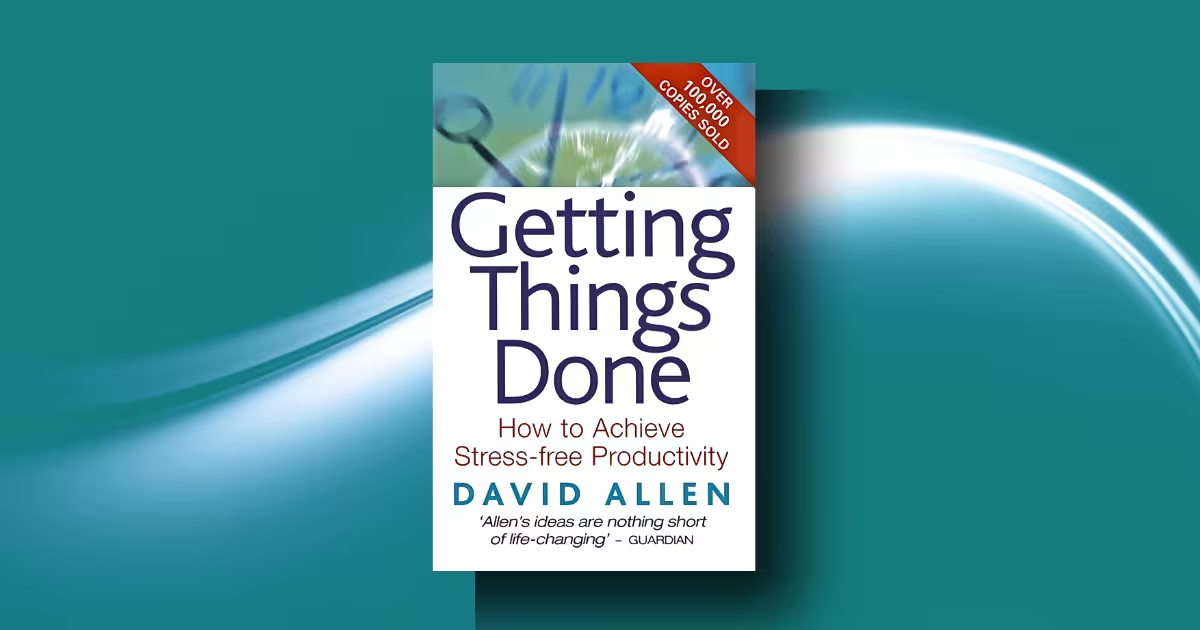

Getting Things Done: The Art of Stress-Free Productivity argues that productivity is not simply about working harder—it is about getting commitments out of your head, clarifying the next action, organizing what needs attention, and regularly reviewing your system. In this Getting Things Done review, I break down Allen’s five-step GTD method, its most useful ideas, its limitations, and the lessons that still matter for modern work and everyday life.
Allen argues that stress comes from broken agreements with yourself—things you’ve told yourself you should do but haven’t captured, clarified, or organized. The solution is a five-step method: Capture everything that has your attention, Clarify what each item means and what action it requires, Organize the results into trusted systems, Review your commitments regularly, and Engage (do the work).
The book sold over 4 million copies, has been translated into 28 languages, and Time magazine called it “the definitive business self-help book of the decade”. Fast Company dubbed Allen “the personal productivity guru”.
In short, the Getting Things Done method works if you implement it fully. But the book itself? It’s repetitive, overly detailed, and feels dated despite the 2015 revision. The system is brilliant. The reading experience? Less so.
Getting Things Done Core Lessons
Getting Things Done (GTD) by David Allen is a productivity system designed to reduce mental clutter by moving tasks, commitments, ideas, and projects from your head into a trusted external system. The method has five core stages: capture, clarify, organize, reflect, and engage.
The central idea is simple: instead of trying to remember everything, capture what has your attention and determine the next physical action required. Getting Things Done also emphasizes the two-minute rule, project lists, contextual action lists, and a regular Weekly Review to keep the system current.
Key takeaway: Getting Things Done is less about squeezing more tasks into your day and more about creating a reliable system that lets you decide what deserves your attention without constantly carrying unfinished commitments in your mind.
Core stages and principles:
- Capture everything that has your attention.
- Clarify what each item means and whether it requires action.
- Define the next physical action rather than keeping vague to-do items.
- Organize tasks, projects, calendars, and reference material into a trusted system.
- Review your system regularly, especially through the Weekly Review.
- Engage by choosing what to do based on context, time, energy, and priorities.
- The ultimate goal is a calmer mental state in which you can focus on the task in front of you.
Best for: People managing many personal or professional commitments who feel overwhelmed by scattered tasks.
Potential limitation: Getting Things Done requires regular maintenance, especially the Weekly Review, and its detailed system can feel cumbersome for people with relatively simple workloads.
Table of Contents
Reader Recommendation
You’ll probably love this book if:
- You feel overwhelmed by the sheer volume of stuff you need to track—e-mails, projects, personal commitments, random ideas
- You’re the kind of person who makes lists but never actually follows through on them
- You work in a role with lots of moving pieces—project management, executive leadership, creative work, entrepreneurship
- You’re willing to invest significant time upfront (Allen recommends two full days) to set up the system
- You don’t mind reading repetitive content to extract useful principles
You should probably bounce if:
- You already have a productivity system that works for you
- You’re looking for quick tips you can implement in an afternoon (this isn’t that book)
- You prefer digital-first solutions and get frustrated by paper-based examples
- You want a book that respects your time and gets to the point efficiently
- You’re looking for a “life purpose” or “values” book—Getting Things Done is about execution, not meaning
1. Introduction
Getting Things Done: The Art of Stress-Free Productivity was first published in 2001 by Penguin Books. A revised edition was released in 2015 to reflect changes in information technology. The book runs 267 pages in its original edition.
David Allen (born December 28, 1945) is an American author and productivity consultant. He founded the David Allen Company, a management consulting and training firm. Before writing Getting Things Done, Allen claims to have held 35 different professions before age 35. He attended New College in Florida and completed graduate work in American history at UC Berkeley.
Context
Getting Things Done sits at the intersection of time management, personal organization, and what Peter Drucker called “knowledge work”. The book addresses a specific problem: work has changed dramatically, but our methods for managing it haven’t kept up.
Allen observes that traditional time management models—calendars, daily to-do lists, ABC priority codes—were designed for an industrial era where work had clear boundaries. Knowledge work, by contrast, has no edges. Projects can always be done better. Information is infinite. Jobs keep shifting.
“In the old days, work was self-evident. Fields were to be plowed, machines tooled, boxes packed, cows milked, widgets cranked,” Allen writes. Now? Most people have at least half a dozen projects they’re trying to achieve, and even with the rest of their lives, they couldn’t finish them to perfection.
Purpose
The book’s central argument is simple: Your productivity is directly proportional to your ability to relax. Stress comes from “open loops”—things pulling at your attention that don’t belong where they are. The solution is to capture everything external to your mind, clarify what needs to be done, and organize the results into a trusted system you review regularly.
Allen states the core principle clearly: “There is an inverse relationship between things on your mind and those things getting done”.
2. Background
Before Getting Things Done, productivity advice largely fell into two camps: time management (calendars, scheduling, priority matrices) and self-help (goals, values, purpose). Allen’s contribution was to bridge these worlds with a practical, behavior-based system.
The book emerged from Allen’s work as a management consultant in the 1980s and 1990s. He spent thousands of hours coaching people “in the trenches” at their desks. What he discovered was that most people’s organizational systems failed because they were trying to organize “stuff” that hadn’t been properly defined.
“Most of the to-do lists I have seen over the years (when people had them at all) were merely listings of ‘stuff,’ not inventories of the resultant real work that needed to be done”.
The 2015 revised edition attempted to update the material for a digital world. But as we’ll discuss, the book still feels like it was written for a paper-based era.
3. Getting Things Done Summary
Let me walk you through what the book actually teaches. I’ll be honest: the system is detailed, and Allen doesn’t skimp on explanation. Here’s what I took away.
The Core Problem: Open Loops and Mental RAM
Allen introduces a concept he calls “open loops”—anything pulling at your attention that doesn’t belong where it is. These can be big (“End world hunger”) or small (“Replace electric pencil sharpener”). Every single one is being tracked by some part of your brain.
The problem? Your mind has limited short-term memory, like RAM on a computer. “You can think about only two or three things at once. But the incomplete items are still being stored in the short-term-memory space”. Most people walk around with their mental RAM bursting at the seams.
Here’s the kicker: your mind doesn’t know the difference between past and future. “As soon as you tell yourself that you need to do something, and store it in your RAM, there’s a part of you that thinks you should be doing that something all the time”.
As soon as you have two things to do stored only in your head, you’ve created internal conflict. You can’t do both at once. That’s a recipe for stress.
The Five Stages of Mastering Workflow
The Getting Things Done method rests on five discrete stages:
1. Capture: Collect everything that has your attention. Physical in-basket, paper notes, voice recordings, e-mail—whatever works. The key: get it all out of your head and into a trusted system.
2. Clarify: Process each item. What is it? Is it actionable? If not, trash it, incubate it (tickler file or Someday/Maybe list), or file it as reference. If it is actionable, decide the next action.
The critical question: “What’s the next action?” Not “What should I do about this?” but “What’s the next physical, visible activity required?”
3. Organize – Put the results into appropriate categories. Allen identifies eight: trash, incubation tools, reference storage, projects list, project support materials, calendar, next actions lists, and a waiting-for list.
4. Reflect: Review your system regularly. Allen recommends a Weekly Review: gather all loose papers, process your notes, review past and upcoming calendar data, empty your head, review projects and action lists, and check your waiting-for and someday/maybe lists.
5. Engage: Make choices about what to do using four criteria: context, time available, energy available, and priority.
The Two-Minute Rule
This might be the most practical takeaway from the entire book.
If a next action will take less than two minutes, do it immediately. “The rationale for the two-minute rule is that that’s more or less the point where it starts taking longer to store and track an item than to deal with it the first time it’s in your hands”.
Allen tells the story of a vice president at a large software company who was drowning in 300+ e-mails a day. Using the two-minute rule, he cleared 800 backlogged e-mails and maintained that standard going forward. “He never let his e-mails mount up beyond a screenful anymore. He said it had changed the nature of his division”.
The Natural Planning Model
For projects requiring more thought, Allen offers a five-phase planning model that mirrors how our brains naturally work:
- Purpose and principles: Why are you doing this? What are the boundaries?
- Outcome visioning: What does success look, sound, and feel like?
- Brainstorming: Generate ideas without judgment. Go for quantity, not quality.
- Organizing: Identify components, sequences, and priorities.
- Identifying next actions: What’s the physical next step?
Allen uses a simple example: planning dinner out. Purpose (hunger, socializing), vision (Italian food at Giovanni’s), brainstorming (what time? is it open? what’s the weather?), organizing (first call the restaurant, then call friends), next action (call Suzanne’s to see if it’s open).
The book argues that most formal planning gets this backward. People start with “Who’s got a good idea?” before clarifying purpose or vision. That’s unnatural planning, and it creates resistance.
The Six-Level Model for Reviewing Your Work
Allen provides a framework for thinking about priorities at different “altitudes”:
- Runway: Current actions
- 10,000 feet: Current projects
- 20,000 feet: Areas of responsibility
- 30,000 feet: One- to two-year goals
- 40,000 feet: Three- to five-year vision
- 50,000+ feet: Life purpose
The book’s approach is bottom-up. Allen argues that getting control of the runway level—your current actions and projects—is the prerequisite for meaningful higher-level thinking. “Trying to manage from the top down, when the bottom is out of control, may be the least effective approach”.
The Weekly Review
This might be the most important habit the book recommends.
The Weekly Review is when you gather all your loose papers, process your notes, review past and upcoming calendar data, empty your head, review projects and action lists, check waiting-for and someday/maybe lists, and browse through support files.
Allen suggests blocking out two hours every Friday afternoon. Why Friday? The week’s events are still fresh, you can reach people before they leave for the weekend, and you can clear your mind for the weekend.
“Most people feel best about their work the week before their vacation,” Allen writes. “What do you do the last week before you leave on a big trip? You clean up, close up, clarify, and renegotiate all your agreements with yourself and others. I just suggest that you do this weekly instead of yearly”.
The Waiting-For List
One of the most overlooked but useful components: a list of everything you’re waiting for from others. “The proposal from the vendor,” “the OK from the client,” “the tickets from the theater”—all go here.
“You’ll get a great feeling when you know that your ‘Waiting For’ list is the complete inventory of everything you care about that other people are supposed to be doing”.
4. Getting Things Done Analysis
Does the Book Deliver on Its Promise?
Yes and no.
The Getting Things Done methodology itself is genuinely effective. I’ve used versions of it for years, and the core principles—capture everything, decide next actions, review regularly—have made a real difference in my ability to manage work without constant mental clutter.
But the book? It’s a frustrating read.
Allen has a tendency to over-explain. The book is repetitive, and at 267 pages, it could easily have been half that length. One reviewer on Goodreads noted they “DNF because it felt repetitive and too granular”. Another said the author “spends wayyyy too much time describing the problem. We all know what the problem is”.
The book’s strength is its systematic approach. Allen doesn’t just tell you to “get organized”—he walks you through exactly how to set up a filing system, process your in-basket, and organize your action lists. The step-by-step instructions are detailed enough that you could implement the system without additional guidance.
The weakness? The book feels like it was written in 2001. Despite the 2015 revision, Allen’s focus on paper-based systems feels dated. The examples—physical in-baskets, file folders, labelers—assume a world where paper is the primary medium. One reviewer noted the book “was a system originally devised before the smartphone, and even the updated edition feels a little behind the times”.
The Science Behind Getting Things Done
In 2008, a paper titled “Getting Things Done: The Science Behind Stress-Free Productivity” was published examining the method’s effectiveness. The research suggested Getting Things Done provides a methodology for identifying things that need focused attention, especially in knowledge work.
The method aligns with what cognitive science tells us about working memory. Our conscious mind can hold only a few items at once. Externalizing tasks reduces cognitive load and frees mental resources for actual work.
The Knowledge Work Problem
Allen’s diagnosis of the problem is spot-on. The core problem with modern knowledge work is that it never feels finished. Unlike assembly-line work, where tasks have clear boundaries, knowledge work is infinite. There’s always more you could do, more information you could consider, more improvements you could make.
“Almost every project could be done better, and an infinite quantity of information is now available that could make that happen”.
This is why traditional time management fails. Calendars and to-do lists can’t handle infinite work. You need a system that helps you decide what not to do, and feel OK about it.
5. Strengths and Weaknesses
What Works
The system is comprehensive. Allen doesn’t leave gaps. He tells you exactly how to set up your filing system, what to put on each list, how to process your in-basket, and how to review your commitments. The level of detail is unusual for a productivity book.
The core principles are timeless. “Capture everything,” “decide the next action,” “review regularly”—these aren’t trends. They’re fundamentals that work regardless of technology.
The two-minute rule is genuinely useful. I’ve applied this consistently and it’s eliminated countless small tasks that would otherwise accumulate into overwhelming piles.
The focus on “next actions” is clarifying. Most people think about projects in vague terms. Allen forces you to get specific: what’s the physical next thing you need to do? This alone eliminates a lot of procrastination.
The Weekly Review is a game-changer. The habit of stepping back weekly to review all commitments creates a sense of control that daily list-making can’t provide.
What Doesn’t
The book is repetitive. Allen makes the same points multiple times. The core concepts could be explained in 100 pages, but the book stretches to 267.
It’s paper-centric. The 2015 revision updated some language, but the book’s DNA is still rooted in physical filing cabinets and paper in-baskets. If you work primarily digitally, you’ll need to translate many of the examples.
The system requires significant upfront investment. Allen recommends two full days to set up the system. That’s a lot to ask, especially when you’re already overwhelmed.
The maintenance burden is real. Getting Things Done requires ongoing discipline. You need to process your in-basket regularly, maintain your lists, and do a Weekly Review. For some people, the system becomes another thing to manage.
It can create a false sense of productivity. Completing tasks on your lists can feel productive even if you’re working on the wrong things. Getting Things Done helps you manage your commitments, but it doesn’t tell you which commitments matter most.
The book isn’t well-written. Allen is a consultant, not a writer. The prose is functional but flat. The book lacks the narrative drive or elegant phrasing that makes other business books memorable.
6. Comparison with Similar Works
Getting Things Done vs. The 7 Habits of Highly Effective People
Stephen Covey’s classic takes a top-down approach, starting with principles and values and working down to daily actions. Allen works from the bottom up, get control of your actions first, then elevate your thinking.
Covey is more philosophical. Allen is more practical. Covey asks “What matters most?” Allen asks “What’s the next action?”
Getting Things Done vs. Atomic Habits
James Clear’s book focuses on behavior change through small habits. Allen’s system is about managing workflow. They complement each other: Clear helps you build the habits, Allen helps you organize the work.
Getting Things Done vs. Deep Work
Cal Newport argues for focused, distraction-free work. Allen’s Getting Things Done is about clearing the mental clutter so you can focus. Newport is about the how of deep work; Allen is about the prerequisite.
Getting Things Done vs. Four Thousand Weeks
Oliver Burkeman’s book is almost an anti-Getting Things Done. He argues that productivity systems are a form of avoidance—we try to “get everything done” because we can’t accept our limitations. Burkeman suggests embracing finitude instead. The two books represent opposing philosophies: control vs. acceptance.
7. Conclusion
Getting Things Done is an important book with a flawed execution.
The methodology is genuinely effective. If you implement the core principles—capture everything, decide next actions, organize the results, review regularly, you’ll experience less mental clutter and greater control over your work.
But the book itself is a slog. It’s repetitive, overly detailed, and feels dated despite the revision. Allen would have benefited from a more aggressive editor.
Who Should Read This Book
You should read Getting Things Done if:
- You feel overwhelmed by the volume of things you need to track
- You’ve tried other productivity systems and found them lacking
- You’re willing to invest time upfront to set up a comprehensive system
- You can translate the paper-based examples to your digital tools
You should skip it if:
- You already have a system that works
- You’re looking for quick tips
- You prefer philosophical approaches to practical ones
- You get frustrated by repetitive writing
Final Thought
The book’s most valuable insight might be this: Stress doesn’t come from having too much to do. It comes from broken agreements with yourself.
When you tell yourself you’ll do something and don’t capture it, clarify it, and organize it, you’re breaking an agreement. Your mind knows. It keeps track. And it makes you pay.
The solution isn’t to do less. It’s to manage your commitments consciously. Capture everything. Decide what you’re actually going to do. Review regularly. And renegotiate when you need to.
That’s the art of stress-free productivity. The book may not be a pleasure to read, but the principles it teaches are worth the effort.
Related Books and Resources
- The 7 Habits of Highly Effective People by Stephen Covey
- Atomic Habits by James Clear
- Deep Work by Cal Newport
- Four Thousand Weeks by Oliver Burkeman
- Essentialism by Greg McKeown
- The Power of Full Engagement by Jim Loehr and Tony Schwartz