
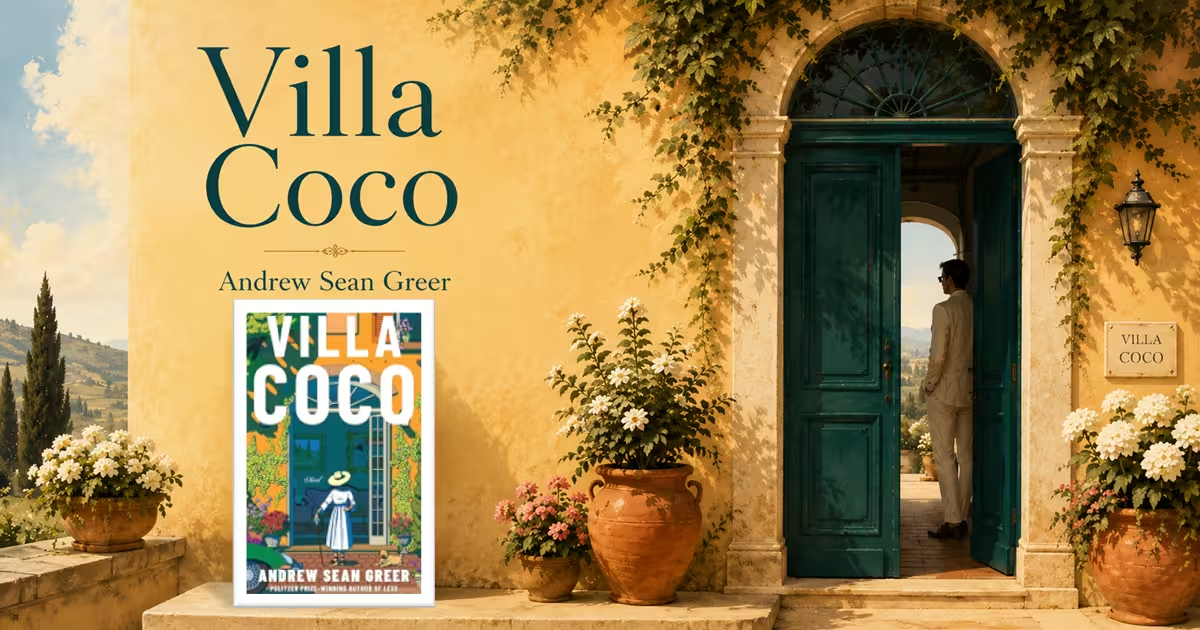
Did you ever wonder what your life might have looked like if, instead of playing it safe, you had followed the most implausible, most beautiful version of it? Villa Coco answers that question not with advice, but with a story so vivid and warm and quietly devastating that the answer reaches you before you even know you have been asked.
It explores the story of an an uptight, twenty-one-year-old American archivist who travels to a Tuscan villa expecting a life of meticulous order, only to find himself swept up in the hilarious, septic-tank-overflowing reality of a 92-year-old Baronessa’s wildly eccentric household.
Villa Coco is best for readers who loved the wry tenderness of Less; anyone drawn to Italian setting fiction with genuine depth; those who enjoy comedy that earns its emotion; LGBTQ readers seeking a story where queerness is part of the texture of life rather than its defining crisis; anyone who has ever felt simultaneously too young and too late.
The book is not for readers who demand plot-driven urgency; those who find leisurely, character-centered fiction frustrating; anyone expecting a sequel to Less in anything but spirit.
Table of Contents
1. Introduction
Title: Villa Coco
Author: Andrew Sean Greer
Publisher: Doubleday (Penguin Random House)
Publication Date: June 9, 2026
Pages: 288
Villa Coco is Andrew Sean Greer’s seventh novel and his first standalone work since Less won the Pulitzer Prize for Fiction in 2018. Greer, who divides his time between San Francisco and Venice, has written a book that smells of Tuscan wild mint, tastes of first-press olive oil, and aches, very quietly, like old friendship.
It is dedicated to Enrico Rotelli and Beatrice Monti della Corte von Rezzori, which tells you everything about what kind of book this is: real people, real feeling, fictional everything else.
The novel sits at the center of a particular tradition — the expatriate bildungsroman, the comic novel of manners, the late-life elegy — and does something none of those categories quite accounts for. It takes an old woman who is running out of time and a young man who does not yet know what time is, and it makes them teach each other everything.
2. Background
The context in which Villa Coco arrives is worth noting. Andrew Sean Greer published Less in 2017 to almost comically delayed recognition — it won the Pulitzer the following year after selling modestly at first — and its 2022 sequel Less Is Lost continued the misadventures of middle-aged gay novelist Arthur Less with equal warmth but less of the first book’s surprise.
Villa Coco marks a departure: the protagonist is younger, the setting is fixed rather than peripatetic, and the comic register has darkened slightly around the edges.
Greer has spoken in interviews about his connection to the Santa Maddalena Foundation, a writers’ residency in Tuscany run by Beatrice Monti della Corte von Rezzori, who is one of the dedicatees of this novel.
He thanks her in his acknowledgments as “my baronessa.”
It is not difficult to see how a young writer, arriving at such a place, surrounded by such a figure, in such a landscape, might spend the next decade or two turning the experience into fiction. The result is a book that has the feeling of something long carried and carefully set down.
Historically, the novel draws lightly on mid-to-late twentieth century European aristocratic bohemianism — Capri as a postwar gathering point for artists and expatriates, the tradition of rich women running literary salons, the art market of the 1960s and 1970s — without making any of this its explicit subject.
It is history as atmosphere. What matters is the present tense of the story, which is set somewhere near the end of the millennium in a Tuscan farmhouse with an overflowing septic tank and a Picasso in the bedroom.
3. Villa Coco Summary
Part One: Arrival at the Villa
The novel opens with a young American — he is never named, referred to throughout by the nicknames others give him, most persistently “Giovedi” (Italian for Thursday) — arriving at a small train station in Tuscany.
He is twenty-one years old, recently graduated in Archives and Record Management, and has been sent here by a college adviser who despaired of him. He has spent his college years in chaotic romantic entanglements with men and has vowed, arriving in Italy, to close himself into the cloister of intellectual work.
No more chaos. No more men. He has brought gin for a princess and fish oil for something called a faina.
A wiry old Lebanese man named Ghazel — called Gazelle by the household, communicating in a dialect no one fully understands — collects him in a rattling Mitsubishi. They drive through forests and olive groves and past an old woman who shouts from a chair at every car that passes, and eventually arrive at a two-story house hidden behind a wall of ivy.
The house is Villa Coco, and its owner is the Baronessa Lisabetta — known to her intimates as Coco — who descends the iron staircase in a lace gown trailing two fawn pugs, informing the narrator that he is not blond, not British, and therefore useless to her. He may leave on the next train. There is, fortunately, a train strike.
Within hours of his arrival, the narrator has helped locate the overflowed septic tank, welcomed a visiting Italian princess named Pippa (full title: Principessa Giuseppina Maria Augusta Raffaella of Saxe-Coburg and Gotha, great-great-niece of Queen Victoria), and been told he can remove a curse caused by placing a hat on a bed by touching the testicles of the nearest man.
This, as it turns out, is a very usual Thursday at Villa Coco.
The other permanent inhabitants of this world quickly emerge. Estelle is an Algerian-Italian woman who lives down the road and is inexplicably part of the household — an artist, it turns out, with a past she reveals slowly.
Nimali is the Sri Lankan cook whose morning complaints about life form a daily liturgy; her husband, Vinsanda, is the quietly competent handyman. Oscar is an elderly gentleman from Genova who arrives carrying mysterious brown paper packages, smells of rose and old leather, wears a chestnut ascot and cobalt polka dots, and offers the young narrator his first real education in how to live.
The narrator’s official job is to catalog the contents of the villa before Christmas: a task perpetually delayed by the Baronessa’s own chaotic schedule, her insistence that the rooms are “not yet ready,” and an endless series of practical emergencies — the marten (faina) that has been eating the chickens, the rose pruning, the olive harvest, the television murder mysteries that require telephone collaboration between the two floors of the house.
The catalog, it slowly becomes clear, is not what it appears to be.
Part Two: The Harvest Season and Giacomo
Into this slow domestic comedy arrives, eventually, Giacomo. He is the Baronessa’s younger cousin from Vicenza, blond and bespectacled and resembling his grandfather’s nineteenth-century photograph, who drives a lizard-green Fiat and knocks over the brass crocodile every single time he visits. The narrator, who has vowed celibacy, sees him and thinks: Oh no.
The trip to Ferrara — originally planned as a joint expedition with Oscar, now taken abruptly without him — brings the narrator and Giacomo together for the first time.
A broken-down Mitsubishi near Comacchio, the small fishing town on the Po delta famous for eels, strands the two of them overnight at the house of an elderly woman called Nonna.
They eat eel with oranges, drink Lambrusco, listen to live liscio music, talk about eels and marriage and desire and God, and end up, in the mint-green bedroom with a matrimonial bed and photographs of ballet dancers on the walls, together.
It is not love, exactly, not yet. Giacomo asks two things of the narrator: don’t make this a habit, and don’t tell his cousin. The narrator agrees. He is relieved. He tells himself it is only one lapse.
The olive harvest draws Giacomo back to the villa, and Estelle — with the assistance of a bottle of wine so potent it turns the shadows green and makes the fire lie down like a naked woman — engineers a second, different encounter.
This time Giacomo is desperate, hungry, rapturous: he holds the narrator against the cushions and strokes his hair and kisses him like a soldier home from war. The narrator understands, perhaps for the first time, that he is someone’s treasure.
The Baronessa, who arranged all of this with the precision of a zookeeper who has finally succeeded in bringing two pandas to the same side of the pen, pretends not to notice.
Oscar, visiting between harvests, offers the narrator the most important advice he will receive: “Do not be lazy in love, my friend. You take what comes.” The narrator is not yet sure what this means. He thinks Oscar is urging him forward. He will later understand Oscar was confessing a lifelong mistake.
Part Three: Disappearances and the Final Caper
Things begin to disappear from the villa. A painting here. A drawing there.
The narrator notices but attributes the thinning of the atmosphere to his imagination, or to the Baronessa’s decorating whims. He is wrong. Oscar keeps arriving with brown paper packages and departing with them too.
A visit to a church in Cascia reveals a Masaccio triptych — the first use of Renaissance perspective in Western art — which Oscar explains with the quiet joy of someone who has been waiting his whole life to show someone something beautiful. At a restaurant called Lala, Oscar tells the story of dressing as a little boy during the Italian Fascist occupation, answering questions only by lifting the soles of his shoes — si on one, no on the other — for two weeks.
He also tells the narrator: “I gave my heart. And those are the years I will not get back.”
Giacomo invites the narrator to Florence to meet his wife, Laurine. What the narrator does not know, until she steps off the train in a raincoat billowing around her, is that Laurine is pregnant. The pregnancy is the product of a clinic, not a romance — Laurine is gay, her girlfriend Carlotta arrives too, and the four of them eat too much bistecca alla fiorentina and too little of anything else.
When Laurine’s aunts appear at the hotel, occupying the same floor, the quartet is forced to room correctly — Laurine with Giacomo, Carlotta with the narrator — and whatever private goodbye might have happened does not. The narrator wakes up furious and confused.
In the morning, Giacomo explains his actual proposal: a pink building on Via Abramo Lincoln, near Via Beniamino Franklin, in Milan. Three connected apartments. His parents and relatives to see the married couple on the ground floor. Laurine and Carlotta on the second. Giacomo and the narrator on the top floor, with a terrace garden of lemon trees and laurel. The narrator listens. He does not say yes.
The call that interrupts this conversation is from Ghazel, shouting one word from Villa Coco: CADERE. To fall.
But it is not the Baronessa who has fallen. Oscar has been found in his entry hall in Genova, where he lay all night. He is in hospital. And the diagnosis is leukemia — which, it emerges, the Baronessa and Oscar’s doctor have known about for months. They decided not to tell him. They thought they were being kind. They thought they had more time.
Oscar dies before the storm clears.
He dies having a little gin, which he had renounced for decades, believing it was bad for his heart. The leukemia, it turned out, had nothing to do with his heart. The Baronessa, in her grief, is furious with him for dying. “There was no one else who could talk about roses.” The narrator understands, finally, that she loved him.
The novel’s final movement is a caper — the Baronessa’s preferred mode of grief. Oscar is to be memorialized in Genova at the apartment he has left to his maid, Maria. The plan is simple: steal the ashes.
The narrator attends the memorial in Tonino’s black suit. He meets Furman Childress, the Baronessa’s old nemesis from Capri, who tells him two things: she was always a thief, and she is no more a baronessa than he is. Both of these things, in their own way, are true. He wanders into Oscar’s bedroom and finds, on a valet stand, a pair of red velvet slippers from Venice — the ones Oscar had promised him but never delivered.
He does not take the slippers. But he takes the ashes.
“I thought of you and the toe,” he explains to the Baronessa afterward, referring to an ancient fragment of a Roman statue she once pocketed in Istanbul. “I just popped it in.”
She claps her hands in glee.
On the train to Venice for what the Baronessa calls a necessary trip — and what turns out to be the return of a stone toe to the Four Tetrarchs on the corner of the Basilica of San Marco, a sculpture Oscar witnessed her stealing decades earlier — the narrator makes his decision about Giacomo and Milan. He turns the offer down. He ends the story. He chooses the unknown.
In Venice, the Baronessa meets someone at Florian — it turns out to be the grandson of the Ukrainian man who once took her beloved boat, the Caprice, in exchange for saving her from prison — and completes the last stage of an elaborate transaction.
With Oscar’s help across several years, she has sold forgeries of her own art collection to Furman Childress, using the originals to fund the purchase of her boat.
The catalog the narrator has spent three months compiling is, precisely, the list of fakes that a buyer needs to believe he is getting the real thing. The narrator was hired because he was young and American enough not to notice.
On Christmas Eve, standing on the Riva degli Schiavoni with the Baronessa beside him, watching a two-masted trabaccolo come through the morning fog, the narrator understands his bag is already on board. Estelle is waving from the deck, holding the pugs. The skipper is deeply tanned and apparently very attractive.
The carabinieri are coming.
The narrator goes.
“Of course we’ll be back,” the Baronessa says. “It’s Venice.”
And she lived forever, says the final line.
4. Villa Coco analysis
4.1 Characters
Our Young Man (the Narrator)
He arrives in Italy thinking he needs order, and Villa Coco is, of course, nothing but disorder — which is the point. The narrator is a classic Greer protagonist: brainy, self-aware just enough to be insufferable about it, and constitutionally unable to follow his own advice.
His vow of celibacy lasts approximately thirty-five pages. His promise to stay emotionally uninvolved lasts somewhat longer. His insistence that he is leaving at Christmas lasts until Christmas Eve, when he chooses, instead, a boat.
The Baronessa (Lisabetta/Coco)
She is ninety-two years old, possibly not a real baronessa, likely a former thief, almost certainly an art forger, definitely the most alive person in any room she has ever occupied. Greer introduces her descending a wrought-iron staircase in eyelet lace, preceded by two pugs, talking to the air.
She tells the narrator he is useless and should leave on the next train, then immediately puts him to work solving the septic problem.
The Baronessa is drawn from life — Greer’s acknowledgments make this clear — but the fictional version has been given an interiority and a grief that lift her beyond tribute. What she carries, throughout the novel, is the knowledge that Oscar is dying and the refusal to let that knowledge narrow her life.
Her insistence on “high spirits” is not denial. It is a philosophical position. She has lived long enough to know that a life of caution is not a life saved but a life wasted, and she is constitutionally incapable of the other kind anyway.
Her relationship with the narrator is the emotional core of the book. She does not love him, not exactly, but she recognizes him — recognizes his quality, whatever it is, the thing that makes him worth the trouble of being found. The moment when she calls him by his real name, “Geoffrey,” for the first time, is one of the most quietly devastating moments in recent literary fiction.
Oscar
Oscar is the novel’s secret protagonist.
A silver-haired gentleman from Genova, apparently a minor artist with a particular talent, it turns out he was not an artist at all but a great art dealer — and, under the Baronessa’s protection, her closest collaborator in a long life of beautiful, borderline-criminal high spirits.
He gave his heart, once, to the wrong person, and spent decades as “a very cheerful, very harmless old man” who ate salad from a cabbage bowl and declined all pleasures for the sake of a heart that was going to fail anyway, for a different reason entirely.
Giacomo
He is the narrator’s “warm dictionary” — a term Oscar uses for a native speaker who can teach you a language through proximity. Giacomo is also a man who has made an arrangement with God: he will be perfect, perfectly obedient, and in return God will not strike him down for being gay.
God never responded to this proposal, but Giacomo kept his end of the bargain anyway: the marriage to Laurine, the life in Milan, the carefully bounded happiness.
What the Baronessa sees in Giacomo — and what she engineered the olive harvest to address — is that he is living too small. The Milan proposal, the pink building on Via Lincoln near Via Franklin, is his version of courage. It is not enough for the narrator, in the end, but it is real courage, and Greer handles its refusal with unusual care.
Nobody is wrong. The narrator is not rejecting Giacomo; he is rejecting a version of himself that does not yet exist and may never.
Estelle
The most mysterious character and, arguably, the wisest. An Algerian-Italian painter who came to Villa Coco by way of a shared lover and stayed by way of something less definable, Estelle is the novel’s chorus figure — the one who sees everything clearly, says almost nothing, and occasionally paints it instead.
Her portrait of the narrator, committed to canvas on a hardcover-book-sized canvas, shows him older than he is. She leaves on the boat at the end, and it feels absolutely right.
4.2 Themes and Symbolism
The catalog as life
The central structural metaphor of Villa Coco is archival work: sorting, labeling, identifying, provenance. The narrator has been trained to believe that the world becomes knowable when organized, and that organization is the highest form of intelligence.
The Baronessa’s house is a sustained argument against this proposition. Her organizing principle is “affinita” — the attraction objects have for one another, their echoes in each other. The right question is not what something is worth but what it resonates with.
By the end of the novel, the narrator has produced a catalog that is, in a technical sense, a list of forgeries — and it has been notarized. The catalog is real. The objects are real. The names are wrong. This is, in its way, a description of identity as the book understands it. The Baronessa may not be a real baronessa, but she is indisputably herself.
Art forgery as freedom
Oscar was not an artist. He was an art dealer. He spent decades making copies of the Baronessa’s best works — not to deceive museums, but to free her from possession.
To let her sell what Furman Childress thought was the original while she kept the real thing, until she was ready to sell the real thing too, to fund a boat and a life at sea.
The forgery is not theft; it is liberation. This is a characteristically Greer-ish inversion: the moral and the immoral switch places under sufficient examination, and what remains is motive. What did you want? Did you know? Did you take it?
The boat
The sculpture of the Caprice — a bronze boat in the entrance hall of Villa Coco — sits there from the narrator’s first morning until his final understanding. He walks past it daily.
He catalogs it. He does not understand what it means until, at Estelle’s cottage, Giacomo corrects him: the Baronessa’s great love was not a person. It was a boat. She bought it with the proceeds of a stolen diamond. She sailed it to Istanbul, to India, to the Amazon.
She lost it to a Ukrainian toothpaste magnate who threw her shoe into the sea to keep her from leaving. She has spent the last decades of her life arranging to get it back.
The boat is called Caprice. Seven letters, good luck. It is the symbol of wanting something so specifically, so persistently, so unreasonably, that life eventually relents and gives it to you.
Italy as transformation
Greer’s Italy is not postcard Italy. It is the Italy of fog and mud and hard mattresses and train strikes and Nimali’s morning complaints and old men shouting in dialect. But it is also genuinely transformative — not because it is beautiful, though it is, but because it refuses the narrator his usual defenses.
He cannot organize it. He cannot catalog it properly. He cannot even drive on the right road without being thwacked with a cane.
The language acquisition subplot is significant: the narrator learns Italian not from a textbook but from Nimali’s kitchen liturgy, from Italian in macchina with the Baronessa, from Giacomo’s Veneto dialect, from the old woman at the crossroads who turns out, when he finally understands her, to be shouting “hedgehog-fuckers” at everyone who stops in the road without choosing a direction.
This is Greer’s central joke and his central argument: you learn a new language when you stop trying to translate and start trying to live.
The Faina
The marten — the faina — who has been eating the chickens since before the narrator arrived, who defeats every trap Ghazel constructs, who appears at the narrator’s window on his first night and terrifies him, who is the first creature the Baronessa asks him to help deal with, turns out to outlive Oscar and outlive the narrator’s time at the villa.
She is found, on the narrator’s mattress, dead from an overdose of fish oil. She ate the very thing that was meant to lure her into a trap.
She is the wildness of Villa Coco. She cannot be caught or tamed or organized. She dies on her own terms, in her own time, at the heart of the place she chose.
Days are the countries
The epigraph of Part II — “Days are like countries. Meaning: they will change tomorrow” — is carved in Arabic on a stone in the entrance hall. It was chipped from the wall of an Egyptian publisher’s dining room because the Baronessa wanted it.
Alayam dewl. It is the philosophical statement that the entire novel is written around: impermanence not as loss but as possibility. The country you are in today is not the country you will be in tomorrow. This is terrifying and it is beautiful and it is the only reliable fact about being alive.
5. Evaluation
Villa Coco is a magnificent, funny, deeply felt novel that reads like a long afternoon in good company — the kind where you realize, at six o’clock, that you have said more true things than you have said in six months.
It is the best book Andrew Sean Greer has written, and given that he won the Pulitzer for a previous one, that is not a small claim. It is, in the fullest sense, a great novel of character: a book in which the people are so alive that the plot feels, correctly, like something that simply happens to them on their way to becoming themselves.
Strengths
The greatest strength of Villa Coco is its comic register. Greer has always been funny, but here the comedy has the precision of something thought about for years and then set down very lightly.
The septic tank scene, the hat on the bed and its Neapolitan cure, Giacomo’s inability to resist the exit for Forli, the puppet show at Christmas in Florence, the memorial at Oscar’s apartment, the carabinieri on the Riva degli Schiavoni — each set piece is perfectly constructed, landing without a squeak. More importantly, the comedy never deflects the emotion. It intensifies it.
This is the technique the Baronessa is herself trying to teach the narrator: make it a funny story. Not instead of the grief. Out of the grief.
The Baronessa herself is one of the great characters in recent literary fiction. She is drawn with love but not sentiment — Greer gives her pettiness and stubbornness and occasional cruelty alongside the radiance, and the result is a woman who feels entirely real. The moment she calls the narrator by his true name at the end is one of those fictional moments that stays.
Greer’s Italy is another pleasure. The olive harvest, the raccolta, the frantoio at midnight, the sfogliatelle in Venice, the focaccia in Recco on the way to a memorial lunch — food in this novel is not decoration, it is argument. Every thing you eat only exists now, in this form, in this place. We won’t be back.
Weaknesses
Some readers may find the pace frustrating. Villa Coco is not a plot-driven novel. For its first hundred pages especially, things happen slowly, and the pleasures are primarily atmospheric and character-driven. The central revelation — that the catalog is a list of forgeries, that the narrator was hired to authenticate a long con — is, as one New York Times reviewer notes, telegraphed well in advance.
This is probably intentional: Greer is not interested in the shock, but in the narrator’s willingness to not-see, and in the reader’s slow dawning comprehension that a person of ninety-two, if she is any good at life, has been three moves ahead the entire time.
The Giacomo subplot is, arguably, the weakest element of the book — not because Giacomo is a weak character, but because the emotional resolution of their relationship is somewhat gestured at rather than dramatized. We are told the narrator chose not to go to Milan, and we understand why, but the interior of that decision is less fully inhabited than the exterior.
Impact and Controversy
Villa Coco arrived on June 9, 2026, to warm critical reception. Publishers Weekly, Booklist, and BookPage gave it starred reviews. The Kirkus review describes it as “a delightful distraction from the mundane.”
The New York Times Book Review acknowledges Greer’s occasional “gratingly cloying” moments while granting that the book earns most of its pleasures. Early Goodreads and reader responses are enthusiastic, with comparisons to E.M. Forster and Henry James appearing frequently in reader notes — comparisons that are not entirely wrong.
Comparison with Similar Works
- The Enchanted April by Elizabeth von Arnim (eccentric characters and transformation in Italy)
- A Room with a View by E.M. Forster (young outsider discovering life in Italy)
- The Talented Mr. Ripley by Patricia Highsmith (a darker but similarly atmospheric Italy)
- The Garden of the Finzi-Continis by Giorgio Bassani (Ferrara, memory, elegance, fading worlds)
- Brideshead Revisited by Evelyn Waugh (aristocratic eccentricity and nostalgia)
- Still Life by Sarah Winman (warm-hearted found family in Tuscany)
- The House in the Cerulean Sea by T.J. Klune (chosen family and whimsical characters)
- My Family and Other Animals by Gerald Durrell (comic memoir of eccentric life abroad)
- The Leopard by Giuseppe Tomasi di Lampedusa (Italian aristocracy facing change)
6. Personal insight and educational relevance
The theme that runs under everything in Villa Coco, deeper than the forgeries or the coming-of-age or the love story, is the theme of finality disguised as the present moment. “We won’t be back,” the Baronessa says, everywhere she goes, and she means it practically — they won’t be back to that shop, that focaccia, that stretch of road — but she also means it in the larger sense. This afternoon will not come again.
This friendship will not come again. This version of yourself, young and unknowing and full of potential, will not come again.
This is not a new theme in literature. What is specific to Greer, and to this novel, is the tone in which it is held: not mournful, not sentimental, but actively demanding. The Baronessa’s “we won’t be back” is not an elegy. It is an instruction. If you will not be back, then you had better take it now, eat it now, love it now, choose it now.
Contemporary psychology supports this intuition in ways the Baronessa would find amusing and unnecessary.
A well-documented phenomenon sometimes called “last time bias” suggests that people tend to underinvest emotionally in experiences they know will end, when in fact the knowledge of an ending should logically increase the intensity of attention.
Research on hedonic adaptation — the tendency to take good things for granted — suggests that conscious awareness of impermanence is one of the few reliable antidotes. In practical terms: the focaccia you know you will not have again tastes better than the focaccia you believe will always be available.
Five Lessons from Villa Coco for Contemporary Life:
1. The catalog is never the collection. You can list and describe and organize everything you own, everything you know, every person you have met — and still have no idea what any of it is worth. Worth is relational. It depends on what it resonates with.
The Baronessa’s “eye” — her ability to see affinita, the attraction between things — is not a skill you can acquire from a checklist. It requires self-knowledge, which is itself the work of a lifetime.
2. Making a funny story is not the same as being shallow. The Baronessa’s insistence on finding the comedy in every experience is not a form of denial. It is the hardest form of engagement: to process grief or failure or loss until you have found the element of it that is genuinely absurd, and to present that element to another person as a gift.
Humor as generosity. This is different from deflection, and the difference matters.
3. Do not be lazy in love. Oscar’s warning to the narrator — you take what comes — is the warning of someone who had done exactly that for sixty years and knew what it cost. Laziness in love is not passivity; it is the specific decision to accept what is offered rather than to name and pursue what is wanted. It is easier.
It is also, eventually, devastating. The narrator’s refusal of the Milan flat is an act of bravery, not cowardice, because it means staying with the unknown rather than accepting a beautiful substitute.
4. Every house and lover has a fatal flaw. The Baronessa says this about Villa Coco‘s water supply, but it applies everywhere. The skill is not to find the person or place without a flaw — they do not exist — but to decide in advance which flaw you can live with.
She knew, buying the villa, that it had no well. She chose it anyway. What she could not have known was how much she would love it. This is the irreducible gamble of commitment.
5. Alayam dewl — days are like countries. They will change tomorrow. One of the things that makes life terrifying is also one of the things that makes it livable: nothing lasts, which means the present is never the whole story, which means even today’s bad luck is not the permanent verdict.
The Baronessa, who has outlived friends and lovers and a whole atlas of countries that no longer exist, holds this truth not as consolation but as strategy. The day that is against you now will change. Go find the next one.
7. Conclusion
Villa Coco is one of those rare novels that earns comparison to the books one loves most: funny in the way that only very serious writers can be funny, because they understand that comedy and sorrow are not opposites but dimensions of the same sensation.
Andrew Sean Greer has written, in this seventh novel, something that feels both inevitable and surprising, as if the book had been waiting, fully formed, inside him for thirty years, and has now simply arrived.
I read it in two days and thought about it for weeks afterward. I thought about the focaccia in Recco, which I have never tasted. I thought about the first press of olive oil, chartreuse and stinging like nettles, poured over white beans in a stone mill at midnight.
I thought about an old woman in a red wool suit standing on a windy canal in Venice, holding in her purse the ashes of her best friend and a stolen piece of ancient Rome, looking out at the fog.
And I thought: she is right. We won’t be back.







