
Last updated on June 9th, 2026 at 04:24 pm
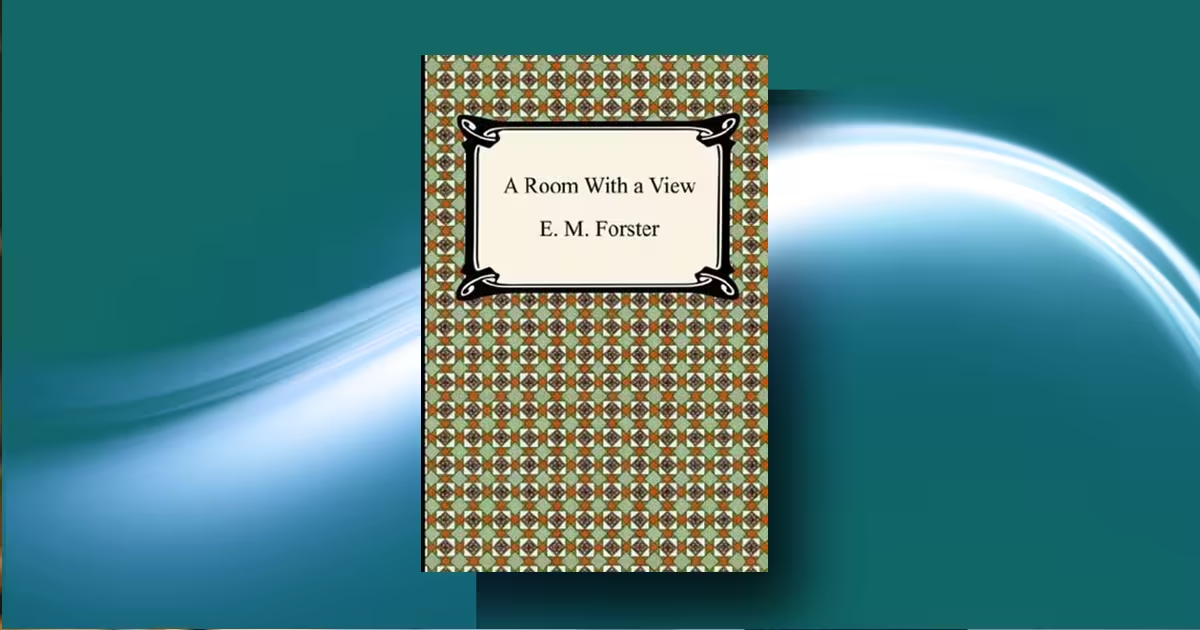
Have you ever felt that the life you’re supposed to live and the person you really are exist in two completely separate rooms? That’s the emotional prison Lucy Honeychurch finds herself in. A Room with a View by E. M. Forster is much more than a period romance.
It’s a brilliant, witty, and surprisingly profound novel about the battle between social conformity and authentic human passion. If you’ve ever felt stifled by the expectations of others, this book is your blueprint for escape.
A Room with a View was written by Edward Morgan Forster, published in 1908 by Edward Arnold (London). The edition referenced here is the Abinger Edition, edited by Oliver Stallybrass, which includes fascinating historical context and textual notes.
It stands as one of Forster’s most beloved and accessible novels, sitting alongside Howards End and A Passage to India.
Table of Contents
I. Background
To truly understand the tension in this book, we have to look at the era. We are in the Edwardian period (1901-1910), a time of immense social upheaval in Britain. The strict, rigid morality of the Victorian era was crumbling.
People were starting to question the old rules about class, religion, and sexuality. Forster, a member of the Bloomsbury Group, was at the forefront of this intellectual revolution. He wasn’t just writing a love story; he was critiquing the “undeveloped heart” of the English upper-middle class. As noted in the Abinger introduction, Forster himself felt the novel was “clear and bright and well constructed. But so thin”.
However, this “thinness” is a deceptive lightness; beneath the charming surface lies a deep critique of Edwardian hypocrisy.
2. A Room with a View Summary
Part 1: A Muddle in Florence
The story begins in Florence, Italy, at the decidedly un-Italian Pension Bertolini. Young, impressionable Lucy Honeychurch and her overbearing, nervous cousin, Charlotte Bartlett, have been given rooms with no view. Frustrated, they complain. Enter Mr. Emerson and his son George, two “ill-bred” but refreshingly honest Englishmen who offer to swap their rooms with a view.
Charlotte is horrified by their forwardness, but Lucy is intrigued.
During a chaotic trip to the Santa Croce church, Lucy loses her Baedeker guidebook—a symbol of rigid, planned tourism—and finds herself alone. She stumbles upon the Emersons again. Mr. Emerson, a wise and unconventional old man, tells her: “Let yourself go. Pull out from the depths those thoughts that you do not understand, and spread them out in the sunlight and know the meaning of them”.
It’s a philosophy that terrifies and excites her.
Later, Lucy witnesses a violent murder in the Piazza Signoria: an Italian is stabbed over a debt. In a moment of shock, Lucy faints, and George catches her.
As he carries her to a nearby fountain, something primal shifts between them. Later, by the river, George retrieves her bloody photographs and throws them into the Arno. He is shaken, not by the violence, but by the realization of life’s fragility. He looks at Lucy and declares, “I shall want to live”.
The tension climaxes during a carriage ride up to Fiesole. George and Lucy separate from the group and find themselves on a hillside covered in wild violets. Overwhelmed by the beauty and the moment, George kisses her.
Of course, Charlotte catches them. Panicked, she manipulates Lucy into fleeing Florence for Rome the very next morning, creating a “secret” that festers like a wound.
Part 2: A Battle in Surrey
Back home at Windy Corner in Surrey, Lucy re-enters her “proper” life. She becomes engaged to the supercilious, intellectual snob Cecil Vyse. Cecil is everything a proper English lady should want: cultured, wealthy, and “medieval,” treating Lucy as a work of art to be admired from a distance rather than a woman to be loved up close.
The disaster unfolds when Cecil, trying to be clever, arranges for the Emersons to rent a nearby cottage as a joke on the local gentry. Suddenly, George is living just down the road. George is honest about his feelings, while Lucy lies to everyone: to Cecil, to her mother, and most dangerously, to herself. As Mr. Beebe observes, she is “muddled”.
The climax is a masterpiece of English farce. During a tennis party, Cecil reads aloud from a trashy novel written by Miss Lavish (a gossip they met in Florence). The scene is a thinly veiled account of George and Lucy’s kiss on the hillside.
The truth is out. That night, Cecil confronts Lucy, and she breaks off the engagement, hiding behind empty platitudes of wanting “freedom”. Yet, she still refuses to admit she loves George. Instead, she plans to flee again, this time to Greece.
The Ending
Just before her escape, Lucy goes to the rectory to pick up Charlotte. There, alone, she finds old Mr. Emerson. He sees through her lies instantly. In a heart-wrenching, profound speech, he forces her to confront her own soul: “You love George!… You can transmute love, ignore it, muddle it, but you can never pull it out of you”.
He tells her that she is ruining her life by denying “the holiness of direct desire”. His words shatter her resistance.
Lucy finally stops running. She runs to George, who is staying in their original room at the Bertolini. The novel ends where it began, but everything has changed. They look out at the Florence view together, finally “conscious of a love more mysterious than this”.
3. A Room with a View Analysis
4.1. Characters
Lucy Honeychurch: She isn’t a rebel; she’s an everywoman. Her genius is that she learns to grow through her lies. Her piano playing is the key to her soul: “She was then no longer either deferential or patronizing… Victory of what and over what—that is more than the words of daily life can tell us”. She is divided between the safety of a “room” (Cecil, propriety) and the terror of a “view” (George, passion).
George Emerson: Forster described the Emersons as “nice and tiresome”.
George is the raw, unfiltered id. He feels too much and thinks too little, but his honesty is his superpower.
Cecil Vyse: One of literature’s great snobs. He represents the “medieval” repression of passion. He doesn’t love Lucy; he loves the idea of her. His exit is perfect: “nothing in his love became him like the leaving of it”.
Charlotte Bartlett: The secret weapon. For most of the novel, she is the dragon guarding propriety. But the final pages reveal a stunning twist. George suggests Charlotte wanted them to be together all along.
She tore them apart to protect her own conscience, but she planted the seeds that reunited them. She is the “muddle” incarnate.
4.2. Themes and Symbolism (Full Spoiler)
Light vs. Shadow: Forster constantly uses visual metaphors. The “room” is darkness, repression, safety. The “view” is light, truth, risk. Old Mr. Emerson gives the final lesson: “Choose a place where you won’t do very much harm… and stand in it for all you are worth, facing the sunshine”.
The Sacred Lake: The pond where the men bathe naked is a powerful symbol of baptism and rebirth. It is a place “where you must fight… before you shall enter the Garden” [150†L28-L29]. This is where George and Freddy connect, shedding their clothes along with their Edwardian stiffness.
Muddle: The central sin of the book isn’t passion—it’s dishonesty. “beware of muddle”. The entire plot is driven by the refusal to communicate clearly.
4. Evaluation
This novel is an enchanting, razor-sharp masterpiece. It is not a heavy tragedy; it is a social comedy that dances toward the truth. Forster writes with a wit that rivals Jane Austen but with a humanism that is entirely his own.
Strengths: The dialogue is electric. The secondary characters (the hysterical Miss Lavish, the dear Miss Alans) are hilarious. The symbolism is rich without being pretentious.
Weaknesses: The first half in Florence can feel slow to modern readers. Also, George Emerson is more of an ideal than a fully fleshed-out man; he is the “Reward” at the end of Lucy’s journey, rather than a complex person.
Impact: It is an intensely optimistic book. It argues that happiness is not found in following rules, but in bravely embracing the chaos of true connection.
Comparison with Similar Works: It sits perfectly between Jane Austen’s Pride and Prejudice (social critique via romance) and D. H. Lawrence’s Sons and Lovers (the celebration of physical/emotional instinct). It lacks the darkness of Lawrence but has more “bite” than Austen.
Adaptation
The 1985 film by Merchant Ivory Productions (directed by James Ivory) is a classic. It stars Helena Bonham Carter (Lucy), Julian Sands (George), Daniel Day-Lewis (Cecil), and Maggie Smith (Charlotte).
Differences: The film is remarkably faithful but visually expands the Italian landscape. The famous scene of the men skinny-dipping is far more explicit in the film.
Box Office: It was a massive art-house hit, grossing nearly $21 million on a $3 million budget, and won three Academy Awards.
5. Personal Insight with Contemporary Educational Relevance:
- Lesson 1: Your “Room” is a Cage: Just because a life looks perfect on paper (Cecil, Windy Corner) doesn’t mean it fits your soul.
- Lesson 2: Travel Changes You: Lucy goes to Italy expecting to see art. She returns having seen life. Travel forces a “muddle” that is necessary for growth.
- Lesson 3: Respect the Body: Forster attacks the Victorian disgust for the physical. The bathing scene is a manifesto for bodily joy.
- Lesson 4: Guard Your Secrets: Lucy’s secret about the kiss corrupts her. Keeping a secret doesn’t protect you; it separates you from yourself.
- Lesson 5: Find the “Yes”: Old Mr. Emerson teaches that even if the universe has an eternal “Why,” life is defined by finding a “Yes” in the moment. This is the ultimate lesson of emotional courage.
6. A Room with a View Quotes
- “The kingdom of music is not the kingdom of this world; it will accept those whom breeding and intellect and culture have alike rejected.”
- “I don’t believe in this world-sorrow… by the side of the everlasting Why there is a Yes—a transitory Yes if you like, but a Yes.”
- “Mistrust all enterprises that require new clothes.”
- “For all his culture, Cecil was an ascetic at heart, and nothing in his love became him like the leaving of it.”
- “You can transmute love, ignore it, muddle it, but you can never pull it out of you.”
7. Conclusion
A Room with a View is not just a book; it is a breath of fresh air. It reassures us that it is never too late to choose freedom, that the “muddle” of life is where we find ourselves, and that sometimes, the best view is the one you have to fight to see.
I would recommend this to anyone who loves classic British wit, fans of period dramas, or anyone struggling to choose between who they are supposed to be and who they really are.







