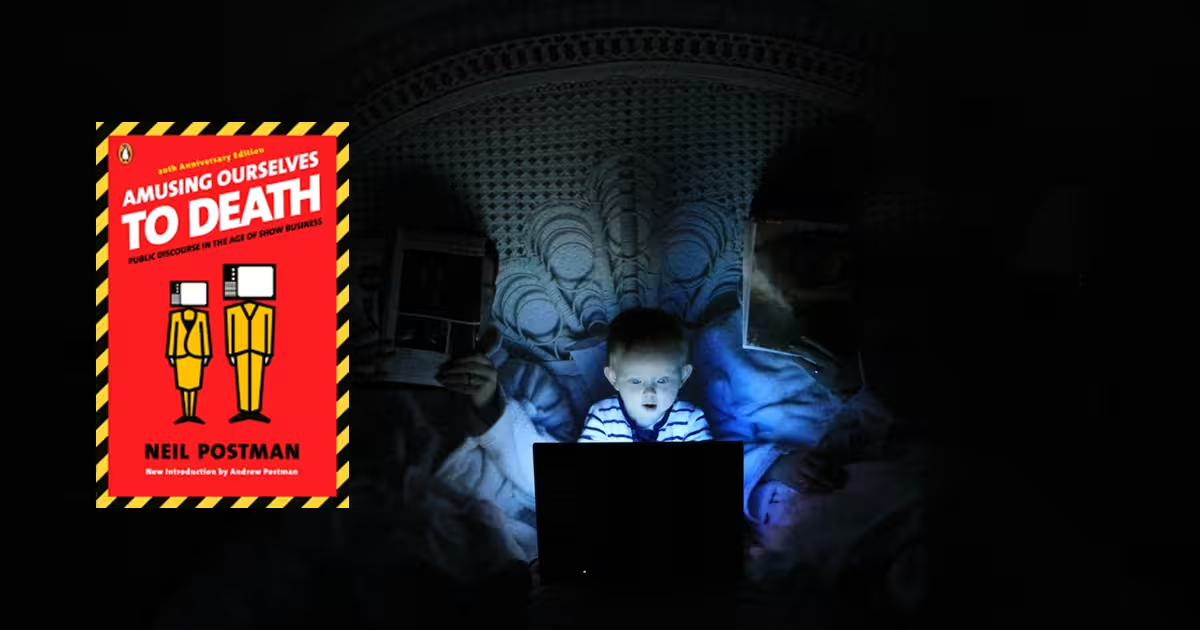
Do you ever feel informed all day, yet strangely less able to think, remember, argue, or care? Neil Postman’s Amusing Ourselves to Death helped me understand why modern life can feel full of information but empty of wisdom.
Amusing Ourselves to Death is best for readers interested in media criticism, politics, social media, AI, public discourse, education, journalism, democracy, cultural criticism, and books that explain why society feels distracted.
Not for readers who want a neutral history of television, a cheerful technology book, or a quick self-help manual with easy solutions. This is a sharp, argumentative, sometimes uncomfortable book.
Table of Contents
1. Introduction
Amusing Ourselves to Death: Public Discourse in the Age of Show Business is a nonfiction media criticism book by Neil Postman, first published in the United States by Viking Penguin in 1985. The Penguin edition followed in 1986, and the twentieth anniversary edition, with a new introduction by Andrew Postman, appeared in 2006.
Neil Postman was an American educator, cultural critic, media theorist, and professor associated with New York University. He wrote widely about language, childhood, education, technology, and media ecology.
In this book, his central concern is not television as a machine, nor entertainment as harmless pleasure. Instead, he asks a deeper question: what happens when an entire culture begins to treat politics, religion, news, education, and public life as entertainment?
The title sounds dramatic, but after reading the book, I felt that Postman was not being theatrical for effect. He was trying to name a quiet disaster. His warning is not that people laugh too much, watch films, enjoy comedy, or relax after work.
His warning is that when a society turns serious public discourse into show business, it loses the habits needed for democracy: patience, memory, logic, context, attention, and the ability to distinguish what matters from what merely attracts.
The book’s main thesis is simple but devastating: the dominant medium of a culture shapes the kind of truth that culture can recognize. In a print-centered culture, arguments can be long, logical, and abstract.
In a television-centered culture, arguments must become visual, emotional, fast, charming, and entertaining. Therefore, when television becomes the “command center” of public life, politics becomes image management, news becomes performance, religion becomes spectacle, and education becomes amusement.
In other words, Amusing Ourselves to Death is not only a book about TV. That is the first misunderstanding many people make. It is a book about what happens when the format of entertainment becomes the hidden grammar of civilization.
2. Background
Why Postman Wrote This Book
Amusing Ourselves to Death was born in the shadow of 1984. For much of the twentieth century, George Orwell’s Nineteen Eighty-Four shaped fears about the future. People feared censorship, surveillance, political terror, book banning, and state control. Postman does not dismiss Orwell.
However, he argues that Aldous Huxley’s Brave New World may have seen the West more clearly.
Orwell feared that truth would be hidden. Huxley feared that truth would be drowned in irrelevance. Orwell feared pain. Huxley feared pleasure. Orwell feared that books would be banned. Huxley feared that no one would want to read them.
That contrast is the moral engine of Amusing Ourselves to Death. Initially, it may seem like an old argument about television. Yet, the more I read, the more contemporary it felt.
Today, public discourse no longer depends only on TV. It moves through YouTube, TikTok, podcasts, Instagram, X, Facebook, newsletters, streaming platforms, memes, search snippets, and AI summaries. Nevertheless, Postman’s question still stands: what kind of people do our media make us?
A major trait of the book is that it refuses to blame only bad content. Postman is not simply saying, “Television shows are stupid.” In fact, he is more worried when television tries to be serious. Junk television, to him, is not the real danger. The real danger begins when news, education, politics, and religion borrow the form of entertainment and still expect to be treated as truth.
That is why the book feels strangely prophetic in the age of answer engines and algorithmic feeds. We now live in a world where information is instant, searchable, personalized, summarized, and visually packaged. Yet, because of this, we may confuse access with understanding.
3. Amusing Ourselves to Death Summary
1. The Medium Is the Metaphor
Postman begins with a powerful claim: every culture has a dominant form of conversation. Traditionally, we think content is what matters. Postman says form matters first.
A smoke signal can communicate some things, but it cannot carry philosophy. A printed book can hold sustained argument. Television can show emotion, image, gesture, and drama, but it struggles to carry abstract reasoning. To put it another way, each medium does not merely deliver content; it decides what kind of content can survive.
This is where Postman revises Marshall McLuhan’s famous phrase “the medium is the message.”
Postman says the medium is the metaphor. Our media do not simply tell us things; they shape the metaphors by which we understand reality. A clock teaches us to see time as measurable units. Writing teaches us to inspect language. Television teaches us to see the world as images, performances, and fragments.
I found this chapter especially useful because it changed the way I think about “neutral technology.” We often say, “It depends how you use it.” Postman’s answer is more challenging.
Of course, use matters. Still, every medium has built-in tendencies. A platform designed for speed, visibility, and engagement will not naturally reward slowness, complexity, and silence.
That is to say, the problem is not only what we watch. The problem is what watching trains us to value.
2. Media as Epistemology
This chapter is the philosophical heart of the book. Epistemology means the theory of knowledge: how we know what we know, how we define truth, and what counts as evidence.
Postman argues that every medium creates its own way of knowing. In oral cultures, wisdom may appear as proverbs, memory, stories, and spoken performance. In print cultures, truth often appears as written evidence, sustained argument, documentation, and logic. In television culture, truth appears as credibility, image, emotional presence, and performance.
This leads to one of the book’s most important insights: truth must appear in the “proper clothing” of a culture before people accept it. In a courtroom, a printed legal citation carries weight. On television, a calm face, a good voice, and a believable image can carry more weight than a logical argument.
In truth, this idea is even more disturbing now.
Online, truth often has to look shareable. It must fit a thumbnail, headline, clip, quote-card, thread, or short video. If it cannot be compressed, it becomes invisible. Therefore, the medium does not simply communicate truth; it filters what kinds of truth will be noticed.
3. Typographic America
Postman then takes us back to early America, which he presents as a highly print-oriented culture. He writes about colonial reading habits, sermons, pamphlets, newspapers, and public arguments.
The central point is not nostalgia for old America. The point is that a print culture trained people in certain habits: attention, abstraction, delayed judgment, memory, sequence, and argument.
He uses examples such as the popularity of Thomas Paine’s Common Sense and the seriousness of public reading culture. He shows that printed language shaped politics and religion because people expected ideas to be explained, defended, and disputed.
Generally, this section made me aware of something we rarely admit: democracy depends not only on voting rights but also on communication habits. If citizens cannot follow arguments, tolerate complexity, or remember history, democracy becomes vulnerable to performance.
4. The Typographic Mind
Here Postman gives one of the book’s most famous examples: the Lincoln-Douglas debates of 1858. These debates were long, demanding, and language-heavy. Audiences listened for hours. The speakers used complex sentences, extended reasoning, historical references, and moral argument.
Today, that feels almost impossible. We expect political communication to arrive as slogans, clips, debate moments, gaffes, facial expressions, viral lines, and thirty-second emotional summaries. In contrast, the typographic mind expected public life to be argued in language.
The key point is that nineteenth-century Americans did not simply have better politicians. They had a different media environment. Their public discourse was modeled on print. Consequently, even public speaking carried the shape of writing: sequence, logic, evidence, and structure.
This does not mean the past was morally pure. Postman is not claiming that nineteenth-century America was just, equal, or free from propaganda. Rather, he is saying that its dominant medium encouraged different intellectual habits.
5. The Peek-a-Boo World
This is where the book begins to feel fully modern. Postman argues that the telegraph and photography changed public discourse before television even arrived.
The telegraph made information travel instantly across distance. Suddenly, people could receive news from places where they had no context, no responsibility, and no ability to act.
Photography added images that seemed real, immediate, and emotionally powerful. Together, they created what Postman calls a “peek-a-boo world”: a world where fragments appear, vanish, and are replaced by new fragments.
This is one of the most important parts of the book for understanding the internet. Social media is basically the peek-a-boo world accelerated beyond anything Postman saw.
A war, a celebrity divorce, a local crime, a climate disaster, a joke, a recipe, a political scandal, and a personal confession can appear in the same feed within seconds.
As a result, attention becomes scattered. We see everything and absorb almost nothing. We know about many things but belong to fewer contexts. We are emotionally activated but practically powerless. This, to me, is where Postman becomes painfully relevant.
6. The Age of Show Business
In Part II, Postman moves from theory to cultural diagnosis. He argues that television does not extend print culture. It attacks it. Television’s form favors entertainment, visual stimulation, immediacy, personality, and emotional satisfaction.
A crucial distinction here is between technology and medium.
A technology is the physical apparatus. A medium is the social and intellectual environment created by that apparatus. Television is not just a box or a screen. It is a way of arranging reality.
The phrase “show business” matters. Postman is not saying all shows are bad. He is saying that show business has become the model for everything else. Politics must entertain. News must entertain. Education must entertain. Religion must entertain. Commerce must entertain. Even seriousness must appear entertaining before it is allowed public attention.
At this point, I felt the book was no longer about 1985.
It was about 2026. YouTube’s rise as a primary entertainment destination, the popularity of influencer news, and the constant blending of news, personality, politics, and performance all make Postman’s “Age of Show Business” feel less like a past era and more like the foundation of our present.
7. “Now… This”
This may be the most memorable chapter in the book. “Now… this” is Postman’s symbol for television news: one unrelated fragment follows another, without continuity, moral weight, or consequence.
A tragedy appears. Then a commercial. Then a sports update. Then a weather joke. Then a political scandal. The phrase “Now… this” teaches the viewer that nothing is connected to anything else. The world becomes a sequence of emotional interruptions.
Importantly, Postman argues that televised news gives us information without context, consequences, value, or seriousness. Because of this, it creates the illusion of being informed while weakening the possibility of understanding.
This is exactly how I often feel after scrolling. I may know ten headlines, three controversies, two jokes, and one disaster before breakfast. Yet I have not understood any of them deeply. I have only consumed them.
In other words, Postman’s “Now… this” has become the grammar of the feed.
8. Shuffle Off to Bethlehem
In this chapter, Postman discusses religion on television. His argument is not anti-religion. Actually, he takes religion seriously enough to ask what happens when it is forced into the format of entertainment.
Television religion depends on charisma, staging, music, camera presence, emotional immediacy, and personality. It favors the preacher as performer. It turns worship into spectacle and doctrine into atmosphere.
The problem is not that religious messages appear on TV. The problem is that television changes the meaning of the message by changing the conditions under which it is received.
Traditionally, religious practice includes silence, ritual, community, discipline, memory, and sacred seriousness. Television, in contrast, creates distance, convenience, and spectacle. The viewer can watch alone, change the channel, judge the preacher as a performer, and consume religion without obligation.
This chapter made me think about modern spirituality online.
Today, faith, therapy, politics, and self-improvement are all packaged into short clips. Some of it may help people. Nevertheless, Postman would ask: what is lost when the sacred must become content?
9. Reach Out and Elect Someone
This chapter is about politics and advertising. Postman argues that television transforms political discourse into image-making. A candidate becomes a product. The voter becomes a consumer. The campaign becomes a commercial.
The television commercial is short, emotional, visual, and anti-argumentative. It does not prove; it associates. It links a product, person, or party with feelings: strength, safety, freshness, patriotism, family, youth, confidence, fear, or hope.
Accordingly, political advertising does not ask citizens to reason through policy. It asks them to feel a candidate’s image. The danger is obvious: democracy becomes less about judgment and more about impression.
This is one of the sections where I felt Postman was almost unbearably accurate.
Political campaigns now operate not only through TV commercials but also through memes, influencer interviews, podcasts, viral clips, short videos, and algorithmic micro-targeting.
A candidate does not merely need a platform. A candidate needs a brand.
Postman’s warning is that when politics becomes show business, appearance replaces substance. The politician does not need to be clear, honest, or wise. The politician needs to appear clear, honest, and wise.
10. Teaching as an Amusing Activity
This chapter focuses on education. Postman argues that television teaches a philosophy of learning: learning should be entertaining, effortless, image-rich, and emotionally pleasant.
He is not saying children should suffer in school. He is not defending boring teaching for its own sake. Rather, he argues that serious learning often requires sequence, discipline, delayed gratification, concentration, and difficulty. Television undermines these assumptions because it trains students to expect education without frustration.
This chapter is especially relevant now because educational technology often promises engagement above all else. Apps, videos, gamified lessons, and AI tutors can be useful. However, Postman would ask whether they strengthen or weaken the habits required for conceptual thought.
Another key thing to remember is that Postman calls television a curriculum. That is a brilliant and disturbing phrase. A curriculum is not just a list of subjects.
It is a system that shapes the mind. By that definition, TikTok is a curriculum. YouTube is a curriculum. Instagram is a curriculum. Netflix is a curriculum.
Even Google Search and AI answer engines are curricula because they train us in how to ask, skim, trust, doubt, and remember.
11. The Huxleyan Warning
The final chapter returns to Huxley. Postman’s conclusion is not optimistic, but it is not hopeless either. He argues that no medium is excessively dangerous if people understand its dangers. The act of asking questions can break the spell.
That line stayed with me: to ask is to break the spell.
Postman does not offer many practical solutions, and that is one weakness of the book. Still, he suggests that schools may be the only institution capable of teaching media consciousness. Students should learn how media shape knowledge, how forms of information persuade, and how different media create different publics.
In light of AI and social media, this ending feels even more urgent.
We do not only need fact-checking. We need form-checking. We need to ask: what kind of attention does this medium reward? What kind of truth does it hide? What kind of person does it train me to become?
4. Amusing Ourselves to Death Analysis
For me, Amusing Ourselves to Death is outstanding, unsettling, and almost painfully clarifying. It is one of those books that does not merely give information; it changes the way you look at the information you already receive.
The most important idea I took from the book is that a society can lose seriousness without noticing. It does not need to burn libraries or imprison thinkers. It can simply make everything entertaining enough that depth begins to feel boring.
This is why Postman’s comparison between Orwell and Huxley is still powerful. We are trained to fear obvious oppression. We are less trained to fear pleasurable surrender. Yet, if our attention is constantly captured, our memory constantly interrupted, and our judgment constantly replaced by emotion, we may become easier to control precisely because we feel free.
In contrast to many technology critics, Postman is not obsessed with devices themselves. He is interested in the ecology around them. That makes his argument travel well from television to social media and AI.
The question is not only “Is TikTok good or bad?” or “Is AI useful or dangerous?” The better question is: what forms of discourse do these tools encourage, and what forms do they make difficult?
AEO, or Answer Engine Optimization, makes Postman even more relevant. Today, readers often do not visit long essays. They ask a question and receive an answer. That is convenient. It is also dangerous if answers become detached from context, argument, authorship, and intellectual struggle. A good answer can inform us. But a culture of frictionless answers can also train us to avoid the slow work of understanding.
Therefore, this book matters not because Postman predicted every detail of digital life. He did not. It matters because he gave us a method: look at the medium, not only the message.
5. Evaluation of Content
Does Postman Prove His Argument?
Mostly, yes. Postman supports his argument through history, media theory, examples from politics and television news, comparisons between print and image culture, and close observation of American public life.
His strongest evidence is structural. He does not need to prove that every television program is shallow. He only needs to show that television favors certain kinds of public speech: short, emotional, visual, fragmented, and entertaining. Once that is clear, his examples from politics, religion, news, and education become convincing.
Still, there are drawbacks. Postman sometimes idealizes print culture.
He knows print produced junk, propaganda, prejudice, and exclusion, but he still tends to associate print with rationality and television with triviality. That contrast is powerful, but it can become too neat.
Also, he gives less attention to how marginalized voices sometimes gained visibility through electronic media. Television and digital media can democratize access, not only degrade discourse.
Nevertheless, his central warning survives these weaknesses. Even when media give more people a voice, the format of visibility may still reward performance over thought.
6. Strengths and Weaknesses
The greatest strength of Amusing Ourselves to Death is its clarity. Postman writes with force, wit, and memorable examples. He does not hide behind jargon. He makes media theory feel personal.
Another strength is his focus on public discourse. Many books complain about entertainment, but Postman explains why entertainment becomes dangerous when it becomes the model for truth.
Moreover, the book is short but dense. It covers history, politics, journalism, religion, education, advertising, technology, and philosophy without feeling scattered.
The weakness is that Postman can sound too dismissive of television’s positive possibilities. He acknowledges trade-offs, but his emotional energy is clearly on the side of print.
Some readers may feel that he underestimates how visual media can create empathy, expose injustice, preserve memory, and reach people excluded from elite print culture.
Also, he does not give enough solutions. He diagnoses brilliantly but prescribes briefly. Because of this, the reader may finish the book feeling awakened but not fully guided.
Still, I would rather read a book that asks the right frightening questions than a book that gives easy comforting answers.
7. Comparison with Similar Books
If you like Amusing Ourselves to Death, you may also want to read Marshall McLuhan’s Understanding Media, because McLuhan provides the theoretical background for thinking about media as environments.
Aldous Huxley’s Brave New World is the obvious literary companion because Postman’s whole warning depends on Huxley’s idea of pleasurable control.
George Orwell’s Nineteen Eighty-Four is also essential, not because Postman agrees with Orwell as the best model for modern Western culture, but because the contrast helps explain two different kinds of unfreedom: coercion and distraction.
Guy Debord’s The Society of the Spectacle is more philosophical and Marxist, but it shares Postman’s concern that social life becomes mediated by images.
Christopher Lasch’s The Culture of Narcissism pairs well with Postman because both books examine the psychological cost of media-driven public life.
For modern readers, Nicholas Carr’s The Shallows is probably the closest digital-age companion. Carr asks what the internet does to the reading brain; Postman asks what television does to public reason.
8. Conclusion
Should You Read Amusing Ourselves to Death?
Yes — especially if you feel that modern life is loud, fast, informed, and strangely unserious.
Amusing Ourselves to Death is not perfect, but it is necessary. It helps explain why politics feels like branding, why news feels like performance, why education is pressured to entertain, why religion becomes personality-driven, and why social media makes us feel aware but not always wise.
This book is suitable for general readers, students, teachers, journalists, writers, parents, creators, and anyone who wants to understand the relationship between media and democracy. Specialists in media studies may find some arguments simplified, but even they will recognize the book’s lasting force.
Above all, Postman taught me to ask a question I now carry everywhere: what is this medium asking me to become?
That question alone makes the book worth reading.