
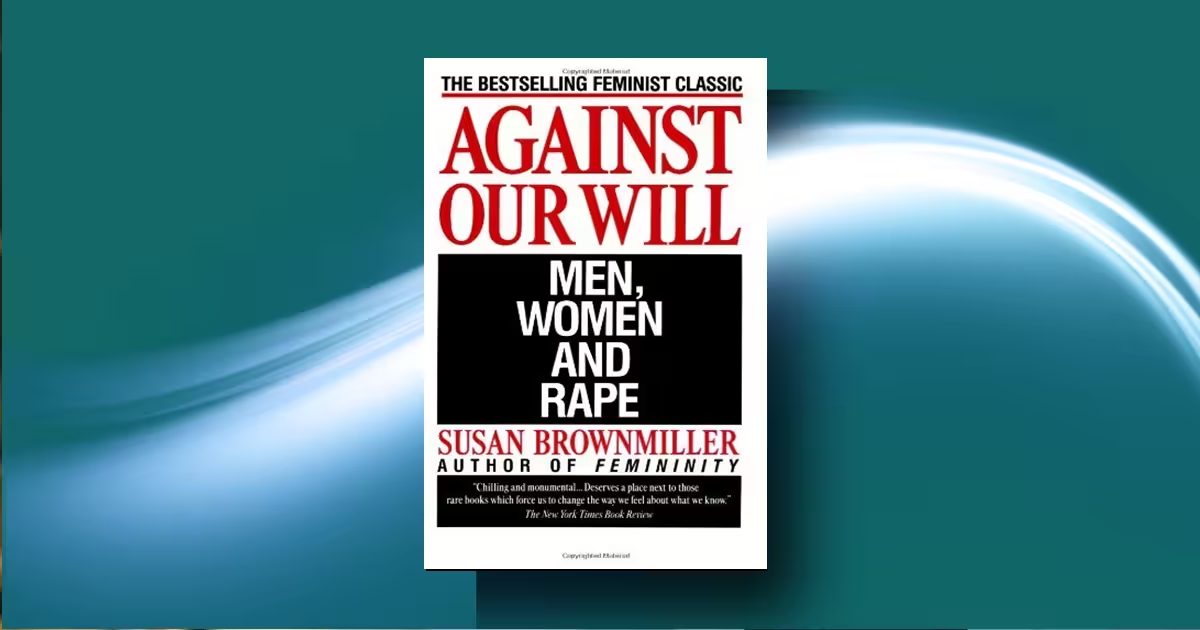
Why should I ask you to read a difficult feminist classic from 1975 in 2026? Because Against Our Will taught me that sexual violence is not just a shocking headline or an individual crime story; it is also a social system of fear, and that insight still feels urgent in a world where the WHO says roughly 1 in 3 women experience physical and/or sexual violence in their lifetime and the UN verified more than 4,600 cases of conflict-related sexual violence in 2024 alone.
Against Our Will is best for readers of feminist history, gender studies, legal history, social criticism, survivor advocacy, journalism, and anyone looking for a serious Against Our Will summary and review that reveals the whole argument rather than tiptoeing around it.
Brownmiller writes across war, law, slavery, prison, child abuse, media myth, jury behaviour, and feminist organising, so the book rewards readers who want scope as well as force.
Not for readers wanting a gentle introduction to feminism, a contemporary intersectional overview without major historical blind spots, or an emotionally easy reading experience.
Against Our Will is foundational, still in print, and widely credited with changing public discussion of rape; nevertheless, its treatment of race, especially in the Emmett Till material, remains one of its most serious and most criticised failures.
Table of Contents
Why Reading Against Our Will
Against Our Will is Susan Brownmiller’s sweeping argument that rape is not primarily a crime of lust, but a political and social instrument of power, one that history, law, war, myth, and institutions have repeatedly normalised in ways that discipline women’s freedom.
That is the beating heart of the book, and every chapter is built to prove it from a different angle.
What makes Against Our Will still worth reading, in my view, is not simply that Brownmiller was early. Plenty of books are early and yet feel embalmed. This one does not. Initially, it may seem like a compendium of historical atrocities.
In fact, it reads more like an x-ray of social power. Brownmiller keeps asking the same question in different settings: who gets believed, who gets blamed, who gets protected, and who gets reduced to a cautionary tale? As a result, the book lands not as an archive of the past but as a map of patterns that still live among us.
There is also a timely reason to revisit it now.
Brownmiller died in May 2025 at the age of 90, and the book has been reconsidered around both that loss and its fiftieth anniversary.
Recent retrospectives in the Yale Review, AP, TIME, and The Guardian all treat Against Our Will as a landmark that reshaped public conversation even while they also stress how contested parts of it remain. That mix of durability and dispute is exactly why the book still matters.
Against Our Will, the author, and the original purpose
Against Our Will: Men, Women and Rape is a work of feminist history, social criticism, legal analysis, and investigative reportage by Susan Brownmiller, a journalist and activist whose career included work in civil rights, anti-war protest, television journalism, and freelance writing for outlets such as The New York Times and The Village Voice.
The book was first published by Simon & Schuster in 1975. It has remained in print and was later included by the New York Public Library among its Books of the Century.
Brownmiller did not arrive at the subject from nowhere. Recent and archival accounts trace the book’s origins to consciousness-raising and anti-rape organising in the early 1970s, especially within New York Radical Feminists.
She also received an Alicia Patterson Fellowship in 1973 to research and write on rape. In other words, the book was born not just from library work but from movement work. That matters, because Against Our Will is not a detached scholarly object. It is a polemical intervention aimed at changing how readers think, how courts frame evidence, and how women organise.
Brownmiller states her motive with unusual candour in the opening pages. In the personal statement of the book, she calls herself “a woman who changed her mind about rape” and dates that statement to New York City, February 1975. That sentence is a key to the whole project. It is not merely autobiographical throat-clearing.
It signals that the book will ask readers to undergo a similar intellectual reversal: to stop treating rape as an aberration committed by monsters and to start seeing it as something built into social order, cultural storytelling, and public institutions.
The purpose of the book, then, is both descriptive and argumentative. Descriptively, Brownmiller wants to gather rape’s sprawling history into a single frame: biblical law, military conquest, racial terror, prison hierarchy, celebrity immunity, media sensation, and courtroom humiliation.
Argumentatively, she wants to prove that these are not disconnected episodes. They form a pattern.
Accordingly, the book’s thesis is not modest. It is large, memorable, and deliberately confrontational. Brownmiller defines rape as “a conscious process of intimidation by which all men keep all women in a state of fear.” Whether one agrees with that absolutely or not, it is the sentence around which the entire book turns.
Against Our Will Summary
Brownmiller begins by doing something that still feels surprisingly fresh: she criticises major male intellectual traditions for having either ignored rape or badly misunderstood it.
In the introduction, she moves through sexology and psychoanalysis, arguing that figures such as Krafft-Ebing and Freud had a great deal to say about sexual disorder, fantasy, and symbolism, yet astonishingly little to say about rape as lived violence. This leads to one of the book’s major structural moves: she relocates the subject from the clinic to the social order.
In other words, she refuses to let rape remain either a private pathology or a salacious episode. She turns it into a question about civilisation itself.
The next major movement is the law. Brownmiller argues that rape entered formal legal systems not first as a violation of a woman’s bodily integrity, but as a property offence by one man against another, with woman figured as the damaged possession. From there, she traces how ideas of chastity, male guardianship, marriage, and possession shaped the legal imagination. A major trait of this chapter is its refusal to romanticise “protection.”
Brownmiller insists that protection was often the other face of ownership. The price women paid for male protection from male violence, she argues, was chattel status, compulsory chastity, and the absorption of rape into male rights.
That is one of Against Our Will‘s most important insights, and it remains devastating because it explains why so many rape laws historically seemed less interested in harm to women than in trespass on male claims.
From law, Brownmiller moves to war, and this is where the book’s scale becomes unmistakable. The war chapter opens with martial swagger and official hypocrisy, then peels both away. Brownmiller argues that war gives men permission to translate victory into sexual domination.
She then surveys rape across wars and occupations, including the American Revolution, the world wars, Bangladesh, and Vietnam.
Significantly, she does not treat wartime rape as collateral excess. She treats it as a predictable extension of conquest, occupation, humiliation, and masculine performance. The chapter also includes hard data where she can get it.
For example, a table in the World War II section lists 971 U.S. Army general courts-martial convictions for rape across 1942 to 1947, with a dramatic spike during occupation periods. Brownmiller uses such evidence to show that rape is not an accidental stain on war but one of its recurrent social languages.
Her Bangladesh pages are especially striking.
Brownmiller records reports of women seized from villages, raped in military compounds, rejected by husbands, and then reframed by the new Bangladeshi state as “national heroines.” She notices not only the violence itself but also the media hierarchy surrounding it: some reporters foregrounded the atrocity; others barely recognised it as news.
Rape in Bangladesh (War of Independence, 1971)
This section (pages 78-86 of the book) details the systematic mass rape of Bengali women by Pakistani soldiers during the nine-month Bangladesh Liberation War (March–December 1971) and its aftermath.
1. Initial News Reports (December 1971)
Date/Event: Two days before Christmas, 1971, the New York Post reports that the new Bangladesh government, led by Sheik Mujibur Rahman, has declared all raped women “heroines” of the war.
Key Detail: Traditional society leads to ostracization of rape victims.
Dec. 27, 1971: War correspondent Joseph Fried reports from Jessore in the New York Daily News on the reappearance of young women after nine months of hiding.
2. Scope of the Atrocity (January 1972 & Overall Stats)
Mid-January 1972: The Reverend Kentaro Buma of the World Council of Churches holds a press conference in Geneva, reporting over 200,000 Bengali women were raped (a figure from Bangladesh authorities).
Other Statistics from the 9-month conflict (March-Dec 1971):
Deaths: Approximately 3 million persons.
Refugees: 10 million fled to India.
Rapes: Estimates range between 200,000 and 400,000 women.
Victim Demographics: 80% were Muslim (reflecting the population), but Hindu and Christian women were not exempt. Women lived in purdah (strict veiled isolation).
Pregnancy: Approximately 25,000 women became pregnant from rape.
3. Methods of Rape and Abduction
Hit-and-Run Tactics: Pakistani soldiers and local collaborators (razakars) used trucks to raid villages.
Case Study (Aubrey Menen): A 17-year-old Hindu bride of one month was raped by six soldiers in front of her bound husband. Her husband later refused to see her, and her father was “ashamed.”
Extent of Victims: Girls as young as 8 and grandmothers aged 75 were assaulted.
Abduction & Military Brothels: Hundreds of women were kept naked in military barracks for nightly use. Pornographic movies were shown to soldiers to work them up.
Testimony (Khadiga, 13): Kidnapped with four other girls, forced into a military brothel for six months, abused by two men a day (others serviced 7-10 men daily; some accounts mention 80 assaults in a single night). Food was withheld until they complied.
4. Consequences and Social Rejection
Ostracization: Due to Islamic tradition, most husbands rejected their raped wives. Some husbands who watched were then killed.
Pregnancy Crisis: Women did not want to bear children of forcible rape, especially as the fair-skinned Punjabi features of the babies would mark them as illegitimate and prevent acceptance into Bengali culture.
Suicide & Infanticide: Dr. Geoffrey Davis (International Abortion Research and Training Center) reported “countless” incidents of suicide (rat poison, drowning) and infanticide, plus an estimated 5,000 self-induced abortions with medical complications.
5. International Response and Rehabilitation (Post-War)
Feminist Response (January 1972): A letter from eleven women to the New York Times stated: “It is unthinkable that innocent wives… are now being totally destroyed by their own husbands.”
International Aid: Coordinated by the International Planned Parenthood Federation (London office), which set up abortion clinics with the Bangladesh Central Organization for Women’s Rehabilitation.
Women-Led Aid: Dr. Helena Pasha (who previously disapproved of abortion) and social worker Tahera Shafiq (who called the experience “torture”) led relief efforts.
Rehabilitation Efforts: The “marry them off” campaign failed. Men demanded high dowries (e.g., a red Japanese car), and many victims could not tolerate a man’s presence.
Long-term Tragedy: Some women ended up in brothels.
Brownmiller argues the mass rape of Bangladesh was not unique or unprecedented. She compares the per capita incidence to the Rape of Nanking (1937, 1 month), Belgium and France in WWI (first 3 months), and Soviet villages in WWII.
For the first time in history, the rape of women in war received serious international attention due to a combination of Bangladesh’s need for aid, a new feminist consciousness viewing rape as a political issue, and growing acceptance of abortion.
Likewise, in Vietnam she examines military prostitution, the differential behaviour of armies, abuses in interrogation settings, and the way war bureaucracies convert women’s bodies into logistics.
Whether one accepts every inference or not, the chapter’s power lies in its insistence that wartime rape must be analysed politically and institutionally, not sentimentalised as regrettable chaos. Modern UN reporting on conflict-related sexual violence, still rising in alarming numbers, makes that part of Brownmiller’s analysis feel painfully contemporary.
After war comes collective upheaval: riots, pogroms, revolutions, colonial violence, and racial mob terror. Brownmiller’s point here is that sexual violence is not limited to formal armies.
It flourishes wherever male group power seeks to mark dominance, revenge, and territorial control. She reads the American Revolution, anti-Jewish pogroms, the persecution of Mormons, Klan violence, Congo unrest, the conquest of Native peoples, and slavery through a common lens: rape becomes a way to write ownership and hatred onto vulnerable bodies.
This section also shows Brownmiller at her most relentless. She is less interested in neat chronology than in pattern recognition. Accordingly, the reader starts to feel the book’s full claim: rape is not a sidebar to history; it is one of the means by which history has often been made and enforced.
The chapter titled “The Police-Blotter Rapist” turns from history to the modern criminal stereotype. Here Brownmiller attacks the comforting fiction that rape is mainly the work of pathological strangers unlike ordinary men.
On page 175, she points to police and FBI data, while at the same time warning readers about the incompleteness of crime statistics. That caution is important.
She knows the numbers are distorted by under-reporting, unequal policing, and failed prosecutions. Nevertheless, she still uses the available data to challenge middle-class complacency. Typically, the point is not that rape has one profile, but that the culture’s preferred profile—the deranged outsider—is too convenient.
Brownmiller wants readers to understand that rape can be banal, communal, local, adolescent, and socially legible. It can happen in pairs, in gangs, and within familiar neighbourhoods. This leads to her larger rejection of the idea that good families and respectable communities somehow stand outside the problem.
“A Question of Race” is one of Against Our Will’s most ambitious and most combustible chapters. Brownmiller opens by describing how interracial rape accusations scramble public reason in the United States. She wants to analyse the convergence of sexism and racism: the historical weaponisation of rape accusations against Black men, the white mythology of purity, the lynching regime, and the way white male power positioned white women as symbols of possession.
In part, this chapter is attempting something valuable. Brownmiller knows that American rape history cannot be separated from racial terror. She spends considerable time on slavery, on post-Emancipation violence, on legal double standards, on Willie McGee, on lynching, and on the white fantasy of the Black rapist.
Yet, surprisingly and disastrously, the chapter also bends toward arguments about Emmett Till and Black male retaliation that later readers, especially Black feminists, found deeply flawed and morally compromised.
I will come back to that because it is the book’s sharpest wound. Still, within the architecture of the book, this chapter shows Brownmiller trying to grasp how rape discourse has been used not only against women but also as a racial technology of power.
The next turn is one of the book’s smartest.
In “Power: Institution and Authority,” Brownmiller widens the field beyond the street attack and into structured dependence. On page 257, she argues that rape is especially potent where one party controls the setting, the hierarchy, or the avenue of redress.
Thus, she examines prison rape, police rape, child sexual abuse, therapist abuse, authority coercion, and celebrity cases. In contrast to the stranger-danger myth, these chapters insist that access, dependency, glamour, and rank can weaken resistance before overt force even arrives.
Brownmiller’s examples range from inmates under threat, to women abused by policemen, to patients, students, or aspirants unable to interpret coercion clearly until too late.
In order to make the point vivid, she shows how institutions routinely rename domination as consent.
Her child abuse pages are especially disturbing because they dismantle adult evasions with unusual clarity.
Pages 273 to 282 gather anecdotes, studies, and critiques of supposedly expert opinion that minimised or even psychologised children’s abuse. Brownmiller attacks the tendency to blame mothers, eroticise children’s compliance, or treat trauma as parental overreaction.
She cites, among other things, findings from a Brooklyn-Bronx study summarised on pages 279 to 281: the median age of sexually abused children was 11, girls far outnumbered boys, most offenders were male, and in most cases the offender was known to the child or family.
Even allowing for the dated and local nature of those figures, the argumentative point is larger: sexual violence thrives in proximity, secrecy, and hierarchy. It is not the exception of the dark alley; it is often the corruption of the familiar room.
“The Myth of the Heroic Rapist” and the “Victims” chapters then shift from institutions to culture.
Brownmiller begins to dissect how media, literature, psychoanalysis, headlines, and social fantasy make sexual violence easier to consume than to confront. She attacks the notion of the glamorous rapist, the eroticised outlaw, the woman who “secretly wants it”, and the news culture that reduces female victims to hair colour, beauty, or celebrity sheen.
On pages 322 to 341, she takes apart the mythology of rape fantasy, the “beautiful victim”, and sensationalist headlines that turn murdered or assaulted women into objects of lurid fascination.
What I found especially acute here is Brownmiller’s attention to framing. She sees that representation is not decorative; it trains emotion. If the public repeatedly encounters rape as romance, adventure, punishment, or spectacle, then empathy and evidence are weakened before any trial even begins.
The legal material in “Victims: The Crime” remains among the book’s most useful sections. Brownmiller shows how archaic evidentiary assumptions turned the rape plaintiff into the accused.
On pages 369 to 375, she walks through corroboration rules, judicial suspicion, the shadow of Matthew Hale, the admissibility of sexual history, and the way juries frequently judged women’s “conduct” rather than men’s violence.
She notes, for example, New York City’s 1971 figures: 2,415 “founded” complaints, 1,085 arrests, 34 indictments, and only 18 convictions. Whether one reads that as a legal scandal, a sociological document, or a feminist indictment, the argument is unmistakable: the system was built to distrust the complainant.
Brownmiller reinforces that point by citing social-scientific work showing that juries imported concepts like “contributory negligence” into rape cases, effectively asking whether the woman had invited her own victimisation. That section still feels brutally recognisable.
Against Our Will ends not in despair but in defiance. “Women Fight Back” is Brownmiller’s answer to fatalism.
She redefines rape from the victim’s standpoint, argues for broader sexual assault law, questions the marital rape exemption, proposes more realistic sentencing, calls for protection of children and vulnerable dependants, and insists that bodily self-determination must be non-negotiable.
She also chronicles the feminist anti-rape movement’s practical inventions: speak-outs, rape crisis centres, hotlines, legal reform groups, public education, and self-defence.
On page 398 she recounts the birth of rape crisis centres and hotlines as unprecedented movement infrastructure; on pages 404 to 405 she writes about her own self-defence training and the shock of learning that women could be trained to resist effectively. In other words, Brownmiller refuses to let analysis stop at exposure.
She wants law changed, institutions changed, and female fear politically answered rather than privately managed.
Why the argument still lands
My own feeling, after reading deeply through, is that Against Our Will is one of those books that changes the temperature of your thinking even when you do not agree with every room inside it.
It is an outstanding, unsettling, and genuinely consequential work: not flawless, not sacred, but impossible to dismiss. Brownmiller writes with the energy of someone who knows that euphemism is part of the problem. That urgency, far from ruining the book, gives it pressure.
Against Our Will succeeds because Brownmiller does not rely on one kind of evidence.
She layers legal history, war reporting, criminology, cultural criticism, survivor testimony, press language, and institutional analysis. To put it another way, she writes like a journalist who has discovered that journalism alone is not enough, so she starts assembling a much larger evidentiary machine.
Even when one chapter is more persuasive than another, the cumulative force is formidable. By the time she reaches the final activism chapters, the reader understands why the book was received not merely as information but as a challenge.
Contemporary and retrospective accounts agree that it became a bestseller quickly, helped push anti-rape politics into the mainstream, and is widely credited with energising reforms around rape crisis support, rape shield protections, and marital rape law.
The central thesis still lands because it captures something many later frameworks would refine rather than erase: sexual violence is tied to power, and power is social before it is individual. Brownmiller may overstate when she universalises that principle into a claim about all men and all women, yet the structural insight remains sharp.
WHO still frames violence against women as both a human-rights violation and a public-health crisis rooted in inequality, and CDC’s ongoing NISVS work treats sexual violence as inseparable from broader public-health and social-system questions. Brownmiller did not invent all of that, of course, but she helped make such thinking publicly thinkable.
Still, reading Against Our Will now also shows where history has moved. Brownmiller’s conceptual frame is overwhelmingly male-on-female.
Modern public-health research uses wider definitions and tracks a broader range of harms: rape, being made to penetrate, sexual coercion, unwanted sexual contact, and harassment, across both women and men. CDC’s 2016/2017 report found that about 1 in 4 women in the United States reported completed or attempted rape in their lifetime, while about 1 in 9 men reported being made to penetrate someone.
That does not cancel Brownmiller’s analysis of patriarchal domination. Nevertheless, it does mean her framework is no longer sufficient on its own if one wants a full contemporary account of sexual violence.
Where Brownmiller is brilliant and where she is wrong
The strengths come first, because they are substantial. Brownmiller is brilliant at synthesising forms of violence that had often been siloed: war rape over here, family abuse over there, tabloids in one corner, statutes in another.
She forces the reader to see connection. Likewise, she is superb at showing how language does damage before verdicts are ever reached. Her reading of headlines, heroic myths, and courtroom logic anticipates what later generations would call rape culture, even if that phrase became more widespread later.
A major strength of Against Our Will is that it never lets culture float above institutions. Representation matters, Brownmiller argues, because it helps decide whose pain looks serious and whose sounds suspect.
She is also ahead of her time on marital rape, acquaintance rape, child abuse within domestic structures, and institutional coercion. What is now common sense in many feminist and legal discussions—that danger often comes from intimates, colleagues, authority figures, or familiar social settings rather than an unknown predator leaping from nowhere—was far less established in mainstream discourse when she wrote.
That is one reason the book had such force on publication. It shifted the scene of concern from the isolated alley to the whole architecture of social life.
Yet the weaknesses are real, and there is no honest way to soften them. Brownmiller sometimes slides from structural analysis into sweeping biological or quasi-biological vocabulary about sex difference and male capacity that can sound deterministic rather than explanatory.
In places, the argument risks making patriarchy seem almost too total, as if history leaves little room for variability, contradiction, or non-patriarchal forms of relation.
That can flatten complexity. It also makes parts of the prose feel less like analysis and more like sentence passed in advance. This, in turn, is where critics have raised the charge of essentialism.
The gravest weakness, however, is the race chapter.
Brownmiller is right to insist that American rape history cannot be understood apart from white supremacy and the weaponisation of false allegations against Black men. But she is badly wrong in places about how she handles that insight, especially around Emmett Till.
Critics including Angela Davis and later Black feminist thinkers argued that Brownmiller’s attempt to fold lynching, interracial desire, and rape politics into one total theory became historically clumsy and racially harmful. Recent retrospectives continue to name this as the book’s most serious failing.
I agree. The problem is not that Brownmiller entered dangerous territory; the problem is that she entered it with an argument that, at key moments, burdens the wrong people and underestimates the lethal history of racial accusation in America.
There is another weakness, quieter but still important. Because Against Our Will is so committed to political reinterpretation, Brownmiller sometimes treats evidence as a pattern to be assembled rather than a question to be tested with equal scepticism in every direction.
To be fair, she often admits the incompleteness of official data and the silence surrounding unreported assaults. Even so, some of the criminology and wartime data she mobilises are inevitably products of the 1970s research environment, with all the blind spots that implies.
Due to insufficient evidence in some historical zones, a comprehensive view of incidence cannot always be formed from her material alone. That does not invalidate the book, but it does mean modern readers should treat some figures as historically revealing rather than presently definitive.
Books that belong beside it
If you want to understand Against Our Will properly, the smartest move is not to read it alone. Read it beside other books that either deepen its strongest insights or correct its blind spots.
Kate Millett’s Sexual Politics is the closest analogue in terms of second-wave force, but it works through literature and ideology rather than rape history specifically.
Where Brownmiller moves through battlegrounds, court records, and police files, Millett dissects patriarchal power in novels, criticism, and intimate social norms. Brownmiller gives the social emergency; Millett gives the conceptual grammar.
Judith Herman’s Trauma and Recovery belongs beside Brownmiller because it takes the next necessary step: it places the survivor’s psychological reality in a political frame and then builds a model for understanding trauma, healing, memory, and recovery.
Brownmiller is strongest on structural indictment; Herman is stronger on what violence does inside the survivor’s mind and body over time. If Brownmiller convinces you that rape is political, Herman helps explain what that politics feels like when it enters memory, identity, and everyday functioning.
Joanna Bourke’s Rape: Sex, Violence, History is another crucial comparison because it revisits rape historically while shifting attention toward perpetrators and questioning simplistic uses of the “rape is about power” formula without abandoning feminist seriousness.
In contrast to Brownmiller’s very broad structural thesis, Bourke tries to historicise motives, embodiment, and perpetrator context more finely.
Reading the two together is intellectually productive: Brownmiller gives you the galvanising political frame; Bourke gives you a later, more revisionary historical method.
Chanel Miller’s Know My Name is different in genre but essential in moral perspective. Brownmiller writes from investigative breadth; Chanel Miller writes from survivor interiority and public aftermath.
Where Brownmiller analyses bureaucracy, media framing, and courtroom suspicion as systems, Miller shows how those systems feel when they pass through one person’s body and name. The memoir is a reminder that structural analysis and lived testimony should not be rivals. They need each other.
Final verdict and practical notes
My conclusion is simple. I recommend Against Our Will strongly, but not blindly. Read it if you want to understand why rape moved from being treated as private shame and sensational crime copy to being treated as a political, legal, and cultural problem. Read it if you want to see how anti-rape feminism built one of its earliest major intellectual frameworks.
Read it if you want a book that makes connections between war, law, race panic, prison hierarchy, media myth, and survivor activism with almost frightening confidence. And read it, above all, if you want a feminist classic that still has the power to disturb your settled categories.
At the same time, I would not call it the final word. It is a first great word, and perhaps that is the better way to honour it. Because of this, the best modern reading strategy is double vision: take Brownmiller’s structural brilliance seriously, and take the book’s failures seriously too.
Do not flatten it into either simple canon or simple error. Its achievements are too large for dismissal; its blind spots are too grave for reverence. That balanced response, in my judgement, is the most intellectually honest one.
A brief note on limitations is worth adding.
Brownmiller’s statistics, case selections, and gender framework reflect the historical research environment of the 1970s. Accordingly, where current context mattered, I have relied on more recent public-health and international sources such as WHO, CDC, and UN Women.
Likewise, some claims about the book’s legal and cultural influence are best described as widely credited rather than singly caused, because social change was produced by movements, organisers, survivors, lawyers, and multiple feminist texts working together.







