
Are you tired of watching modern foreign policies collapse because leaders treat the world as they wish it to be rather than how it actually is? If you want to crack open the brutal, hidden clockwork of global power, Henry Kissinger’s masterwork will fundamentally rewire how you read the nightly news.
Diplomacy is best for aspiring strategists, political science buffs, history enthusiasts, and digital marketers seeking to understand the deep global architectures of power and structural equilibrium.
Anyone who wants a comprehensive, no-nonsense education in why nations act the way they do behind closed doors will find this book indispensable.
But it is not for idealistic purists, casual readers looking for light historical summaries, or those who find cold, transactional power calculations morally repulsive. If you prefer foreign policy guided entirely by humanitarian sentiment rather than strategic leverage, this dense text will likely cause you to bounce.
Table of Contents
1. Introduction
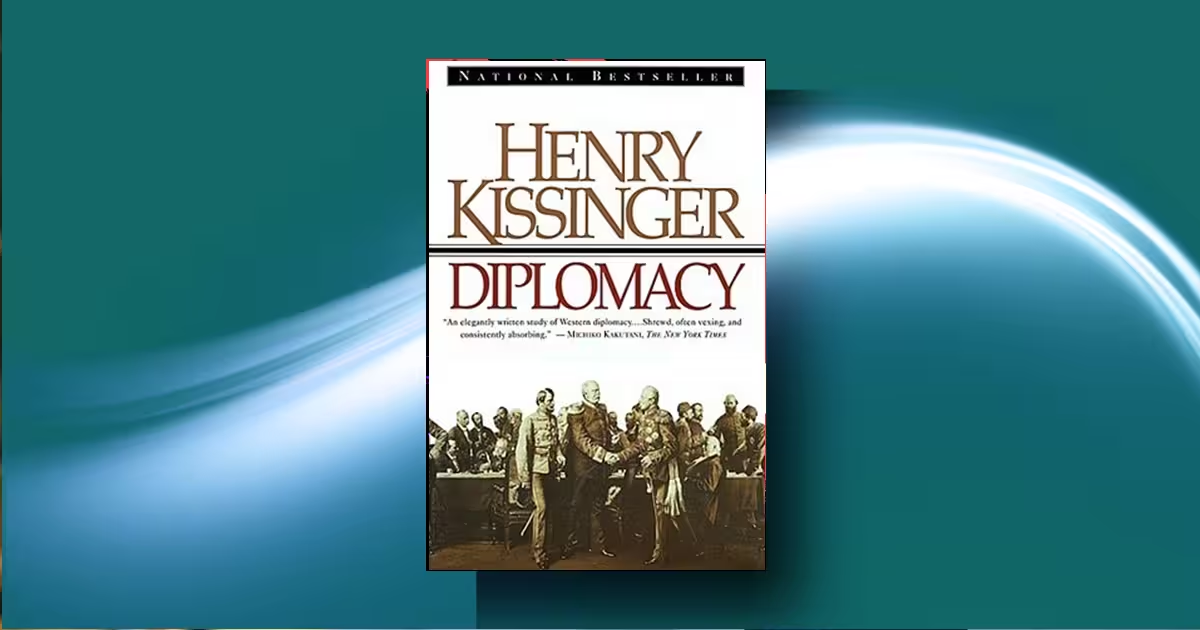
The book under review is Diplomacy, an extensive and monumental masterwork authored by Dr. Henry Kissinger, the fifty-sixth Secretary of State of the United States and a towering figure of twentieth-century geopolitics.
Published originally in April 1994 by Simon & Schuster, this 912-page book functions as both an academic treatise on grand strategy and a primary-source memoir from an individual who sat at the absolute center of global events during the Nixon and Ford administrations.
Diplomacy occupies a unique genre that straddles international relations theory, diplomatic history, and geopolitical memoir. To understand its subject matter, one must examine the author’s credentials.
Dr. Kissinger was an academic at Harvard University before he became a policymaker, graduating summa cum laude from Harvard College in 1950 and serving on its faculty from 1954 to 1969. He was later awarded the Nobel Peace Prize in 1973, the Presidential Medal of Freedom in 1977, and the Medal of Liberty in 1986.
Consequently, he approaches international relations not as a detached philosopher, but as a practitioner who has wrestled with the real-world constraints of time, incomplete information, and the existential threat of nuclear confrontation.
The central thesis of Diplomacy is that international stability is never an accidental byproduct of goodwill; instead, it is the deliberate result of an engineered equilibrium known as the balance of power.
The balance of power is a system where multiple states of roughly equal strength prevent any single power from dominating others, typically through shifting coalitions. Its primary goal is not to achieve peace but to ensure stability and moderation by limiting the scope of conflicts and keeping dissatisfaction below the level that would provoke a revolutionary challenge to the international order.
Kissinger argues that states must decouple their foreign policy from abstract, universal moral crusades and instead anchor their actions in Realpolitik and a clear, unsentimental assessment of national interest.
He asserts that the historical failure of American foreign policy has often been its oscillation between isolationism and a messianic desire to reshape the world in its own image, rather than learning to manage a multipolar world through strategic equilibrium.
2. Diplomacy Summary
To read Diplomacy is to undergo a comprehensive education in international relations so thorough that, after absorbing its core chapters, you will never need to return to raw textbooks.
Kissinger maps out more than three centuries of history, dissecting how modern statecraft emerged from the collapse of medieval universalism and how it operates in our contemporary era.
Chapter 1: The New World Order
In opening his grand historical sweep, Kissinger postulates a fundamental historical cycle:
“Almost as if according to some natural law, in every century there seems to emerge a country with the power, the will, and the intellectual and moral impetus to shape the entire international system in accordance with its own values.”
Traditionally, different nations have assumed this mantle by varying methods. In the seventeenth century, France under Cardinal Richelieu pioneered the modern, secular approach to international affairs, introducing the nation-state motivated by raison d’état (national interest).
Subsequently, in the eighteenth century, Great Britain developed and refined the concept of the balance of power, which effectively dominated European diplomacy for the next two hundred years.
Moving into the nineteenth century, Metternich’s Austria brilliantly reconstructed the Concert of Europe, whereas Otto von Bismarck’s Germany later dismantled it, turning European diplomacy into a cold-blooded, unforgiving game of power politics.
Significantly, the twentieth century witnessed the rise of the United States, a nation that influenced international relations as decisively as it did ambivalently. Traditionally, America has operated under two deeply contradictory attitudes toward foreign policy:
The Beacon: The belief that America serves its values best by perfecting democracy at home, thereby acting as a light for the rest of mankind.
The Crusader: The belief that America’s unique moral values impose a global obligation to actively crusade for democracy around the world.
Because of this internal tension, American thought has consistently oscillated between isolationism and global commitment. This means that while European diplomacy was forged in the school of hard knocks, American foreign policy has been a triumph of faith over experience.
Consequently, when Soviet communism collapsed, America found itself face to face with an emerging world order where nationalism gained a new lease on life, and where the United States could neither completely withdraw nor completely dominate.
In this post-Cold War era, power has become symmetrical, consisting of at least six major global pillars: the United States, Europe, China, Japan, Russia, and India.
The table that organizes and explains the Twentieth Century Architecture of international relations as presented in Henry Kissinger’s Diplomacy, comparing the American and European traditions.
| Dimension | American Tradition | European Tradition |
|---|---|---|
| Core Belief | International harmony is natural; war results from misunderstanding or undemocratic governments. | International relations is inherently competitive; war is a recurring tool of statecraft. |
| Guiding Principle | Moral Exceptionalism – The U.S. is a “beacon of liberty” and must lead by example or crusade. | Balance of Power – Stability comes from preventing any single state from dominating the continent. |
| Method of Diplomacy | Collective Security – All nations unite against aggression; legal and institutional frameworks (League of Nations, UN). | Spheres of Influence – Great powers have legitimate zones of interest; diplomacy is about managing rivalries. |
| Justification for Action | Raison de Système – Acting on behalf of universal principles (democracy, human rights, rule of law). | Raison d’État – Acting in the calculated national interest; security and survival override moral considerations. |
| View of Power | Power is problematic; arms races cause war. Strength should be used only to enforce international law. | Power is neutral; it must be balanced. Weakness invites aggression, strength preserves peace. |
| Key Historical Examples (from the book) | – Wilson’s Fourteen Points & League of Nations – Truman Doctrine & NATO (justified as collective security) – Reagan’s “evil empire” crusade | – Richelieu’s anti-Habsburg alliances – Congress of Vienna (Metternich) – Bismarck’s Realpolitik – Nixon/Kissinger’s triangular diplomacy |
| Kissinger’s Synthesis | America cannot dominate alone nor withdraw. It must learn to operate in a multipolar world by blending its idealism with a realistic appreciation of equilibrium – essentially adopting European methods while retaining American values. (Chapters 1, 28, 31) |
This table distills the central conflict of 20th-century diplomacy as Kissinger sees it: the perpetual tension between America’s missionary idealism and Europe’s hard-nosed realism.
Chapter 2: The Hinge: Theodore Roosevelt or Woodrow Wilson
Next, Kissinger addresses the great intellectual pivot of American global entry through the contrasting presidencies of Theodore Roosevelt and Woodrow Wilson.
Initially, it may seem that both men sought the same thing—an end to absolute American isolationism—yet they justified this transformation with entirely opposite philosophies.
Theodore Roosevelt was a sophisticated, brilliant analyst of the balance of power. He insisted on an international role for America because he believed its expanding national interest demanded it, and because a global balance of power was simply inconceivable without active American participation.
Make no mistake, Roosevelt was a geopolitical realist who viewed international life as an unceasing Darwinian struggle where the weak only survive if they are backed by efficient force. He famously derided fantastic peace treaties and universal legal mechanisms, stating that:
“A milk-and-water righteousness unbacked by force is to the full as wicked as and even more mischievous than force divorced from righteousness.”
In contrast, Woodrow Wilson approached the world from a purely messianic, ideological framework. For Wilson, the justification of America’s entry into world affairs was not the maintenance of equilibrium, but the active propagation of its democratic principles throughout the globe.
He believed that the balance of power was inherently immoral and that international stability must be anchored in collective security, open agreements, and ethnic self-determination.
Surprisingly, although Roosevelt had a far more accurate understanding of how international politics actually operated among the Great Powers, it was Wilsonian idealism that ultimately captured the soul of American foreign policy.
Since that watershed presidency, American leaders have continuously marched to the drumbeat of Wilsonian idealism, justifying realpolitik actions with altruistic rhetoric.
Chapter 3 to 6: From Westphalia to Realpolitik
To give a comprehensive illustration of how Europe arrived at this system, Kissinger traces the historical lineage back to the Peace of Westphalia in 1648. When the medieval dream of a universal empire collapsed, a multiplicity of European states of relatively equal strength emerged from the ashes.
This leads to an structural reality: when equal states are forced to coexist, they must either submit to a single dominant empire or maintain a balance of power.
Cardinal Richelieu of France was the foremost architect of this transition. He recognized that the state possesses a separate morality; hence, the state’s survival overrides any personal ethical constraints.
Similarly, King William III of Orange and later William Pitt of Great Britain constructed grand alliances against French hegemony, not out of abstract moral outrage, but to restore continental equilibrium.
This calculated system reached its peak under the Concert of Europe following the Congress of Vienna in 1815. Figures like Klemens von Metternich moderated raw power politics by wrapping it in a shared framework of conservative moral values among European monarchs.
However, this subtle equilibrium was completely dismantled by two revolutionary figures: Napoleon III of France and Otto von Bismarck of Germany. Bismarck, in particular, subjected the European balance of power to a cold-blooded, mathematically precise calculation of Realpolitik.
He made alliances based purely on utility rather than ideological affinity, proving that in a system of pure power, stability can only be maintained if a state remains flexible enough to align with any partner depending on shifting circumstances.
Here is the information from the diagram converted into a table format for easy copy-pasting:
| Era / Event | Key Characteristics | Key Figures / Concepts | Outcome / Transition |
|---|---|---|---|
| Medieval Universalism | Empire & Papal Authority | (Pre-Westphalian order) | Leads to collapse of universal authority |
| Peace of Westphalia (1648) | Multi-state System Emerges; Raison d’État | Cardinal Richelieu; British Offshore Balancing; Fluid, Shifting Alliances | Establishes modern state system; leads to 18th Century Equilibrium |
| Concert of Europe (1815) | Congress of Vienna; Balance of Power + Shared Conservative Morality | Metternich | Creates stable European order |
| Bismarckian Realpolitik (1871) | Amoral Power Calculations; Utility over Ideology | Otto von Bismarck | Replaces morality with power politics |
| The Doomsday Machine | Hardening of Rigid Alliance Blocs; Inflexible Military Mobilization | (Pre-WWI alliances & mobilization schedules) | Makes general war nearly inevitable |
| World War I (1914) | First Systemic Collapse | (Allied vs. Central Powers) | Destroys old European order |
| Treaty of Versailles (1919) | Wilsonian Idealism & Collective Security; League of Nations (Excluding Germany & USSR) | Woodrow Wilson | Creates flawed peace; sets stage for revisionism |
| Interwar Crisis & World War II (1939) | Failure of Appeasement & International Law | (Hitler, Chamberlain, Stalin) | Second Systemic Collapse |
| Bipolar Cold War (1945) | Zero-Sum Ideological Struggle; Nuclear Containment Strategy | Kennan, Truman; NATO vs. Warsaw Pact | Divides world into two spheres of influence |
| Triangular Diplomacy (1972) | Nixon & Kissinger’s Rapprochement with China; Leveraging the Sino-Soviet Split for Détente | Nixon, Kissinger, Mao, Brezhnev | Creates strategic flexibility; eases Cold War tensions |
| The New World Order (Post-1991) | Collapse of Soviet Communism; Return to Multipolarity | US, China, Russia, EU, Japan, India | Emergence of multiple power centers |
The table captures the evolution of the international order from medieval times to the post‑Cold War era, based on your flowchart.
Chapter 7 to 14: The Doomsday Machines and World Wars
A major trait of pure Realpolitik is that when it is stripped of a shared moral or consensus framework, it eventually turns on itself. By the late nineteenth century, European diplomacy had transformed into an unforgiving, rigid system of opposing alliances.
This political doomsday machine, coupled with inflexible military mobilization schedules, meant that a minor crisis in the Balkans in the summer of 1914 automatically triggered a catastrophic global war from which no nation could shrink.
Following the carnage of World War I, the Treaty of Versailles in 1919 attempted to construct a new face of diplomacy based on Wilsonian principles.
Nevertheless, the victors faced an irreconcilable dilemma: they had created a system that excluded both Germany and the new Soviet Union, while failing to provide an enforcement mechanism. During the interwar years, British and French leaders fell into an end of illusion, attempting to appease Adolf Hitler while relying on the hollow declarations of the League of Nations.
Concurrently, Joseph Stalin operated a cynical geopolitical bazaar, culminating in the shocking Nazi-Soviet Pact of August 1939, which divided Eastern Europe between two totalitarian systems and directly inaugurated World War II.
Chapter 15 to 22: The Cold War and Containment Era
As World War II drew to a close, America re-entered the global arena under Franklin Delano Roosevelt, who, along with Winston Churchill and Joseph Stalin, hammered out a messy postwar division at Yalta and Potsdam.
This quickly devolved into the Cold War. Kissinger provides an exhaustive analysis of the success and the pain of the containment policy, which was initially formulated by diplomats like George Kennan to halt Soviet expansionism.
The table that organizes the “Evolution of Containment” based on Henry Kissinger’s Diplomacy, breaking down the successes and dilemmas as outlined in your diagram.
| Aspect | Key Events / Elements | Kissinger’s Analysis |
|---|---|---|
| THE SUCCESSES | ||
| Marshall Plan (1948) | Economic recovery of Western Europe | Combined economic aid with political stability; removed conditions that made populations vulnerable to communism; “containment by prosperity.” |
| Berlin Airlift (1948-49) | Western air resupply of West Berlin during Soviet blockade | Demonstrated resolve without war; confronted Soviet pressure with “unalterable counter-force” at a point of encroachment. |
| NATO Stabilization | Formation of North Atlantic Treaty Organization | Institutionalized U.S. commitment to Europe; anchored West Germany to the West; created a stable military balance. |
| THE DILEMMAS | ||
| Inflexible Commitments | Treating all local conflicts as tests of U.S. credibility | Led to overextension; U.S. failed to distinguish between core interests (Europe) and peripheral ones (Southeast Asia). |
| The Korean War (1950-53) | Limited war resulting in stalemate | Exposed gap between “positions of strength” theory and reality of limited war; no doctrine for inconclusive conflict; sapped domestic support. |
| Nuclear Brinkmanship | Reliance on nuclear threats (e.g., Berlin, Cuban missile crisis) | Nuclear parity made massive retaliation incredible for small aggressions; forced dangerous brinkmanship without direct superpower war. |
This table captures the core tension in Kissinger’s view: containment built the durable architecture of the Cold War West but also created the psychological and strategic traps that led to Vietnam and American self-doubt.
During this bipolar era, the traditional rules of the balance of power were drastically modified. In a two-power world, any gain for one side is perceived as an absolute loss for the other, eliminating the subtle adjustments characteristic of nineteenth-century European diplomacy.
Kissinger walks the reader through several critical flashpoints:
The Korean War (1950–1953): A brutal illustration of the dilemma of containment, where America fought a limited war for status quo stability but suffered immense domestic political strain.
The Suez Crisis (1956): A watershed moment where the United States actively thwarted its own allies (Britain and France), effectively leapfrogging traditional imperial arrangements to prevent Soviet alignment with Arab nationalism.
The Hungarian Uprising (1956): A tragic confirmation of the spheres-of-influence reality, where the West stood by as Soviet tanks crushed Budapest because intervening would risk a third world war.
Chapter 23 to 31: From Brinkmanship to the New World Order Reconsidered
Subsequently, the book covers the agonizing years of the Berlin and Cuban missile crises, where Nikita Khrushchev’s volatile ultimatums tested Western resolve.
This led directly into America’s entry into the Vietnam morass under Presidents Kennedy and Johnson. Kissinger chronicles the long, painful road to despair in Vietnam, detailing how America entered an asymmetric conflict with high Wilsonian ideals but failed to comprehend the unyielding geopolitical realities of Hanoi’s revolutionary determination.
When Richard Nixon assumed the presidency, he and Kissinger executed a profound shift toward foreign policy as geopolitics. By engineering a bold, triangular diplomacy that reopened relations with Mao Tse-tung’s China in 1972, the Nixon administration successfully leveraged the Sino-Soviet split.
This masterstroke forced the Soviet Union into a period of détente, giving America maximum strategic flexibility.
Ultimately, the book concludes with the collapse of the Soviet Union under Ronald Reagan and Mikhail Gorbachev.
While Reagan’s crusading moral rhetoric re-energized American resolve, it was his tactical willingness to negotiate alongside the deep structural rot of the Soviet economic model that brought about the end of the Cold War.
In his final reconsideration, Kissinger returns to his ultimate warning: the twenty-first century will not be a seamless tapestry of American triumph, but a complex, fragmented world requiring a delicate, sophisticated appreciation of equilibrium among competing civilization-states.
3. Diplomacy Analysis
Henry Kissinger’s Diplomacy is an astonishingly profound, intellectually breathtaking, and chillingly calculated framework that strips global politics of its comforting moral camouflage.
Expressing my feelings on this foundational text directly, it stands as an epochal masterpiece of geopolitical literature that exposes the unyielding, iron-clad mechanics of state survival with a chillingly beautiful, pragmatic clarity.
Evaluation of Content
To form a comprehensive view of the issue, we must assess whether Kissinger effectively supports his grand thesis with historical evidence. Make no mistake, his historical lineage is meticulously constructed.
By analyzing the structural evolution from Cardinal Richelieu’s handling of the Thirty Years’ War to his own triangular diplomacy with China and Russia, Kissinger demonstrates a remarkable internal consistency.
His arguments operate with a geometric logic: when a state ignores its relative power position in favor of ideological vanity, it invariably jeopardizes its survival.
| Historical Order Model | Primary Organizing Principle | Key Architectural Figures | Historical Fate / Outcome |
| Westphalian System (1648) | Pure State Sovereignty & Raison d’État | Cardinal Richelieu | Fragmented Europe; constant tactical wars |
| Concert of Europe (1815) | Balance of Power paired with Shared Ideological Values | Metternich, Castlereagh | Century of relative peace without systemic collapse |
| Bismarckian Realpolitik (1871) | Amoral, Flexible Alliances based on Relative Force | Otto von Bismarck | Hardened into rigid blocks, leading to WWI |
| Wilsonian Collective Security (1919) | Universal International Law & Democratic Consensus | Woodrow Wilson | Helpless against the rise of totalitarian dictators |
| Bipolar Cold War (1945) | Zero-Sum Nuclear Containment & Ideological Blocks | Truman, Kennan, Stalin | Systemic freezing; proxy wars at the periphery |
Undoubtedly, the book fulfills its stated purpose with remarkable brilliance. It contributes meaningfully to the field of international relations by serving as a counterweight to the native moralism of Western democracies.
Kissinger systematically deconstructs the illusion that international law or abstract international organizations can protect a state from aggressive neighbors.
He uses the tragedy of the League of Nations and the structural failures of the interwar years to prove that an international order is only as stable as the physical enforcement mechanisms behind it.
However, there are distinct limitations in his evidence that must be taken into consideration. Because Kissinger views history exclusively through the lens of elite statecraft and summit negotiations, he frequently downplays the powerful bottom-up forces of popular nationalism, economic interconnectedness, and ideological passion.
To put it another way, he treats whole populations as passive chess pieces to be moved across a map by enlightened statesmen. For example, his analysis of the Vietnam War places immense blame on America’s domestic political fractures and Wilsonian guilt, while largely understating the absolute, unyielding human endurance of the Vietnamese anti-colonial movement.
Furthermore, as noted by eminent historians such as Ernest R. May, Kissinger occasionally bends historical details to fit his clean, bipolar archetypes—such as his assertion that the concept of self-determination was completely foreign to European statesmen before Woodrow Wilson arrived at Versailles.
4. Strengths and Weaknesses
Strengths
The foremost strength of Diplomacy resides in its unmatched, sweeping grasp of grand historical macro-trends paired with an insider’s understanding of real-world statecraft.
Kissinger’s prose is laced with deep historical knowledge, structural irony, and a razor-sharp wit that makes complex diplomatic maneuvers reads like a high-stakes psychological thriller.
His portraits of world leaders—such as Charles de Gaulle’s magnificent construction of political reality through sheer force of will, or Zhou Enlai’s calculated elegance—are masterpieces of character analysis based on direct personal interactions.
What is more, his conceptualization of “triangular diplomacy” provides a permanent blueprint for how an astute nation can maximize its strategic leverage by ensuring its relations with two bitter adversaries are always closer than their relations with each other.
The table explaining Nixon’s Triangular Diplomacy based on the book, with each side of the triangle described in terms of strategy, outcomes, and Kissinger’s analysis.
| Relationship | Type of Link | Strategic Logic | Key Outcomes / Insights |
|---|---|---|---|
| USA ↔ Soviet Union | Détente (arms control, summitry) | Leverage the Sino‑Soviet split to make Moscow more cooperative; trade geopolitical restraint for reduced tensions. | SALT I (1972), Anti‑Ballistic Missile Treaty, Berlin Agreement (1971); Soviets became more cautious to avoid a U.S.–China alliance. |
| USA ↔ China | Rapprochement (1972 Nixon visit, Shanghai Communiqué) | End 20+ years of isolation; use China as a counterweight to the USSR, gaining flexibility in Asia and Vietnam. | China’s tacit cooperation against Soviet expansion; U.S. could pressure Moscow without fighting alone; breakthrough in Asia strategy. |
| Soviet Union ↔ China | Bitter Split (ideological rivalry, border clashes) | Pre‑existing condition that enabled the whole triangle. The U.S. did not create it, but exploited it. | Each communist power feared the other more than it feared the U.S.; allowed America to be the “balancer” between two hostile giants. |
Key Quote from Kissinger (paraphrased)
“In a subtle triangle of relations between Washington, Peking, and Moscow, we improve the possibilities of accommodations with each as we increase our options toward both.”
This triangular diplomacy turned the Cold War from a two‑player zero‑sum game into a three‑player game where the United States, though weakened by Vietnam, regained strategic initiative.
Weaknesses and Criticisms
Conversely, the primary weakness of the book is its profound, almost pathologically amoral blind spot regarding the human cost of pure geopolitical calculations.
Because of his single-minded dedication to equilibrium, Kissinger treats matters of mass violence, covert destabilizations, and systemic human suffering as mere secondary line items in a global ledger.
As the cultural critic and journalist Christopher Hitchens famously noted, Kissinger’s grand strategies frequently left a catastrophic trail of third-party destruction in their wake—most notably the secret bombing and subsequent destabilization of Cambodia during the withdrawal from Vietnam.
In Diplomacy, these catastrophic real-world outcomes are sanitized under high-level phrases like “geopolitical necessities” or tactical “extrication”.
Additionally, the book exhibits a clear, self-serving bias when discussing the Nixon and Ford administrations, functioning as an elegant, highly sophisticated defense of Kissinger’s own historical legacy against critics from both the anti-war left and the anti-communist right.
5. Comparison with Similar Other Works
When placed alongside classical texts of political theory, Diplomacy shares a direct lineage with Niccolò Machiavelli’s Discourses on Livy and Thucydides’ History of the Peloponnesian War.
In fact, a major review in The New York Times accurately predicted that future generations will read Kissinger’s work precisely for its cold, unvarnished wisdom regarding the behavior of states under pressure, much like Machiavelli’s classic texts.
In contrast to modern structural realists like John Mearsheimer—whose book The Tragedy of Great Power Politics treats international behavior as an automatic, almost mathematical system dictated entirely by structural anarchy—Kissinger injects a vital emphasis on human agency, historical memory, and the individual creativity of statesmen.
Furthermore, if we compare this book to classical histories of diplomacy, such as Sir Harold Nicolson’s 1939 work Diplomacy, Kissinger’s volume is far wider in its geographical scope and vastly more ambitious in its theoretical intent.
While Nicolson focuses primarily on the traditional, functional mechanics and manners of professional diplomats, Kissinger treats diplomacy as a grand philosophical battlefield where conflicting national styles and civilizations collide.
6. Conclusion
In summary, Henry Kissinger’s Diplomacy remains an essential, monumental landmark of geopolitical literature that cannot be ignored by anyone who wishes to truly understand the unforgiving architecture of global power.
Provided that you can look past the author’s calculated self-justifications, the historical insights offered within these pages provide an invaluable lens for analyzing our current multipolar reality.
Ultimately, this work is highly recommended for specialists in international relations, military strategists, and advanced students of history. It is also an extraordinary resource for modern digital marketers and strategic content creators who wish to understand the systemic forces that govern global structures and institutional authority.
While general audiences may find its scale and density daunting, anyone willing to dedicate the time will emerge with a permanent, unvarnished understanding of how the world truly operates behind closed doors