
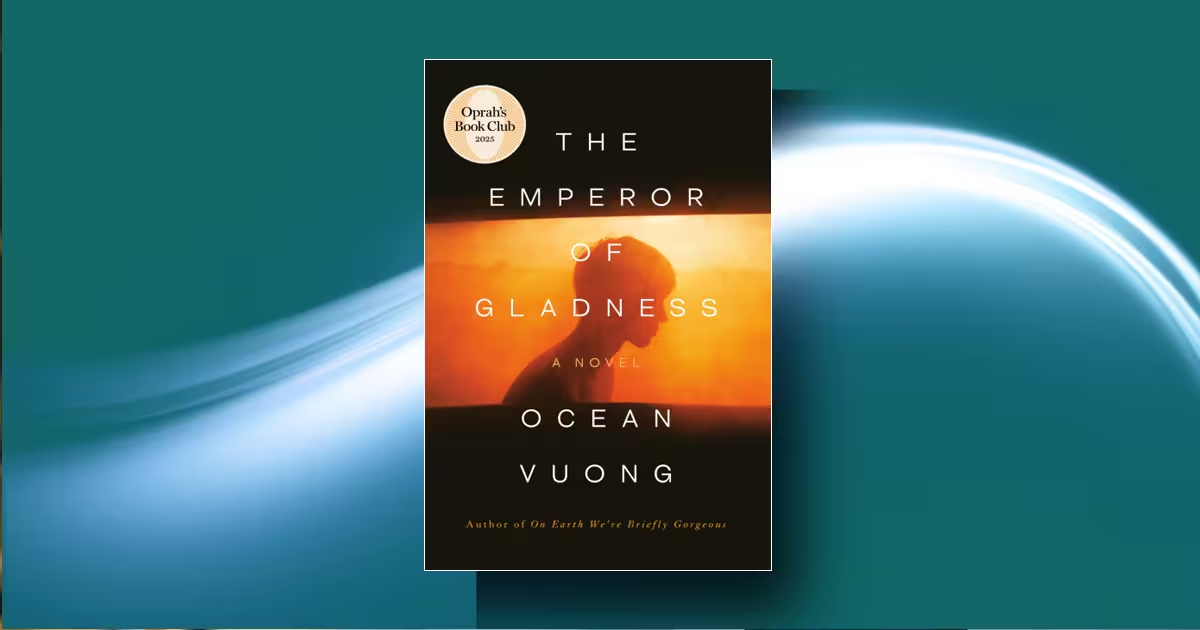
Did you ever wonder why the most life-affirming books you will ever read are often the ones set in the most broken, forgotten corners of the country — the ones where people are barely surviving, yet somehow, stubbornly, beautifully, choosing to stay? The Emperor of Gladness by Ocean Vuong seeks the answers to that.
A nineteen-year-old Vietnamese-American boy, pulled back from a suicide attempt by an eighty-two-year-old Lithuanian woman with dementia, discovers that to be human is to be soft, leaky, impermanent — and that this is not a flaw but the whole point.
The Emperor of Gladness is best for readers who love Steinbeck’s working-poor America, the lyricism of Marilynne Robinson, the street-level tenderness of Denis Johnson, or anyone who has ever felt like they were the blur in someone else’s window. Not for readers seeking a tightly plotted narrative with clean resolutions, or those who want their literary fiction cheerful and aspirational.
Table of Contents
1. Introduction
The Emperor of Gladness (Penguin Press, 2025) is Ocean Vuong’s debut novel — his first long-form fiction after the autofictional On Earth We’re Briefly Gorgeous (2019) established him as one of the most essential American voices of his generation.
Published in 2025, the novel is set in a small, economically devastated Connecticut River Valley town called East Gladness, in the autumn of 2009, and it follows nineteen-year-old Hai — Vietnamese-American, opioid-addicted, college dropout — across one life-altering year in which he becomes the unlikely caregiver of an eighty-two-year-old Lithuanian-born woman with frontal lobe dementia named Grazina Vitkus.
The novel’s epigraphs say much: one is from Hamlet — “Your worm is your only emperor” — and the other from Wallace Stevens: “Let be be finale of seem.” Together, they frame Vuong’s central preoccupation: what happens when we stop pretending?
When the body, the mind, the country, the story all begin to rot — and we are left with only what is actually, stubbornly, irreducibly real?
2. Background
The Emperor of Gladness arrives steeped in a very specific American history. East Gladness, the fictional Connecticut mill town at the novel’s center, is not merely a setting but a character — and it is drawn from the post-industrial Connecticut River Valley that Vuong knows intimately from his years living in Northampton and Easthampton, Massachusetts (he acknowledges local restaurants and venues in his author’s note).
The town is a palimpsest of forgotten histories: Algonquin land stolen by Puritans, a bridge named for Wampanoag chief Metacomet (King Philip) who was beheaded and his skull staked as a warning, the Civil War’s legacy running through the valley in the form of Colt firearms manufactured in Hartford, and the opioid crisis of the late 2000s quietly claiming the lives of young people who had nowhere else to go.
The novel is set during the final months of 2009 and into early spring 2010 — the tail end of the post-2008 financial crash, during the early Obama presidency. Vuong places this period carefully: the radio crackles with reports of troop withdrawals, Obama’s presidency briefly makes even the most broken people feel like “the charity of the world had tipped, finally, to one side of the rusted scale.”
Meanwhile, the opioids keep flowing, the mills stay shuttered, and the minimum wage at HomeMarket is $7.15 an hour.
The novel is also, in its literary DNA, deeply indebted to Dostoyevsky’s The Brothers Karamazov — Hai carries an unfinished copy throughout the book, and the line Vuong quotes at the end, “Life is good when we do good things for each other,” is explicitly attributed to Dostoyevsky’s translation in the acknowledgments. Sony is called “Alyosha” by Hai — the saintly, innocent brother of that novel’s trio.
Consequently, Vuong is consciously working within the tradition of the great social novel, asking Dostoyevskian questions about suffering, human decency, and grace.
3. The Emperor of Gladness Summary
Part One: The Bridge and the Bread
The novel opens with an extended, extraordinary passage describing East Gladness, Connecticut — a town that exists just below the threshold of national attention, populated by veterans, migrants, addicts, and minimum-wage workers living in a landscape of potholes so deep minnows swim in them after rain.
The narrator speaks in a community voice, a “we,” before narrowing focus to “the boy.”
That boy is Hai, nineteen years old, who on September 15, 2009, crosses King Philip’s Bridge in the rain wearing a dead friend’s UPS jacket, intending to jump. He climbs out over the bridge’s beams, looks down at the churning Connecticut River below — and then stops.
He spots what he thinks is a corpse floating below, which turns out to be a bedsheet.
More significantly, he is noticed by an old woman on a fire escape struggling with laundry in the downpour.
The woman is Grazina Vitkus, eighty-two years old, Lithuanian-born, who has been living alone in her rotting two-story rail house at 16 Hubbard Street since her live-in nurse abandoned her months ago. Grazina is suffering from mid-stage frontal lobe dementia and is desperately lonely.
She calls out to Hai from across the river, ordering him down. When he cannot simply leave, she takes him inside, feeds him latke, and makes him crush dinner rolls in the mud of her backyard. “Anytime I feel my soul going dim,” she tells him, “I just step on some rolls and it’s like a magic spell.”
She invites him to stay, offering room and board in exchange for help with her medication and daily care.
Hai has nowhere else to go.
He is a college dropout who had told his mother he was going to Boston to become a doctor — a lie. He came from New Hope, a rehabilitation center, having been addicted to opioids since his mid-teens, introduced to them by Randy, the neighborhood “Candy Man,” who first sold him candy as a child and later prescription pills.
His best friend Noah — a boy he met working tobacco fields at fourteen, whose name Hai gave him posthumously because “why shouldn’t the dead receive new names?” — died of a fentanyl overdose two years earlier, while Hai was in his first year at college.
The grief, the debt, the addiction, and his grandmother’s recent death from bone cancer were too much. He dropped out, returned home, and eventually found himself on the bridge. He agrees to stay with Grazina.
Part Two: HomeMarket and the Third Best
Needing money, Hai seeks out his cousin Sony — actually named after the Sony Trinitron television, the first TV Sony’s father bought after being released from a Vietnamese reeducation camp, in a quietly devastating detail about immigrant aspiration — who works at the HomeMarket, a “fast-casual” rotisserie chicken and comfort food restaurant in a strip mall on Route 4.
Sony was born with hydrocephalus, which left a surgical scar down the center of his head and a neurodivergence that manifests partly as an obsessive, encyclopedic knowledge of the American Civil War. He is quietly, purely good — the novel’s Alyosha.
The manager of HomeMarket is BJ, a towering, brilliantly eccentric Haitian-Canadian woman who considers herself destined for professional wrestling greatness, takes extraordinary pride in her corn bread recipe (kept secret), and runs her store with the passion of a general. Wayne carves the chicken with the focused melancholy of a man whose personal life is quietly in ruins.
Maureen, a middle-aged Midwestern woman, tends the counter and believes fervently in reptilian overlords draining human energy. Russia (a white kid with a nose ring, not actually Russian) works the drive-through. Together they form a found family of the overlooked and overworked.
Hai is hired on the spot — $7.15 an hour.
The scene of BJ conducting his “interview,” which turns out to simply be a tour of the facilities ending with a taste of her miraculous corn bread, is among the funniest and most tender passages in contemporary American fiction.
Crying after eating the chicken on his first day, Hai realizes he has been granted “an eternal present, manifested only by his functional existence on the time card. He had no history because one was not required of him, and having no history also meant having no sadness.”
Part Three: The Pills in the Drawer
Back at 16 Hubbard Street, Hai falls into a rhythm with Grazina.
He administers her thirteen daily medications, negotiates her dementia episodes — when she speaks to imaginary guests, attempts to feed the secretary of defense her stuffed cabbages, or wakes screaming in the night believing she is trapped in wartime Lithuania trying to rescue her brother from bombing rubble — by singing his Vietnamese grandmother’s folk songs until she calms. Their odd tenderness is real.
He reads her the opening of Slaughterhouse-Five.
She tells him carrots give you the will to live because they grow their own light underground.
But in a kitchen drawer Hai finds a half-full bottle of Dilaudid prescribed to Grazina’s dead husband Jonas. He pockets it. “If there was one, there would be others.” The novel never blinks at this. Hai is an addict. His care for Grazina is genuine; his theft is also genuine. Vuong holds both without judgment or resolution.
Meanwhile, he continues lying to his mother about being in medical school, calling her from the slaughterhouse where he and his HomeMarket colleagues work a grueling side day killing hogs for extra cash — the grotesque conditions of “free-range organic” pork production described with the unflinching precision of Upton Sinclair.
While covered in blood and watching hogs die, he tells his mother the screaming in the background is from “pigs they use for dissection.”
She tells him to pray for their souls. He will forget.
Part Four: Winter and the Unraveling
Winter deepens. Sony is diagnosed as neuro-atypical.
Hai has been secretly medicating himself from Grazina’s supply. When he walks past his mother’s apartment window one night after leaving the rehabilitation center for the second time — having checked himself out against medical advice — he sees her beautifully lit by candlelight, texting someone, wearing lipstick, more alive than he has ever seen her.
He cannot bring himself to knock. He goes back to Grazina’s house instead and swallows a pill from the growing stash.
The dementia worsens. Grazina’s son Lucas appears with a social services counselor, demanding she be moved to a nursing home. Grazina does not want to go.
In an extraordinary scene, Hai invents a fake legal citation from the Geneva Convention (“Article 11.5, Section 12”) about refugees not being displaced against their will, and Grazina hurls owl salt-and-pepper shakers and fistfuls of sugar at them, screaming about Nazis. They temporarily escape.
Part Five: Vermont, and the Diamond That Isn’t There
Sony is fired from HomeMarket because the regional manager objects to the origami penguins he leaves on every dining table. He learns from Hai — who has learned it from Aunt Kim, now in jail for arson — that his father has been dead for years.
The letters Sony believed came from his father in Vermont were written by his mother from prison, using a Vietnamese-English dictionary, signing them as Uncle Minh to give her son a father.
Sony’s father was not a soldier. He worked in the laundry of a US Army base, acquired a commando uniform from the GIs’ clothes he washed, wore it to Sony’s seventh birthday, and died in a car fire on a Vermont roadside when a cigarette ignited gasoline. Sony has known for some time. He still wants to go to the site.
In an extraordinary road trip sequence — BJ driving the HomeMarket catering van, ostensibly to pick up creamed spinach — the whole HomeMarket crew, plus Grazina, travels to Vermont.
They sleep in a barn on a garlic farm, Maureen sings an Irish ballad, Grazina announces her father invented fruit salad. At the crash site, Sony finds not a car but a small circle of blackened leaves and, at its center, a half-burned car headrest. He puts his Civil War Union cap on it and grieves. His colleagues surround him, crying, BJ holding his head. No diamond.
There never was a diamond. They return.
The Ending
Social services comes the next afternoon. Hai and Grazina attempt one last escape on her electric scooter, riding through a pollen-thick fog at 3 a.m. They have a last supper at the Town Line Diner — she tries to call her daughter Lina on a payphone, but the number is her own kitchen, and it rings unanswered.
At dawn they witness hundreds of salamanders crossing the diner parking lot on their annual migration to breed. “They’re so fucking brave,” Hai says, weeping. “They’re crawling across a parking lot in an armpit of a town to make babies.”
When the van comes for Grazina that afternoon, Hai dresses her in a game he has been playing — she is a young Lithuanian immigrant arriving in America; he is Sergeant Pepper escorting her across. “America is just a big old door,” he tells her. She disappears into the van.
Hai walks to HomeMarket, gives Sony all the money from his savings and from a cookie tin Grazina kept hidden — enough to bail out Aunt Kim and deposit on an apartment. Then he climbs into a dumpster behind the abandoned tenements and lies in the dark, surrounded by garbage bags, and calls his mother. He is still pretending to be in medical school.
He tells her he is dissecting a human body in the lab. She asks what it looks like inside. “Space,” he tells her. “There’s so much space you wouldn’t believe it.”
“I’m scared, Ma,” he says.
“That’s only because you’re young,” she answers. “Eventually, it gets smaller. But don’t be afraid of life, son. Life is good when we do good things for each other.”
Hai whispers in Lithuanian — “Tu esi mano draugas” (You are my friend) — a phrase Grazina must have taught him, though the novel never records the lesson. And then he drifts. The last lines describe the hogs screaming from somewhere inside him, “dragged by their hooves into the emperor’s butchery.”
And they sound “just like people. Soft, simple people, who live only once.”
The Emperor of Gladness‘s coda — delivered as a future flash-forward — tells us where each character ends up: Grazina dies seven months later in a Rhode Island Alzheimer’s facility; Sony becomes a docent at the New England Civil War Museum; BJ becomes a regional wrestling champion; Maureen survives a mastectomy and outlives her son; Russia gets his sister through rehab on the fifth try; Wayne opens a smokehouse in North Carolina.
The HomeMarket on Route 4 will be entirely staffed by strangers within six years. The only evidence the crew was ever there: a Chewbacca sticker in the back of the broom closet.
4. The Emperor of Gladness Analysis
4.1 The Emperor of Gladness Characters
Hai is one of the most fully rendered young men in recent American fiction — and crucially, not a sympathetic protagonist in any simplified sense. He steals from a vulnerable old woman he loves.
He lies constantly: to his mother, to Grazina, to Sony, to himself. He is an addict who cannot stop. Yet Vuong grants him, nonetheless, a rich interiority. His desire to be a writer who “held everything I loved, including unlovable things.
Like a little cabinet” is arguably the most direct statement of Vuong’s own artistic project that the novel contains. Hai is neither redeemed nor destroyed by the novel’s end — he is, rather, still falling, still lying, still alive, and on the phone with his mother.
Grazina Vitkus is the novel’s most remarkable creation. She is eighty-two, half-demented, ferociously funny, spiritually alive, and profoundly lonely.
Her dementia is neither sentimentalized nor merely functional as a plot device — it is treated as a form of time-travel, a mind that refuses the linearity of the present and keeps returning to wartime Lithuania, to her dead children’s childhoods, to a young self crossing the Atlantic.
The novel’s most heartbreaking scene — when she calls her own kitchen from a payphone at 3 a.m., believing she is calling her daughter, and nobody picks up — is almost too much to bear.
Sony is pure: a Civil War obsessive, a maker of origami penguins with the wings cut off, a boy who fills in his surgical scar with Magic Marker so he can be normal and “join the Marines.” His neurodivergence is never played for pathos or comedy at his expense — Vuong gives him equal dignity, equal complexity. His speech at the crash site — half a Civil War battle command, half a farewell to a father he never had — is among the most original expressions of grief in recent fiction.
BJ, Wayne, Maureen, Russia are drawn with the fullness of novelists who spend years with their secondary characters.
BJ’s entire wrestling subplot could have been absurdist decoration; instead, it becomes a profound statement about dreams that refuse to be appropriately scaled to circumstance.
Maureen’s lizard-people cosmology is likewise not mere eccentricity — it is a working-class woman’s way of making the world legible when its actual mechanisms — corporate food production, insurance industries, healthcare gaps — are too abstract and too hostile to confront directly.
4.2 The Emperor of Gladness Themes and Symbolism
The Emperor and the Hog. The novel’s title is never explained directly — it must be assembled from fragments. The epigraph from Hamlet: “Your worm is your only emperor.” Wayne’s story of the Berkshire pigs, which opened up Japan to Christianity because the emperor was so delighted by their flavor that “they call them emperor hogs.”
And finally the title’s ironic warmth: Gladness is the name of the vanished town, so the “Emperor of Gladness” could be the worm at the center of a place named for joy. Alternatively, it is Hai himself — an emperor of nothing, of a town that no longer exists, of a gladness he cannot hold.
The hogs screaming at the novel’s close are the perfect final image: they are us. They are the soft, simple people who live only once and are fed to the machines that sustain others.
Lies as Love. Almost every relationship in this novel is mediated by a fiction that keeps someone alive. Hai lies to his mother about medical school. Aunt Kim writes letters from a dead father. Grazina may be inventing her dementia symptoms, partly.
Hai invents the Geneva Convention citation to protect Grazina. The novel never condemns these lies outright — it asks instead what they are protecting, whether the fiction might be more nourishing than the truth.
The Dostoyevsky echo is deliberate: the Karamazov brothers, too, are sustained by competing stories about who their father was and what they owe him.
Food as Care, Food as Violence. Vuong constructs a brilliant dialectic around food. HomeMarket gives people “the sensation of home” — it provides the emotional texture of care to people who may not have it. Yet its chickens are also mass-produced carcasses.
The meatpacking chapter — where Hai and his colleagues kill fifty hogs in an afternoon — is Vuong’s most visceral critique of industrial capitalism, presented without editorializing. The corn bread that BJ sees as her greatest achievement is literally engineered, by a corporate subcommittee backed by behavioral science, to trigger nostalgia for a grandmother customers may not even have had.
Everything that nourishes in The Emperor of Gladness is also contaminated.
The Connecticut Valley as America’s Unconscious. Vuong’s East Gladness is not a symbol — it is a specific, deeply researched place. Yet it contains, in compressed form, American history from the Wampanoag rebellion to the Civil War to the opioid crisis.
The King Philip’s Bridge passage — noting that Metacomet’s skull was displayed for twenty-five years — is not parenthetical. It is the foundation on which every suffering in this novel rests. America has always known how to discard. The question Vuong asks is whether what is discarded can still choose to live.
Dementia as Time-Travel, Addiction as Time-Arrest. Grazina’s dementia shuffles her between 1944 Lithuania and 2009 Connecticut with no regard for sequence. Hai’s opioid addiction, meanwhile, functions as a different kind of temporal disruption — a chemical erasure of past and future, leaving only a floating, drugged present.
Both characters are, in different ways, unmoored from linear time. Their unlikely kinship makes sense: they are both people for whom the present tense is uninhabitable.
5. The Emperor of Gladness Evaluation
The Emperor of Gladness is a ferocious, aching, and intermittently hilarious masterpiece — the kind of novel that arrives so fully formed, so abundantly generous in its vision of who matters, that it makes most contemporary literary fiction seem narrow and timid by comparison.
It is Vuong’s announcement that his gifts are not those of the lyric poet-memoirist alone but those of a genuine novelist, one who can sustain an entire social world for four hundred pages without once losing the granular precision of his prose.
Strengths. The characterization is the novel’s supreme achievement. Every figure in this book — from Grazina’s son Lucas, trembling with frustrated love and institutional authority, to Russia, whose casual racism and underlying sweetness coexist without contradiction — feels scraped from life rather than arranged for effect.
The comedy is extraordinary: the meatpacking chapter, BJ’s HomeMarket philosophy speeches, Sony’s Civil War oration at a burned car headrest — these are genuinely, helplessly funny while being simultaneously devastating.
And the prose never condescends. Vuong writes East Gladness’s poorest residents with the same rhetorical richness he gives the Connecticut River landscape — both are described as if they are worthy of being looked at this carefully.
Weaknesses. The novel’s structural looseness — seasonal, episodic, frequently digressive — will frustrate readers who want forward momentum. Particularly in the middle section, as winter deepens, the novel risks becoming a series of beautifully observed scenes in search of narrative urgency. Some readers will also find Hai’s passivity frustrating: he rarely acts so much as react, float, drift.
This is, of course, Vuong’s point — that drift is the appropriate mode of a person in crisis and economic precarity — but it asks considerable patience from the reader.
Impact. It is difficult to read The Emperor of Gladness without feeling that the novel has fundamentally altered your sense of who deserves to be in a novel, who deserves this quality of attention.
The HomeMarket crew — a Haitian-Canadian aspiring wrestler, a middle-aged woman who believes in lizard people, a Vietnamese-American kid in a dead friend’s UPS jacket, a neurodivergent Civil War scholar — are not secondary characters in someone else’s story.
They are the story.
Comparison with similar works. The Emperor of Gladness sits naturally alongside Denis Johnson’s Jesus’ Son (the opioid-numbed drifter’s America), Richard Russo’s Empire Falls (the post-industrial New England working-class novel), and Toni Morrison’s insistence that the lives of overlooked Americans are the proper subject of serious literature.
It also invites comparison with Vuong’s own debut novel, On Earth We’re Briefly Gorgeous, which covered similar terrain — Vietnamese-American identity, opioids, Connecticut — in an epistolary, autofictional mode.
The Emperor of Gladness is more novelistic, more capacious, and, as a result, more demanding. It does not have that book’s lyric compression but offers instead a novelistic breadth that feels more ambitious.
6. Personal Insight: The Opioid Crisis
The most urgent contemporary relevance of The Emperor of Gladness is its unflinching portrait of opioid addiction as a structural condition rather than a personal failing.
Hai is not weak or reckless — he is a child from a poor immigrant family who was handed pills by a neighborhood dealer who had himself been selling “candy” to children for years.
The continuity between Randy the candy man and Randy the pill supplier is one of the novel’s quiet horrors, and also one of its most honest gestures.
According to the US Centers for Disease Control and Prevention, more than 80,000 Americans died of opioid overdoses in 2021 — a number that has continued to rise. The crisis has been disproportionately devastating in post-industrial communities in New England and Appalachia, precisely the communities Vuong depicts.
A 2025 study published in JAMA Network Open found that socioeconomic deprivation was the single strongest predictor of opioid overdose death — meaning the addiction crisis is inseparable from the poverty crisis.
Five lessons from this novel deserve particular attention:
Proximity is the first form of care. Grazina does not rescue Hai by calling authorities or offering therapy. She simply invites him inside, asks him to crush dinner rolls, and offers him a room. Sometimes, not dying is the result of someone offering you carrots and a place to sleep.
Work is not dignity, but it can be community. Hai’s HomeMarket job does not fix anything — it pays $7.15 an hour and goes nowhere. Yet it gives him teammates, a shift, a rhythm, a name tag. The novel is deeply skeptical of the American myth that hard work equals redemption, while acknowledging that labor, and the people you do it alongside, can be a reason to stay alive.
Dementia and addiction share the same enemy: a livable present. Both Grazina and Hai are people for whom “now” is not survivable without chemical or neurological mediation. The novel asks what a society that offered them a better present might look like.
Immigrants carry multiple timelines. Grazina’s mind returns obsessively to wartime Lithuania not because she is broken but because that time is not over for her — it is still happening, at some frequency she cannot turn off. Hai’s mother works thirteen-hour shifts and falls asleep face-down in pizza.
Their lives in America are built on the wreckage of what they came from, and no amount of optimism erases that architecture.
The truest form of love is presence in someone’s mess. Nobody in this novel saves anyone else. Hai does not save Grazina from the nursing home.
Grazina does not cure Hai’s addiction. BJ cannot keep Sony’s job. Yet they show up for each other, again and again, in the mess of it. This is Vuong’s quiet argument: salvation is not the point. Presence is.
7. The Emperor of Gladness Quotes
“The hardest thing in the world is to live only once. But it’s beautiful here — even the ghosts agree.”
“If you aim for Gladness and miss, you’ll find us. For we are called East Gladness.”
“He had become an employee and thus had obtained an eternal present, manifested only by his functional existence on the time card. He had no history because one was not required of him, and having no history also meant having no sadness.”
“You wanna be a writer and you want to jump off a bridge? That’s pretty much the same thing, no? A writer just takes longer to hit the water.”
“Anytime I feel my soul going dim, I just step on some rolls and it’s like a magic spell.”
“Tears deplete your iron, you know.”
“Carrots become bright orange because it’s so dark in the ground. They make their own light because the sun never reaches that far. So when you eat it, you take in the carrot’s will to go upward.”
“When they’re in the forest, with their people, you know? They all go straight up, reaching tall as they can.”
On the slaughterhouse: “Because that’s what happens when you die — the world gets in.”
The salamander scene: “They’re so fucking brave. They’re crawling across a parking lot in an armpit of a town to make babies. When has anyone ever crawled across a parking lot for anything?”
“There’s so much space you wouldn’t believe it. There shouldn’t be just one.”
On the hogs at the novel’s close: “They sounded just like people. Soft, simple people, who live only once.”
8. Conclusion
The Emperor of Gladness is one of those rare novels that finishes and leaves you changed — not because it offers consolation or resolution, but because it has spent four hundred pages insisting, with great intelligence and enormous warmth, that the people it portrays deserve to be looked at this carefully, this long, this lovingly.
Ocean Vuong has written a book about minimum-wage workers, opioid addicts, a dementia patient, and a neurodivergent Civil War scholar, and made them the most interesting people you will encounter in fiction this year.
This is a novel for readers who believe that American literature should answer for the whole of America — not just its coasts, not just its winners, not just the people whose suffering gets named on national broadcasts.
It is for anyone who has ever worked a shift under fluorescent lights for less than eight dollars an hour and still managed to find something like gladness in it.
It is, above all, a novel about what it costs to stay, and why, improbably, most of us keep choosing to.
Read it slowly. Read it twice.







