
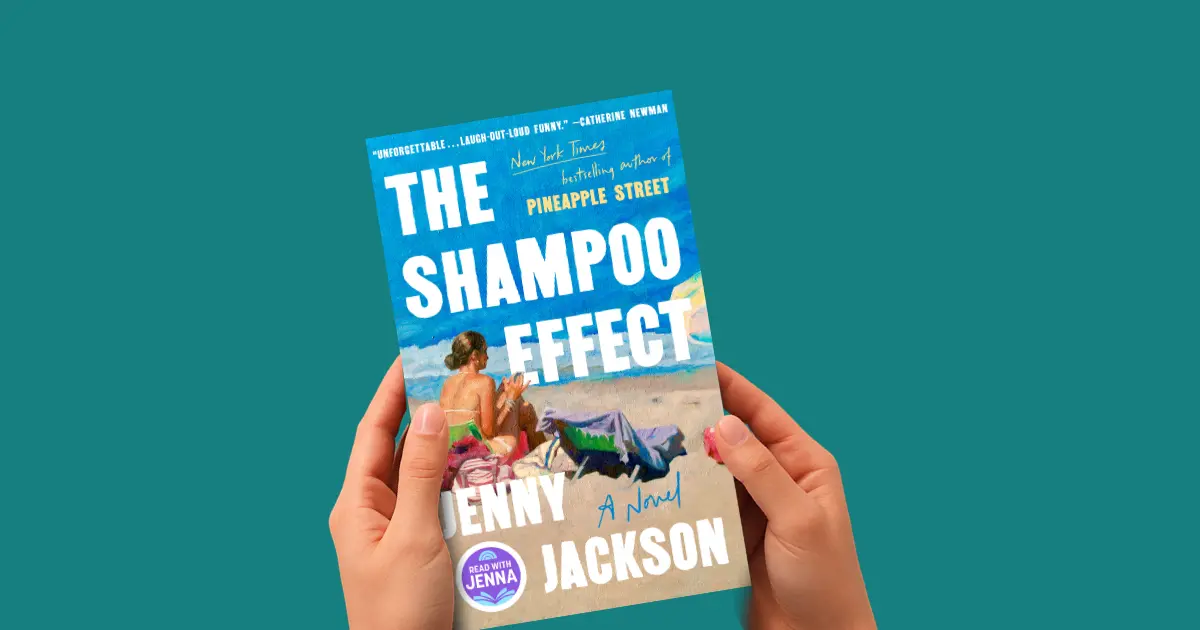
Are you trying to figure out why Jenny Jackson called her new beach read The Shampoo Effect, and whether it’s worth bumping to the top of your summer stack? I read through everything on this book the week it launched, the reviews, the author interviews, the publisher notes, so you don’t have to hunt for it across ten different tabs. Here’s the full picture.
The Shampoo Effect is Jenny Jackson’s follow-up to her bestseller Pineapple Street, and it swaps wealthy Brooklyn for a fictional Massachusetts beach town, where a writer’s residency turns into a front-row seat to a friend group’s slow-motion unraveling. It’s funny, warm, occasionally messy in structure, and genuinely interested in what “old friends” costs you as an adult. It’s already Jenna Bush Hager’s July 2026 book club pick.
Jackson’s real subject isn’t romance or scandal, it’s the uncomfortable truth that friendship, unlike family, is conditional, and that a group’s shared history can lather up old grievances just as fast as it creates new joy.
The Shampoo Effect is best for readers who loved Pineapple Street and want more of Jackson’s eye for the small, specific details of a place and its people. It’s also a strong pick if you’re drawn to multi-POV women’s fiction in the Emily Henry or Emma Straub lane, or if you’re a fan of Elin Hilderbrand’s New England settings but want something with a bit more bite underneath the beach umbrella.
It’s probably not for you if you want a tight, fast-moving plot from page one. Several early readers have flagged that the setup takes its time before the real conflict lands, and if you’re not invested in the ensemble by then, that slower stretch can feel like a lot of scene-setting. It’s also not the book to reach for if you want a single, uncomplicated romantic arc; this is an ensemble story told from several angles, and Caroline shares the page with almost as many characters as she has scenes alone with Van.
Important Passages
Jackson has a gift for the hyper-observant detail that reveals character instantly. For instance, when we first meet Van, he’s described as having “the vibe of someone who knew his way around a kayak or a climbing gym” with “long, brown hair tucked behind his ears.”
He’s the type who “picked up litter when they walked on the beach, empty beer cans or tattered candy wrappers,” and once, he “picked up the plastic applicator of a tampon that had floated in from the sea and carried it in his hand two miles to put it in the trash.”
One of the novel’s defining moments comes when Caroline struggles to find her footing within Van’s friend group. As she tells her friend Nina, “They kept calling me ‘the pledge’ which was weird?” This captures the impenetrable nature of the group perfectly.
The Shampoo Effect Summary
The Shampoo Effect opens with a meet-cute that’s equal parts charming and embarrassing. Caroline Lash, a 28-year-old writer and daughter of a famous author, is on a train to Greenhead, Massachusetts, where she’s been awarded an 18-month writer’s fellowship.
In her rush to board, she steps on a jelly donut, which explodes red goo all over her crotch. A cute guy—Van Whittaker—offers her napkins and disappears with the awkward assumption that it’s a menstrual situation.
Caroline soon settles into her seaside cottage, the former home of literary legend Palmer Preston, and begins her fellowship. She runs into Van again—first at the bank, then at the drugstore, where he leaves a jelly donut on her car.
They eventually connect for real on a tour of Crane Castle, where Caroline discovers Van actually works as an environmental scientist for the property. He’s been following her around. They start dating, and Caroline is thrilled. Van is kind, thoughtful, and refreshingly different from the Brooklyn boys she used to date.
But Van comes with baggage—specifically, a tight-knit group of childhood friends. There’s Bailey, a gorgeous blond who looks like she stepped out of a ’90s magazine and who has an on-again, off-again history with Van.
There’s Augusta, an old-money horsewoman who’s rigid and judgmental. And there’s Fran, a dark-haired engineer drowning in her family’s problems while raising two kids with her fun-loving but immature partner, RJ.
The situation becomes infinitely more complicated when Bailey reveals she’s pregnant—and Van is the father. Van and Caroline decide to stay together and muddle through, but the pregnancy throws the entire friend group into disarray. Caroline struggles to find her place, constantly feeling like an outsider compared to Bailey’s lifelong bond with Van.
Meanwhile, cracks begin to appear in the other relationships. Augusta discovers a pair of mystery underwear in her couch cushions, sending her into a spiral of suspicion about her husband Colin. She becomes convinced he’s cheating. Fran, on a work trip to Hawaii, meets a man named Cal and forms an intense emotional connection, falling asleep in his bed (though nothing physical happens). She returns home questioning everything about her life with RJ.
The pressure builds as Caroline’s fellowship comes to an end. Van admits he can’t be the partner Caroline needs, that his priority will always be Dylan, his son with Bailey. They break up. Van eventually moves in with Bailey, trying to make a family work for Dylan’s sake. Devastated, Caroline turns her heartbreak into art. She writes a short story for The New Yorker that’s loosely based on Van’s friend group—exposing all their secrets.
The story goes viral. Augusta sees herself portrayed as a delusional housewife who doesn’t know her husband is gay. Fran is depicted as a victim of her family’s financial ruin, stuck with a drunk partner. And most devastatingly, Caroline reveals that Colin—Augusta’s husband—used to hook up with her brother, Eben.
The fallout is immediate and brutal. Colin moves out. Eben freezes Augusta out even more. Fran confronts Caroline and gives her the cold shoulder. Caroline’s reputation in Greenhead is destroyed. She retreats to New York, living in her childhood bedroom, grappling with what she’s done.
But here’s where the shampoo effect comes into play—the idea that old feelings and patterns are never fully washed away. For decades, this group has been cycling through the same dynamics. Van and Bailey on again, off again. Colin and Eben’s secret. Augusta’s rigid control. Fran’s resentment. The short story forces everything into the sunshine.
Over time, the characters begin to reckon with their lives. Colin comes back to Augusta. They have difficult conversations about his past and her own insecurities. Fran confronts RJ about his drinking and their unequal partnership; he agrees to quit and they decide to get married. Augusta reconnects with her brother Eben, apologizing for prioritizing her father’s money over their relationship.
In the end, Caroline’s book actually helps the group. By exposing the secrets they’ve all been ignoring, she forces them to finally grow up. The book ends with Caroline back in New York, having written a new novel—this time about herself.
She returns to Greenhead for a book event and finds a jelly donut on her car, a sign from Van that he remembers her too.
Table of Contents
The Shampoo Effect Analysis
Characters
Caroline Lash is the catalyst of the entire novel. She’s ambitious, observant, and deeply insecure about her famous mother’s shadow. Her fatal flaw is turning real life into art without considering the consequences. She’s both sympathetic and maddening—you understand why she did what she did, but you also see how it destroyed trust in the group.
Van Whittaker is the ultimate good guy. He’s described as having the “personality of a Border Collie”—loyal, helpful, and happiest when assigned tasks. He picks up litter on the beach, checks the oil in Caroline’s car, and genuinely wants to be a good father. But his flaw is his inability to fully commit. He’s pulled between Caroline and the gravitational pull of his lifelong history with Bailey.
Bailey Newmarch is the confident, gorgeous ex who can’t quite shake Van even when she doesn’t want to be with him. She gets pregnant with his child but insists she wants to be a single mother. She’s more complicated than she first appears, grappling with her own superficiality and the guilt of keeping Van waiting for years.
Augusta Nickerson is the uptight old-money friend who married her brother’s best friend. She’s so obsessed with maintaining appearances that she can’t see what’s right in front of her—the secret her husband and brother have been keeping for decades. Her arc is about learning to let go of control and accept imperfection.
Fran Gianopoulos is the most grounded of the group, but she’s drowning. She’s raising two sons while managing her family’s financial ruin and her husband’s immaturity. Her emotional affair in Hawaii serves as a wake-up call to address the inequities in her relationship with RJ.
Colin Nickerson and Eben Nickerson are at the center of the novel’s biggest twist. Colin and Eben were high school lovers, a secret they’ve kept from Augusta for years. Colin married Augusta to be close to the family (or at least, that’s the gossip), and Eben has been freezing Augusta out to avoid revealing the truth. When Caroline outs them in her story, it forces everyone to confront what happened and whether it even matters anymore.
Themes and Symbolism
The Shampoo Effect: This is the central metaphor of the book. The term refers to the way a second squirt of shampoo produces outsized suds, just as old feelings and patterns can be reactivated instantly when a relationship is revisited. Jackson applies this to everything—romantic relationships, friendships, and the way people revert to their teenage selves when they go home.
In-Group vs. Outsider: Caroline is an outsider who doesn’t realize how deeply entrenched Van’s friend group is. No matter how much Van loves her, he will always revert to his high school self when surrounded by his childhood friends. The group is “very much like brothers and sisters, except that some of them happen to be married to one another.” This clannishness makes it nearly impossible for Caroline to truly belong.
Secrets and Honesty: The novel explores the cost of keeping secrets. Augusta and Colin’s relationship is built on a lie. Fran’s family hides their financial problems. The group as a whole hides from their own patterns. Caroline’s story is malicious, but it also functions as a kind of truth-telling that ultimately frees everyone.
Millennial Midlife: Jackson’s characters are in their thirties, navigating the gap between their youthful identities and the responsibilities of adulthood. The book explores how parenthood changes everything: “You can think you’re an environmentalist and only buy things secondhand and then suddenly you’re neck-deep in plastic toys.”
Motherhood vs. Creative Identity: This theme comes through most clearly in Caroline’s mother, Gwendolyn, a famous writer who tells Caroline that parenthood would “drain you of your creative energy.” The question of whether women can have both family and a successful career hovers over the entire novel, especially when Caroline ultimately chooses her writing over Van and his baby.
Coming of Age in Middle Age: Jackson has called this a “coming-of-age story for those heading for middle age.” The characters are all in their thirties, but they haven’t fully matured. They’re still partying, gossiping, and holding onto old grudges as if they were teenagers. The crisis forces them to finally grow up.
Loyalty and Chosen Family: The novel interrogates the tension between lifelong friendship and romantic love. Van’s loyalty to his friends is so strong that it prevents him from fully committing to Caroline. Bailey’s loyalty to her friend group—and her complicated history with Van—keeps her from fully moving on. The book asks whether chosen family can ever truly be unconditional.
Evaluation
Jackson’s sophomore novel is a significant step forward from her debut, Pineapple Street. While the earlier novel was a sharp, satirical take on the 1%, The Shampoo Effect is more grounded and emotionally complex. It’s funny and gossipy without being mean-spirited, and it offers real insight into the pressures of modern parenting and the difficulty of maintaining old friendships.
Strengths
Precision of Observation: Jackson has an incredible gift for taking the most ordinary moments and turning them into something meaningful. As one reviewer put it, she’s “hyper-observant,” making every small detail reveal character.
Rotating POV: The novel shifts between Caroline, Bailey, Augusta, and Fran, giving us a 360-degree view of the drama. This makes the story feel rich and nuanced, never reducing anyone to a villain.
Sharp Dialogue: Jackson’s characters talk the way people actually talk—with wit, vulnerability, and the shorthand of people who’ve known each other forever.
The Shampoo Effect Metaphor: This is a brilliant organizing principle that gives the novel its title and its emotional core. It captures why these characters can’t seem to move forward.
Weaknesses
Low Stakes: As some reviewers have noted, these are extremely privileged people dealing with first-world problems. If you’re not already invested in their world, the lack of high-stakes conflict can feel like a weakness.
Caroline’s Story Is Overwhelming: While the rotating POV is effective, the novel’s heart is really with Caroline, and her story can sometimes feel less compelling than the secrets unfolding in the original group.
The Ending Feels Tidier Than Real Life: After all the drama—the pregnancy, the short story, the revelation of Colin and Eben’s secret—the ending wraps up almost too neatly. Everyone gets their happy ending, and the shampoo effect seems to wash away most of the damage.
Impact and Controversy
The novel has been compared to John Updike’s Couples, a scandalous 1968 novel about extramarital entanglements that exposed the secrets of its author’s own social set. Jackson acknowledges this inspiration in her author’s note. The comparison is apt—both novels are about the ripple effects of sexual mores and secrecy in a small community.
The Shampoo Effect has been a commercial success, selected as a “Read with Jenna” book club pick for July 2026 and receiving mostly rave reviews. It’s been described as “the platonic ideal of a beach read” by The New York Times. But it’s also sparked discussion about the ethics of writing about real people. Caroline’s story—and the way she weaponizes her writing—raises uncomfortable questions about the boundaries of fiction.
Comparison with Similar Works
The clearest comparison is with John Updike’s Couples, which inspired the novel’s setting and themes. Both books are set in small Massachusetts towns and explore the sexual and emotional dynamics of a close-knit friend group. However, Jackson’s novel is more contemporary, focusing on millennials navigating parenthood and the lingering effects of the sexual revolution.
For fans of contemporary fiction, The Shampoo Effect will appeal to readers who enjoyed Jackson’s Pineapple Street, as well as the work of Emma Straub, Taffy Brodesser-Akner, and Katherine Heiny. These authors share a gift for sharp social observation and character-driven plots.
Personal Insight: The “Shampoo Effect” in Real Life
The central insight of the novel is that we all have a “shampoo effect” in our own lives—patterns and relationships that we can’t fully wash away. When we return to our childhood homes, we revert to our teenage selves. When we reconnect with old friends, we slip back into old dynamics.
This resonates because it’s true. As Jackson said in her NPR interview, “I think we’re all familiar with the concept of going home for Thanksgiving and becoming our teenage selves.” The key is recognizing when those patterns are holding us back.
The novel also offers a sharp critique of the way we manage our relationships in adulthood. We sweep things under the rug to preserve the peace, but eventually, everything comes out. As Jackson put it, “When you’ve been friends with people for a really long time, things start to change. And the changes start to make you question yourself.”
Ultimately, The Shampoo Effect suggests that the cost of keeping secrets is higher than the cost of honesty. The characters who thrive are the ones who are willing to have difficult conversations and forgive the people they love.
5 Key Lessons from the Novel
Old Patterns Are Hard to Break: The “shampoo effect” means that even when you think you’ve moved on, old relationships and habits have a way of resurfacing. True growth requires breaking the cycle.
Secrets Always Come Out: The novel demonstrates that hiding uncomfortable truths only makes the fallout worse when they inevitably surface.
Parenthood Changes Everything: The characters who are parents all grapple with the tension between their pre-baby identities and their new responsibilities. You can’t live the same life once you have a child.
Lifelong Friendships Are Conditional: Unlike family, friendships require active nurturing. They can survive secrets, but only if both parties are willing to do the work.
Art Has Consequences: Caroline’s story is a cautionary tale about the ethics of writing about real people. Even when you disguise the truth, the people you love will see themselves.
Quotable Lines
“Virtue was no longer sought in temple or market place but in the home—one’s own home, and then the homes of one’s friends.” — John Updike, Couples (Used as the novel’s epigraph)
“And my friends all smell like weed or little babies.” — Taylor Swift, “Florida!!!” (Also used as an epigraph)
“I think we’re all familiar with the concept of going home for Thanksgiving and becoming our teenage selves.” — Jenny Jackson, on the novel’s central theme
“Van is a pure guy. His love language is acts of service. He will check the oil on your car. If you go for a walk on the beach, he’s going to be picking up litter the whole way.” — Jenny Jackson, describing Van
Conclusion
The Shampoo Effect is a sparkling, insightful novel about the messy work of growing up—even in your thirties. Jenny Jackson has crafted a story that’s both a breezy beach read and a sharp, deeply felt exploration of friendship, family, and the secrets we keep.
While the low stakes and tidy ending may frustrate some readers, the novel’s strengths far outweigh its weaknesses. Jackson’s prose is precise, her characters are vividly drawn, and her central metaphor—the shampoo effect—is smart and resonant.
Recommendation: This is a must-read for fans of character-driven fiction about complicated relationships and modern domestic life. If you loved Pineapple Street, Big Little Lies, or the work of Emma Straub, you’ll want to pick this one up.







