
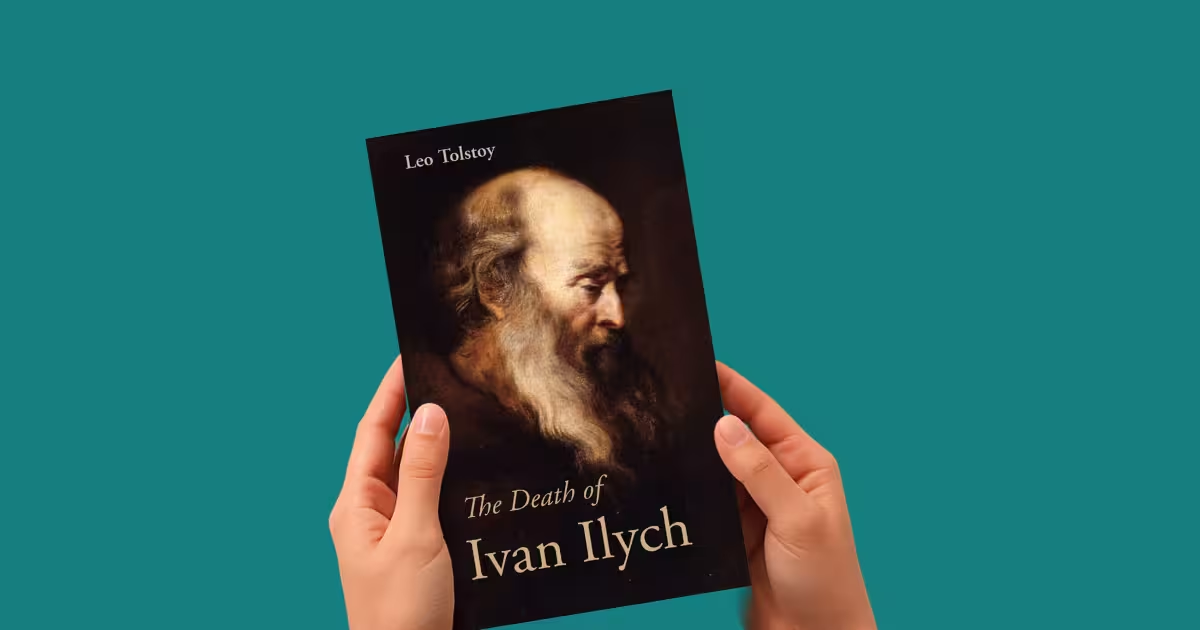
Did you ever climb the ladder of a career, a marriage, or a reputation, only to wonder halfway up whether you had picked the right wall to lean it against? Leo Tolstoy asked that question in 1886, and few writers since have answered it as directly, or as uncomfortably, as he does in The Death of Ivan Ilyich.
A respected Russian judge falls off a stepladder while hanging curtains, develops a pain in his side that never goes away, and spends the rest of the book dying and slowly realizing that his entire “successful” life may have been built on the wrong things. The only person who tells him the truth about his own death is his servant. It is short, it is bleak, and it is one of the most assigned pieces of fiction in medical schools around the world.
The Death of Ivan Ilyich is best for readers who liked Tolstoy elsewhere and want him at his shortest and sharpest, medical and nursing students, anyone who has recently sat with a sick relative, book clubs that want a fast read with a lot to argue about, and fans of existential fiction like Kafka or Camus.
Not for anyone who wants a plot-driven page-turner, readers who are currently grieving a recent loss and need something gentler right now, or anyone hoping the ending wraps up neatly with obvious comfort.
Table of Contents
1. Introduction
The Death of Ivan Ilyich (Смерть Ивана Ильича in the original Russian, sometimes transliterated Ilych or Ilyitch) is a novella by Leo Tolstoy, first published in Russian in 1886. Tolstoy was 58 years old and already the author of War and Peace and Anna Karenina when it appeared, but this book reads like it was written by a different man.
It runs to roughly 30,000 words across twelve short chapters, tells the story of a mid-level Russian magistrate named Ivan Ilyich Golovin, and opens, unusually, with his funeral. Everything else in the book explains how he got there, and what happened to him in the months before he did.
2. Background
Tolstoy did not invent this story out of nothing. In July 1881, a judge in the Tula court system named Ivan Ilyich Mechnikov died of stomach cancer at age forty-five, the same age Tolstoy would later give his fictional protagonist.
Tolstoy heard the details from Mechnikov’s brother, who reportedly said the judge had undergone a real spiritual change near the end and come to see much of his career as wasted. Tolstoy’s first idea was to call the story “The Death of a Judge” and tell it as a diary, but he eventually chose a third-person narrator instead, which let him show how an entire society, not just one dying man, reacts to death.
The timing matters.
A few years earlier, Tolstoy had gone through the religious and moral crisis he documents in A Confession (1879-1882), in which he wrote that he could no longer live without confronting the fact that every day was carrying him toward death.
The Death of Ivan Ilyich was the first major fiction he published after that crisis, and it reads like an argument he needed to finish making to himself. The Death of Ivan Ilyich is also set against the backdrop of Russia’s 1864 judicial reforms, which created the modern court system Ivan Ilyich climbs through, and which the novella itself references directly.
One detail that tends to surprise people: Tolstoy gave the finished manuscript to his wife Sonya as a birthday present, and by most accounts she was delighted with it, grim subject matter and all.
3. The Death of Ivan Ilyich Summary
Part One: The Funeral (Chapter I)
The Death of Ivan Ilyich opens in a courthouse, where a group of lawyers learns from a newspaper notice that their colleague Ivan Ilyich has died. Their first reactions are not grief. Each man quietly calculates what the vacancy might mean for his own career, and each feels a small, guilty flash of relief that it is Ivan Ilyich who is dead and not himself.
One of them, Pyotr Ivanovich, goes to pay his respects that evening. At the house, he performs the expected rituals (crossing himself, murmuring the right words to the widow, Praskovya Fedorovna) while privately negotiating an uncomfortable hassock and thinking mostly about getting to his card game on time.
The widow’s real agenda becomes clear fast: she wants Pyotr Ivanovich’s advice on how to word her pension request so the government pays her more. Only one person in the house behaves without any performance at all: Gerasim, the young peasant who assisted Ivan Ilyich during his final illness.
When Pyotr Ivanovich offers him an awkward condolence, Gerasim answers simply that it is God’s will, that everyone will die someday. Pyotr Ivanovich leaves the funeral and heads straight to his card game.
Part Two: Climbing the Ladder (Chapters II-III)
Tolstoy then rewinds to tell us who Ivan Ilyich actually was, and the description is deliberately deflating: his life had been “the most simple and the most ordinary and the most horrible,” precisely because there was nothing unusual about it at all.
He was the middle son of a Petersburg official, went to law school, and built a career by doing exactly what was expected of him at every stage: pleasant to superiors, correct with subordinates, comme il faut (proper, as the French phrase repeated throughout the book puts it) in every visible respect.
He married Praskovya Fedorovna less out of love than because marrying her was the sensible, socially approved thing to do. When she became demanding and difficult, especially after the birth of their children, he did not confront the problem. He simply retreated further into his career, treating the office as a walled garden where life stayed pleasant because he controlled it completely.
Several of the couple’s children died young; two survived, their daughter Liza and their son Vasya. After a professional setback in 1880 when a hoped-for promotion goes to a rival named Goppe, Ivan Ilyich travels to Petersburg in frustration and, through a stroke of office politics unrelated to his own merit, lands an even better position than the one he had been chasing, with a five-thousand-ruble salary.
Thrilled, he and Praskovya Fedorovna find a new house and Ivan Ilyich throws himself into decorating it, prizing the furniture and drapery almost more than anything else in his life. While standing on a stepladder to show an upholsterer how he wants the curtains hung, he slips and bruises his side on a window frame. He laughs it off. It heals quickly. It also, as we later learn, does not really heal at all.
Part Three: The Fall (Chapters IV-VI)
A dull ache in his side, at first barely worth mentioning, slowly grows into something he cannot ignore.
Marital fights escalate. Praskovya Fedorovna finally insists he see a doctor, and Tolstoy stages that visit as a mirror image of Ivan Ilyich’s own courtroom: the doctor is evasive, technical, and more interested in sounding authoritative than in answering the one question Ivan Ilyich actually wants answered, which is whether he is going to die.
Diagnoses pile up and contradict each other (a floating kidney, appendicitis, chronic catarrh), and Ivan Ilyich starts consulting doctor after doctor, hoping one of them will tell him something different. None do.
By Chapter V, his brother-in-law arrives for a visit and, on seeing Ivan Ilyich for the first time in months, cannot hide his shock. Ivan Ilyich locks himself in his room afterward and compares his reflection to an old photograph, and for the first time really sees how much he has deteriorated.
That night, lying in bed, the truth arrives all at once: this is not a kidney problem or an appendix problem, this is a matter of life and death, and no one around him will say so out loud.
In Chapter VI, Tolstoy gives us the passage the book is now best known for in classrooms: Ivan Ilyich remembers the syllogism from his old logic textbook, “Caius is a man, men are mortal, therefore Caius is mortal,” and realizes that he has always believed this only applied to a generic man named Caius, never to the specific, particular person he is, the boy who loved a striped ball and kissed his mother’s hand.
The abstract fact of mortality and the felt reality of his own death turn out to be two completely different things.
Part Four: The Lie and Gerasim (Chapters VII-VIII)
As the illness worsens, Ivan Ilyich becomes almost entirely dependent on Gerasim, the young servant, who helps him with basic bodily functions and often holds Ivan Ilyich’s legs up on his shoulders for hours because it is the only position that eases the pain.
Gerasim does this cheerfully and without disgust, and at one point tells Ivan Ilyich plainly that everyone dies eventually, so a little extra work now is no burden. He is the only person in the household who does not pretend Ivan Ilyich is merely “a bit unwell.”
Tolstoy is explicit that this constant, low-grade dishonesty (family, friends, and doctors all insisting he is going to get better) tortures Ivan Ilyich more than the physical pain does.
Chapter VIII shows a full day of this: a doctor’s visit full of theater and no honesty, Praskovya Fedorovna dressing up to take their daughter and future son-in-law to see Sarah Bernhardt at the theater while Ivan Ilyich stays home in pain, and a stilted family visit afterward that ends in an unbearable silence no one knows how to break.
Part Five: The Black Bag (Chapters IX-X)
Alone one night, Ivan Ilyich breaks down completely, crying and demanding to know from God why this is happening to him. In the quiet that follows, he starts to hear something like an internal voice asking him plainly what it is he actually wants.
The answer surprises him: not medicine, not a cure, just to live, and to live well, the way he always believed he had been living. But when he replays his happiest memories in search of proof, he finds the opposite: the further he gets from childhood, the thinner and more hollow every pleasure looks in hindsight.
He arrives at one of the book’s sharpest lines, reflecting that he had gone downhill in perfectly measured steps while believing the whole time that he was climbing.
He briefly wonders whether he simply failed to live as he should have, then immediately rejects the thought as impossible, because he did everything correctly by every standard he was ever taught to measure himself against.
Chapter X deepens this spiral: unable to leave the sofa now, he pictures his life as a stone falling faster and faster toward the ground the closer it gets to impact, and admits to himself that there is no way to make sense of any of it if he insists his life was actually lived right.
Part Six: Was My Whole Life Wrong? (Chapter XI)
In the middle of all this, Liza’s fiance Petrishchev finally proposes, and the household is briefly happy about something else for a change. That same night, Ivan Ilyich takes a serious turn for the worse. The doctor admits privately to Praskovya Fedorovna that nothing more can be done except managing pain with opium.
And here The Death of Ivan Ilyich turns from physical suffering to something worse: watching Gerasim’s calm, patient face one night, Ivan Ilyich is struck by a genuinely new and horrifying thought, not the comforting old question of whether he lived correctly, but its opposite: what if his whole life, his entire conscious life, has actually been false? He tries to defend his career, his marriage, his reputation, and finds that none of it holds up under his own scrutiny anymore. He agrees, mostly to please his wife, to take communion.
It brings him a short-lived, false sense of hope that he might recover after all. When Praskovya Fedorovna asks brightly whether he feels better, he says yes, but everything about her, her clothes, her voice, her performance of concern, screams the word false back at him. He orders her out of the room.
Part Seven: The Light (Chapter XII, Ending Explained)
The final chapter covers three days of continuous screaming, audible from two rooms away, as Ivan Ilyich struggles against dying the way a condemned prisoner struggles against an executioner he knows he cannot beat.
Tolstoy’s image for this is a black, narrow bag or sack that some invisible force keeps pushing him deeper into, with something faintly lit at the bottom of it. What is actually torturing him in these last hours is not the pain but the unresolved question underneath it: he still cannot admit his life was wrong, and that refusal is what keeps him stuck.
An hour before he dies, his schoolboy son Vasya creeps to the bedside, catches his father’s flailing hand, and kisses it, then begins to cry. In that instant, something in Ivan Ilyich finally gives way. He looks at his son and feels sorry for him. He looks at his weeping wife and, for the first time in the book, feels sorry for her too, rather than hating her.
He tries to say “forgive me” to his family but what actually comes out, garbled, is “forego me,” and he does not have the strength left to correct himself; he simply trusts that whoever needs to understand it will. The moment he stops defending his old life and lets himself feel compassion instead of self-justification, the torment breaks.
He searches for the pain and cannot find it. He searches for his fear of death and it is simply gone. In its place, he sees light instead of darkness. His last clear thought is that death itself, the thing he has been fighting for three days, is finished, and that whatever comes next is not death at all. He exhales, and dies, while the people gathered around him keep waiting for another two hours of visible agony that, for him, is already over.
4. The Death of Ivan Ilyich Analysis
4.1 The Death of Ivan Ilyich Characters
Ivan Ilyich Golovin is built to be an everyman, and that is the entire point of him. Tolstoy goes out of his way to make sure Ivan Ilyich is not a villain, not a fool, and not unusually cruel.
He is “intelligent, polished, lively, and agreeable,” a genuinely capable judge who never once takes a bribe or abuses his power. His tragedy is not that he did anything wrong by the standards of his world. It is that the standards of his world turn out, on his deathbed, to have been worth almost nothing. Watching him shift from smug self-justification to real vulnerability over twelve chapters is the engine of the whole book.
Praskovya Fedorovna, his wife, is the character readers argue about most, and for good reason.
For most of the novella we see her only through Ivan Ilyich’s increasingly bitter point of view: self-absorbed, performative in her grief, more interested in her pension than in her dying husband. But it is worth noticing that Tolstoy gives her almost no interior life of her own, which means we are getting one side of a marriage that, by the text’s own account, went wrong from both directions.
She is a difficult woman married to a man who retreated from her for two decades and treated the marriage as an inconvenience to be managed rather than a relationship to be lived in.
Neither spouse comes out of that arrangement looking especially good.
Gerasim, the young peasant servant, is the moral center of the book despite having barely any dialogue. He is healthy, physically strong, and utterly unbothered by the smell and indignity of caring for a dying man, because in his worldview death is simply something that happens to everybody, including eventually him, so there is no reason to lie about it or flinch from it.
Every other character in the novella performs a version of normalcy around Ivan Ilyich’s illness. Gerasim is the only one who does not perform anything at all, and that honesty is what makes him, oddly, the most comforting presence in the sickroom.
Pyotr Ivanovich, who opens the book at the funeral, exists mainly to show us how easy denial is. For one unguarded moment at the wake, he is genuinely frightened by the thought that Ivan Ilyich’s fate could be his own, and then, almost immediately, he talks himself out of the feeling and heads off to play cards. He is the reader’s own likely reaction, dramatized and gently mocked.
Liza and Vasya, the surviving children, split the book’s judgment on the next generation. Liza is largely absorbed in her own engagement and treats her father’s illness as an intrusion on her happiness.
Vasya, the younger, is the one exception among the family: a frightened schoolboy who, along with Gerasim, seems to be the only person who actually understands and pities his father, and whose small act of kissing his father’s hand becomes the emotional hinge of the book’s final page.
The doctors function almost as a single character. Tolstoy draws a pointed parallel between them and Ivan Ilyich’s own career as a judge: both professions perform confident authority over people at their most vulnerable, both reduce a human being’s specific suffering to generic procedure, and both put on a convincing show of competence rather than telling an uncomfortable truth.
4.2 The Death of Ivan Ilyich Themes and Symbolism
The Death of Ivan Ilyich‘s central theme is the difference between an authentic life and a merely correct one. Ivan Ilyich spends decades optimizing for comme il faut, propriety, the good opinion of people whose good opinion turns out not to matter at all once he is dying. Only Gerasim, who has never organized his life around anyone’s approval, is shown living authentically, and only Gerasim’s honesty gives Ivan Ilyich any real comfort.
Closely tied to that is the theme Tolstoy simply calls “the lie”: the collective, well-meaning dishonesty of everyone around a dying person, insisting he is merely ill rather than dying, because the truth is too uncomfortable for them to sit with. This idea is exactly what later made the book required reading in medical schools, discussed in detail in the personal insight section below.
Tolstoy’s key symbols reinforce all of this. The stepladder fall that starts his illness is not incidental: the injury that kills him happens while he is literally straining to make his home look more expensive and correct than it needs to be, so the cause of his death is, in a very real sense, his own vanity.
Whist, the card game he loves, stands in for every trivial, absorbing distraction people use to avoid sitting with anything real; it is no accident that Pyotr Ivanovich heads straight for a card table the moment he leaves Ivan Ilyich’s funeral.
The recurring image of a black sack or bag that Ivan Ilyich is forced through in his final days captures both the narrowness and the inevitability of dying; some readers see an echo of birth in it too, a narrow passage, a violent push, and then, on the other side, light.
And the story’s final reversal of light and darkness, in which the death he has feared for chapters turns out to dissolve into brightness rather than the black nothing he expected, is Tolstoy’s clearest statement that the fear of death and death itself might not be the same thing at all.
Finally, the syllogism about Caius (“men are mortal, therefore Caius is mortal”) dramatizes the gap between knowing a fact and believing it applies to you, which is arguably the single idea the entire novella is built to close.
5. Evaluation
Reading The Death of Ivan Ilyich in one sitting feels less like finishing a story and more like being handed a diagnosis. It is a genuinely uncomfortable piece of writing, and I mean that as the highest compliment I can give it. Few short books have made me put my phone down and just sit still for a minute afterward the way this one did.
5.1 Strengths
Tolstoy’s control of pacing is the real achievement here. He tells you in the first paragraph that Ivan Ilyich is dead, which should remove all suspense, and then spends eleven chapters making you dread the outcome anyway.
The physical description of illness (the taste in the mouth, the smell, the specific torment of a body that will not cooperate) is written with a precision that still reads as clinically accurate almost a century and a half later, which is exactly why doctors keep assigning it. And Gerasim, in maybe thirty lines of dialogue total, is one of the most quietly moving characters in Russian literature.
5.2 Weaknesses
The book’s honesty about Ivan Ilyich’s family works against it a little in the case of Praskovya Fedorovna, who is given almost no chance to be anything other than grating, which can feel like a one-sided verdict on a two-person marriage.
Tolstoy wrote this immediately after his own religious crisis, and it shows: the final chapter’s turn toward moral clarity and light arrives quickly after eleven chapters of unrelieved bleakness, and some readers find that shift a little too tidy given everything that came before it, more like the author’s own hoped-for resolution than something the character earns on the page.
5.3 Impact and Controversy
The novella’s reach goes well beyond literature classes. Arthur Miller’s Death of a Salesman and Aleksandr Solzhenitsyn’s Cancer Ward both work variations on the same basic premise: a man near the end of his life discovers that the metrics he used to measure his own worth were the wrong metrics all along. Interestingly, even the reception at the time was not uniformly glowing.
The brother of the real judge who inspired the story reportedly felt that his sibling’s actual spiritual awakening near death had been more significant than anything Tolstoy managed to put on the page, a reminder that turning a real person’s death into fiction rarely satisfies everyone who knew them.
The book also remains a genuine point of debate in classrooms for the reason mentioned above: readers regularly split on whether Ivan Ilyich or Praskovya Fedorovna is more to blame for the marriage’s failure, and whether either of them deserves the reader’s sympathy at all.
5.4 Comparison With Similar Works
If you liked this, Arthur Miller’s Death of a Salesman is the closest American cousin, another portrait of a man whose sense of self collapses the moment his professional usefulness runs out.
Franz Kafka’s The Metamorphosis shares its interest in a body and an identity betraying an ordinary man at the worst possible moment. Albert Camus’s The Stranger sits in similar philosophical territory, though it gets there from the opposite direction, indifference rather than false propriety.
And on the nonfiction side, Atul Gawande’s Being Mortal is close to a direct descendant, a modern doctor working through exactly the questions this novella raises about how badly medicine and family life handle the fact of dying.
6. Personal Insight: Why This 1886 Novella Still Matters in Medical School
Surgeon and public health researcher Atul Gawande opens Being Mortal by describing a single medical school seminar built entirely around this novella, and he is far from the only doctor with that story.
It has become a rite of passage into thinking seriously about death, and current numbers show why the exercise still matters: global surveys suggest only around 30 percent of people have had a detailed end-of-life conversation with their own families, and the World Health Organization estimates roughly 40 percent of people worldwide still lack access to basic palliative care.
A 2024-2025 Copenhagen University Hospital study found that patients who had a documented “serious illness conversation” before death were more likely to receive palliative care and less likely to face aggressive treatment in their final two weeks.
The gap Tolstoy dramatized in 1886, between what a dying person needs to hear and what everyone around them is willing to say, has not closed.
Five lessons The Death of Ivan Ilyich still teaches: competence at your job is not the same thing as a meaningful life; the people who tell you the truth, like Gerasim, are worth more than the people who manage your feelings; honesty about dying is a skill that has to be practiced, not an instinct anyone has naturally; regret has a specific, recognizable shape, matching Bronnie Ware’s well-known finding from years in palliative care that the most common deathbed regret is not having had the courage to live true to oneself rather than to others’ expectations; and a good death is ultimately a relational outcome, not a medical one.
7. Quotable Lines and Key Passages
Because the Dreiblatt translation used for this piece is still under copyright, the passages below are described rather than reproduced at length, with chapter references so you can locate the exact wording in your own copy.
- Chapter II: The book’s thesis statement in miniature, describing Ivan Ilyich’s life as simple, ordinary, and for that very reason, terrible.
- Chapter I: Gerasim’s blunt response to condolences, that death is simply God’s will and something everyone will eventually face, is often cited as the book’s most quoted line of dialogue.
- Chapter VI: The syllogism about Caius (“men are mortal, therefore Caius is mortal”) and Ivan Ilyich’s realization that he never actually believed it applied to him.
- Chapter VII: Gerasim’s remark that he does not begrudge Ivan Ilyich “a little sweat,” since everyone dies in their turn, is the closest thing the book has to a moral center.
- Chapter IX: The image of going downhill in perfectly measured steps while believing the whole time that he was climbing upward, arguably the sharpest single line in the entire novella.
- Chapter XI: The turning point where Ivan Ilyich first allows himself to wonder whether his entire conscious life has been false.
- Chapter XII: The final exchange in which he means to say “forgive me” and instead says “forego me,” followed by the description of fear dissolving into light rather than darkness at the very end.
8. Conclusion
The Death of Ivan Ilyich is not a comfortable read, and it is not trying to be. It is a book that asks you to sit with a stranger’s death for a hundred pages so you can look honestly at your own life while there is still time to change something about it.
Tolstoy wrote it at fifty-eight, freshly out of his own confrontation with mortality, and it shows in every chapter: this is a writer working out something urgent for himself, not performing sentiment for an audience.
I would recommend it without hesitation to anyone who has ever felt the specific, quiet dread of wondering whether they are climbing the right ladder, to medical and nursing students who want to understand where modern conversations about honest end-of-life care actually started, and to any serious reader of Russian literature who has read Anna Karenina but skipped the shorter, stranger books Tolstoy wrote afterward.
It is not a long book. It is one of the few short books that can genuinely change how you spend the rest of a Tuesday.
Frequently Asked Questions
What is The Death of Ivan Ilyich about?
It is a novella by Leo Tolstoy about a Russian judge who develops a fatal illness after a minor household accident and spends his final months realizing that his outwardly successful, proper life may have been built on the wrong priorities.
How does The Death of Ivan Ilyich end?
Ivan Ilyich screams in agony for three days, then, in his final hour, his son kisses his hand and he feels genuine compassion for his family for the first time. He tries to say “forgive me,” his fear of death disappears, he sees light instead of darkness, and he dies.
Is The Death of Ivan Ilyich based on a true story?
Yes, loosely. Tolstoy based it on the real 1881 death of Ivan Ilyich Mechnikov, a judge in the Tula court system who reportedly underwent a genuine late-life spiritual reckoning that Tolstoy heard about from the man’s brother.
Why do medical schools assign The Death of Ivan Ilyich?
Because it captures, with clinical precision, the isolation of a dying patient surrounded by people who cannot be honest with him. It remains a touchstone in medical humanities courses and is discussed at length in Atul Gawande’s Being Mortal.
Is there a movie based on The Death of Ivan Ilyich?
There is no major direct film adaptation, but Akira Kurosawa’s Ikiru (1952) is a celebrated loose adaptation, and the 2022 British film Living, written by Kazuo Ishiguro and starring Bill Nighy, is a remake of Ikiru two generations removed from Tolstoy’s original.
Who is Gerasim in The Death of Ivan Ilyich?
Gerasim is the young peasant servant who cares for Ivan Ilyich during his illness. He is the only character who does not lie to Ivan Ilyich about his prognosis, and his honesty and simple kindness make him the novella’s moral center.







