
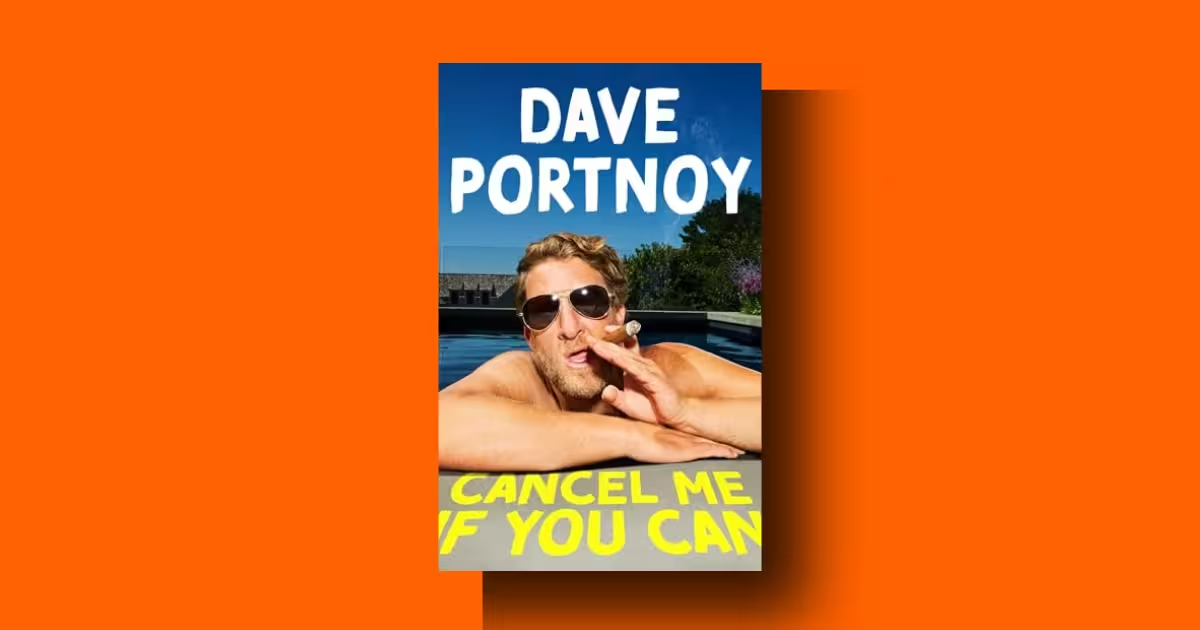
Do you want to know why a book that critics called “hagiography for a dumbass” landed at number one on the very bestseller list its author openly despises? I read all 21 chapters of Cancel Me If You Can twice, cross-checked every scandal Dave Portnoy describes against the public record, and wrote this so you can decide whether his side of the Barstool Sports story is worth your money before you buy it.
Cancel Me If You Can is Dave Portnoy’s first book, a 300-page memoir tracing Barstool Sports from a four-page Boston newspaper in 2003 to a company that has been valued at $650 million.
It is funny in places, genuinely informative about how internet media businesses get built, and almost entirely one-sided. Portnoy relitigates every fight he has ever had, from the “size six skinny jeans” joke to the Business Insider sexual misconduct allegations, and rarely gives an inch.
It debuted as an instant #1 New York Times bestseller and a national bestseller the same week Slate ran a review titled “Hagiography for a Dumbass.” Both things are true at once, and that contradiction is the most interesting thing about the book.
Cancel Me If You Can is best for longtime Stoolies who already know the cast of characters, readers who like unfiltered founder memoirs such as Shoe Dog or Can’t Hurt Me, media and marketing students studying how a blog outran legacy newspapers, and anyone who wants the inside numbers behind Barstool’s sale to Chernin Group and Penn Entertainment.
Cancel Me If You Can is not for readers hoping for self-reflection, anyone sensitive to crude jokes about sex, weight, or physical appearance, journalists or public figures named in the book expecting a fair hearing, or readers who want a business book with tidy, transferable lessons instead of two decades of grudges.
Table of Contents
1. Introduction
Cancel Me If You Can is Dave Portnoy’s debut memoir, published by Gallery Books, an imprint of Simon & Schuster, in June 2026. The hardcover runs 300 pages and lists for $32.99. Portnoy, known to millions as “El Presidente,” is the founder of Barstool Sports, the digital media company he started as a print sports and gambling newspaper in Boston in 2003.
Barstool has since grown into what its own marketing copy calls a nine-figure company with more than 300 employees and roughly 150 active brands, spanning blogs, podcasts, a sportsbook, merchandise, and live events.
Cancel Me If You Can‘s genre sits somewhere between business memoir and score-settling autobiography. Portnoy writes as both founder and unreliable narrator of his own legend, walking through the newspaper years, the blog era, the Blackout Tour, the sale to Peter Chernin’s investment group, the Penn Entertainment gambling partnership, and the string of media controversies that have followed him since roughly 2012.
His stated purpose, more or less, is right there in the title and in the book’s closing line: he was never actually canceled, no matter how many times journalists, activists, or advertisers tried, and he wants credit for that survival on his own terms.
One detail worth knowing before you start reading: Portnoy did not originally write this book alone. He told Front Office Sports that he first handed the project to a ghostwriter, his longtime Barstool colleague Francis Ellis, who spent six to eight months on a draft.
Portnoy read the opening paragraph, decided it did not sound like him, and rewrote the entire manuscript himself over the following six to eight months, working several hours a day.
Whatever else you think of the finished product, that origin story explains why the prose reads less like a polished celebrity memoir and more like an extremely long, extremely candid blog post.
2. Background
To understand why this memoir exists at all, it helps to remember what Barstool Sports has represented in American media for the better part of two decades. It launched into a media world still dominated by newspapers and sports-radio gatekeepers, and it built its audience by being deliberately crude, tribal, and fast, long before “influencer” was a job title.
That same formula made Barstool one of the most reliable flashpoints in the culture wars of the 2010s and 2020s, colliding repeatedly with feminist campus activism, #MeToo-era journalism, labor organizing, and eventually electoral politics.
Publishing a book under those conditions is not simple.
According to Slate‘s review of the memoir, several more traditionally minded publishing houses reportedly passed on the project before Gallery Books picked it up, a detail Portnoy himself references in the text when discussing how the fallout from the Blackout Tour still follows him.
That backdrop matters because it shapes the entire tone of the book: this is not a memoir written to win over skeptics. It is written for the audience that has already decided it is on Portnoy’s side.
3. Cancel Me If You Can Summary
If you would rather not track down all 300 pages, here is everything that happens, organized into the seven eras the book itself roughly follows.
3.1 The Newspaper Years (Chapters 1 to 2)
Portnoy graduated from the University of Michigan in 1999 and took a sales job at a Boston research firm before quitting to launch a gambling and sports newspaper. He started with $50,000, split between his own savings and a loan from his father, bought a hundred newsracks, and drove a secondhand Astrovan around Boston to distribute copies himself.
Early advertisers included the offshore sportsbook BetJamaica and Hooters. The turning point came when a reader named Ian White, who later became Business Insider’s chief technology officer, offered to build Barstool a website for free so he could keep reading it after moving to New York.
That website, launched around 2007 to 2008, turned Barstool from a print operation with a Boston ceiling into one of the first true sports blogs, unrestricted by print schedules or geography.
3.2 The Blog Boom and the Blackout Tour (Chapters 3 to 7)
As the blog grew, Barstool expanded into live college events, most notably Stoolapalooza, a campus tour that reportedly sold out three thousand tickets at UMass Amherst in under a minute.
That success fed directly into the Blackout Tour, an EDM concert series co-branded with the fantasy sports company DraftStreet that, at its peak, Portnoy says was clearing close to $200,000 in profit a night.
The tour also produced the memoir’s most consequential controversy: a small group calling itself KO Barstool organized protests after Portnoy published a joke online suggesting a woman “in skinny jeans” was less likely to be sexually assaulted.
Portnoy has never apologized for the joke, though he does call it, in his own words, one that “didn’t hit.” The controversy hardened into what he describes as the media’s permanent “Exhibit A” against Barstool, cited in nearly every hostile article written about the company since.
3.3 Building the Brand (Chapters 8 to 13)
This stretch covers Barstool’s cultural rise through the 2010s: the “Go Pres Go” rallying cry, Portnoy’s short-lived and unsuccessful run for mayor of Boston after the city rejected roughly 8,500 of his campaign’s ballot-access signatures, Barstool’s coverage of the 2013 Boston Marathon bombing, and the “Brady Four” chapters covering Deflategate and the NFL’s tense relationship with the company.
The pivotal business event here is the 2016 sale of a 51 percent stake to Peter Chernin’s investment firm, which opened negotiating at $7.5 million for that majority stake, valuing the whole company at roughly $12.5 to $15 million, a figure independently corroborated by outlets including the New York Times and Celebrity Net Worth.
That capital funded Barstool’s move from Boston to New York and the launch of Pardon My Take, the podcast hosted by Dan “Big Cat” Katz and Kevin “PFT Commenter” Clancy that Portnoy credits as one of the company’s biggest long-term earners.
3.4 Scandal and Superstardom (Chapters 14 to 16)
Portnoy calls the 2016 blowup known internally as “Grudgement Day” the single biggest day in Barstool Radio history, though the chapter’s real emotional center is his account of building and losing talent, including his description of discovering and later clashing repeatedly with radio host Nate “Spider Monkey” Kimball.
Cancel Me If You Can then turns to Pat McAfee’s arrival and eventual departure for ESPN, before landing on the most-discussed section of the entire memoir: the 2020 collapse of Call Her Daddy, the podcast hosted by Alex Cooper and Sofia Franklyn.
Portnoy describes offering the two women a joint $500,000-salary renewal deal, watching the partnership implode amid dueling loyalties, and ultimately recording a solo episode of the show himself that he says drew roughly two million subscribers.
Cooper went on to sign a three-year, $60 million deal with Spotify when her Barstool contract expired, then a three-year, $125 million deal with SiriusXM in 2024, figures Portnoy states directly in the book and that align with widely reported industry coverage of both agreements.
3.5 Selling the Pirate Ship (Chapters 17 to 18)
By 2019, Portnoy writes, he wanted an investor who would take on the company’s financial risk without requiring him to sell the Barstool name outright.
That led to the 2020 deal with Penn National Gaming, later renamed Penn Entertainment, which purchased a 36 percent stake for roughly $163 million with an option to acquire the rest for up to $388 million more, a structure that put Barstool’s total valuation at $650 million by Portnoy’s own account, a number in the same range independently reported by CelebrityNetWorth and the New York Times.
The same period produced “Davey Day Trader Global,” Portnoy’s viral pandemic-era livestream trading persona, which put him at the center of the January 2021 GameStop and r/WallStreetBets short squeeze, an interview with Robinhood CEO Vlad Tenev, and a cameo appearance built from his own footage in the 2023 film Dumb Money.
He also recounts turning down an early Bitcoin position at roughly $11,000 per coin, a decision he says cost him about $12 million in missed profit.
3.6 Politics, Business Insider, and the Fight to Survive (Chapters 19 to 20)
Portnoy describes his 2016 vote for Donald Trump, the backlash that followed, and his surreal July 2020 trip to interview Trump in the White House Rose Garden, an interview in which he says he became one of the only people to get Trump to admit, on camera, that he regretted some of his own tweets.
Cancel Me If You Can then turns to what is by far its most serious material: the November 2021 and February 2022 Business Insider articles by reporter Julia Black, which included on-the-record and pseudonymous accounts from multiple women alleging that sexual encounters with Portnoy became violent or nonconsensual, and a follow-up report alleging he filmed encounters without consent.
Portnoy calls the reporting a fabricated hit piece timed to hurt Penn Entertainment’s stock and describes suing Insider, its reporters, and its executives for defamation.
What Cancel Me If You Can does not mention is how that lawsuit actually ended. Court records reported by Axios, Mediaite, and Awful Announcing show a federal judge dismissed Portnoy’s case in November 2022, ruling he could not clear the “actual malice” standard required of public figures in defamation suits, and specifically noted that Insider had corroborated the women’s accounts with photographs, text messages, medical reports, and third-party witness statements.
Portnoy dropped his appeal in February 2023. Insider has said it stands by the reporting. None of that legal context appears in the memoir’s account of the episode, which is worth knowing before you take the chapter’s framing at face value.
Cancel Me If You Can also describes a lengthy, ultimately fruitless New York Times investigation into Portnoy conducted by reporters Emily Steel and Liz Day, which he presents as further proof of his innocence in the broader court of public opinion, along with an anecdote in which he and a colleague drove to Liz Day’s home to confront her, an incident he says his own book editor urged him to cut.
3.7 Buying It Back for a Dollar (Chapter 21 and Epilogue)
The memoir’s final act covers the 2023 firing of on-air personality Ben “Mintzy” Mintz after he read a racial slur while reciting rap lyrics on a livestream, a firing Penn’s gambling regulators required and that Portnoy says he fought against internally.
Weeks later, Penn negotiated an exclusive sportsbook partnership with ESPN, which insisted, as a condition of the deal, that Portnoy have no ongoing role at Barstool.
Rather than accept a buyout, Portnoy negotiated to purchase the entire company back from Penn for one dollar, taking on Barstool’s roughly $12 million in annual losses along with a ten-year non-disparagement agreement covering ESPN Bet.
When Penn exited its ESPN partnership at the end of 2025, per the book, that clause expired, freeing Portnoy to tell the story publicly for the first time. The book closes with a short epilogue describing life back in full control of Barstool as he approaches his fiftieth birthday, splitting time between Nantucket and the Florida Keys.
4. Cancel Me If You Can Analysis
Does Portnoy support his version of events with real evidence? Selectively.
He is genuinely strong on business detail: specific dollar figures, dates, percentages, and deal structures show up constantly, and where those numbers can be checked against outside reporting from outlets like the New York Times, Axios, and CelebrityNetWorth, they generally hold up.
That is real, verifiable value for anyone studying how a scrappy media company negotiates with private equity and a public gaming company.
Where Cancel Me If You Can falls apart as evidence is anywhere the conflict is personal rather than financial. Portnoy is judge, jury, and narrator of every feud in this book, and the people he fights with, Sofia Franklyn, journalist Marisa Ingemi, journalist Julia Black, ESPN’s Mina Kimes, never get to answer back on the page.
That is not automatically dishonest; it is simply the nature of a first-person memoir.
But when Portnoy frames the Business Insider lawsuit’s dismissal as vindication rather than a First Amendment ruling that never reached the underlying facts, the book crosses from “unreliable narrator” into territory that a critical reader needs outside sourcing to catch.
Judged purely on its stated purpose, proving that Portnoy was never actually canceled, the book succeeds. Judged as a trustworthy account of the controversies it describes, it does not.
5. Cancel Me If You Can evaluation
5.1. Strengths and Weaknesses
What works: The early chapters on building Barstool from a newsrack operation into a national blog are genuinely compelling, full of the kind of granular, “here is exactly how much a hundred-pound bag of sand costs” detail that makes founder stories worth reading.
Portnoy is also funny when he is self-deprecating rather than combative, and his account of the “Fat Dave” era, the failed hot dog eating contest, and the six-mile-run, twelve-beer, eighteen-jerk-off, twenty-four-donut challenge lands as intentional comedy rather than accidental cringe.
The business chapters on the Chernin and Penn deals are also unusually transparent for a founder memoir, naming specific percentages and dollar amounts most executives keep private.
What does not work: The score-settling overwhelms roughly the back half of the book. Multiple chapters exist mainly to relitigate old fights with named private citizens, including one passage mocking a reporter’s appearance that even Portnoy admits is “mean.” The N-word incident involving Mintz gets several pages of justification rather than reflection.
And the Business Insider chapter, the section readers most need context for, presents only Portnoy’s account without acknowledging the legal record. Readers who already dislike Portnoy will find nothing here to change their mind, and that appears to be by design rather than by accident.
6. Comparison With Similar Books
Readers who liked Cancel Me If You Can for its unfiltered founder voice might also try Shoe Dog by Phil Knight, the Nike founder’s memoir, which covers similarly high-stakes company building but with far more self-doubt and hindsight built in.
David Goggins’s Can’t Hurt Me shares Portnoy’s aggressive, profanity-heavy tone and his refusal to soften hard truths, though Goggins’s book is built around personal transformation rather than public feuding.
Richard Branson’s Losing My Virginity covers similar “built an empire by breaking rules” territory with considerably more warmth toward the people along the way.
And in terms of pure market dynamics, critically panned but commercially dominant celebrity memoirs are not new; Prince Harry’s Spare followed a nearly identical pattern of savage reviews paired with record first-week sales, suggesting that for sufficiently famous, sufficiently divisive authors, the review and the sales chart are simply answering two different questions.
7. Contemporary Relevance: Why the Critics and the Bestseller List Disagree
Cancel Me If You Can debuted as an instant number one New York Times bestseller and a national bestseller the same week Slate published a review under the headline “Hagiography for a Dumbass,” calling it “300 pages of ‘I’m not owned, I’m not owned.'”
Portnoy’s public response to that review was four laughing emojis on social media, which tells you almost everything about how little the critical reception affects his commercial calculus. Barstool’s core audience, the Stoolies, functions less like a readership and more like a subscription base that has followed Portnoy’s daily content for two decades; they are not buying a book so much as renewing a relationship.
That dynamic explains a real tension worth naming directly: a book can be a legitimate publishing success and a legitimately one-sided piece of writing at the same time.
Neither fact cancels out the other, and pretending otherwise, in either direction, misses what is actually happening with this release.
8. Cancel Me If You Can Quotes
A few short lines capture the book’s voice better than any summary can:
- “Don’t give up the ship.”
- “Hate is my Gatorade.”
- “My currency is loyalty.”
- “I don’t negotiate with terrorists.”
- “If you hit me with a feather, be ready for the wrench.”
- “You don’t cancel me; I cancel you.”
9. Conclusion
Cancel Me If You Can is best suited to readers who already follow Barstool Sports, business students curious about how a scrappy digital media company negotiated its way through two major private equity deals, and anyone who enjoys blunt, profane, unfiltered founder memoirs in the Shoe Dog or Can’t Hurt Me tradition.
It is not suited to readers looking for a balanced account of Portnoy’s most serious controversies, or for anyone hoping a bestselling memoir automatically means a well-reported one.
The two things Cancel Me If You Can proves most clearly are that Dave Portnoy built a genuinely significant media company almost entirely through instinct and stubbornness, and that he has still, after twenty years, never once considered that some of his critics might have had a point.
FAQs
Is Cancel Me If You Can worth reading?
It depends on what you want from it. As a business story about building a media company from a Boston newsrack operation into a $650 million brand, it is genuinely informative. As a fair account of Dave Portnoy’s controversies, it is one-sided by design, since only his version of events appears on the page.
What is Cancel Me If You Can about?
It is Dave Portnoy’s memoir of founding and running Barstool Sports, covering the newspaper years, the Blackout Tour, the sale to the Chernin Group and later Penn Entertainment, the Call Her Daddy podcast dispute, his interview with Donald Trump, the Business Insider allegations against him, and his 2023 buyback of the company for one dollar.
Who wrote Cancel Me If You Can?
Dave Portnoy is credited as the sole author. He has said a ghostwriter, Barstool colleague Francis Ellis, produced an early draft that Portnoy ultimately rewrote himself over roughly six months.
Is Cancel Me If You Can a New York Times bestseller?
Yes. Simon & Schuster and multiple retailers list it as an instant number one New York Times bestseller and national bestseller following its June 2026 release, despite largely negative critical reviews.
Does the book address the Business Insider sexual misconduct allegations?
Yes, but only from Portnoy’s perspective. He describes suing the outlet for defamation; the book does not mention that a federal judge dismissed that lawsuit in 2022 on First Amendment grounds without ruling on whether the underlying allegations were true.
How long is Cancel Me If You Can?
The hardcover edition runs 300 pages across 21 chapters plus an epilogue, published by Gallery Books, an imprint of Simon & Schuster, in June 2026.
What happened between Dave Portnoy and the Call Her Daddy hosts?
Portnoy describes a contract dispute with hosts Alex Cooper and Sofia Franklyn in 2020 that ended their partnership with Barstool. Cooper later signed a three-year, $60 million deal with Spotify, followed by a three-year, $125 million deal with SiriusXM in 2024.







