
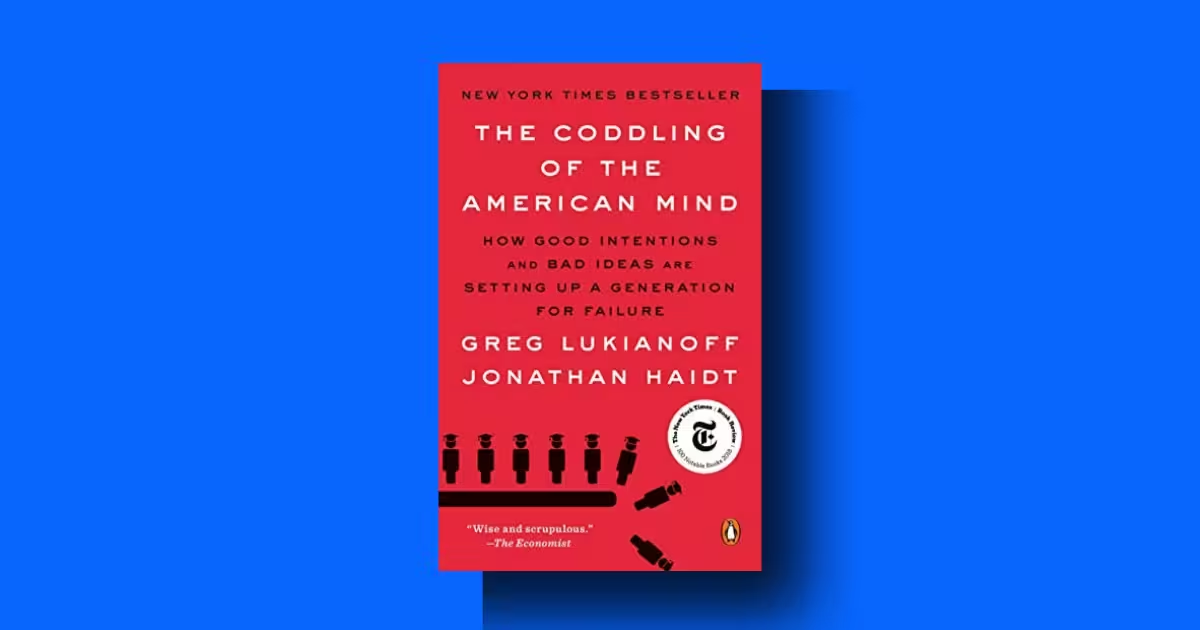
Do you ever feel like the world has become too fragile—where words wound like weapons and disagreement feels like danger? If that question stirs something in you—whether you’re a parent watching your child navigate an anxious adolescence, an educator wondering why students seem increasingly brittle, or simply someone who remembers when college was a place for intellectual combat rather than emotional safety—then Greg Lukianoff and Jonathan Haidt’s The Coddling of the American Mind demands your attention.
This isn’t just another culture war screed. It’s a meticulously researched, psychologically grounded intervention into one of the most pressing questions of our time: Why are today’s young people more anxious, depressed, and fragile than ever before—and what can we do about it?
The Coddling of the American Mind argues that well-intentioned efforts to protect young people from discomfort have backfired spectacularly. Drawing on cognitive behavioral therapy, developmental psychology, and social science, Lukianoff and Haidt identify three “Great Untruths” that have taken root in education and parenting:
- The Untruth of Fragility: What doesn’t kill you makes you weaker.
- The Untruth of Emotional Reasoning: Always trust your feelings.
- The Untruth of Us Versus Them: Life is a battle between good people and evil people.
These ideas, the authors contend, contradict ancient wisdom and modern psychology, and they’re actively harming the generation that embraces them.
The book traces how these untruths spread through a confluence of forces: rising political polarization, surging teen anxiety and depression, paranoid parenting, the decline of free play, expanding campus bureaucracy, and a shifting conception of social justice.
The result is a generation less resilient, more anxious, and ill-prepared for adult life.
The Coddling of the American Mind is best for parents, educators, university administrators, mental health professionals, and anyone concerned about the mental health crisis among young people. Also essential reading for students themselves who want to understand why they feel the way they do and what they can do about it.
Not for readers seeking a purely conservative or liberal partisan take—the book defies easy political categorization and will frustrate anyone looking for simple ideological comfort. Also not ideal for those who believe that all campus activism is justified or that trigger warnings and safe spaces are universally beneficial.
Table of Contents
Introduction
First published on September 4, 2018, by Penguin Press, The Coddling of the American Mind: How Good Intentions and Bad Ideas Are Setting Up a Generation for Failure emerged from a highly influential 2015 Atlantic article by the same authors.
Greg Lukianoff, a First Amendment lawyer and president of the Foundation for Individual Rights in Education (FIRE), brought a lawyer’s precision to the problem. Jonathan Haidt, a social psychologist at NYU’s Stern School of Business and author of The Righteous Mind and The Happiness Hypothesis, contributed deep expertise in moral psychology and cross-cultural wisdom.
Together, they crafted a book that The New York Times Book Review called “a disturbing and comprehensive analysis of recent campus trends,” warning that “the consequences of a generation unable or disinclined to engage with ideas that make them uncomfortable are dire for society”.
The book’s central thesis is provocative yet grounded: Overprotection is harming university students, and practices like trigger warnings and safe spaces may do more harm than good. But this isn’t a book about coddled, entitled kids.
As one reviewer noted, “despite the title, students are never actually portrayed as ‘coddled’ or ‘entitled.’ Rather, the authors’ primary focus is on enhancing the well-being of ‘iGen’ students who Haidt and Lukianoff recognize are more anxious and depressed with every successive year”.
In fact, Lukianoff himself has admitted he preferred the title “Disempowered” because the book is about how well-meaning adults have unwittingly taught young people the mental habits of anxious and depressed individuals.
Background
When the book was published in 2018, teen anxiety and depression rates were already surging. By 2016, roughly one out of every five girls aged 12–17 had experienced a major depressive episode in the past year—up significantly from just a few years earlier. Suicide rates among adolescent girls had nearly doubled since 2007. Something was clearly wrong.
Fast forward to today, and the crisis has only deepened—though there are glimmers of hope. The 2024-2025 Healthy Minds Study, surveying more than 84,000 students across 135 colleges, found that severe depression among students has dropped from 23% in 2022 to 18% in 2025.
Suicidal thoughts decreased from 15% to 11% over the same period. Yet still, more than one in three college students report experiencing moderate anxiety or depression. The problem hasn’t disappeared; it’s simply plateaued at crisis levels.
What makes The Coddling of the American Mind particularly urgent reading in 2025 is how presciently it diagnosed the forces driving this crisis—and how its proposed solutions have only gained relevance.
Haidt has since written The Anxious Generation (2024), expanding on many of these themes with a specific focus on smartphones and social media. But The Coddling remains the foundational text, the one that connected the dots between parenting, education, psychology, and politics in a way no other book had done.
The Coddling of the American Mind Summary
The Framing Device: A Journey to Misoponos
The book opens with a memorable allegory. Lukianoff and Haidt describe a fictional journey to Greece to consult an oracle named Misoponos—a name that means “hater of painful toil and hardship”. The oracle dispenses three pieces of “wisdom” that are, in fact, the three Great Untruths:
- “What doesn’t kill you makes you weaker. So avoid pain, avoid discomfort, avoid all potentially bad experiences.”
- “Always trust your feelings. Never question them.”
- “Life is a battle between good people and evil people.”
The irony is deliberate: these sound like sensible, protective advice. But they’re precisely wrong, and they’re making young people less capable of navigating life’s challenges.
Great Untruth #1: The Untruth of Fragility
The first Great Untruth—”What doesn’t kill you makes you weaker”—is a direct inversion of Nietzsche’s famous aphorism and a rejection of the concept of antifragility.
Drawing on Nassim Nicholas Taleb’s work, the authors explain that complex systems—including human minds—actually require stressors to grow stronger. Just as muscles atrophy without exercise and immune systems fail without exposure to pathogens, young people need challenges to develop resilience.
The book illustrates this with the compelling example of peanut allergies. In the 1990s, parents began protecting children from peanuts, fearing allergic reactions.
The result? Peanut allergies tripled. When researchers deliberately exposed high-risk infants to peanut products, only 3% developed allergies, compared to 17% in the “protected” group. The lesson: shielding children from potential threats often creates the very vulnerability we’re trying to prevent.
This insight extends directly to campus culture. The authors write: “When children are raised in a culture of safetyism, which teaches them to stay ’emotionally safe’ while protecting them from every imaginable danger, it may set up a feedback loop: kids become more fragile and less resilient, which signals to adults that they need more protection, which then makes them even more fragile and less resilient”.
Great Untruth #2: The Untruth of Emotional Reasoning
The second Great Untruth—”Always trust your feelings”—contradicts ancient wisdom from Epictetus (“What really frightens and dismays us is not external events themselves, but the way in which we think about them”) to Buddha (“Our life is the creation of our mind”).
The authors draw heavily on cognitive behavioral therapy (CBT), which Greg Lukianoff credits with saving his life during his own battles with depression. CBT teaches that feelings are compelling but often unreliable—they distort reality, deprive us of insight, and damage our relationships.
The goal isn’t to ignore emotions but to question them, to examine the evidence, and to free ourselves from common cognitive distortions.
The book lists nine common cognitive distortions, including:
- Emotional reasoning: Letting your feelings guide your interpretation of reality (“I feel depressed; therefore, my marriage is not working out”)
- Catastrophizing: Focusing on the worst possible outcome (“It would be terrible if I failed”)
- Dichotomous thinking: Viewing events in all-or-nothing terms (“I get rejected by everyone”)
- Mind reading: Assuming you know what people think without sufficient evidence (“He thinks I’m a loser”)
The authors argue that the concept of microaggressions—particularly the emphasis on “impact over intent”—encourages these very distortions. When students are taught to interpret ambiguous statements in the least generous way possible, they’re being trained to engage in mind reading, catastrophizing, and dichotomous thinking.
Great Untruth #3: The Untruth of Us Versus Them
The third Great Untruth—”Life is a battle between good people and evil people”—activates our most primal tribal instincts. Drawing on social psychology research, the authors show how easily humans divide the world into “us” and “them,” even on arbitrary criteria like overestimating or underestimating the number of dots on a page.
The book distinguishes between two forms of identity politics. Common-humanity identity politics, exemplified by Martin Luther King Jr., draws larger circles of inclusion and appeals to shared values. Common-enemy identity politics, in contrast, unites people through shared hatred of an outgroup.
The latter, the authors argue, has become increasingly dominant on campus, amplified by social media and intersectionality theory.
The result is a call-out culture where students gain status by identifying and publicly shaming offenders. One student quoted in the book describes the experience: “I probably hold back 90 percent of the things that I want to say due to fear of being called out”. Another describes a campus where “everyone was on exactly the same page about a suspiciously large range of issues. Internal disagreement was rare”.
How Did We Get Here? Six Explanatory Threads
Part III of the book identifies six intersecting forces that have created the current crisis:
1. Rising Political Polarization
Since the 1990s, Americans have become increasingly hostile toward the opposing political party. Figure 6.1 in the book shows that the distance between Republicans and Democrats on policy questions has grown dramatically since 2004. Figure 6.2 shows that Americans’ feelings toward the other party have become increasingly “cold” or hostile.
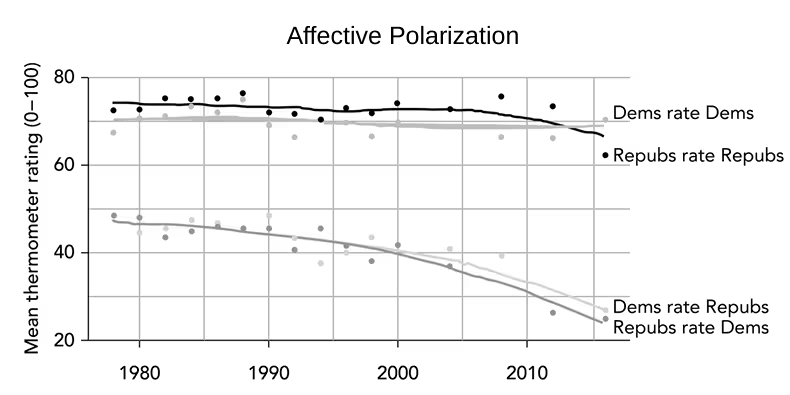
have barely changed since the 1970s, but Americans have become increasingly “cold” or
hostile toward the other party since the 1990s.
This affective polarization has turned politics into a tribal battle, with universities as prime battlegrounds.
2. Rising Rates of Teen Anxiety and Depression
Anxiety and Depression is the book’s most cited chapter and the direct seed of Haidt’s later work. Drawing on psychologist Jean Twenge’s research, it shows that the generation born in and after 1995, which Twenge calls “iGen,” reports far higher rates of anxiety, depression, and self-harm than Millennials did at the same age.
Specific figures include: teen girls’ suicide rate roughly doubling from 2007 to the mid-2010s; hospital-recorded self-harm rates for girls aged 10 to 14 nearly tripling, from about 110 to 318 per 100,000 between 2009 and 2015; and the share of college students self-reporting a psychological disorder rising 126% for men and 150% for women between 2012 and 2016, according to the Higher Education Research Institute.
Twenge’s own data point to screen time as the strongest single correlate, with risk climbing sharply past roughly two hours of daily leisure screen use, and Common Sense Media figures cited in the book put average teen screen time at around nine hours a day.
The statistics are stark. By 2016, roughly one in five adolescent girls had experienced a major depressive episode in the past year. Suicide rates among girls had nearly doubled since 2007. The authors link this surge to the rise of smartphones and social media, particularly for girls who are more affected by social comparison and relational aggression.
3. Paranoid Parenting
Despite crime rates falling to historic lows, American parents have become increasingly fearful. The book traces this to highly publicized child abductions in the 1980s and the subsequent media amplification of stranger danger. The result is a generation of children who have been deprived of unsupervised play and the opportunity to develop independence.
(Paranoid Parenting) and (The Decline of Play) track how fear of abduction (statistically tiny, and lower than in the 1970s and 80s) combined with test-prep culture to strip children of unsupervised outdoor play, which the authors argue is not a luxury but a biological requirement for building risk tolerance and social skill.
4. The Decline of Free Play
Children today spend far less time in unstructured, unsupervised play than any previous generation. This matters because play is essential for developing social skills, risk assessment, and resilience.
As Peter Gray, a leading play researcher, explains: “Children seem to be dosing themselves with moderate degrees of fear, as if deliberately learning how to deal with both the physical and emotional challenges of the moderately dangerous conditions they generate”.
5. The Bureaucracy of Safetyism
(The Bureaucracy of Safetyism) shows how campus administrative staff have grown faster than faculty for decades, encouraging a “CYA” (cover-your-ass) instinct that produces ever-more-restrictive rules, including “Bias Response Teams” that let students anonymously report each other.
Universities have become increasingly administrative and bureaucratic, with a growing focus on managing risk and liability. This has created a culture of moral dependency, where students rely on authorities to resolve conflicts rather than developing the skills to do so themselves.
6. The Quest for Justice
(The Quest for Justice) distinguishes “proportional-procedural” social justice, which tries to guarantee fair process and equal opportunity, from “equal-outcomes” social justice, which is sometimes willing to bend fair process to guarantee equal results, and argues that campus conflict often comes from these two intuitions clashing without anyone naming the difference out loud.
Today’s students have been shaped by a series of powerful social justice movements and events—from Black Lives Matter to #MeToo, from the election of Donald Trump to the Charlottesville rally. Their passion for justice is real and admirable, but when combined with the other five threads, it can lead to destructive outcomes.
Wising Up
The final section is prescriptive. Chapter 12 (Wiser Kids) offers six parenting principles built around free play, teaching kids CBT basics at home, and a proposed new American norm of a gap year of national service or paid work before college.
Chapter 13 (Wiser Universities) recommends that schools formally adopt the University of Chicago’s 2015 free-speech statement (reprinted in Appendix 2), refuse to reward the “heckler’s veto,” and add viewpoint diversity to their existing diversity goals.
The Conclusion ends on real optimism, pointing to Utah’s 2018 “free-range parenting” law and a wave of universities adopting the Chicago Statement as early proof that the trend can reverse.
The Coddling of the American Mind Analysis
What the Book Gets Right
The diagnosis is largely correct. The three Great Untruths are genuinely harmful, and they have spread through education and parenting. The mental health statistics speak for themselves: something is going badly wrong for American teenagers, and the book offers a compelling explanation.
The CBT framework is powerful. The insight that many campus controversies reflect cognitive distortions is genuinely illuminating. When students catastrophize about a visiting speaker or engage in dichotomous thinking about their opponents, they’re not just being difficult—they’re exhibiting patterns that, if left unchecked, will make them more anxious and depressed.
The historical context is valuable. By tracing the rise of safetyism through multiple threads—parenting, play, politics, bureaucracy—the authors avoid simplistic explanations and offer a genuinely multifaceted account.
The solutions are practical. The book doesn’t just diagnose; it prescribes. From teaching children CBT basics to promoting free play to encouraging gap years, the authors offer concrete, evidence-based recommendations.
Where the Book Falls Short
The title is misleading. As even Lukianoff has admitted, the word “coddling” suggests spoiled, entitled children—which is precisely what the book argues against. The subtitle, “How Good Intentions and Bad Ideas Are Setting Up a Generation for Failure,” is more accurate but less catchy.
The critique of intersectionality is oversimplified. The authors acknowledge that intersectionality can be a valuable tool for understanding complex forms of oppression, but they focus primarily on its more problematic manifestations. This can make the book seem like a wholesale rejection of identity politics rather than a nuanced critique of its excesses.
The political framing can be frustrating. The book has been embraced by conservatives and criticized by progressives, even though the authors are themselves liberal. This isn’t necessarily the authors’ fault, but it does mean the book is often read through a partisan lens that obscures its more nuanced arguments.
Some evidence is dated. Reading the book in 2025, some of the examples—particularly the focus on Milo Yiannopoulos and the 2016 election—feel like ancient history. The underlying dynamics remain relevant, but the book would benefit from an updated edition.
Comparison with Similar Works
If The Coddling of the American Mind is the diagnosis, Haidt’s own 2024 follow-up, The Anxious Generation: How the Great Rewiring of Childhood Is Causing an Epidemic of Mental Illness, is the treatment plan for just one of its six threads: the phone-based childhood.
Reading them back to back is genuinely illuminating, since Coddling explains why safetyism spread and The Anxious Generation explains, in far more detail, exactly how smartphones did the damage.
Jean Twenge’s iGen is the raw data source behind Chapter 7 and is worth reading directly if the statistics interest you most. Haidt’s earlier book, The Righteous Mind, supplies the “elephant and rider” psychology this book leans on throughout, and I cover it in my roundup of 100 best nonfiction books that changed the world.
On the media-and-attention side of the argument, Neil Postman’s Amusing Ourselves to Death, which I reviewed here, makes a strikingly similar case about an earlier medium, television, training a culture out of patience and argument, decades before smartphones existed.
Chris Murphy’s Crisis of the Common Good, which I also reviewed, picks up the loneliness and polarization threads from Chapter 6 and Chapter 11 and carries them into the 2020s.
And for the free-speech-on-campus angle specifically, my piece on the real-world banned-book fights around Slaughterhouse-Five is a useful companion, since it shows the same “protect students from discomfort” instinct playing out in a completely different setting: the high school reading list rather than the university lecture hall.
William Deresiewicz’s Excellent Sheep (2014) critiques the elite university system and the pressure-cooker environment that produces anxious, directionless students. The Coddling shares this concern but offers a more systematic psychological framework, while Nassim Nicholas Taleb’s Antifragile (2012) provides the philosophical foundation for the book’s argument about the benefits of stress and challenge.
Conclusion
The Coddling of the American Mind is ultimately a hopeful book. The problems it diagnoses are serious, but they’re not irreversible. The authors conclude: “We predict that things will improve, and the change may happen quite suddenly at some point in the next few years”.
Their optimism rests on several “green shoots”: growing awareness of social media’s harms, the spread of free-range parenting laws, a rethinking of identity politics, and universities recommitting to the pursuit of truth. The book’s final message is one of empowerment: we can choose to reject the Great Untruths and raise children who are wiser, stronger, and more resilient.
As Chief Justice John Roberts put it in a commencement speech quoted in the book: “From time to time in the years to come, I hope you will be treated unfairly, so that you will come to know the value of justice. I hope that you will suffer betrayal because that will teach you the importance of loyalty… I wish you bad luck, again, from time to time so that you will be conscious of the role of chance in life”.
That’s not cruelty. That’s wisdom. And it’s precisely the wisdom that The Coddling of the American Mind seeks to restore.
Who should read this book? Parents, educators, university administrators, mental health professionals, and anyone who cares about the next generation.
It’s accessible to general readers but rigorous enough for specialists. If you’ve ever wondered why so many young people seem anxious, fragile, and quick to take offense—and what you can do about it—this book offers both diagnosis and cure.
Frequently Asked Questions
What are the three “Great Untruths” in The Coddling of the American Mind?
The Untruth of Fragility (what doesn’t kill you makes you weaker), the Untruth of Emotional Reasoning (always trust your feelings), and the Untruth of Us Versus Them (life is a battle between good people and evil people).
What does “safetyism” mean in The Coddling of the American Mind?
Safetyism is a belief system, a term coined by researcher Pamela Paresky, in which safety, including emotional comfort, becomes a sacred value that overrides other practical and moral concerns, such as free inquiry or fair process.
How is The Coddling of the American Mind connected to The Anxious Generation?
Jonathan Haidt co-wrote Coddling in 2018 with Greg Lukianoff, and its Chapter 7 argument about smartphones, social media, and rising teen anxiety became the full subject of Haidt’s 2024 solo bestseller, The Anxious Generation.
Is The Coddling of the American Mind based on real events?
Yes. Every major case study, including incidents at Yale, Claremont McKenna, Middlebury, UC Berkeley, and Evergreen State College, is a real, dated, named event, sourced to news coverage and, where available, video footage.
Who should read The Coddling of the American Mind?
Parents, K-12 and university educators, college-bound students, journalists covering education or youth culture, and anyone trying to understand rising teen anxiety and campus speech conflicts through one connected argument.
What is the main criticism of The Coddling of the American Mind?
Critics, including The Guardian‘s Moira Weigel, argue the book leans on case studies from a small number of elite universities and gives less weight to tuition costs, student debt, and the corporatization of higher education as competing causes of student stress.







