
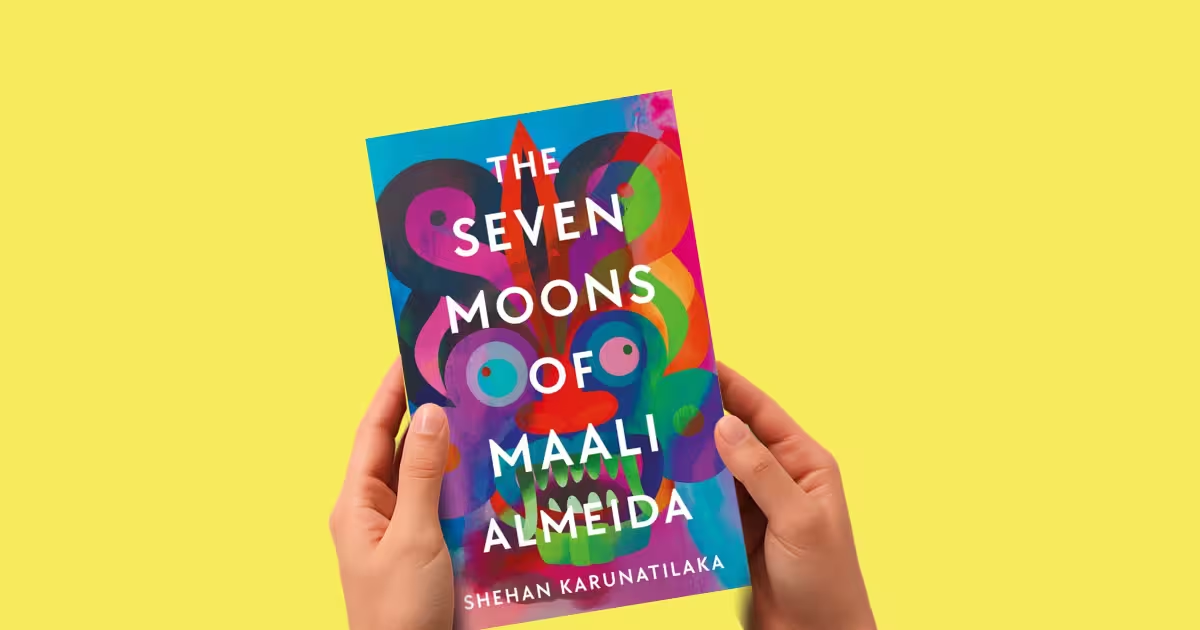

Did you ever wonder what the dead would say if they could speak? Shehan Karunatilaka’s Booker Prize-winning novel answers that question with a ghost story that’s equal parts murder mystery, political satire, and love letter to a broken country.
The Seven Moons of Maali Almeida is a searing satire of Sri Lankan politics, a murder mystery, and a ghost story all in one. Discover why this Booker Prize-winning novel is essential reading for fans of magical realism and political fiction. A dead war photographer gets seven moons (one week) in the afterlife to solve his own murder and lead his loved ones to a hidden cache of photographs that could bring down the Sri Lankan government. What follows is a searing, darkly comedic journey through one of the most violent periods in modern Sri Lankan history.
The Seven Moons of Maali Almeida is best for readers who enjoy literary fiction with magical realism, political satire, murder mysteries, and complex, morally grey protagonists. Fans of Salman Rushdie, Kurt Vonnegut, or George Saunders will find much to love here.
Not for those seeking a lighthearted read or a straightforward whodunnit. The Seven Moons of Maali Almeida deals with graphic violence, torture, and the brutal realities of civil war. Readers uncomfortable with explicit content or non-linear narratives may struggle.
Table of Contents
1. Introduction
Title: The Seven Moons of Maali Almeida
Author: Shehan Karunatilaka
Publisher: Sort Of Books
Publication Date: August 4, 2022
Awards: Winner of the 2022 Booker Prize
Shehan Karunatilaka made his mark on the literary world with his debut novel Chinaman: The Legend of Pradeep Mathew (2010), which won the Commonwealth Book Prize and was hailed as one of the great Sri Lankan novels.
His second novel, The Seven Moons of Maali Almeida, arrived twelve years later and immediately cemented his place among the most important voices in contemporary fiction. The book won the 2022 Booker Prize, Britain’s highest literary honour, marking only the second win from the South Asian subcontinent.
An earlier version of The Seven Moons of Maali Almeida was originally published in the Indian subcontinent as Chats with the Dead in 2020. The final version, published by the small independent London publisher Sort of Books, represents Karunatilaka’s ambitious attempt to weave together the socio-political concerns of the novel within a framework of magical realism.
2. Background
To understand The Seven Moons of Maali Almeida, you need to understand the Sri Lanka of the late 1980s. The novel is set in Colombo in 1989-1990, during one of the most violent periods in the country’s modern history.
Sri Lanka was embroiled in multiple conflicts simultaneously. The government was fighting a two-front war: against the Liberation Tigers of Tamil Eelam (LTTE) in the north and east, and against the Janatha Vimukthi Peramuna (JVP), a Marxist insurgency in the south. The Indian Peace Keeping Force (IPKF) had been deployed in 1987 and was itself accused of atrocities against civilians.
The book provides a useful cheat sheet for these abbreviations:
LTTE – Liberation Tigers of Tamil Eelam: wanted a separate Tamil state and were prepared to slaughter Tamil civilians and moderates to achieve this
JVP – Janatha Vimukthi Peramuna: wanted to overthrow the capitalist state and were willing to murder the working class while they liberated them
UNP – United National Party: in power since the late ’70s and embroiled in both wars
STF – Special Task Force: on behalf of the government, would abduct and torture anyone suspected of being or abetting the LTTE or the JVP
The government’s response to the JVP insurgency was brutal. As Minister Cyril Wijeratne reportedly said, “Twelve of yours for one of ours”. The JVP killed less than three hundred people; to crush them, the government killed more than twenty thousand, perhaps twice that.
Karunatilaka drew heavily on real-life figures for his characters. Maali Almeida is based on Richard de Zoysa, a journalist and human rights activist who was tortured and murdered by paramilitary forces close to the government. Dr. Ranee Sridharan is based on Dr. Rajini Thiranagama, a Tamil human rights activist murdered by the LTTE. Sena Pathirana is based on student activist Daya Pathirana.
As Karunatilaka observed in his Booker acceptance speech, he did not write about more recent events, such as the 2009 conclusion of the war, because he found them too recent and politically risky. However, the 1987-89 period remains a not-too-distant memory for Sri Lankans, and the novel’s proximity to “real life” adds to its unsettling effect.
3. The Seven Moons of Maali Almeida Summary
First Moon: Waking Up Dead
The Seven Moons of Maali Almeida opens with Maali Almeida waking up in what seems to be an endless waiting room. He’s wearing a safari jacket and faded jeans, one shoe, three chains, and a camera around his neck—a Nikon 3ST with a smashed lens. He doesn’t remember how he got there.
The afterlife, as Maali soon discovers, is a bureaucratic nightmare. “The afterlife is a tax office and everyone wants their rebate,” he observes. The dead queue in an amorphous crowd, shouting at Helpers in white saris who sit behind fibreglass counters.
Maali learns from Dr. Ranee Sridharan, a Tamil university lecturer who was gunned down for criticising the LTTE, that every soul has seven moons—seven nights—to wander the “In Between” before they must enter “The Light”. They must get their ears checked, their deaths counted, their sins coded, and their moons stamped by a Helper.
Maali is approached by a figure in a black garbage bag—Sena Pathirana, a dead JVP organiser. Sena warns Maali against the Helpers and their “brainwashing bureaucracy”. He offers to help Maali escape the afterlife bureaucracy and solve the mystery of his death.
The Discovery of the Body
Maali follows Sena to the banks of the Beira Lake, where he watches his own corpse being dumped by two garbage men—Balal Ajith and Kottu Nihal. They’ve tied bricks to his body, but the knots are loose, and the body floats. Maali watches in horror as his body is chopped at the spinal cord.
Sena reveals that he was also dumped in the Beira Lake many moons ago. He was the chief JVP organiser for Gampaha, one of the first to be taken out by the government’s death squads. He tells Maali that he tried to kiss Sena at a JVP rally in Wennappuwa—a memory Maali has repressed.
The Box Under the Bed
Maali remembers the photographs he took during his life. He has photos of the government minister who looked on while the mobs of ’83 torched Tamil homes and slaughtered the occupants. He has portraits of disappeared journalists and vanished activists, bound and gagged and dead in custody. He has images that could bring down governments.
These photos are hidden in a white shoebox under a bed in his mother’s house. Maali needs to get his loved ones—his flatmate Jaki and his lover DD—to find the box before the government does.
The Investigation
Maali’s investigation takes him through the ghostly In Between, where he encounters a host of characters: the Dead Atheist, a headless man who’s been wandering for over a thousand moons; the Dead Lawyer, a victim of the 1983 riots who now works with the Mahakali; and the Dead Priest, who sits on the roof of the torture Palace feeding on screams.
Meanwhile, in the living world, Jaki, DD, and Maali’s mother, Lakshmi Almeida, are searching for him. They visit police stations, confront corrupt cops, and eventually discover the box of photographs. But Minister Cyril Wijeratne, the man responsible for much of the violence, confiscates the box.
The Fifth Moon: Dreams and Whispers
Dr. Ranee teaches Maali to visit people in dreams. He appears to Jaki and DD, guiding them to the negatives hidden in Elvis and Queen record sleeves. He also visits his mother, finally making peace with her.
Maali learns that Sena is working for the Mahakali, the most powerful demon in the In Between. The Mahakali feeds on lost souls and has grown fat on the violence of the Sri Lankan civil war. Sena has recruited an army of dead JVP-ers, dead Tigers, and innocent civilians, and he plans to use them to exact revenge on the death squad that killed them.
The Sixth Moon: Mission Kuveni
Sena’s plan, Mission Kuveni, involves using Drivermalli—a young driver who lost his leg in the war—to bomb a meeting of the death squad leaders. Maali is horrified when he learns that Jaki has been kidnapped and taken to the Palace, the torture facility run by Major Raja Udugampola.
Maali makes a deal with the Mahakali: his soul in exchange for the power to whisper to the living. He uses his whispers to guide Detective Cassim to release Jaki. Stanley Dharmendran, DD’s father, arrives at the Palace just in time to take Jaki home.
The Seventh Moon: The Bomb
Maali follows Sena and the Mahakali to the Department of Justice Administrative Branch, where Drivermalli is about to detonate a suicide vest. Sena’s army of ghosts has orchestrated everything: the Acid-scarred Woman whispers in Ranchagoda’s ears; a bomb victim checks the circuitry; the Defiled Beauty Queen distracts the Minister’s Demon.
Maali uses his final whisper to stop Drivermalli from detonating the bomb. But Stanley Dharmendran bursts into the room, demanding answers about Jaki’s kidnapping. The Minister’s Demon wakes up, and in the chaos, Drivermalli detonates the bomb.
Major Raja Udugampola, the Mask (the interrogator), and ASP Ranchagoda are killed instantly. Stanley Dharmendran is also killed. Minister Cyril Wijeratne survives, having been pushed into the bathroom by his demon.
The River of Births
Maali flees the scene and finds his way to the River of Births, where Dr. Ranee is waiting. He drinks the kola kenda (green porridge) and enters The Light.
In The Light, Maali discovers the truth about his death. It wasn’t the government or the Tigers or the JVP who killed him. It was Stanley Dharmendran, DD’s father. Stanley had found a note Maali left for DD, came to the Hotel Leo, and confronted him. When Maali refused to leave DD alone, Stanley force-fed him cyanide capsules and had his thugs throw him off the balcony.
The Ending: A New Beginning
Maali wakes up as a Helper in the afterlife, working behind a counter just like Dr. Ranee. He processes souls, sends them for Ear Checks, and guides them towards The Light. He makes peace with his death and with the people he left behind.
DD leaves for Hong Kong with a new boyfriend. Jaki moves in with Radika Fernando. Maali’s mother joins the Mothers’ Front, campaigning for mothers whose children have been disappeared. The photos are exhibited at the Lionel Wendt gallery, but most are stolen or destroyed by the government.
In the final scene, Maali jumps into the River of Births with a dead leopard. He is reborn, forgetting everything, but knowing that “the brightness of The Light will force you to open your eyes wider”.
4. The Seven Moons of Maali Almeida Analysis
4.1. The Seven Moons of Maali Almeida Characters
Maali Almeida (Malinda Albert Kabalana): The protagonist is a deeply flawed but compelling character. A war photographer, gambler, and “closet queen,” Maali is cynical, sarcastic, and self-aware.
He’s also a man who genuinely loves—his lover DD, his best friend Jaki, and even his broken country. As one reviewer noted, “his love is genuine, and you can feel that in the way he talks about DD and Jaki — but also Sri Lanka”.
Maali’s character arc is one of redemption. He begins as a man who “quit each game they made you play”—chess, Cub Scouts, rugger, art class, insurance-selling, master’s degrees. He “dumped everyone who ever saw you naked” and “abandoned every cause you ever fought for”. But in death, he finally commits to something: exposing the truth about Sri Lanka’s civil war and protecting the people he loves.
Dilan Dharmendran (DD): The perfect ten on a scale of one to thirteen. DD is Maali’s lover, a former swimmer and ruggerite who works for Earth Watch Lanka. He’s privileged but idealistic, struggling to reconcile his love for Maali with his family’s expectations. His father, Stanley, kills Maali to protect DD from what he sees as a corrupting influence. DD never learns the truth about his father’s role in Maali’s death.
Jacqueline Vairavanathan (Jaki): Maali’s best friend and flatmate. Jaki is a young Tamil woman working at the Sri Lanka Broadcasting Corporation. She’s fierce, independent, and deeply loyal to Maali.
She’s the one who figures out where the negatives are hidden and who helps DD escape the Palace. Her relationship with Maali is platonic but profound—she loved him, and he loved her, just not in the way she wanted.
Sena Pathirana: The JVP organiser who becomes Maali’s guide through the In Between. Sena is driven by a desire for revenge against the death squad that killed him. He recruits an army of dead souls and plans to destroy the government through violence. He represents the cycle of vengeance that perpetuates Sri Lanka’s conflicts.
Dr. Ranee Sridharan: Based on the real-life activist Dr. Rajini Thiranagama, Dr. Ranee is a Helper in the afterlife. She’s a Tamil moderate who was killed by the LTTE for criticising them. She represents the possibility of justice and reconciliation, even as she acknowledges the limitations of the afterlife bureaucracy.
Stanley Dharmendran: DD’s father and a cabinet minister. Stanley is a Tamil who has compromised his principles to survive in a Sinhala-dominated government. He kills Maali to protect his son, demonstrating how even “good” people can commit terrible acts when they believe they’re protecting their families.
4.2. The Seven Moons of Maali Almeida Themes and Symbolism
The Afterlife as Bureaucracy: One of the novel’s most powerful conceits is its depiction of the afterlife as a dysfunctional government office. “The afterlife is a tax office and everyone wants their rebate”.
This satire extends to the Ear Checks, the endless queues, and the Helpers who seem more interested in processing paperwork than helping souls. It’s a direct critique of Sri Lanka’s own bureaucratic failures and the government’s inability to provide justice for its citizens.
The Power of Photography: Maali’s photographs are central to the novel’s themes. He believes that images can “bring down governments” and “stop wars”. His photos document the atrocities of the civil war, from the 1983 riots to the torture of journalists and activists. The novel asks whether images can truly effect change, or whether they merely become another form of propaganda.
The Cycle of Violence: The novel is deeply pessimistic about the possibility of breaking the cycle of violence in Sri Lanka. Sena’s revenge mission, Mission Kuveni, kills innocent people alongside the guilty.
The government responds to the JVP insurgency with disproportionate violence, killing twenty thousand people to crush a movement that killed three hundred. The novel suggests that violence only begets more violence.
Kuveni’s Curse: The Seven Moons of Maali Almeida invokes the legend of Queen Kuveni, the indigenous Naga queen who cursed the land after being betrayed by Prince Vijaya. According to Sinhala mythology, Vijaya and his followers arrived from North India, killed the native Naga people, and seduced their queen. Kuveni cursed the land before killing herself. The novel suggests that Sri Lanka’s violence is the legacy of this original sin.
The Mahakali: The Mahakali is the novel’s most terrifying figure—a demon that feeds on lost souls and grows fat on the violence of the civil war. It represents the accumulated suffering of Sri Lanka’s dead, and its power comes from the despair and rage of the victims. Sena works for the Mahakali, believing that revenge will bring justice, but he’s merely feeding the beast.
The Lion and the Tiger: The novel mocks both the Sri Lankan flag (which features a lion holding a sword) and the Tamil Eelam flag (which features a tiger). “When did we have bloody lions here? Or tigers?” Maali asks. The animals are symbols of violence and division, representing the destructive nationalism that has torn the country apart.
5. The Seven Moons of Maali Almeida Evaluation
5.1. Strengths
The Voice: The Seven Moons of Maali Almeida is written in the second person, a risky choice that pays off brilliantly. “Maali quickly became one of my favourite protagonists,” one reviewer noted. “Sardonic, sceptical, sarcastic and self-aware”. The voice is immediate, intimate, and darkly funny, even when describing the most horrific events.
The Humour: Despite its grim subject matter, the novel is incredibly funny. “It is only a slight exaggeration to say that The Seven Moons of Maali Almeida has virtually nothing but jokes,” one critic wrote. The humour is a coping mechanism, a way of making suffering “relatable and tolerable”. Karunatilaka himself has said that laughter is Sri Lankans’ coping mechanism.
The Structure: The Seven Moons of Maali Almeida is structured around seven “moons” (nights), each corresponding to a chapter. This gives the narrative a sense of urgency and inevitability. Maali is racing against time, and we feel every moment slipping away.
The Historical Context: The novel doesn’t shy away from the brutal realities of Sri Lanka’s civil war. It depicts torture, murder, and the systematic destruction of civilian life. But it never feels like exploitation—the violence is always in service of the novel’s themes.
5.2. Weaknesses
The Complexity: The Seven Moons of Maali Almeida is demanding. There are many characters, many plot threads, and a non-linear narrative that can be confusing. As one reviewer noted, “the book as a whole is a demanding read”. Readers unfamiliar with Sri Lankan politics may struggle to follow the various factions and their motivations.
The Pacing: Some sections drag, particularly in the middle of the novel. The exploration of the In Between, while imaginative, can feel repetitive. As one reviewer put it, “some sub-plots were less interesting than others”.
The Ending: The revelation that Stanley killed Maali is powerful, but it comes late in the novel and feels somewhat rushed. The final section, in which Maali becomes a Helper, provides closure but may feel anticlimactic to readers invested in the mystery.
5.3. Impact
The Seven Moons of Maali Almeida is an outstanding work of literary fiction and a worthy winner of the Booker Prize. It’s a complex narrative that combines satire with surrealist moments and a powerful drama that exposes the brutality of civil war.
The novel resonated deeply with readers, particularly those from South Asia. One reviewer called it “the most sprawling and ambitious piece of fiction that I have read in 2024”. Another said it “changed my life”.
The novel also sparked controversy. Some critics accused Karunatilaka of being too cynical, of portraying Sri Lankans as irredeemably violent. Others praised him for telling the truth about a conflict that has been largely ignored by the international community.
5.4. Comparison with Similar Works
The Seven Moons of Maali Almeida has been compared to the work of Salman Rushdie, both for its magical realism and its irreverent humour. It also shares DNA with Kurt Vonnegut’s work—the dark comedy, the existential despair, the critique of war and nationalism.
The novel is similar to Anuk Arudpragasam’s A Passage North, another Booker-shortlisted novel about the Sri Lankan civil war. But where Arudpragasam’s prose was “stately and patient,” Karunatilaka’s is “compulsively bawdy”. The two novels represent different approaches to the same subject.
The Seven Moons of Maali Almeida also echoes George Saunders’s Lincoln in the Bardo, another Booker-winning novel about the afterlife. Both books use the supernatural to explore grief, memory, and the legacy of violence.
6. Personal Insight with Contemporary Educational Relevance
5 Lessons from The Seven Moons of Maali Almeida
1. The Truth Doesn’t Always Set You Free
Maali spends his life taking photographs that could “bring down governments.” He believes that if people see the truth, they’ll act. But when his photos are finally exhibited, they’re ignored, stolen, and destroyed. The Colombo bubble—the wealthy, educated elite—isn’t interested in the suffering of the poor. The novel forces us to ask: what is the point of documenting atrocity if no one acts?
2. Revenge Is a Trap
Sena Pathirana is consumed by revenge. He recruits an army of dead souls and plans to destroy the death squad that killed him. But his mission kills innocent people alongside the guilty. The novel suggests that revenge only perpetuates the cycle of violence. The only way out is forgiveness—not because the perpetrators deserve it, but because the alternative is endless suffering.
3. The System Is Rigged
The afterlife in The Seven Moons of Maali Almeida is a bureaucracy, just like the Sri Lankan government. It’s understaffed, inefficient, and designed to keep people in line. The Helpers aren’t evil; they’re just overwhelmed. The system doesn’t work because it was never designed to work. This is a powerful critique of institutional failure, whether in the afterlife or in the living world.
4. Love Is the Only Thing That Matters
Maali’s relationships with DD and Jaki are the only things that give his life meaning. His photographs, his gambling, his affairs—none of it matters compared to the people he loves. In the end, he sacrifices his soul to save Jaki. The Seven Moons of Maali Almeida suggests that love is the only force capable of transcending the cycle of violence.
5. We Are All Complicit
Stanley Dharmendran kills Maali to protect his son. He’s not a monster; he’s a father making a terrible choice. The novel suggests that we’re all capable of evil when we believe we’re protecting the people we love. The question is whether we can recognise our own complicity and choose differently.
Contemporary Relevance
Sri Lanka’s economic crisis in 2022, which saw protests topple the government, was a reminder of the country’s ongoing struggles. The novel’s depiction of the beeshanaya (time of terror) resonates with the current predicament. As one reviewer noted, “the frequent invocations of beeshanaya are disturbing reminders of this violent past”.
The novel also speaks to broader questions about the role of journalism in conflict zones. In an era of disinformation and “fake news,” Maali’s photographs are a reminder of the power of visual evidence. But they’re also a reminder of its limits—truth doesn’t always change hearts and minds.
7. The Seven Moons of Maali Almeida Quotes
On the Afterlife:
“The afterlife is a tax office and everyone wants their rebate.”
On Photography:
“You have photos that will bring down governments. Photos that could stop wars.”
On Sri Lanka:
“When did we have bloody lions here? Or tigers?”
On the Cycle of Violence:
“If you stay here, you will run out of things to do.”
On the Mahakali:
“The Mahakali is the most fearsome of them all. I cannot protect you from it after your seventh moon.”
On Justice:
“Revenge is no justice. Revenge lessens you. Only karma grants what is yours. But you must be patient.”
On the In Between:
“Every soul is allowed seven moons to wander the In Between. To recall past lives. And then, to forget.”
On Death:
“You were born without a heartbeat and kept alive in an incubator. And, even as a foetus out of water, you knew what the Buddha sat under trees to discover. It is better to not be reborn.”
8. Conclusion
The Seven Moons of Maali Almeida is a remarkable achievement—a novel that manages to be both a gripping mystery and a profound meditation on war, memory, and the possibility of justice. It’s funny and heartbreaking, cynical and idealistic, brutal and tender.
The novel is a searing satire set amid the mayhem of the Sri Lankan civil war. It’s a murder mystery, a ghost story, and a love letter to a broken country. It’s also a warning: about the dangers of nationalism, the limits of revenge, and the power of love to transcend even death.
For readers who want to understand Sri Lanka’s recent history, or who simply want to read a brilliantly crafted novel, The Seven Moons of Maali Almeida is essential reading. It’s a book that will stay with you long after you’ve turned the final page.
Recommended for: Fans of literary fiction, magical realism, political satire, and murder mysteries. Anyone interested in South Asian literature or the legacy of civil war.