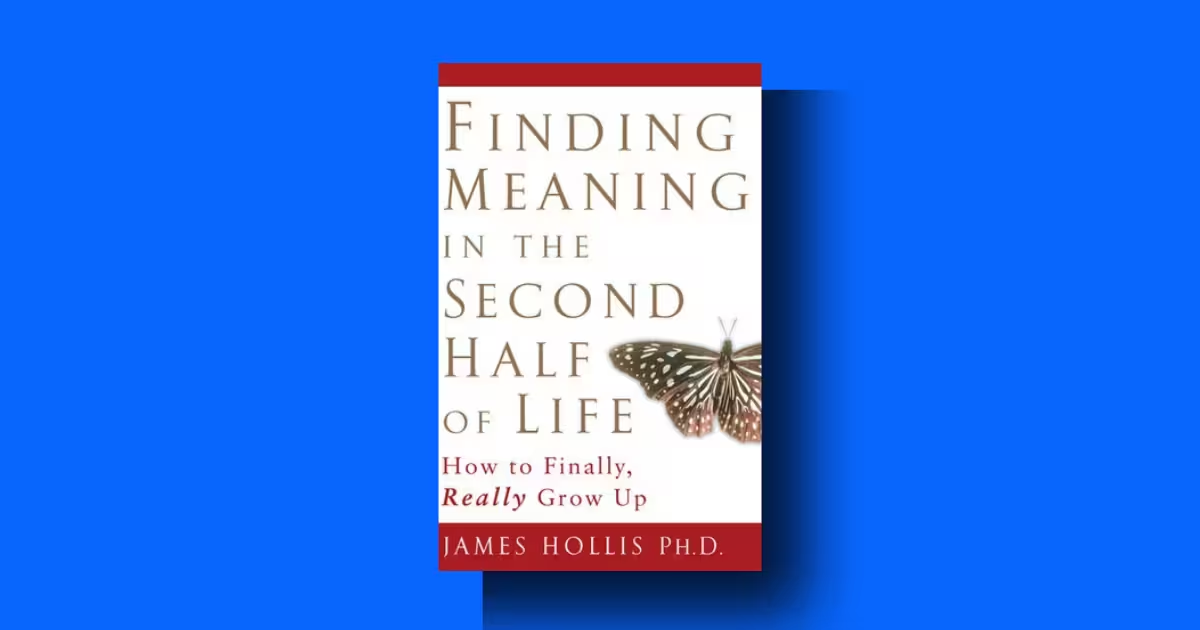
Does your life look right on paper and still feel wrong underneath? Did you do everything you were supposed to do, the degree, the job, the marriage, the mortgage, and still catch yourself wondering who actually chose this? I picked up James Hollis’s Finding Meaning in the Second Half of Life during exactly that kind of week, and it is the rare psychology book that answered the question honestly instead of selling me a five-step fix for it.
Finding Meaning in the Second Half of Life: How to Finally, Really Grow Up is a 2005 Jungian analysis of what Carl Jung called individuation, written by analyst James Hollis for readers roughly between their mid-thirties and their eighties.
Hollis argues that the first half of life is spent building an identity to satisfy parents, culture, and fear, while the second half asks a harder question: who are you underneath all of that.
Instead of checklists, the book walks through the psychological patterns, the “expensive ghosts,” that quietly run our careers, marriages, and moods, and it asks the reader to take personal responsibility for a life that finally belongs to them. It is dense, occasionally repetitive, and unapologetically literary, but for the right reader at the right moment, it lands with real force.
Finding Meaning in the Second Half of Life is best for readers in their late thirties through seventies sitting with a career, marriage, or identity that no longer fits; anyone who has already tried therapy or journaling and wants a framework rather than another platitude; readers who enjoy literature, mythology, and Jungian thought and do not mind a demanding, reflective read.
Not for readers who want a quick action plan with bullet points and worksheets; anyone allergic to religious or spiritual language, since Hollis leans heavily on the word “soul”; and younger readers still in their twenties who are building a first identity rather than questioning one, since much of the book assumes you already have a life to look back on.
Table of Contents
Introduction
Finding Meaning in the Second Half of Life: How to Finally, Really Grow Up is a work of nonfiction by James Hollis, Ph.D., first published by Gotham Books, an imprint of Penguin Group USA, in 2005, with the first trade paperback printing arriving in May 2006.
Finding Meaning in the Second Half of Life sits inside the genre of Jungian depth psychology, a tradition that treats dreams, symptoms, and recurring life patterns as messages from an unconscious “Self” that is trying to move a person toward wholeness rather than mere comfort.
Hollis wrote Finding Meaning in the Second Half of Life after twenty-six years teaching humanities at various colleges, followed by training as a Jungian analyst at the C.G. Jung Institute in Zurich, Switzerland, between 1977 and 1982.
At the time of writing, he served as executive director of the C.G. Jung Educational Center of Houston, Texas, and had already published ten previous books, including the widely read The Middle Passage: From Misery to Meaning at Midlife. Today Hollis practices in Washington, D.C., where he has served as executive director of the Jung Society of Washington, and his catalogue has grown to roughly nineteen titles translated into twenty languages, with a new book, Living with Borrowed Dust, released by Sounds True in 2025.
That long, continuous body of work is worth knowing before you start this particular title, because the book in front of you is one chapter in a decades-long argument Hollis has been making his entire career.
The purpose of Finding Meaning in the Second Half of Life, stated plainly in its own introduction, is not to comfort the reader. Hollis writes that his goal is to “stir thought, trouble sleep, and provide some wider perspective,” and he is explicit that this is not a how-to guide toward finding God, the right partner, or professional success.
His central thesis, in one line he repeats near the book’s end, is that “the goal of life is not happiness but meaning.” Everything that follows in Finding Meaning in the Second Half of Life‘s eleven chapters builds toward that single claim.
Background
The idea of a “midlife crisis” entered popular language through Canadian psychoanalyst Elliott Jaques in the mid-1960s, and by the time Hollis published this book in 2005, the term had become a cultural cliché, more often used to mock a man buying a sports car than to describe a genuine psychological turning point.
Hollis wrote directly against that flattening. He also wrote into a demographic reality that has only become more pronounced since. According to the Centers for Disease Control and Prevention, average life expectancy in the United States was just 47.3 years in 1900; by 2024, it had climbed to a record 79.0 years.
Hollis makes exactly this point in his opening chapter: before the last century, most people simply did not live long enough to have a “second half of life” in any meaningful sense.
Today we have twice as much adult life as our great-grandparents did, and precious little cultural guidance for what to do with it.
The other demographic shift Hollis leans on is marriage. In 2005 he cited a figure of 56 percent of American adults being currently married, down from 75 percent thirty years earlier.
Pew Research Center’s most recent analysis of Census data puts the current figure at roughly half of all American adults, continuing the decline Hollis was already tracking two decades ago.
In other words, the very institutions Hollis warned readers not to lean on for a complete identity, career and marriage, have both become less stable and less universal in the years since he wrote this book, which if anything makes his argument more relevant now than when it was published.
Finding Meaning in the Second Half of Life Summary
Introduction: The Dark Wood
Hollis opens with three short case histories: a retired academic who dissolves into unexplained grief, a successful sales executive who realizes mid-flight that she hates her life, and Hollis’s own first dream in Zurich analysis, a knight under siege in a castle. Each person, he argues, was living someone else’s script and only discovered it when the unconscious staged a rebellion.
Borrowing Dante’s opening image from the Inferno, of finding oneself lost in a dark wood at the midpoint of life, Hollis frames the whole Finding Meaning in the Second Half of Life as a guide through that wood, not around it. He distinguishes the “Self,” Jung’s term for the deep organizing intelligence of the psyche, from the smaller, more fragile “ego,” and argues that most suffering comes from the ego mistaking itself for the whole person.
Notably, he also takes a swipe at how modern therapy leans on behaviorism, cognitive reframing, and medication, all useful, he says, but each one capable of letting a person avoid the deeper question of what their life is actually for.
Chapter One: Expensive Ghosts
The opening chapter asks a blunt question: how much of your life have you actually chosen? Hollis introduces the idea that we are all shaped by “unconscious,” a Freudian and Jungian premise, and that what we do not bring to consciousness will keep replaying itself as fate.
He traces how, for most of human history, a life expectancy in the forties meant nobody got a real second act; the entire concept of a deliberate “second half of life” is a modern invention made possible by longer lives.
He also lays out a four-stage pattern he has seen in decades of clinical work: denial, doubling down on the old plan, chasing some new external fix such as an affair or a job change, and only then, reluctantly, therapy.
Chapter Two: Becoming Who We Think We Are
Here Hollis gets into the mechanics of how a personality forms. Drawing on the Eden story and on D.H. Lawrence’s poem “Snake,” he describes two competing pulls in every person: the pull forward into growth and consciousness, and the pull backward into comfort and what he calls the “cosmic sleep” of unconsciousness.
He introduces a memorable formula: choose anxiety over depression, because anxiety is the price of growth while depression is what happens when growth is refused.
The chapter’s real engine, though, is his framework of “existential wounding.” Every child experiences either overwhelmment, the sense that the world is too big and powerful, or insufficiency, the sense that the world will not reliably meet their needs, and usually some mix of both.
From overwhelmment, Hollis identifies three typical adult patterns: avoidance, seizing control or power over others, and becoming reflexively “nice” or compliant, which he links to the modern idea of codependency.
From insufficiency, he identifies hiding out and self-sabotage, overcompensating through wealth or status, illustrated with a sharp portrait of Richard Nixon’s climb and fall, and an anxious, addictive hunger for reassurance from others.
Chapter Three: The Collision of Selves
This chapter examines what happens when the “provisional personality,” the persona built to survive childhood, collides with the deeper Self trying to emerge.
Hollis reaches for Tolstoy’s The Death of Ivan Ilyich as his central literary example: a man who lived entirely by social codes and only confronts what his life actually meant on his deathbed. Hollis’s point is not that we should wait for a terminal diagnosis to ask these questions, but that most of us do wait for some equivalent crisis.
He offers a genuinely useful distinction between three kinds of depression: biologically based depression, which typically responds to medication; reactive depression, a normal and even healthy grief response to real loss; and intrapsychic depression, which he treats as the psyche actively withdrawing energy from a life it no longer believes in.
He also lays out a five-stage life cycle for projection, the process by which we place a hidden, unlived part of ourselves onto a job, a partner, or a cause, only to be disappointed when reality fails to match the fantasy.
Chapter Four: Barriers to Transformation
Chapter four is Hollis’s fullest treatment of the Jungian idea of the “complex,” a charged cluster of old memory and emotion that can hijack present-moment behavior without warning. He compares a complex to a “splinter personality” that briefly takes over the driver’s seat, and points to something as ordinary as road rage as evidence of “referred anger” from an old, unrelated wound.
He names fear and lethargy as the two forces most responsible for keeping people stuck, and argues that growing up requires two disciplines: taking full responsibility instead of blaming others, and learning to recognize your own recurring patterns instead of denying them.
Chapter Five: The Dynamics of Intimate Relationship
This is, by Hollis’s own account, the subject his audiences ask about most, and the chapter is built around what he calls the “magical other,” the belief that a single right partner will complete us and spare us the work of growing up.
He walks through projection and transference as they operate specifically inside romance, distinguishes “falling in love,” which he treats as closer to a temporary altered state than a real relationship, from mature love, which requires two people strong enough to tolerate each other’s genuine otherness.
He is careful to say the problem is not romance itself but the weight we ask it to carry, and closes with a line worth sitting with: real intimacy depends less on finding the right person than on each partner doing the private work of “growing up.”
Chapter Six: The Family During the Second Half of Life
Leaning on a Jung quote he returns to more than once, that a child’s heaviest burden is often the unlived life of the parent, Hollis examines how families transmit both healing and damage across generations.
He is skeptical of easy nostalgia for “family values,” arguing that the real test of any family is whether it supports each member’s individual growth or demands conformity to a parent’s own unresolved needs.
The chapter covers the necessary pain of watching children leave, sometimes called empty nest syndrome, which Hollis reframes as a parent’s confrontation with their own undone inner work rather than a loss to be cured, and the particular strain of the “sandwich generation” caring for aging parents and growing children at once.
Chapter Seven: Career Versus Vocation
Hollis draws a hard line between career, what pays the bills, and vocation, from the Latin vocare, “to call,” what your soul actually asks of you. He is candid about his own path: a midlife depression pulled him out of a tenured academic career and into analytic training, a decision he frames as vocation overruling career.
Some of the chapter’s gender generalizations, that men over-identify with work while women are typically more emotionally differentiated, read as dated by current standards, a point several contemporary reviewers of this book have raised, and worth flagging for today’s reader even as the underlying argument, that outer success and inner alignment are not the same thing, still holds.
Chapter Eight: The New Myth Emerging from the Psychopathology of Everyday Life
Borrowing Freud’s title for his own purposes, Hollis argues that as traditional mythology and religion have lost their hold, the psychic energy those systems once carried has not disappeared, it has simply resurfaced as addiction, obsession, and what he calls the “paraphilias” of modern life: materialism, hedonism, narcissism, and fundamentalism.
He treats fundamentalism itself as a kind of anxiety management, a way of trading the discomfort of ambiguity for the false comfort of certainty, and connects the same mechanism to the modern “culture of sensation,” from cable news to reality television.
Chapter Nine: Recovering Mature Spirituality in a Material Age
This is Finding Meaning in the Second Half of Life‘s most explicitly religious chapter, though Hollis is careful to separate spirituality from any single doctrine. He proposes a test built on what he calls inner confirmation: a belief system is worth keeping only if your own lived experience backs it up, not merely because it was inherited from family or culture.
He works through the history of animism, polytheism, and modern secularism as three successive ways humans have related to mystery, and lands on the idea that dreams remain one of the last reliable channels through which the unconscious still speaks to us directly.
Chapter Ten: Swampland Visitations
Named after Hollis’s earlier book Swamplands of the Soul, this chapter is a tour through unavoidable human suffering: guilt, grief, betrayal, doubt, loneliness, depression, and addiction.
His central move is a distinction between pain, which is physical and should be treated, and suffering, which is spiritual and carries meaning if we let it. He is unusually direct here: the goal of a life well lived is not happiness, and no amount of right thinking, right diet, or right therapy will exempt anyone from these swamplands.
The task, each time, is to ask what the visitation demands of us rather than only how to make it stop.
Chapter Eleven: The Healing of the Soul
The closing chapter returns to a set of questions Hollis poses at the very start of the book, among them “why, even when things are going well, do things feel not quite right?” and “is the life you are living too small for your soul’s desire?”
He walks through each one, using dream examples from his own practice, and ends with a list of ten direct questions for the reader to sit with alone, covering where you are still blocked by fear, where you are still waiting for someone else’s permission, and what you have always wanted to do but never risked.
Finding Meaning in the Second Half of Life closes not with an answer but with an assignment.
Finding Meaning in the Second Half of Life Analysis
Judged on its own terms, Finding Meaning in the Second Half of Life does what it sets out to do. Hollis is not trying to build an evidence-based intervention; he is trying to give language to an experience that resists language, and on that front his prose earns its reputation.
His case histories, though disguised, land with real emotional weight, and his use of literature, from Kafka to Rumi to Tolstoy, does something a purely clinical text could not: it places the reader’s private confusion inside a much older human conversation.
Where Finding Meaning in the Second Half of Life is less persuasive is in its evidentiary base.
This is a work built almost entirely on clinical anecdote, myth, and Jungian theory rather than data, which is a fair description of the genre but worth naming plainly for a reader coming from a more empirical psychology background.
Several of Hollis’s generalizations about men and women, in particular, read as products of their 2005 moment rather than durable claims, and a handful of chapters, especially six through eight, cover ground that overlaps closely with his earlier and shorter book The Middle Passage, published twelve years before this one.
If you have already read that book, expect some repetition here rather than an entirely new argument.
Strengths and Weaknesses
What compelled me most was Hollis’s reframing of depression, not as a single problem to medicate away but as three genuinely different conditions with three different remedies, and his sharp, useful distinction between career and vocation, which alone justified the price of Finding Meaning in the Second Half of Life for me.
I also appreciated that he never once tries to make suffering sound easy; he respects the reader enough to say plainly that some of this will hurt.
What frustrated me was the density. This is not a book you skim on a commute.
The Jungian vocabulary, complex, Self, individuation, imago, arrives quickly and without much on-ramp for a first-time reader of depth psychology, and a few chapters circle the same core idea from slightly different angles longer than they need to.
The gender framing in chapter seven has also aged unevenly, and readers looking for a more contemporary, less heteronormative treatment of similar material may want to pair this with something newer.
Comparison with Similar Works
Readers who want the more compact, more technically Jungian version of this same argument should go directly to Hollis’s own earlier book, The Middle Passage: From Misery to Meaning at Midlife, which covers similar territory in far fewer pages.
For a secular existentialist take on the same core question, meaning over happiness, Viktor Frankl’s Man’s Search for Meaning remains the classic comparison. Readers who prefer a spiritual, less doctrinally Jungian framing of the two halves of life should look at Richard Rohr’s Falling Upward.
And for the generational mirror image of this book, what happens when children rather than midlife adults are the ones drowning in anxiety, Probinism’s review of The Coddling of the American Mind and its companion piece on Antifragile both sit naturally beside this one, since Hollis’s warning that an unlived parental life becomes a child’s burden is arguably the psychological backstory to the youth mental health crisis those books describe.
Readers drawn to the literary side of Hollis’s argument may also want Probinism’s roundup of the 100 Best Psychology Books of All Time and its review of The Intelligence Trap for further reading in the same general territory.
Conclusion
Finding Meaning in the Second Half of Life is not a book for everyone, and Hollis would likely say that is exactly the point. It rewards readers who already suspect that their outer success and their inner life have quietly drifted apart, and who are willing to sit with hard questions instead of grabbing for a quick fix.
It is less suited to readers wanting a scientifically grounded, secular approach, or a fast, actionable read. For the right reader, someone in their late thirties or beyond, standing at the edge of their own dark wood, this book will not make that wood smaller.
It will make walking through it feel less like a personal failure and more like the actual work of becoming an adult.