
Last updated on July 16th, 2026 at 10:44 am
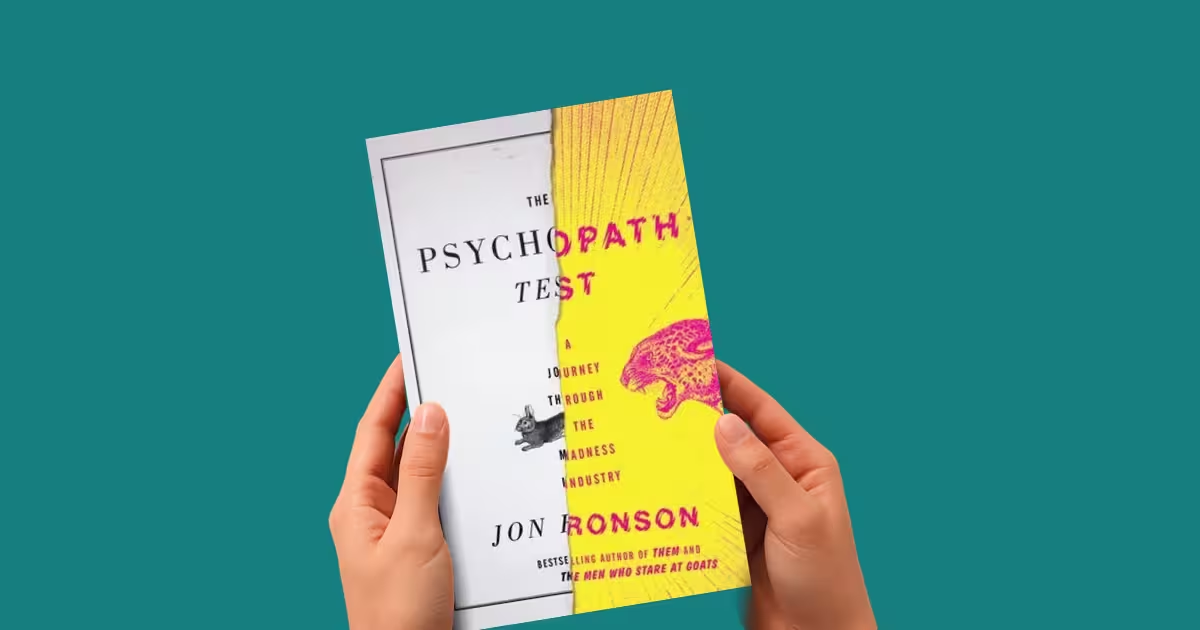
Ever wonder why you feel anxious when the phone rings late at night, or why some people seem to glide through life leaving a trail of wreckage behind them—and never lose a moment’s sleep over it? Jon Ronson’s The Psychopath Test isn’t just a book about criminals in maximum-security hospitals.
It’s a mirror held up to a world where the line between sanity and madness has become dangerously blurred, and where the very people we trust to define normality might be the ones who need examining most.
Overview
The Psychopath Test is Jon Ronson’s 2011 New York Times bestselling investigation into the world of psychopathy and the sprawling “madness industry” that diagnoses, treats, profits from, and sometimes imprisons people based on a checklist of personality traits.
The Psychopath Test begins with a mystery—a cryptic handmade book called Being or Nothingness sent anonymously to academics around the world—and spirals into a wide-ranging journey that takes Ronson from the corridors of Broadmoor psychiatric hospital to the lavish Florida mansion of a ruthless corporate CEO, from the radical LSD experiments of 1960s psychiatrists to the living rooms of American children diagnosed with bipolar disorder at age three.
Along the way, Ronson meets Bob Hare, creator of the Hare Psychopathy Checklist (PCL-R), and learns to spot the twenty traits that supposedly define a psychopath.
But the more he learns, the more he begins to question not just the checklist, but the entire enterprise of labeling human beings by their “maddest edges.” The book is a gripping, often hilarious, deeply unsettling exploration of who gets to decide what “normal” means—and what happens when that power falls into the wrong hands.
The Psychopath Test is best for:
- Readers who enjoy narrative nonfiction that blends investigative journalism with personal reflection
- Anyone curious about psychology, psychiatry, and the diagnostic criteria behind mental health labels
- Fans of Jon Ronson’s signature style—wry, self-deprecating, and deeply human
- Those who have ever wondered if the boss who fired them or the politician they voted for might be a psychopath
- People interested in the history of the DSM and the pharmaceutical industry’s role in expanding mental health diagnoses
Not for:
- Readers seeking a clinical, textbook-style deep dive into psychopathy research
- Those who prefer purely objective journalism without the author’s personal presence in the story
- Anyone looking for a definitive answer to “who is a psychopath?”—Ronson offers more questions than conclusions
- Readers uncomfortable with dark humor applied to serious subjects like murder, mental illness, and institutional abuse
Table of Contents
The Psychopath Test Summary
The Missing Piece of the Puzzle
The Psychopath Test opens with a peculiar invitation. Deborah Talmi, a neurologist at University College London, contacts Ronson about a strange package she and dozens of other academics have received in the mail.
The package contains a beautifully produced but cryptic book called Being or Nothingness—a play on Sartre’s Being and Nothingness—with twenty-one pages of text and twenty-one blank pages, mysterious quotations, and words carefully cut out with scissors.
The sender, identified only as “Joe K,” has included a sticker that reads: “Warning! Please study the letter to Professor Hofstadter before you read the book. Good Luck!”
Ronson, an investigative journalist with a taste for the bizarre, takes the case.
He travels to Gothenburg, Sweden, tracks down the translator of the book (a psychiatrist named Petter Nordlund), and eventually uncovers the truth: the book is not a sophisticated puzzle from a shadowy organization but the obsessive project of one man—a “crackpot,” in the words of cognitive scientist Douglas Hofstadter, who himself received dozens of copies.
As Ronson reflects, “It’s as if the rational world… was a still pond and Petter’s brain was a jagged rock thrown into it, creating odd ripples everywhere”.
This realization sparks Ronson’s broader thesis: madness doesn’t just affect individuals—it shapes society itself. The book that follows is an exploration of how the “madness industry”—psychiatrists, psychologists, drug companies, and the media—defines, exploits, and sometimes creates madness for its own purposes.
The Man Who Faked Madness
Ronson’s first major stop is Broadmoor psychiatric hospital, home to some of Britain’s most notorious criminals, including Ian Brady, Peter Sutcliffe, and Robert Napper. He’s there to meet “Tony,” a young man who, according to the Scientologist Brian Daniels (from the Citizens Commission on Human Rights), faked his way into Broadmoor and has been trapped there for twelve years.
Tony’s story is haunting. At seventeen, facing a prison sentence for assault, he followed the advice of fellow inmates and faked mental illness, plagiarizing characters from movies like Blue Velvet and A Clockwork Orange.
He told psychiatrists he liked sending “love letters” that were really bullets from a gun, that he wanted to crash cars for sexual pleasure, and that he wanted to kill women because looking into their eyes as they died would make him feel normal. It worked—but instead of a cushy county hospital, he was sent to Broadmoor.
Once inside, Tony realized his mistake and tried to convince the psychiatrists he was sane. But as he discovered, “It is an awful lot harder to convince people you’re sane than it is to convince them you’re crazy.” Every normal behavior was reinterpreted as evidence of madness.
When he subscribed to New Scientist and mentioned that the U.S. Army was training bumblebees to sniff out explosives, his medical notes recorded: “Thinks bees can sniff out explosives.”
When he volunteered to weed the hospital garden, they decided his good behavior proved he could only behave well in a psychiatric environment—which proved he was mad.
The Broadmoor clinicians eventually concluded that Tony wasn’t mentally ill but psychopathic. As Professor Anthony Maden, the head clinician, told Ronson: “Tony faked mental illness… Tony is a psychopath. That doesn’t come and go. It is how the person is”.
Tony, predictably, insisted he wasn’t. The more he tried to prove his sanity, the more it confirmed his diagnosis. As he put it, “It’s like witchcraft. They turn everything upside down.”
The Psychopath Test
Ronson’s investigation leads him to Bob Hare, the Canadian psychologist who developed the Hare Psychopathy Checklist-Revised (PCL-R), the “gold standard” for diagnosing psychopaths. Ronson attends Hare’s three-day training course in rural Wales, where he learns to administer the twenty-item checklist.
The checklist includes traits like:
- Glibness/Superficial Charm
- Grandiose Sense of Self-Worth
- Need for Stimulation/Proneness to Boredom
- Pathological Lying
- Conning/Manipulative
- Lack of Remorse or Guilt
- Shallow Affect
- Callous/Lack of Empathy
- Parasitic Lifestyle
- Poor Behavioral Controls
- Promiscuous Sexual Behavior
- Early Behavior Problems
- Lack of Realistic Long-Term Goals
- Impulsivity
- Irresponsibility
- Failure to Accept Responsibility for Own Actions
- Many Short-Term Marital Relationships
- Juvenile Delinquency
- Revocation of Conditional Release
- Criminal Versatility
Each item is scored 0, 1, or 2, with a maximum score of 40. A score of 30 or above is considered diagnostic of psychopathy. Hare’s research shows that while psychopaths make up only about 1% of the general population, they account for a disproportionate share of violent crime.
During the course, Ronson watches video interviews with convicted psychopaths and learns to spot the telltale signs: the disconnected way they describe violence (“I put excessive pressure on his arm and it just snapped”), their inability to feel fear or remorse, and their chilling tendency to see others as pawns to be manipulated.
As Hare explains, psychopaths don’t experience the normal startle response when shown grotesque images—they’re not horrified, they’re absorbed, treating violence as a fascinating puzzle.
LSD, Naked Psychotherapy, and the Oak Ridge Experiment
One of The Psychopath Test‘s most extraordinary chapters details the history of the Oak Ridge psychiatric hospital in Ontario, Canada, where in the late 1960s and 1970s, psychiatrists Elliott Barker and Gary Maier attempted to cure psychopaths using radical, experimental methods.
Inspired by the human potential movement and R.D. Laing’s therapeutic community at Kingsley Hall in London, Barker created the “Total Encounter Capsule”—a small room painted bright green where psychopaths were given LSD, stripped naked, and encouraged to scream, confess, and claw at the walls.
The sessions lasted for eleven days at a time. Psychopaths were encouraged to be one another’s therapists. Visitors to the unit were given gruesome crime-scene photographs to wear around their necks. Patients who refused to cooperate were forced to wear little-girl dresses.
Remarkably, the program seemed to work—at first. Barker’s psychopaths became gentle, caring, even tender. Some requested not to be released until they’d completed their therapy.
But the long-term results were devastating. A follow-up study found that 80% of the psychopaths released from the program went on to re-offend—compared to the usual 60%. Among them was Peter Woodcock, a serial killer of children, who admitted that the program had taught him how to be a more devious psychopath: “I did learn how to manipulate better and keep the more outrageous feelings under wraps better.”
The Oak Ridge experiment had become an “empathy-faking finishing school” for psychopaths.
Psychopaths in the Boardroom
Ronson then turns his attention to Hare’s contention that psychopaths aren’t just found in prisons—they’re disproportionately represented in the upper echelons of business and politics.
As Hare puts it: “Serial killers ruin families. Corporate and political and religious psychopaths ruin economies. They ruin societies.”
To test this theory, Ronson visits Al Dunlap, the notorious former CEO of Sunbeam and Scott Paper, who earned the nickname “Chainsaw Al” for his ruthless mass layoffs.
Dunlap’s Florida mansion is filled with statues of predatory animals—lions, panthers, sharks, eagles—and giant oil paintings of himself and his wife.
When Ronson runs through the Hare Checklist with him, Dunlap cheerfully reinterprets every psychopathic trait as a business positive: manipulation becomes “leadership,” impulsivity becomes “quick analysis,” and a lack of remorse frees you up to move forward and achieve more great things.
But the most chilling moment comes when Ronson asks Dunlap how he’d react to a gruesome crime-scene photograph. Dunlap replies, “No… I think I intellectualize it. What enters my mind is, What happened here? Why did it happen?”—the exact response Hare’s research predicts in psychopaths.
Ronson also meets Toto Constant, the Haitian death-squad leader who fled to America and now sits in a New York prison for mortgage fraud. Constant is charming, self-deprecating, and disarmingly honest.
When Ronson asks if he feels empathy, Constant replies: “No… It’s not a feeling I have.” When Ronson asks why he wants people to like him, Constant admits: “If people like you, you can manipulate them to do whatever you want them to do.” It’s a textbook psychopathic confession, delivered with a smile.
The Creation of Madness
The Psychopath Test‘s final sections explore how mental disorders are created and labeled. Ronson traces the history of the DSM (Diagnostic and Statistical Manual of Mental Disorders) to Robert Spitzer, the psychiatrist who, in the 1970s, transformed it from a 65-page booklet into a 494-page checklist of mental disorders.
Spitzer’s goal was to make psychiatry more scientific by replacing subjective psychoanalysis with observable checklists. But the result, as critics argue, was an explosion of diagnoses that pathologize normal human behavior.
Ronson meets Allen Frances, Spitzer’s successor as DSM editor, who now admits they made terrible mistakes. “We inadvertently contributed to three false epidemics,” Frances says: autism, attention deficit disorder, and childhood bipolar disorder.
In the United States, the rate of autism diagnosis has gone from less than 1 in 2,000 to more than 1 in 100. Children who would previously have been considered “eccentric” or “different” are now labeled autistic.
And childhood bipolar disorder—which most child psychiatrists outside the U.S. believe doesn’t exist—has become an epidemic, with children as young as three being prescribed powerful antipsychotic drugs.
The consequences are devastating. Ronson tells the story of Rebecca Riley, a four-year-old girl diagnosed with bipolar disorder and given ten pills a day. She died of an overdose of her medication. Her mother later admitted: “Maybe she was just hyper for her age”.
The Psychopath Test Analysis
What Ronson Gets Right
Ronson’s greatest strength is his willingness to be the fool in his own story. He doesn’t pretend to be an objective observer; he’s a nervous, anxious, self-doubting narrator who constantly questions his own motives and conclusions. This makes him an ideal guide through the moral minefield of psychopathy diagnosis.
When he starts seeing psychopaths everywhere—in A.A. Gill, in the hotel concierge who grabs his phone, in his own friends—he recognizes the danger of the power the checklist gives him. “I was attaining a new power,” he writes, “like a secret weapon, the kind of power that heroes of TV dramas about brilliant criminal profilers display.”
But he also realizes that this power can corrupt. As Adam Curtis, the documentary filmmaker, tells him: “You’re like a medieval monk, stitching together a tapestry of people’s craziness… We all do it. We wait for the gems. And the gems invariably turn out to be the madness.”
Ronson is also unflinching in his examination of the “madness industry.”
He shows how the DSM’s checklist approach, intended to bring scientific rigor to psychiatry, has instead created a system where ordinary behavior is pathologized, pharmaceutical companies profit from ever-expanding diagnoses, and people are reduced to their “maddest edges.”
The story of Colin Stagg—the innocent man whose life was destroyed by a criminal profiler’s checklist-based certainty that he was a psychopathic murderer—is a devastating illustration of how the tools of psychiatry can be misused.
What Ronson Misses
Critics have pointed out that The Psychopath Test is more entertaining than it is rigorous. Ronson skates over complex scientific debates, preferring anecdote and character to data and analysis.
As one review put it: “He skates when you want him to dig; he does that amazed, disingenuous thing, when a little old-fashioned anger and indignation would serve him far better; he makes peculiar connections between things that are not really connected at all”.
The Psychopath Test also doesn’t fully engage with the most important question it raises: If the line between sanity and madness is so blurry, how should we treat people who are genuinely dangerous?
Ronson shows us Tony, the man who faked madness and spent twelve years in Broadmoor, and we feel sympathy. But Tony also committed a violent assault that left his victim with serious injuries.
Ronson never quite grapples with the fact that some people—whether we call them psychopaths or not—do cause real harm and need to be contained.
Strengths and Weaknesses
Strengths:
Brilliant narrative voice: Ronson is one of the funniest and most engaging writers working today. His self-deprecating humor and willingness to expose his own anxieties make the book a joy to read.
Fascinating characters: From the psychopaths in Broadmoor to the Scientologists fighting psychiatry, Ronson finds unforgettable people and gives them space to tell their stories.
Important questions: The book raises profound questions about how we define normality and who gets to make that definition.
Accessible science: Ronson explains complex concepts like the Hare Checklist and the DSM in clear, engaging prose.
Weaknesses:
Lack of depth: The Psychopath Test is more of a tour than a deep dive. Readers who want a thorough understanding of psychopathy research will need to look elsewhere.
Moral ambiguity: Ronson never quite resolves the tension between sympathy for people like Tony and the need to protect society from dangerous individuals.
Structural looseness: The Psychopath Test can feel like a series of loosely connected vignettes rather than a cohesive argument.
Comparison with Similar Works
The Psychopath Test belongs to a genre of narrative nonfiction that explores the intersection of psychology, crime, and society. It’s most similar to:
Malcolm Gladwell’s Talking to Strangers: Both books explore how we misread others and the consequences of those misreadings.
Oliver Sacks’s The Man Who Mistook His Wife for a Hat: Both use individual case studies to illuminate broader questions about the brain and behavior.
Susan Cain’s Quiet: Both challenge the way we label and value different personality types.
However, Ronson’s book is unique in its combination of gonzo journalism, dark humor, and genuine moral inquiry. As Will Self wrote: “At his best, Ronson is one of the finest comic writers working today”.
Conclusion
The Psychopath Test is not a textbook on psychopathy. It won’t teach you how to diagnose a psychopath with clinical certainty, and it won’t resolve the ethical dilemmas posed by the mental health industry.
But it will make you think—and laugh—and question everything you thought you knew about sanity and madness.
Ronson’s central insight—that we are all “increasingly judged by our maddest edges”—is more relevant than ever. In a world where social media amplifies our worst moments, where diagnostic labels are applied with increasing liberality, and where the line between eccentricity and illness grows ever more blurred, The Psychopath Test is a vital reminder of our shared humanity.
As Ronson writes, “There is no evidence that we’ve been placed on this planet to be especially happy or especially normal.
And in fact our unhappiness and our strangeness, our anxieties and compulsions, those least fashionable aspects of our personalities, are quite often what lead us to do rather interesting things.”
If you’re ready to question everything you think you know about psychopaths—and about yourself—this book is essential reading.







