
Last updated on August 25th, 2026 at 08:53 am
Why does a 2,800 year old poem about a man rowing home to his wife still feel like the most urgent story a filmmaker can put on a movie screen in 2026? I went into Christopher Nolan’s The Odyssey expecting spectacle.
I came out thinking about guilt, and about how little separates a hero from a war criminal once the cheering stops. If you are trying to decide whether to spend three hours and the price of an IMAX ticket on this film, or whether the ending actually holds up once the axes and arrows settle, this review covers all of it: the full plot with spoilers, the ending explained, the performances, the controversies, and an honest verdict.
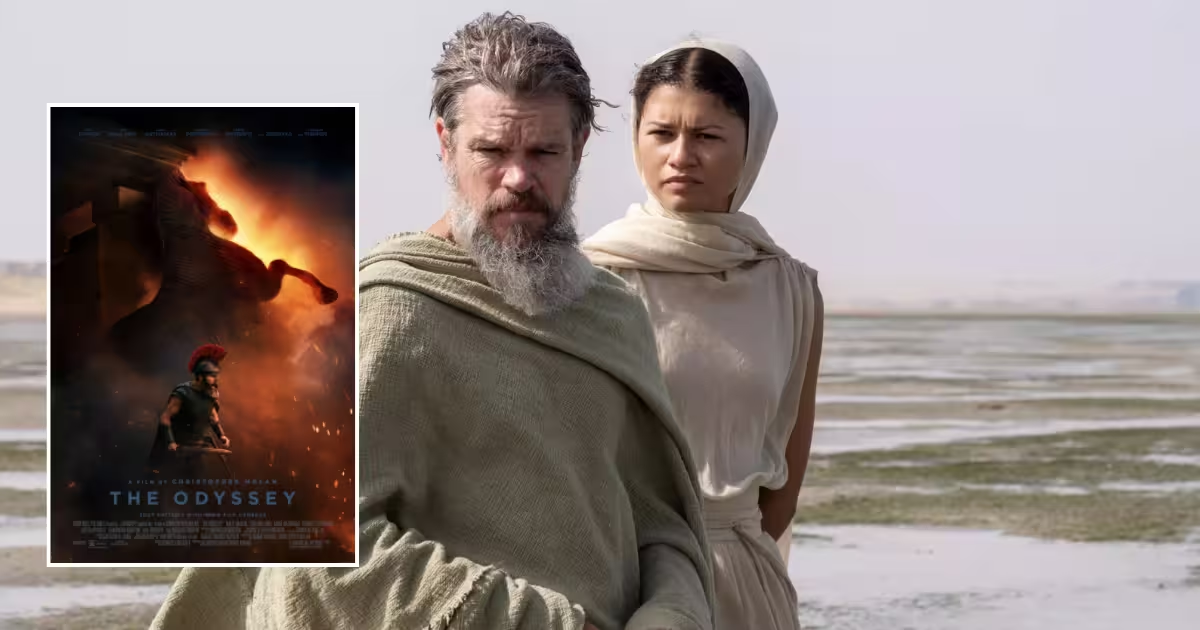
The Odyssey is Christopher Nolan’s IMAX 70mm adaptation of Homer’s epic, starring Matt Damon as Odysseus, Anne Hathaway as Penelope, and Tom Holland as Telemachus. It opened July 17, 2026, runs close to three hours, and has drawn some of the best reviews of Nolan’s career (a Rotten Tomatoes score in the high 90s, a Metacritic score around 88).
It keeps Homer’s monsters and its bow contest intact but ends on a note of guilt rather than triumph, sending Odysseus into exile instead of letting him keep his throne. It is gorgeous, occasionally slow, and one of the more thoughtful blockbusters of the year.
Table of Contents
Introduction
The Odyssey is a 2026 epic adventure film written, directed, and co-produced by Christopher Nolan, adapting Homer’s roughly 2,800 year old Greek poem of the same name, The Odyssey. It stars Matt Damon as Odysseus, the king of Ithaca, whose ten year journey home after the Trojan War forms the spine of the story, alongside Anne Hathaway as his wife Penelope and Tom Holland as their son Telemachus.
Robert Pattinson, Zendaya, Lupita Nyong’o, Charlize Theron, Samantha Morton, and Jon Bernthal round out an unusually stacked ensemble.
Universal Pictures released The Odyssey 2026 worldwide on July 17, 2026, following a London premiere on July 6, and it is Nolan’s first project since Oppenheimer swept the 2024 Academy Awards with seven wins, including Best Picture and Best Director.
My honest first impression: this is Nolan at his most sincere. He is not winking at the material or modernizing it for irony’s sake. He wants you to feel what it costs a man to survive a war and then discover that surviving it was only half the problem.
The Odyssey 2026 has real flaws, and I will get into them, but it is not a cynical cash grab dressed up in a toga. It is trying to say something about what violence does to the people who commit it, and it mostly succeeds.
Background
Nolan began writing the script in March 2024, shortly after winning his Oscars for Oppenheimer, and Universal Pictures set the project up directly at the studio (rather than acquiring it later, as it had with Oppenheimer) with a summer 2026 release date already attached.
Casting rolled out through late 2024 and early 2025: Matt Damon was confirmed as Odysseus in February 2025, having previously worked with Nolan on Interstellar and Oppenheimer, while Tom Holland, Anne Hathaway, Robert Pattinson, Zendaya, Lupita Nyong’o, and Charlize Theron joined across the following months.
Nolan has said he leaned on the 2017 translation of the Odyssey by classicist Emily Wilson, the first complete English translation by a woman, particularly for how it renders Odysseus as a “complicated” and “wily” strategist rather than a straightforward hero.
He also drew on the stop-motion monster work of effects artist Ray Harryhausen and older Hollywood epics like Jason and the Argonauts (1963) and The 300 Spartans (1962) for the film’s visual language.
Principal photography ran 91 days between February 25 and August 8, 2025, wrapping nine days ahead of schedule, and took the production to Morocco, Greece, Italy, Scotland, Iceland, Western Sahara, and Malta, plus a single soundstage build at Universal Studios in Los Angeles.
It is the first film Nolan has shot entirely on IMAX 70mm cameras, using over 2 million feet of film, and the largest operating Viking longship in the world, the Draken Harald Hårfagre, stood in for Odysseus’s warship. On a reported $250 million budget, it is the most expensive production of Nolan’s career.
The Odyssey 2026 also arrived with real controversy attached, and any honest review has to name it rather than skip past it. Historians flagged the armor, helmets, and ship designs in early trailers as inconsistent with Bronze Age Greece, something even sympathetic critics acknowledged while noting Nolan was taking deliberate creative license.
Filming scenes in Dakhla, in Moroccan-occupied Western Sahara, drew a formal protest from the Sahara International Film Festival and dozens of Spanish artists and filmmakers, who called it whitewashing of the territorial dispute.
And the casting of Lupita Nyong’o in the dual role of Helen of Troy and Clytemnestra triggered a genuinely ugly backlash, amplified by Elon Musk, who called Nolan “an anti-White racist” on X. Nyong’o’s response was direct: “This is a mythological story,” she told Elle, adding that the cast was “representative of the world” and that she wasn’t interested in spending her time defending the choice.

Nolan later dismissed the backlash publicly, saying his job was simply “to make the best film I possibly can in the most sincere way.”
However, The Odyssey 2026 sets sail with $100M potential
The Odyssey 2026 Plot
Homer’s poem does not open at the Trojan War. It opens years later, with Odysseus already stranded, and the wanderings arrive as a flashback he tells to strangers.
Nolan, a director who has spent his career resisting straight timelines in Memento, Dunkirk, and Oppenheimer, keeps that structure rather than flattening it into a simple point A to point B voyage. Here is the story in the order it actually happened, with a note at the end about how the film reassembles it.
The Odyssey 2026 opens with a tense prologue on the final night of the ten year Trojan War. Odysseus, Agamemnon (Benny Safdie), and a company of Greek soldiers hide inside the Trojan Horse while a soldier named Sinon (Elliot Page) convinces the Trojans to wheel the “offering” inside their walls.
That night, the Greeks emerge, open the gates, and the city burns. It is staged as a claustrophobic, almost submarine-like sequence, all cramped bodies and creaking wood, and it sets the tone: this will not be a clean victory.
With Troy gone, Odysseus and his crew, including his second in command Eurylochus (Himesh Patel), sail west. Against warnings from locals, the men raid the settlements of the Cicones and are nearly wiped out in the retaliation that follows.
A storm then blows them further off course, and they land on an unfamiliar island where a stray sheep leads them to a cave, and to the cave’s owner: the one eyed giant Polyphemus, son of Poseidon.
Trapped inside, Odysseus gets his men out by getting the Cyclops drunk, blinding his single eye, and escaping by clinging to the bellies of sheep as they leave the cave, having told Polyphemus his name is “Nobody.”
It is only once they are safely at sea that Odysseus, unable to resist one last boast, shouts his real name back at the cliffs, a moment of pride that seals his fate: the blinded Polyphemus prays to his father Poseidon, who curses Odysseus’s voyage home from that point on.
The wind god Aeolus gives Odysseus a bag containing all the world’s storm winds, and with Ithaca almost in sight, the crew’s own curiosity (they suspect it holds treasure) undoes them: they open it, and the winds blow the ship back out to open sea.
Worse follows on the island of the Laestrygonians, a race of giants who destroy nearly the entire fleet, leaving Odysseus with a single ship and a fraction of his men.
That remaining crew lands on Aeaea, home of the witch Circe (Samantha Morton), who turns several of the men into swine. With help resisting her magic, Odysseus forces her to restore them, and the crew spends roughly a year on her island before Circe sends him toward his next, darker task.
She directs him to the underworld to consult the blind prophet Tiresias, describing a route north until “the river of fire meets the river of ice.” There, Odysseus sacrifices sheep to summon the dead. Among the shades who appear is Agamemnon, who describes his own homecoming: he returned from Troy only to be murdered by his wife, Clytemnestra (Lupita Nyong’o, in the second half of her dual casting).
It is a pointed, uncomfortable mirror held up to Odysseus’s own situation, since Penelope has been alone with suitors circling for nearly twenty years by this point. Tiresias gives Odysseus his central warning: the way home will demand impossible choices, and above all, his men must never touch the sacred cattle of the sun god Helios when they reach the island of Thrinacia.
From there, the crew survives the song of the Sirens by having Odysseus lashed to the mast while the rest plug their ears with wax, then navigates the strait between the sea monster Scylla and the whirlpool Charybdis, losing several men to Scylla’s grasping heads in the process.
On Thrinacia, starving and desperate, the surviving crew ignores every warning and slaughters Helios’s sacred cattle.
Zeus’s punishment is swift: a storm destroys the ship and kills every man except Odysseus, who alone washes up on the island of Ogygia. There, the nymph Calypso (Charlize Theron) keeps him for years, wanting him as an immortal husband, which is where the film’s framing device begins: Odysseus experiencing visions of Athena (Zendaya) urging him to leave, and recounting everything above to Calypso, and to us, as backstory.
Zeus eventually orders Calypso, through the god Hermes (Robert Pattinson doubling in an early divine role before The Odyssey settles him into his mortal one as the suitor Antinous), to let Odysseus go. He builds a raft, only for Poseidon to wreck it in one final storm.
He survives, and by most early trailer breakdowns, tells his own story to King Alcinous and Queen Arete of the Phaeacians, who then help carry him the rest of the way home to Ithaca, disguised by Athena so no one recognizes him.
Home, Odysseus learns from the loyal swineherd Eumaeus (John Leguizamo) that his palace is overrun with suitors pursuing Penelope and his throne.
When the suitors kill a man named Mentor inside a temple where Telemachus is hiding, Odysseus intervenes and rescues his son, still concealing his identity, this time calling himself “Sinon,” the same name of the soldier from the Trojan Horse sequence, a small but pointed detail suggesting the tricks that won him a war have become the only language he has left for coming home.
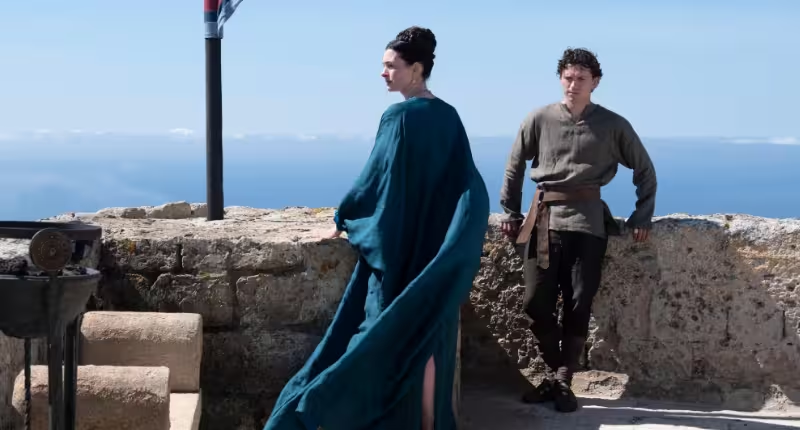
His own dog, Argos, recognizes him at the palace gate and dies peacefully moments later. Telemachus, guided to the truth, finally recognizes his father.
At a tense feast, Odysseus, still disguised, approaches Penelope and confesses his guilt: for breaking the sacred laws around the Trojan Horse, for killing Trojan civilians in the sack of the city, and for desecrating a statue of Athena after killing her priestess (a priestess whose form, we learn, Athena herself had taken to punish him in visions).
Penelope, seemingly out of options, announces she will marry whichever suitor can string Odysseus’s old bow and shoot an arrow clean through a row of axe heads. Every suitor fails.
Odysseus, still in disguise, strings it himself.
The trap he and Telemachus have quietly built springs. Odysseus kills the suitor Polybus; Melanthius, brother of the treacherous maid Melantho (Mia Goth), tries to help the lead suitor Antinous but is killed by Telemachus first, and Odysseus finally kills Antinous.
The remaining suitors surrender rather than fight to the death, a notable break from Homer’s poem, where every suitor dies. Rather than simply reclaiming his throne, as the original epic ends, Odysseus cedes it to Telemachus and sails west into exile with Penelope, choosing to spend what is left of his life honoring the dead instead of ruling.
It is a quieter, sadder ending than the poem’s, and it is the single choice that tells you exactly what kind of adaptation Nolan wanted to make.
The Odyssey 2026 Analysis
Direction and Cinematography
Nolan shoots this like he means every frame of it to be seen on the biggest screen available, and cinematographer Hoyte van Hoytema (working with Nolan since Interstellar) delivers exactly that: real oceans, real islands across six countries, and a genuinely enormous Viking longship standing in for a Bronze Age warship.
Variety’s Guy Lodge called it “a genuinely grand, gutsy vision,” and the Telegraph’s Tim Robey praised the six minute Trojan Horse prologue as capturing a “stifling claustrophobia” reminiscent of the capsizing ship sequences in Dunkirk.
Where Nolan takes his most interesting swing is in how he handles the gods: rather than literal magic, the film mostly renders divine intervention through natural phenomena, storms, visions, and psychological pressure, so that Athena’s punishment of Odysseus plays as much like guilt made visible as it does like myth.
It is a genuinely clever way to adapt gods for an audience that does not believe in them anymore, even if a few critics found the approach a little too “muted” in its color grading and restraint.
Acting Performances
Matt Damon anchors The Odyssey 2026 with what The Hollywood Reporter’s David Rooney described as a performance venturing into darker territory than almost anything else in the actor’s career, and he reportedly dropped to 167 pounds and grew out a real beard for over a year to play the part.
Anne Hathaway matches him; Rooney described her Penelope as “a model of steely self-possession masking vulnerability.”
Tom Holland gets some of the most surprising praise of the ensemble: Deadline’s Gregory Nussen wrote that his performance is “bursting with a newfound maturity,” calling it his strongest work to date, while the BBC noted his post-premiere reception focused specifically on that same maturity.
Robert Pattinson, cast against type as the suitor Antinous, was described by Rooney as biting “into his character’s villainy with gusto,” and Pattinson himself compared the role to Lester Diamond from Casino.
Lupita Nyong’o, in the film’s most publicly debated casting decision, plays both Helen of Troy and Clytemnestra, and by most accounts holds her own in a cast this stacked.
Script and Dialogue
This is where the reviews genuinely split. Nolan wrote characters who speak in plain, contemporary, largely American English rather than anything resembling formal period dialogue, a choice that drew criticism well before release (British cast members were asked to use American accents, and lines like Odysseus’s battle cry, “Let’s go!,” read as jarringly modern to some early viewers).
The Financial Times‘s Danny Leigh admitted certain word choices “jarred me out of the past,” while also noting The Odyssey‘s momentum eventually distracts from it. Nolan’s long standing habit of prioritizing on-set audio over re-recorded dialogue also resurfaced as a complaint; the BBC reported that several critics had trouble simply hearing dialogue in places.
None of this sank the reviews overall, but if crisp, easily audible dialogue matters to you, go in with tempered expectations.
The Odyssey 2026 Themes and Messages
Homer’s poem ends in triumph: Odysseus reclaims his home, his wife, and his kingdom, and the gods largely approve. Nolan’s film does not let him have that.
The confession scene at the feast, where Odysseus admits to breaking sacred hospitality law with the Trojan Horse, killing civilians, and desecrating a goddess’s temple, reframes the entire journey as a kind of extended penance rather than an adventure.
By the ending, Odysseus does not get to simply resume being king; he exiles himself. That single change turns the film into something closer to a companion piece to Oppenheimer than a straightforward monster movie: both films are ultimately about a clever man who wins a war through a devastating trick (a bomb, a horse) and then spends the rest of his life discovering what that trick cost him and everyone around him.
Even the small detail of Odysseus adopting the name “Sinon,” the trickster who fooled Troy, while disguised in his own home, suggests deception has become the only tool he has left, for better and for worse.
The Odyssey 2026‘s take on the gods reinforces this. Rather than staging Athena, Poseidon, and Zeus as literal, visibly present beings pulling strings (as they are in Homer), Nolan largely channels them through storms, visions, and Odysseus’s own guilt, most explicitly in the detail that Athena appeared to him as the priestess he killed, punishing him from inside his own memory rather than from Olympus.
It reframes “divine punishment” as something closer to an internalized moral reckoning, which fits a director whose entire filmography is obsessed with time, memory, and the stories people tell themselves to live with what they have done.
Comparison
Set against Nolan’s own filmography, this plays like a direct spiritual sequel to Oppenheimer: both are about brilliant, self-justifying men who set off catastrophic violence through cleverness and then have to live inside the wreckage of their own success.
Structurally, it also continues the non-linear instinct of Memento and the interwoven timelines of Dunkirk, applied here to Homer’s own famously non-chronological poem rather than imposed on top of it.
Against other big screen takes on Greek myth, it sits closer to Wolfgang Petersen’s Troy (2004), a film Nolan was actually attached to direct decades earlier before it went to Petersen instead, than to the stylized comic book violence of 300.
Classical historian Tom Holland (no relation to the actor) actually preferred 300‘s “more authentic” armor design over this film’s, while still defending Nolan’s right to take “an impressionist take on ancient history.”
Readers who enjoyed The Lensage‘s breakdown of another practical effects heavy, myth-adjacent survival epic shot largely on real locations, Apocalypto (2006), will recognize some of the same instincts here: a filmmaker choosing sweat and geography over green screen.
And for readers who enjoyed The Lensage‘s look at the Before Trilogy and its philosophical undercurrents, several of which were filmed in the same Peloponnese region Nolan used for his Cyclops sequences, there is a nice, unplanned geographic echo between the two.
Audience Appeal: This is aimed squarely at fans of prestige historical epics, mythology readers, and anyone who followed Nolan from Inception through Oppenheimer.
It is R-rated in the United States and rated 15 in the United Kingdom, runs close to three hours, and does not soften its violence, so it is not built for family viewing despite the fairy tale trailer cuts.
Casual viewers may find some of the mid-film wandering (the Aeolus and Laestrygonian detours especially) slower going than the marquee monster sequences.
Reception: Reviews were among the best of Nolan’s career on release. Rotten Tomatoes scores were cited between 96 and 99 percent in the days immediately after the review embargo lifted on July 15, 2026, generally settling near 97 to 98 percent as more reviews came in, with Metacritic commonly cited around 89, which several outlets, including Gold Derby, noted put it in the upper range of Nolan’s own filmography (previously topped by The Dark Knight and Memento at 94 percent).
Not every critic was uniformly positive: the LA Times‘s Amy Nicholson called it “epically satisfying” but felt it “skimps on the character’s ego and lust” compared to Homer’s original.
Awards: As of this review, The Odyssey has not won any awards, since it only just opened.
It has, however, generated significant early Oscar buzz for the 2027 ceremony, with outlets like Gold Derby and Variety projecting nominations for Best Picture, Best Director, Best Actor (Damon), Best Supporting Actress (Hathaway), and Best Adapted Screenplay, with some predictions running as high as 14 total nominations, which would be close to Oppenheimer‘s haul of 13.
These remain predictions, not results, this early in the season.
Personal Reflection
I keep coming back to one idea after watching this: nobody in Homer’s original poem ever really asks whether Odysseus deserved to come home. He is the hero, so of course he does. Nolan’s version asks that question directly, and it does not give you an easy answer, and I think that is exactly the right instinct for 2026.
We are, whether we like it or not, living through another stretch of history defined by long wars and longer homecomings, by people who leave for years and come back changed, and by families who wait without knowing if waiting is even the right thing to do.
Penelope spends twenty years fending off men who want her husband’s throne while raising a son alone, and the film gives her, per multiple reviews, real interiority rather than treating her as a prize sitting quietly at the end of the journey.
That choice feels less like a modern add-on and more like the film simply noticing what was always there in the text: an entire household, not just one wandering man, paying the price of a war none of them chose.
The guilt Odysseus carries by the end (over the Trojan Horse, over the men he lost, over the innocent people killed in Troy’s sack) is not really a myth problem. It is closer to what people now call moral injury: the specific wound of having done, or allowed, something that violates your own sense of who you are, separate from the fear or physical harm of combat itself.
You do not need a classics degree to recognize that in a returning soldier, a first responder, or honestly anyone who has had to make an impossible choice under pressure and then has to live with it afterward. Nolan does not use that language, and I am not going to pretend the film is a clinical study of it, but the shape of the thing is there in how Odysseus confesses to Penelope before he ever reveals himself: he needs to be forgiven before he can be recognized.
There is also something quietly relevant in the hospitality code that runs through the whole poem, the ancient Greek idea of xenia, the sacred duty to welcome and protect strangers. The suitors violate it by treating Odysseus’s home as their own.
Odysseus himself violates it, arguably worse, by using a “gift” (the horse) to destroy the people who accepted it. In a year when questions about who gets welcomed, who gets treated as a guest and who as a threat, are dominating headlines well outside the movie theater, an ancient poem built around the ethics of hospitality landing this hard is not really a coincidence.
It is why the story has survived 2,800 years in the first place: it was never really about monsters. It was about what people owe each other, and what it costs when they fail to pay it.
The Odyssey 2026 Quotes
A few lines that stood out from the film’s officially released dialogue and marketing, kept brief and used sparingly:
- Odysseus, rallying his men before battle: “After years of war, no one could stand between my men and home.”
- Penelope, before Odysseus leaves for Troy: “Promise me you’ll come back.” Odysseus’s reply: “What if I can’t?”
- The bard character played by Travis Scott, framing the whole saga: “A war, a man, a trick to break the walls of Troy.”
- Odysseus’s one word battle cry during the Trojan Horse assault: “Let’s go!”
- Christopher Nolan, describing the project itself at CinemaCon, not a line from the film but a fitting summary of his intent: “Not just a story, but the story.”
The Odyssey 2026 Pros and Cons
| Pros | Cons |
|---|---|
| Genuinely stunning practical, location-shot IMAX cinematography | Some mid-journey stretches (Aeolus, the Laestrygonians) drag compared to the marquee monster scenes |
| Damon, Hathaway, and a scene-stealing Holland all deliver career-level work | On-set audio recording makes some dialogue hard to hear |
| A genuinely bold, guilt-driven ending that breaks from Homer’s triumphant original | Modern American slang and accents pull some viewers out of the ancient setting |
| Real ambition in reframing the Olympian gods as psychological and natural forces | Nearly three hour runtime and R rating limit its audience |
| One of the best-reviewed films of Nolan’s career so far | Historical accuracy of armor and ships drew fair criticism from historians |
Conclusion
The Odyssey is not a perfect film, but it is a serious one, and in the middle of a summer built mostly around sequels and reboots, that counts for a lot. Nolan takes one of the oldest surviving stories in Western literature and asks it a question it was never really designed to answer: what does a hero owe the people he hurt on his way to becoming one?
He does not let Odysseus off the hook for it, and The Odyssey 2026 is stronger for that choice, even when its pacing sags or its dialogue occasionally clangs against its ancient setting. If you have any patience for a slow build alongside your spectacle, this is one of the more rewarding blockbusters of the year, and a genuinely worthy companion piece to Oppenheimer.
Readers who enjoyed The Lensage‘s look at how technical ambition and moral rot can share the same frame in The Birth of a Nation (1915) will find a very different, far less troubling, but structurally comparable case here: a film using every technical tool available to tell what its director clearly believes is a foundational story.
Rating: 4.5 out of 5 stars







