
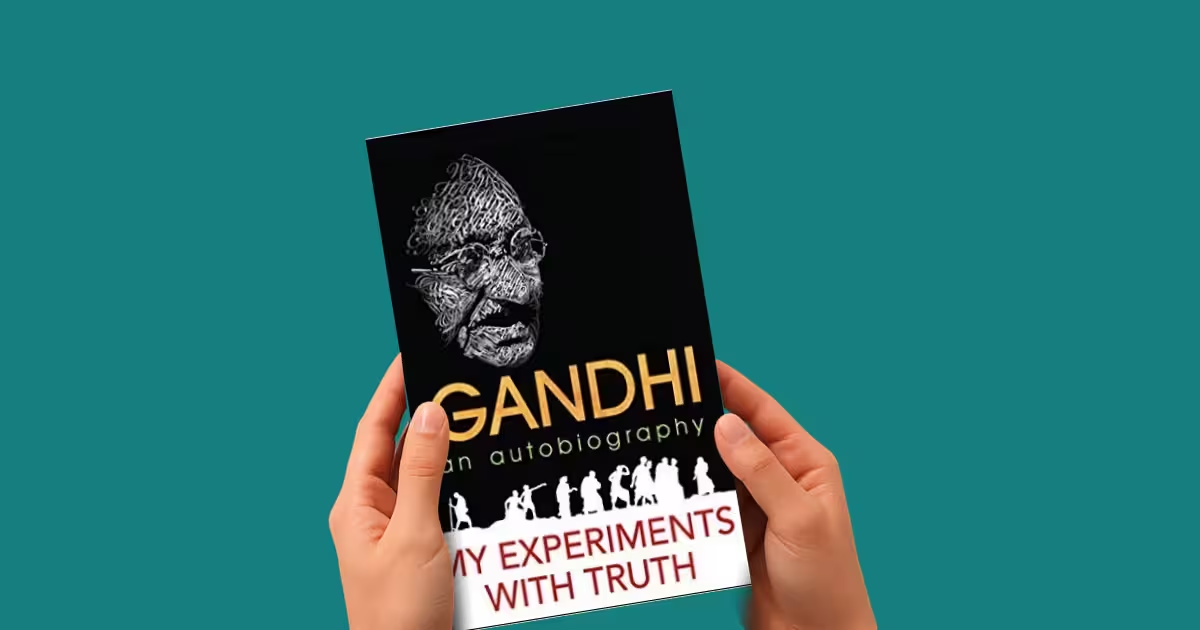
Ever wonder why a book written nearly a century ago about a man’s personal struggles with truth and self-control continues to sell millions of copies worldwide and rank among the most influential autobiographies ever written?
Gandhi: An Autobiography – The Story of My Experiments with Truth is not your typical heroic life story. Originally written in Gujarati between 1925 and 1929 and translated into English by Mahadev Desai, this 500-plus-page work chronicles Gandhi’s journey from a shy, mediocre student and child husband to the architect of nonviolent resistance.
Rather than presenting himself as a saint, Gandhi offers a brutally honest account of his failures, his experiments with diet, celibacy, and truth—even detailing his early meat-eating escapades and his shameful treatment of his wife.
The book is part spiritual diary, part historical document, and part manual for self-improvement. It ends in 1921, just as Gandhi assumes his public leadership role in India’s freedom struggle.
Gandhi: An Autobiography is best for:
- Readers seeking an unvarnished look at how a flawed human being transformed himself into a moral leader
- Those interested in the philosophical foundations of nonviolence and civil disobedience
- History buffs wanting a first-hand account of colonial India and South Africa
- Anyone on a personal journey of self-discipline and self-examination
- Fans of spiritual memoirs and philosophical autobiographies
Not for:
- Readers looking for a conventional, chronologically complete biography (this ends in 1921)
- Those who prefer tight, fast-paced narratives without digressions into diet and bowel movements
- Anyone seeking hagiography or a comfortable, sanitized portrait of a hero
- Readers who dislike detailed accounts of personal struggles with food, celibacy, and daily routines
- Those expecting a political history of India’s independence movement
Table of Contents
1. Introduction
Gandhi: An Autobiography – The Story of My Experiments with Truth was written by Mohandas Karamchand Gandhi (1869–1948), the man the world came to know as Mahatma (“Great Soul”).
Originally published in Gujarati in two volumes between 1927 and 1929, the English translation by Mahadev Desai was published by Navajivan Publishing House, Ahmedabad.
The book has since been translated into numerous languages and remains one of the most widely read autobiographies in history, with over 75,000 ratings on Goodreads alone—44% of which are five-star.
Context
This autobiography is neither a conventional life story nor a political manifesto. Instead, it is exactly what its subtitle promises: a narrative of experiments.
As Gandhi himself makes clear from the opening pages, he is not writing to present himself as a hero or a saint. In fact, he writes with an almost uncomfortable honesty about his failures, his embarrassments, and his moral shortcomings.
The book covers his life from his birth in Porbandar in 1869 through his childhood, his arranged marriage at thirteen, his studies in England, his legal practice in South Africa, and his early activism in India—ending in 1921 as he steps into his public role.
Purpose
The central purpose of this autobiography is disarmingly simple yet profoundly radical: truth is the highest principle, and the only way to find it is through relentless, honest self-experimentation. Gandhi writes, “My uniform experience has convinced me that there is no other God than Truth”.
The book is not meant to impress or to defend his legacy; rather, it is an offering to those who might learn from his successes and, more importantly, his failures. He explicitly states that he is writing “in the interests of truth” and that he would be “false to truth” if he omitted his painful experiences.
2. Background
To understand this autobiography, one must understand Gandhi’s context. He wrote it in installments between 1925 and 1929 while in his mid-fifties, during a period of intense political activity in India’s struggle for independence. The non-cooperation movement had already shaken British rule, and Gandhi was emerging as the undisputed leader of the Indian National Congress.
Yet rather than using his autobiography to consolidate his political legacy or justify his actions, he chose to write an intensely personal, self-critical account.
The book was originally written in Gujarati for the readers of Navajivan, his Gujarati weekly. This explains its conversational, almost diary-like tone. It was not intended for a global audience, which perhaps accounts for its remarkable candor. Gandhi was writing for his countrymen, many of whom knew him personally, and he felt no need to present a polished, heroic image.
Significantly, the book ends in 1921—before the Salt March, before the Round Table Conferences, before independence and partition. Gandhi deliberately stopped at the point where he became a public figure, feeling that the story of his later years belonged to the nation and could not be written with the same personal intimacy.
This decision gives the autobiography a unique quality: it is the story of a man becoming himself, not the story of a man who has already arrived.
3. Gandhi: An Autobiography Summary
Part One: Childhood and Early Life
The autobiography opens with Gandhi’s birth in Porbandar, a small princely state in Kathiawad, Gujarat. His father, Karamchand Gandhi (known as Kaba Gandhi), was a prime minister in several states, “a lover of his clan, truthful, brave and generous, but short-tempered”.
His mother, Putlibai, left the deepest impression on him—a deeply religious woman who “would not think of taking her meals without her daily prayers”.
Gandhi describes himself as a mediocre student, shy and withdrawn. He writes, “I could only have been a mediocre student”. He recalls with painful honesty how he once misspelled “kettle” in an examination and refused his teacher’s prompting to copy from a neighbor’s slate, saying, “I never could learn the art of ‘copying'”. This early commitment to honesty, even at the cost of embarrassment, foreshadows his later life.
Two childhood incidents shaped him profoundly. The first was reading the play Shravana Pitribhakti Nataka about a devoted son who carries his blind parents on a pilgrimage. Gandhi writes: “The book and the picture left an indelible impression on my mind. ‘Here is an example for you to copy,’ I said to myself”.
The second was watching a play about the truthful King Harishchandra, which inspired him to ask himself repeatedly: “Why should not all be truthful like Harishchandra?”
Part Two: Child Marriage and Early Marriage
One of the most striking aspects of the autobiography is Gandhi’s unflinching account of his child marriage at age thirteen. He writes, “Much as I wish that I had not to write this chapter, I know that I shall have to swallow many such bitter draughts… I can see no moral argument in support of such a preposterously early marriage”.
He describes the wedding with vivid detail and then recounts the painful early years of his marriage to Kasturbai. He admits to being a jealous and controlling husband: “The thought made me a jealous husband… I must needs be for ever on the look-out regarding her movements, and therefore she could not go anywhere without my permission”.
He candidly acknowledges his failure to educate his illiterate wife, blaming his “lustful love” for taking up his time.
Part Three: Experiments with Diet, Meat, and Morality
A significant portion of the autobiography deals with Gandhi’s experiments with diet and self-control.
In his youth, influenced by a friend who argued that meat-eating made the English strong, Gandhi secretly tried meat. The experience was disastrous: “I was sick and had to leave off eating… a horrible nightmare haunted me. Every time I dropped off to sleep it would seem as though a live goat were bleating inside me”.
He gave up meat, he says, not out of moral conviction but to avoid lying to his parents.
He also confesses to stealing, smoking, and even contemplating suicide as a teenage. Perhaps the most moving episode is his confession to his father about stealing gold from his brother’s armlet.
He writes: “I handed him the note and sat opposite the plank. He read it through, and pearl-drops trickled down his cheeks, wetting the paper… Those pearl-drops of love cleansed my heart, and washed my sin away”.
Part Four: England and the Making of a Gentleman
At eighteen, Gandhi went to England to study law. He describes his struggle to adapt to Western ways—his awkward attempts to become an “English gentleman” complete with dancing lessons, violin, and elocution classes.
He writes with self-deprecating humor about these failed experiments, noting that he wasted “ten minutes every day before a huge mirror, watching myself arranging my tie and parting my hair”.
In England, he also encountered Christianity and theosophy. He read the Bhagavadgita for the first time with theosophist friends and was deeply moved.
He recalls: “The verses in the second chapter… made a deep impression on my mind, and they still ring in my ears”. The Sermon on the Mount also struck him profoundly, particularly the teaching to “resist not evil”.
Part Five: South Africa and the Birth of Satyagraha
The South Africa years (1893–1914) were formative. Gandhi’s first experience of racial discrimination came on a train in Pietermaritzburg when he was thrown out of a first-class compartment despite having a valid ticket.
He writes: “I began to think of my duty. Should I fight for my rights or go back to India…? It would be cowardice to run back to India without fulfilling my obligation”.
He describes the harsh treatment of Indians in South Africa—the £3 tax on indentured laborers, the color bar, the humiliations. He organized the Natal Indian Congress, led ambulance corps during the Boer War and the Zulu “Rebellion,” and gradually developed the philosophy of Satyagraha (truth-force) that would later shake the British Empire.
Part Six: Return to India and the Ashram
Gandhi returned to India in 1915 and founded the Satyagraha Ashram in Ahmedabad. He describes the early struggles—the admission of an untouchable family, the withdrawal of financial support, the social ostracism.
He writes: “The admission of this family proved a valuable lesson to the Ashram… In the very beginning we proclaimed to the world that the Ashram would not countenance untouchability”.
Part Seven: The Champaran and Kheda Campaigns
The book covers Gandhi’s first major satyagraha campaigns in India: Champaran (1917) and Kheda (1918). In Champaran, he investigated the plight of indigo farmers forced to grow indigo under the oppressive tinkathia system.
He describes his civil disobedience when ordered to leave the district: “I was to be on my trial, but truly speaking Government was to be on its trial”. The case was withdrawn, and an inquiry committee was appointed, eventually leading to the abolition of the tinkathia system.
Part Eight: The Rowlatt Act and Non-Cooperation
The final chapters describe the agitation against the Rowlatt Act (1919), the Jallianwala Bagh massacre, and the birth of the non-cooperation movement.
Gandhi confesses what he called his “Himalayan miscalculation”—calling for civil disobedience before the people were ready for nonviolence. He writes: “My error lay in my failure to observe this necessary limitation. I had called on the people to launch upon civil disobedience before they had thus qualified themselves for it”.
The book ends with the Nagpur Congress of 1920, where non-cooperation was formally adopted, and Gandhi’s farewell to the reader.
4. Gandhi: An Autobiography Analysis
Reading Gandhi: An Autobiography is a deeply unsettling experience—and that is precisely its power. This is not a book designed to make you admire its author.
In fact, Gandhi seems almost determined to alienate the reader at times. He details his experiments with diet with an obsession that borders on the absurd. He confesses to failures that would make most public figures cringe. He admits to treating his wife poorly, to being a jealous husband, to being consumed by lust even at his father’s deathbed.
As one reviewer noted on LibraryThing, “I found myself unimpressed by Gandhi as a man. He is hailed for his humility, yet his own words show he took much pride in his humility. His treatment of his wife and children is appalling”.
Another reviewer called it “a terrible autobiography” because it “fluctuates between reading like a newspaper report to a religious text”.
Yet these criticisms miss the point. Gandhi was not writing a hagiography. He was writing what he called “experiments with truth”—a scientific record of a life dedicated to a single principle. As he writes in the final chapter: “To describe truth, as it has appeared to me, and in the exact manner in which I have arrived at it, has been my ceaseless effort”.
The book’s power lies in its honesty. Gandhi admits to failures that would have destroyed a lesser man’s reputation. He acknowledges that his vow of brahmacharya (celibacy) was “not an easy affair” and that he still struggled with impure thoughts. He admits that his decision to take goat’s milk while on a milk-free diet was “a breach of pledge” that “rankles in my breast and fills me with remorse”.
This relentless self-examination is what makes the book so valuable. Gandhi is not presenting himself as a model to be imitated; he is presenting himself as a laboratory for the study of truth. He writes: “I know that I do not set down in this story all that I remember. Who can say how much I must give and how much omit in the interests of truth?”
The book also reveals Gandhi’s deep engagement with multiple religious traditions.
He studied Christianity, Islam, and theosophy alongside Hinduism. He writes about his respect for Jesus’s Sermon on the Mount, his admiration for the Prophet Muhammad, and his deep devotion to the Bhagavadgita. This ecumenical spirit was central to his political vision.
5. Strengths and Weaknesses
Strengths
1. Radical Honesty. The autobiography’s greatest strength is its unflinching honesty. Gandhi does not spare himself. He admits to being a mediocre student, a jealous husband, a failed “English gentleman,” and a man who made serious miscalculations. This honesty gives the book its moral authority.
As one reviewer put it, “This autobiography is a painfully honest one. Gandhi lays out his faults and mistakes without shame and his achievements without embellishment”.
2. Philosophical Depth. The book is not just a life story; it is a philosophical treatise on truth, nonviolence, and self-discipline. Gandhi’s reflections on ahimsa (nonviolence), brahmacharya (celibacy), and aparigraha (non-possession) are woven throughout the narrative. He shows how these principles emerged from lived experience, not abstract theory.
3. Historical Value. The autobiography provides a first-hand account of colonial India and South Africa, including the Boer War, the Zulu “Rebellion,” and the early Indian independence movement. It is an invaluable historical document.
4. Inspirational Model. Despite its flaws, the book offers a powerful model of self-improvement. Gandhi shows that greatness is not innate but achieved through relentless effort and self-examination. He writes: “I have been a willing slave to the passions… But I have always been able to rise above them”.
Weaknesses
1. Tedious Detail. The most common criticism is the book’s length and excessive detail. Gandhi spends pages on his diet, his bowel movements, and other mundane matters. One reviewer wrote that “500 pages of tedious detail about every aspect of his life (even bowel movements) is a bit much”. Another called it “boring” and noted that “it goes on and on about little things (like how his food was cooked)”.
2. Lack of Political Context. The book assumes readers know the political events and personalities of the time. As one reviewer noted, “It assumes you know the political events and personalities of the day in South Africa, England & India”. This can make it difficult for readers unfamiliar with the historical context.
3. Problematic Personal Relationships. Gandhi’s treatment of his wife and children is deeply troubling. He admits to being a jealous, controlling husband and to neglecting his children’s education. He writes: “I was a cruelly kind husband. I regarded myself as her teacher, and so harassed her out of my blind love for her”. While his honesty is commendable, it does not excuse his behavior.
4. Abrupt Ending. The autobiography ends in 1921, before the most dramatic events of Gandhi’s life—the Salt March, independence, and partition. This can leave readers feeling unsatisfied, as if the story is incomplete.
6. Comparison with Similar Works
Gandhi: An Autobiography belongs to a tradition of spiritual autobiographies that includes Augustine’s Confessions, Tolstoy’s A Confession, and Malcolm X’s The Autobiography of Malcolm X. Like these works, Gandhi’s book is less about external events than about inner transformation.
Compared to The Autobiography of Malcolm X, which is a dramatic story of radical transformation through external events, Gandhi’s book is quieter, more internal. Malcolm X’s autobiography is driven by plot—his criminal past, his conversion in prison, his pilgrimage to Mecca. Gandhi’s autobiography is driven by questions: How can I be more truthful? How can I control my desires? How can I serve others?
Compared to Tolstoy’s A Confession, which is a philosophical crisis narrative, Gandhi’s book is more practical and less anguished. Tolstoy’s confession is a dramatic account of existential despair; Gandhi’s experiments are methodical, almost scientific.
Compared to Augustine’s Confessions, Gandhi’s book is less theological and more practical. Augustine’s conversion is mystical and God-centered; Gandhi’s transformation is gradual and self-directed.
Where Gandhi’s book stands out is its refusal to present its author as a hero. Most autobiographies are, in some sense, self-justifying. Gandhi’s is self-critical to the point of discomfort. He seems determined to show that he is not special—that his achievements came from ordinary effort, not extraordinary gifts.
7. Conclusion
Who Should Read This Book?
Gandhi: An Autobiography is not for everyone. If you want a conventional biography of Gandhi or a straightforward history of India’s independence movement, look elsewhere. But if you are interested in the inner life of a man who changed the world—if you want to understand how a flawed, ordinary human being transformed himself into a moral force—this book is essential reading.
As one Goodreads reviewer put it, “Everyone must read this book irrespective of whether you agree with him or not. Not because it tells you about one of the greatest man ever lived but because it tells you what makes greatness”.
The book’s lessons are timeless. Gandhi shows that truth is not a destination but a process—a series of experiments, failures, and corrections. He shows that self-discipline is not punishment but liberation. He shows that service to others is not sacrifice but fulfillment.
Perhaps most importantly, he shows that greatness is accessible to anyone willing to examine themselves honestly and work relentlessly toward their ideals. In his own words: “The path of self-purification is hard and steep. To attain to perfect purity one has to become absolutely passion-free in thought, speech and action… I know that I have not in me as yet that triple purity, in spite of constant ceaseless striving for it”.
The honesty of that admission—the acknowledgment that he had not yet arrived, that the struggle continued—is what makes this autobiography so powerful. Gandhi is not a saint looking down from a pedestal; he is a fellow traveler on the path, inviting us to join him in the experiment.







