
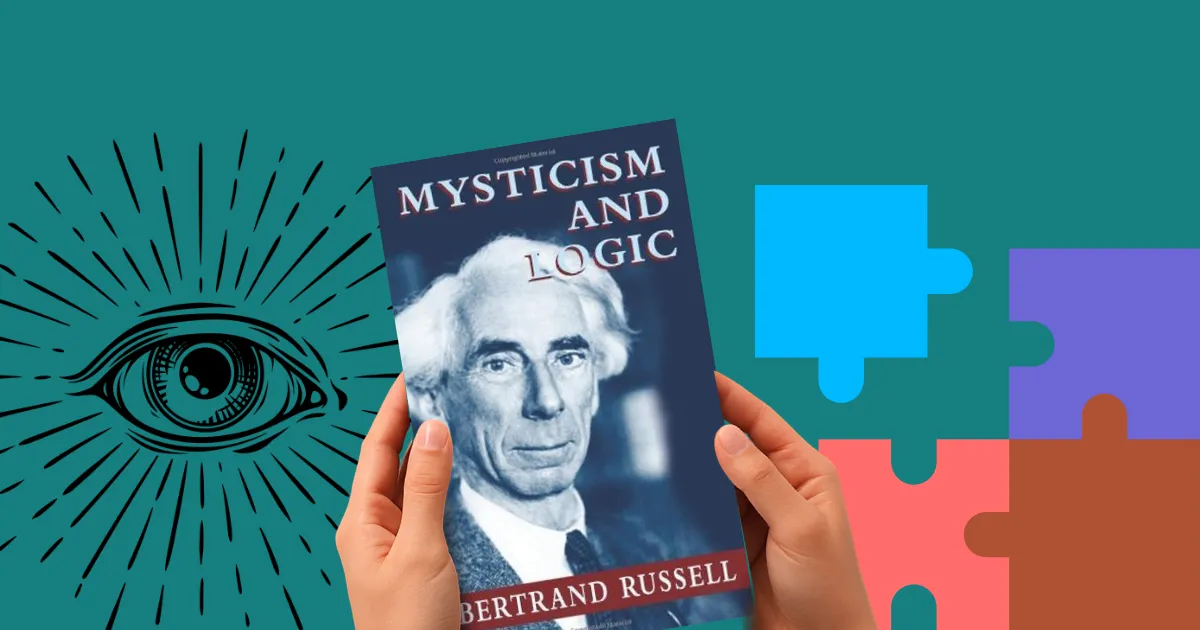
Do you ever feel torn between the cold certainty of science and the profound pull of something beyond reason? If so, Bertrand Russell’s Mysticism and Logic might just be the philosophical mirror you didn’t know you needed.
Overview
Mysticism and Logic (1917) is a collection of ten philosophical essays by Bertrand Russell that explores the enduring tension between two fundamental human impulses: the mystical yearning for unity, transcendence, and immediate insight, and the scientific demand for evidence, analysis, and logical rigour.
Russell does not simply dismiss mysticism as nonsense—instead, he argues that while mystical feelings can enrich life and inspire philosophy, mystical creeds about the nature of reality are logically flawed and cannot withstand scientific scrutiny.
The book covers everything from the foundations of mathematics to the nature of matter, the problem of causation, and the distinction between knowledge by acquaintance and knowledge by description.
It is both a defence of scientific philosophy and a deeply human meditation on how to find meaning in a universe that offers no cosmic guarantees.
Preferred readers
Mysticism and Logic is ideally suited for readers new to philosophy who seek a clear, engaging entry point into Russell’s distinctive analytic method—one that prizes precision, argumentative rigor, and the steady dissection of concepts over grand metaphysical speculation.
For students of logic, mathematics, or the philosophy of science, these essays provide foundational insights into the very tools—set theory, logical atomism, epistemology—that underpin modern analytic thought, while the general reader with a taste for elegant, lucid prose will find Russell’s style a model of how to render the most abstract difficulties accessible without cheapening them.
Yet Mysticism and Logic is not a work for those expecting a systematic, unified philosophical system; it remains, by its very nature, a gathering of occasional pieces and lectures, each illuminating a facet but never cohering into a single edifice.
Nor will it satisfy readers who prefer mysticism to be treated with reverent awe rather than subjected to Russell’s characteristically unsparing critical scalpel—he respects the experience but never the dogma, and his aim is always to analyse, not to venerate.
Those seeking easy answers will be disappointed, for Russell challenges as relentlessly as he clarifies, often replacing one perplexity with a more refined one.
And finally, anyone averse to technical discussions of logic, notation, or the finer points of epistemology will find certain passages arduous.
Table of Contents
1. Introduction
Mysticism and Logic and Other Essays is a collection of philosophical writings by Bertrand Russell (1872–1970), one of the most influential philosophers, logicians, and public intellectuals of the twentieth century.
Mysticism and Logic was first published in 1917 by George Allen & Unwin in London, with a second edition appearing the same year.
Context
Mysticism and Logic brings together essays written and published separately between 1901 and 1915. In his preface, Russell notes that the essays fall into two broad categories: the first five are “entirely popular” in style, while the remaining five are “somewhat more technical”.
The collection reflects a pivotal period in Russell’s intellectual development, during which he was producing some of his most important work in logic, the philosophy of mathematics, and epistemology.
As one commentator puts it, these essays “not only set the tone for analytical philosophy in the English-speaking world but are Russell’s first proper foray into the role of public philosopher”.
Purpose
Russell’s central thesis is that philosophy must be conducted in the spirit of science—rigorous, analytical, and open to revision—rather than in the spirit of mysticism, which seeks immediate, unquestionable insight into a hidden reality.
However, Russell does not advocate for a wholesale rejection of mysticism. He argues that mystical emotion can provide a valuable attitude towards life, fostering universal love and a sense of wonder, but that mystical doctrine is intellectually untenable.
As he writes: “Mysticism is to be commended as an attitude towards life, not as a creed about the world”.
Mysticism and Logic aims to show how philosophy can benefit from the scientific method while still acknowledging the profound emotional and existential questions that mysticism addresses.
2. Background
To fully appreciate Mysticism and Logic, it helps to understand the intellectual climate in which Russell was writing. The early twentieth century was a time of extraordinary upheaval and transformation in both science and philosophy.
The Rise of Modern Logic: Russell, along with his collaborator Alfred North Whitehead, was in the process of revolutionising logic. Their monumental Principia Mathematica (1910–1913) aimed to show that all of pure mathematics could be derived from a small set of logical axioms.
This project, which Russell describes in several essays in this collection, was a direct challenge to the Kantian view that mathematics depended on a priori intuitions of space and time.
The Crisis in Physics: The Newtonian worldview, which had dominated science for over two centuries, was being shaken by the advent of relativity theory and quantum mechanics.
Russell was deeply engaged with these developments, and several essays in the book—notably “The Ultimate Constituents of Matter” and “The Relation of Sense-Data to Physics”—grapple with the question of what the physical world is really like, given that our only access to it is through the senses.
The Legacy of Idealism: In British philosophy, the dominant school at the turn of the century was absolute idealism, associated with figures like F.H. Bradley and T.H. Green.
Idealists held that reality was a single, unified, spiritual whole—a view that Russell saw as a form of mysticism dressed up in logical language. Russell’s commitment to “logical atomism” and his insistence on the reality of many separate things (rather than one all-encompassing Whole) was a direct reaction against this idealist orthodoxy.
The Challenge of Mysticism: Mysticism was also in the air. The French philosopher Henri Bergson was achieving widespread fame for his philosophy of “intuition,” which he contrasted with the “static” and “spatial” thinking of intellect and science.
Russell’s essay on mysticism is, in part, a response to Bergson, though he never mentions him by name. Russell wanted to defend the value of reason and science against what he saw as the anti-intellectual tendencies of his time.
3. Mysticism and Logic Summary: What I Learned
Russell’s collection is remarkably diverse, but certain themes recur throughout. Here is a detailed summary of the key ideas and arguments from each of the ten essays.
Essay 1: Mysticism and Logic
This is the title essay and the philosophical heart of the collection. Russell begins by identifying two fundamental human impulses: the mystical and the scientific. He argues that the greatest philosophers—like Heraclitus and Plato—have felt the pull of both.
Russell then outlines the four defining beliefs of mysticism:
1. Belief in insight vs. discursive knowledge: The conviction that there is a special way of knowing—revelation, intuition, or illumination—that is superior to the slow, fallible methods of science.
2. Belief in unity: The denial of plurality and division; the sense that all things are ultimately one.
3. Denial of the reality of time: The view that past, present, and future are illusions.
4. Belief that evil is mere appearance: The idea that what we call evil is not ultimately real but is a product of our limited, analytical perspective.
Russell subjects each of these beliefs to critical examination.
On Insight vs. Intuition: Russell concedes that intuition can be a valuable source of hypotheses, but he insists that it is not an infallible guide to truth.
He points out that intuition is often wrong—think of the hen who hatches ducklings and is bewildered when they take to the water. Reason, he argues, is a “harmonising, controlling force” that tests our beliefs against each other.
On Unity: Russell argues that the logic used to defend monism (the view that reality is one) is faulty. He suggests that the belief in unity arises from a mystical mood, and that the subsequent logical arguments are a rationalisation of that mood, not a genuine discovery.
He quotes William James to argue that the “oneness” of the world is merely a matter of convenient description, not a profound metaphysical truth.
On Time: Russell does not deny the reality of time outright, but he argues that its importance is largely practical, not theoretical.
He quotes Spinoza: “In so far as the mind conceives a thing according to the dictate of reason, it will be equally affected whether the idea is that of a future, past, or present thing”. The philosopher, Russell says, should strive for an “impartiality of contemplation” that transcends the tyranny of temporal desires.
On Good and Evil: Russell argues that good and evil are subjective, not objective features of the universe. They are “reflections of our own emotions on other things, not part of the substance of things as they are in themselves”.
He concludes that a truly scientific philosophy must be ethically neutral, abandoning the hope that the universe will conform to our moral preferences.
Key Quote: “The kernel of the scientific outlook is the refusal to regard our own desires, tastes, and interests as affording a key to the understanding of the world”.
Essay 2: The Place of Science in a Liberal Education
Russell argues that science deserves a central place in education, not just for its practical benefits, but for its capacity to cultivate a scientific habit of mind.
He contrasts science with a purely classical education, which he says can lead to a “habit of criticism towards the present and the future” and an inability to recognise merit until it is dead.
The purpose of education, Russell argues, is to “enlarge the scope” of our primary impulses by increasing the “number and variety of attendant thoughts”. Science achieves this by fostering an objective, impersonal outlook.
He identifies two key merits of science: (1) its hopefulness about future human achievement, and (2) its “irrelevance of human passions” where truth is concerned.
Key Quote: “The kernel of the scientific outlook is the refusal to regard our own desires, tastes, and interests as affording a key to the understanding of the world”.
Essay 3: A Free Man’s Worship
This is arguably Russell’s most famous essay, and it is a powerful piece of prose that blends philosophical argument with existential reflection. Russell presents a bleak but ultimately liberating vision of the human condition.
He describes a universe that is indifferent to our hopes and fears—a world where “all the labours of the ages, all the devotion, all the inspiration, all the noonday brightness of human genius, are destined to extinction in the vast death of the solar system”.
In the face of this cosmic indifference, Russell argues that we have a choice. We can worship Power (like the savage who bows to his gods) or we can worship Goodness. The free man, Russell says, chooses the latter.
He builds his own ideals, not because they are guaranteed by the universe, but because they are worthy of our devotion. True freedom lies in thought and aspiration, not in action, which is subject to external forces.
Key Quote: “To abandon the struggle for private happiness, to expel all eagerness of temporary desire, to burn with passion for eternal things—this is emancipation, and this is the free man’s worship”.
Essay 4: The Study of Mathematics
Russell argues that mathematics is not merely a useful tool but a source of “supreme beauty—a beauty cold and austere, like that of sculpture”.
He laments that mathematics is often taught as a set of rules rather than as a creative and noble pursuit.
He outlines a vision for how mathematics should be taught: starting with concrete illustrations, gradually introducing abstract reasoning, and ultimately leading students to the fundamental principles of logic from which all mathematics can be derived.
Russell also discusses the revolutionary work of Georg Cantor on the infinite, which, he says, has “given at last the means of treating with logical precision many studies which, until lately, were wrapped in fallacy and obscurity”.
Key Quote: “Mathematics, rightly viewed, possesses not only truth, but supreme beauty—a beauty cold and austere, like that of sculpture”.
Essay 5: Mathematics and the Metaphysicians
This essay is a more technical exploration of the nature of pure mathematics.
Russell defines pure mathematics as “the subject in which we never know what we are talking about, nor whether what we are saying is true”.
This paradoxical definition highlights his view that mathematics is a purely logical discipline, concerned with the deduction of consequences from hypotheses, not with the truth of those hypotheses in the real world.
Russell traces the history of attempts to define the infinite, from Zeno’s paradoxes to the work of Weierstrass, Dedekind, and Cantor.
He argues that the solution to the paradoxes of infinity lies in rejecting the axiom that “the whole has more terms than the part”—a principle that holds only for finite collections. He also discusses the revolution in geometry brought about by non-Euclidean systems, which showed that geometry is not a description of physical space but a branch of pure logic.
Key Quote: “The proof that all pure mathematics, including Geometry, is nothing but formal logic, is a fatal blow to the Kantian philosophy”.
Essay 6: On Scientific Method in Philosophy
Russell argues that philosophy should adopt the methods of science, not its results. He criticises philosophers who build grand systems on the basis of the latest scientific generalisations, such as the conservation of energy or the principle of evolution.
These generalisations, he says, are uncertain and likely to be revised.
The proper method of philosophy, Russell contends, is analysis. Philosophy should break down complex problems into simpler ones, and should aim for piecemeal, tentative progress rather than grand, all-encompassing syntheses.
He illustrates this method with the example of space, distinguishing between three distinct problems: the logical problem (what are the possible kinds of space?), the physical problem (what is the space of the actual world like?), and the epistemological problem (how do we know about space?).
By separating these problems, Russell argues, we can make progress where traditional philosophy has floundered.
Key Quote: “The essence of philosophy as thus conceived is analysis, not synthesis”.
Essay 7: The Ultimate Constituents of Matter
In this essay, Russell defends a form of realism about sense-data. He argues that the immediate objects of perception—colours, sounds, tastes—are not mental but physical. They are the ultimate constituents of matter.
The persistent “things” of common sense and the “particles” of physics are, he says, logical constructions out of these momentary sense-data.
Russell introduces the idea that the world is composed of “particulars” arranged in a six-dimensional space (three dimensions for the space of a single perspective, and three more for the arrangement of perspectives). He argues that this view resolves the traditional conflict between physics and psychology: physics classifies particulars into “things,” while psychology classifies them into “perspectives” and “biographies.”
Key Quote: “Sense-data are merely those among the ultimate constituents of the physical world, of which we happen to be immediately aware; they themselves are purely physical”.
Essay 8: The Relation of Sense-Data to Physics
This is the most technically demanding essay in the collection. Russell tackles the problem of how physics, which deals with unobservable entities like atoms and electrons, can be verified by sense-data.
He argues that if physics is to be empirically grounded, the objects of physics must be definable as functions of sense-data. He introduces the term sensibilia for objects that have the same status as sense-data but are not actually perceived by anyone.
Russell then develops a detailed theory of how to construct a single physical space and time out of the private spaces and times of different perspectives.
He also discusses the problem of illusions, hallucinations, and dreams, arguing that these are not cases of “unreal” data but of data that have unusual correlations with other data.
Key Quote: “Wherever possible, logical constructions are to be substituted for inferred entities”.
Essay 9: On the Notion of Cause
Russell delivers a devastating critique of the traditional concept of causation. He argues that the word “cause” is so bound up with misleading associations (like compulsion, necessity, and temporal contiguity) that it should be “completely extirpated from the philosophical vocabulary”.
Russell shows that the three definitions of “cause” given in Baldwin’s Dictionary are mutually incompatible. He then argues that science does not employ the principle of “same cause, same effect.”
Instead, science uses functional relations—differential equations that relate the state of a system at one time to its state at another. He also addresses the free will problem, arguing that determinism is not incompatible with freedom, properly understood.
Key Quote: “The law of causality, I believe, like much that passes muster among philosophers, is a relic of a bygone age”.
Essay 10: Knowledge by Acquaintance and Knowledge by Description
This essay is a classic of epistemology. Russell distinguishes between two kinds of knowledge of objects:
- Knowledge by acquaintance: This is a direct, immediate awareness of an object. We are acquainted with sense-data, universals (like “yellow” or “before”), and possibly ourselves.
- Knowledge by description: This is knowledge of an object as “the so-and-so.” We know that there is a unique object satisfying a certain description, but we are not directly acquainted with it.
Russell argues that all propositions we can understand must be composed entirely of constituents with which we are acquainted.
This principle forces us to analyse descriptions away. For example, “the author of Waverley was Scotch” does not contain Scott himself as a constituent; it really means: “There was one and only one person who wrote Waverley, and that person was Scotch.”
Key Quote: “Every proposition which we can understand must be composed wholly of constituents with which we are acquainted”.
4. Mysticism and Logic Analysis
Reading Mysticism and Logic is like watching a master craftsman at work. Russell’s prose is a model of clarity—he takes the most abstruse topics and makes them accessible without dumbing them down.
As one reviewer put it, he is “for philosophy what Carl Sagan seemed to be for science: the perfect popularizer”.
Yet this clarity is not achieved by oversimplification. Russell is perfectly willing to acknowledge when a topic is difficult, and he never patronises his reader.
What strikes me most about this collection is its humanity. Russell is often caricatured as a cold, rationalistic logician, but these essays reveal a thinker who is deeply sensitive to the emotional and existential dimensions of life. “A Free Man’s Worship” is a masterpiece of philosophical literature—a meditation on mortality and meaning that is as moving as it is intellectually rigorous.
Russell does not pretend that the scientific worldview offers easy comfort; he confronts the bleakness of a godless universe head-on and then shows us how we can still find value and purpose.
I also admire Russell’s intellectual courage. He is willing to challenge not only religious orthodoxy but also the philosophical establishment of his day.
His critique of causation, his defence of sense-data as physical, and his insistence that philosophy should be ethically neutral were all controversial positions. Yet he argues for them with such force and clarity that even his opponents must have been impressed.
That said, Mysticism and Logic is not without its limitations. The later essays, particularly those on physics and sense-data, are dense and will be tough going for readers without some background in philosophy or mathematics.
Russell’s confidence in the power of logic and science can also seem a little naive from a twenty-first-century perspective. We are now more aware of the limitations of formal logic and the ways in which scientific theories are underdetermined by evidence.
Nevertheless, Mysticism and Logic remains a powerful testament to the value of clear thinking and the pursuit of truth.
5. Strengths and Weaknesses
Strengths
Clarity and elegance: Russell’s prose is a joy to read. He explains complex ideas with remarkable lucidity.
Intellectual range: The book covers an impressive array of topics, from the nature of matter to the foundations of mathematics to the meaning of life.
Balanced approach: Russell does not simply dismiss mysticism; he recognises its emotional and existential value even as he criticises its intellectual pretensions.
Historical significance: The essays provide a window into a crucial period in the history of philosophy, when logic and analysis were coming to the fore.
Enduring relevance: The questions Russell raises—about the relationship between science and spirituality, the nature of knowledge, and the possibility of meaning in a indifferent universe—are as urgent today as they were a century ago.
Weaknesses
Technical difficulty: The later essays are challenging and may put off general readers.
Overconfidence in logic: Russell sometimes seems to assume that logical analysis can solve all philosophical problems, a view that many contemporary philosophers would question.
Date of the essays: Some of the scientific and mathematical discussions are dated, though they remain of historical interest.
Lack of systematic unity: As a collection of essays, Mysticism and Logic does not present a single, unified philosophical system.
6. Comparison with Similar Works
Mysticism and Logic can be compared to several other important works in the history of philosophy:
William James, The Varieties of Religious Experience (1902): James, like Russell, takes religious and mystical experiences seriously. But where James is sympathetic to mysticism and sees it as a source of genuine insight, Russell is more critical. Russell would agree with James that mystical experiences are psychologically real, but he would deny that they provide knowledge about the objective world.
Henri Bergson, Creative Evolution (1907): Bergson is the great champion of intuition over intellect. Russell’s essay on mysticism can be read as a sustained critique of Bergson’s philosophy.
Russell argues that intuition, while valuable in some contexts, is not a reliable guide to truth.
A.J. Ayer, Language, Truth and Logic (1936): Ayer was a logical positivist who took Russell’s empiricism to its logical extreme.
Ayer’s verification principle—that a statement is meaningful only if it can be verified by sense-experience—is a more radical version of Russell’s insistence that philosophy should be grounded in sense-data. However, Ayer lacks Russell’s humanistic warmth and his appreciation for the non-rational aspects of life.
Thomas Kuhn, The Structure of Scientific Revolutions (1962): Kuhn’s work on the history of science challenges Russell’s view of science as a purely rational, progressive enterprise. Kuhn emphasises the role of paradigms, anomalies, and revolutions in scientific change.
Russell would probably have agreed that scientific method is more complex than simple induction, but he would have resisted Kuhn’s suggestion that science is ultimately a matter of social consensus.
7. Conclusion
Who Should Read Mysticism and Logic?
Mysticism and Logic is essential reading for anyone interested in philosophy, science, or the history of ideas. It is particularly recommended for:
Students of philosophy: The essays provide a clear introduction to many of the central themes of analytic philosophy.
Scientists and mathematicians: Russell’s reflections on the nature of mathematics and the philosophy of science are still relevant today.
Anyone seeking a rational response to existential questions: “A Free Man’s Worship” offers a powerful and moving vision of how to live with meaning in a world without God.
While the later essays are more technical, the first five are accessible to any intelligent reader. I would advise starting with “A Free Man’s Worship” and “Mysticism and Logic” before tackling the more challenging material.
Final Verdict
Mysticism and Logic is a classic of twentieth-century philosophy. It showcases Russell at his best: clear, rigorous, humane, and deeply engaged with the most fundamental questions of human existence.
It is a book that rewards rereading, and one that will continue to challenge and inspire readers for generations to come.







