
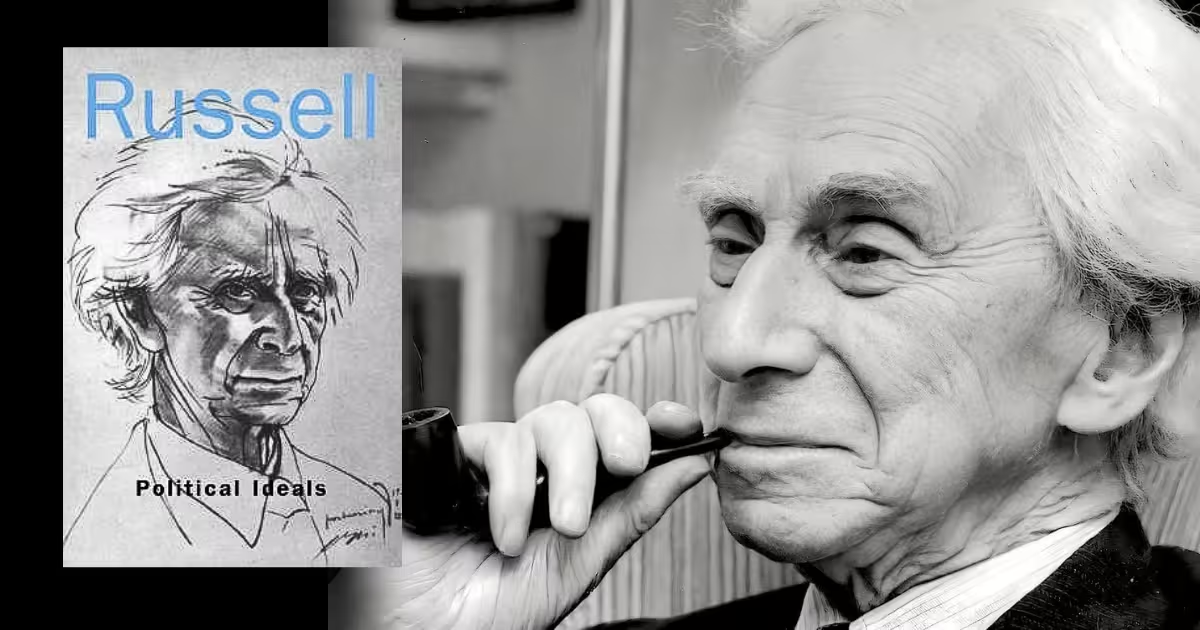
Ever wonder why you feel like just another cog in the machine, despite living in a democracy? Do you sense that something is fundamentally broken, not just with the economy, but with the very way we treat each other? Bertrand Russell’s Political Ideals, written in the fiery crucible of World War I, doesn’t just diagnose the sickness of our political systems—it dissects the soul of modern humanity.
This isn’t a dusty philosophical tome; it’s a radical, passionate, and unsettlingly relevant manifesto that argues the root of all political evil is the triumph of our “possessive impulses” over our “creative impulses.”
This book will show you why we fight, why we feel oppressed, and what a world that truly values human potential might actually look like.
Overview
Political Ideals (1917) is a philosophical pamphlet by Bertrand Russell, written during the devastation of World War I. It argues that the primary purpose of politics should be to enable the best possible life for every individual.
Russell posits that human impulses are divided into two categories: possessive (focused on acquiring material goods, leading to competition, greed, and war) and creative (focused on knowledge, art, and mutual well-being, which benefit everyone).
He argues that our current systems—capitalism and state socialism alike—are fundamentally flawed because they stifle creativity and empower possessiveness.
Russell advocates for a system of guild socialism, where industries are self-governing by workers, and power is radically diffused to protect individual liberty from the tyranny of both the state and the capitalist.
It is a powerful, concise critique that feels as if it were written for the 21st century.
Reader suggestion
Political Ideals can be suggested to anyone feeling disillusioned with modern politics and economics; readers interested in a human-centered philosophy of governance; those curious about the philosophical roots of guild socialism, libertarian socialism, and critiques of both capitalism and authoritarian communism; fans of clear, incisive, and intellectually provocative non-fiction.
Political Ideals is not for readers looking for a detailed, step-by-step political or economic blueprint. Political Ideals is a set of principles and a call to action, not a technical manual. Those who prefer strictly practical, policy-focused books might find it too abstract.
Also, if you are a staunch defender of unfettered capitalism or centralized state power, Russell will challenge your core beliefs.
Table of Contents
Introduction
Title and Author Information: Political Ideals by Bertrand Russell. First published in 1917. The edition I am reviewing is the public domain version, widely available from Project Gutenberg.
Context: Political Ideals is a philosophical treatise written in the midst of one of history’s most devastating conflicts—World War I.
Russell, a British philosopher, logician, and mathematician, was already a prominent figure. He would later be awarded the Nobel Prize in Literature in 1950 “in recognition of his varied and significant writings in which he champions humanitarian ideals and freedom of thought”.
The war served as a brutal confirmation of his worst fears about the political systems of his time. He saw firsthand how the ideals of nationalism, competition, and greed were leading humanity to self-destruction.
This context gives the book a sense of urgent, almost desperate, clarity.
Purpose: The central purpose of Political Ideals is deceptively simple: “Political ideals must be based upon ideals for the individual life. The aim of politics should be to make the lives of individuals as good as possible”.
Russell argues that we have forgotten this fundamental truth. We have created vast, impersonal systems—capitalism, the nation-state, and bureaucracy—that treat people as means to an end, rather than as ends in themselves.
The book is an attempt to re-center political philosophy on the flourishing of the individual human being, arguing that a society that crushes individual creativity and initiative is doomed to stagnation and conflict.
Background
To truly understand Political Ideals, you need to remember the world in which it was born. In 1917, Europe was tearing itself apart.
The optimistic belief in progress that had characterized the 19th century lay in ruins on the battlefields of the Somme and Verdun. The Russian Revolution was just beginning, offering a new, terrifying, and hopeful vision of a state-controlled society.
Russell, a committed pacifist, was imprisoned for his anti-war activism. He saw the war not as an accident, but as the inevitable result of a political and economic system built on competition and possessiveness.
This is the backdrop against which Russell writes.
He isn’t writing as an academic in an ivory tower; he is writing as a man who has seen his worst fears realized and is desperately trying to articulate an alternative before the world destroys itself entirely.
The opening lines set this tone of crisis and hope: “In dark days, men need a clear faith and a well-grounded hope; and as the outcome of these, the calm courage which takes no account of hardships by the way”.
Political Ideals Summary
Russell’s argument is beautifully structured and unfolds logically. Here is a breakdown of the key ideas I learned from the book.
1. The Individual is the Measure of All Things
Russell begins by demolishing the idea that the state or the nation is more important than the people who comprise it. For him, “There is nothing for the politician to consider outside or above the various men, women, and children who compose the world”.
This is a radical humanism. The problem of politics is “to adjust the relations of human beings in such a way that each severally may have as much of good in his existence as possible”. This is the foundational principle from which everything else flows.
2. The Two Great Impulses: Creative vs. Possessive
This is the most crucial distinction in the book. Russell argues that human beings are driven by two fundamental types of impulses.
Possessive Impulses: These are aimed at acquiring or retaining private goods that cannot be shared, such as food, clothing, land, and money. Material goods are finite; if one person has more, another has less. This leads to competition, envy, and conflict. “In particular, it leads to the predatory use of force” . Force can be used to take material possessions.
Creative Impulses: These are aimed at bringing into the world or making available goods that can be shared by all, such as knowledge, art, science, and love. These are infinite goods.
If one person knows a science, it doesn’t prevent others from knowing it; on the contrary, it helps them. Force is impotent in these matters. “You may kill an artist or a thinker, but you cannot acquire his art or his thought”.
Russell’s central argument is that “The best life is the one in which the creative impulses play the largest part and the possessive impulses the smallest”. Our current systems, however, do the exact opposite: they encourage possessiveness and crush creativity.
3. The Corruption of the Modern World
Russell systematically shows how our institutions are poisoned by possessiveness.
On Capitalism: He argues that capitalism forces the wrong choice upon people. It is a system wholly built on competition, where the great majority would fall into utter destitution if they became careless as to the acquisition of material goods.
This struggle for survival forces people into a possessive mindset. “Modern capitalism forces the wrong decision of these alternatives upon all who are not heroic or exceptionally fortunate” .
Furthermore, it concentrates power in the hands of a tiny minority of capitalists who have no right to such power over the lives of others. The system is “wasteful on the production side, and unjust on the side of distribution”.
On the Tyranny of the Employer: Russell provides a scathing critique of the modern workplace. He notes that a man who works for a large organization, like a railway company, “has no voice in its management, and no liberty in politics except what his trade-union can secure for him”.
The employer’s power to dismiss is a form of tyranny that robs men of their initiative and freedom.
On the State and Bureaucracy: While Russell is not an anarchist, he is deeply suspicious of state power. He critiques state socialism, arguing that nationalizing industries without democratizing their management simply replaces a private tyrant with a public one. “State socialism… is not a truly democratic system” because power simply passes into the hands of officials who are “very remote from those whom they govern”.
He warns of the love of power that consumes officials, who prefer “the tidiness of what he has decreed to the apparent disorder of spontaneous growth”.
On Education: Russell’s critique of education is particularly sharp. He laments that the whole spirit of education is designed to crush individuality and impose conformity.
He uses the example of a teacher who would not tolerate a pupil preferring Troilus and Cressida over other Shakespeare plays, saying “A bad teacher will aim at imposing his opinion, and turning out a set of pupils all of whom will give the same definite answer on a doubtful point”.
The goal, he says, should not be to make all men think alike, but “to make each think in the way which is the fullest expression of his own personality”.
4. The Four Goals of a Good Economic System
Russell outlines four purposes an economic system should aim for:
- The greatest possible production of goods and technical progress.
- Securing distributive justice.
- Ensuring security against destitution.
- Liberating creative impulses and diminishing possessive impulses.
He argues that capitalism achieves the first goal, but fails miserably on the other three. State socialism might achieve the second and third, but fails on the first and fourth, stifling initiative and individual liberty.
5. The Solution: Guild Socialism and Diffused Power
So, what is the answer? Russell is highly sympathetic to Guild Socialism, a system he also explored in his later work, Proposed Roads to Freedom. He envisions a system where each industry would be a self-governing unit, owned and managed by the workers themselves.
He suggests that “the workers in a given industry should all be combined in one autonomous unit, and their work should not be subject to any outside control”.
The role of the state would be radically reduced to that of a neutral authority, deciding questions between different self-governing groups, such as fixing prices to prevent exploitation. The goal is the “diffusion of power”. Russell believes that if power is widely distributed, the love of power and the desire for tyranny will be greatly diminished.
6. Internationalism and the Future
Russell applies the same principles to international relations. He argues that nations, like individuals, should be self-governing in their internal affairs but subject to law in their dealings with each other.
The current anarchy between states, which leads to war, is a direct result of the lack of an international government. He believes that “the interests of different nations coincide immeasurably outweigh those in which they clash”.
Progress in science, art, and literature benefits all of humanity, not just one nation. The ultimate goal is a world where “Life and hope… are to be found only in the deeds of love” .
Political Ideals Analysis
Reading Political Ideals in the 21st century is a disorienting experience. On one hand, the book feels incredibly dated. It is a product of its time, written in the shadow of a specific war and engaging with political movements like syndicalism and guild socialism that have largely faded from mainstream discourse.
The prose, while characteristically clear and sharp, carries a formal, early 20th-century tone.
Yet, on the other hand, the book feels prophetic. Russell’s diagnosis of the human condition—the eternal struggle between our desire to create and our desire to own—is more relevant than ever. In an age of staggering wealth inequality, precarious gig-economy work, and the soul-crushing bureaucracy of modern life, his critique of capitalism as a system that forces us into a possessive mindset rings absolutely true.
His warnings about the tyranny of the state and the crushing force of public opinion are a powerful antidote to the authoritarian temptations of our own era.
Russell’s solution, however, is where the book feels most utopian and perhaps a little naive. His advocacy for guild socialism seems quaint in a world of global supply chains and multinational corporations.
The idea that workers in an industry could self-govern effectively is appealing but raises a host of practical questions about efficiency, coordination, and the potential for new forms of parochialism.
Furthermore, as one reviewer noted, the book is “a manifesto of what the world ought to be like” and it is “not helped by Russell’s ‘ought to be’s’”.
He is brilliant at describing the illness but his prescription for a cure is high-level and idealistic.
Nevertheless, the strength of the book lies not in its policy proposals but in its fundamental ethical stance. Russell forces you to ask: What is the point of all this?
Is the purpose of society to maximize GDP, or is it to create conditions where human beings can flourish, create, and love?
His answer is clear, and it is a question that is just as urgent today as it was in 1917.
Strengths and Weaknesses
Strengths (My Pleasant Experience)
Exceptional Clarity: Russell’s writing is a model of philosophical exposition. He takes complex ideas and presents them with breathtaking clarity, making the book accessible to any thoughtful reader.
A Powerful Moral Framework: The distinction between creative and possessive impulses provides a simple yet profound lens through which to view all of human history and current events.
Prophetic Insight: His criticisms of the dehumanizing effects of capitalism, bureaucracy, and nationalism feel startlingly contemporary.
Human-Centered Philosophy: The book is a powerful reaffirmation of the value of the individual. In a world that often treats people as statistics, Russell’s humanism is a breath of fresh air.
Weaknesses (My Unpleasant Experience)
Utopian and Impractical: The proposed solutions, particularly guild socialism, feel underdeveloped and divorced from the complex realities of modern economics and politics.
Lack of a Concrete Plan: The book is a statement of ideals, not a practical guide. Readers looking for actionable steps to create change will be disappointed.
Sweeping Generalizations: At times, Russell makes broad generalizations about human nature and society that lack the nuance of his philosophical arguments.
Dated References: The specific political movements he discusses (syndicalism, guild socialism) are historical artifacts for most modern readers, which can create a barrier to engagement.
Comparison with Similar Works
Political Ideals can be seen as a shorter, more focused precursor to Russell’s own Proposed Roads to Freedom (1918), which is a longer and more detailed examination of socialism, anarchism, and syndicalism.
It shares a philosophical kinship with John Stuart Mill’s On Liberty, as both are powerful defenses of individual freedom against the tyranny of the majority and the state.
However, Russell goes further than Mill by providing a more radical economic critique, arguing that economic tyranny is just as oppressive as political tyranny.
Finally, it presents a fascinating counterpoint to the works of Karl Marx. While both critique capitalism, Russell is deeply skeptical of the Marxist solution, fearing that a state-controlled economy would simply create a new, more powerful form of tyranny.
He represents a liberal, individualistic strand of socialist thought that is often overlooked in discussions of 20th-century political philosophy.
Conclusion
Political Ideals is not a book of answers; it is a book of questions. It is a passionate, eloquent, and deeply humanistic plea for us to remember what we are really here for. Are we here to compete, to amass, and to dominate? Or are we here to create, to love, and to grow?
Reading this book, you will not find a blueprint for a utopia. But you will find a powerful framework for thinking about the world, a way to cut through the noise of modern politics and see the underlying moral failings of our systems.
Russell challenges us to imagine a world where the goal of politics is to encourage the best in each of us, rather than to manage our worst impulses. It is a challenge that, a century later, we have still failed to meet.
I would recommend this book to anyone who feels a sense of powerlessness and despair about the state of the world. It won’t give you easy answers, but it will give you the vocabulary and the courage to ask better questions.







