
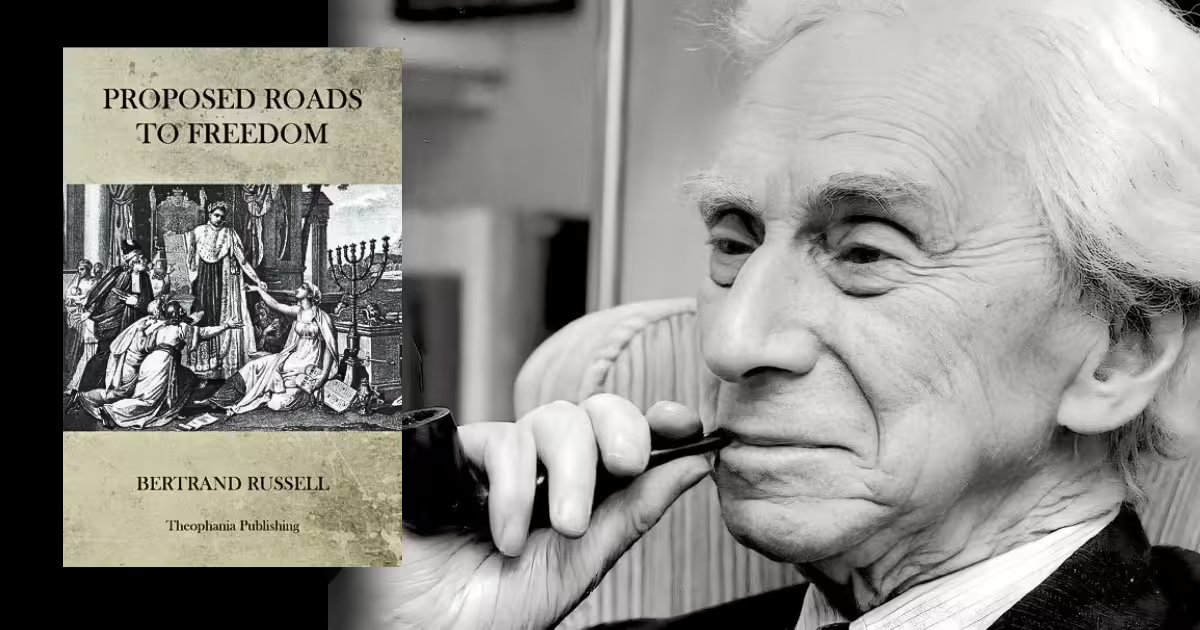
Do you ever feel like the political choices on offer—more State or less State, capitalism or communism—are all roads leading to the same dead end? Bertrand Russell’s Proposed Roads to Freedom doesn’t just diagnose that feeling; it gives you a map to escape it. Written in the final days of World War I, this book argues that neither pure Socialism nor pure Anarchism can deliver the liberty we crave—but a third path, Guild Socialism, just might.
Overview
Proposed Roads to Freedom: Socialism, Anarchism and Syndicalism (1918) is Bertrand Russell’s clear-eyed, unsentimental survey of the three major radical movements of his day.
He traces the ideas of Marx, Bakunin, and the French Syndicalists, weighs their strengths and weaknesses, and then builds his own case for Guild Socialism—a system where workers control industry through democratic guilds, while a reduced State looks after consumers’ interests.
Russell concludes that Anarchism is the ultimate ideal but impractical now, that State Socialism risks bureaucratic tyranny, and that Syndicalism, though vigorous, would collapse without some central authority.
Proposed Roads to Freedom is as much about the spirit of freedom—what makes life worth living—as it is about economic systems.
Reader suggestion
Proposed Roads to Freedom is highly suggested for readers who want a philosophically grounded, historically informed introduction to Socialism, Anarchism, and Syndicalism—without the sectarian dogma.
If you’re tired of shallow hot-takes and want to understand why these ideas matter, and where they break down, this book is for you. It’s also essential for anyone interested in the intellectual roots of workplace democracy, the debate over State power, and the perennial question: how much freedom can a society afford?
Proposed Roads to Freedom is not suggested for those seeking a detailed policy blueprint or a step-by-step guide to revolution. Russell himself admits his proposals are “sketchy”.
-If you need exhaustive economic models or granular institutional design, you’ll find this book frustrating. It’s a work of political philosophy, not a technical manual.
Table of Contents
1. Introduction
Proposed Roads to Freedom: Socialism, Anarchism and Syndicalism was written by Bertrand Russell (1872–1970)—British philosopher, logician, mathematician, historian, social critic, and Nobel Laureate in Literature (1950).
The Nobel committee honoured him “in recognition of his varied and significant writings in which he champions humanitarian ideals and freedom of thought”.
The book was completed in April 1918, “in the last days before a period of imprisonment,” as Russell was jailed for his pacifist activism during World War I. It was first published in London by Allen & Unwin, and in New York by Henry Holt & Co. in 1919.
Context
The book is a work of political philosophy and intellectual history. It belongs to the tradition of utopian social criticism that Russell traces back to Plato’s Republic.
But unlike purely speculative utopias, Russell’s project is grounded in the concrete political movements of his time: the rise of Marxist Socialism, the anarchist currents inspired by Bakunin, and the revolutionary Syndicalism of the French Confédération Générale du Travail (C.G.T.).
Russell writes not as a detached academic but as a passionate participant in the struggle for a better world—a man who had already been imprisoned for his beliefs and would continue to be a thorn in the side of power for decades.
Purpose
The main purpose is twofold. First, Russell argues that pure Anarchism, though the most desirable ideal, is “for the present impossible, and would not survive more than a year or two at most if it were adopted”.
Second, he contends that Marxian Socialism and Syndicalism each contain fatal flaws: the former gives “far too much power to the State,” while the latter, in abolishing the State, “would find itself forced to reconstruct a central authority in order to put an end to the rivalries of different groups of producers”.
The best practicable system, Russell concludes, is Guild Socialism—a federalist arrangement that balances the legitimate claims of both State Socialists and Syndicalists.
2. Background
Russell wrote Proposed Roads to Freedom in the shadow of the Great War—a conflict that, for him, epitomised the catastrophic failure of the existing order. The war had shattered the complacent belief in progress, and the Russian Revolution of 1917 had suddenly made socialist revolution a live possibility.
Yet Russell was deeply sceptical of the Bolshevik model, which he saw as replacing capitalist tyranny with State tyranny.
The intellectual background is equally important.
Russell was a founder of analytic philosophy, but his political writings draw on a different tradition: the British socialist thought of William Morris and the Fabians, the anarchist communism of Kropotkin, and the nascent Guild Socialism of his contemporaries like G.D.H. Cole.
Russell’s unique contribution is to bring the clarity and rigour of analytic philosophy to bear on political questions—without losing the moral urgency that defines the best radical thought.
3. Proposed Roads to Freedom Summary
Russell divides the book into two parts. Part I (Historical) examines the three main radical movements: Marxian Socialism, Anarchism (via Bakunin and Kropotkin), and Syndicalism. Part II (Problems of the Future) tackles the practical issues any new society must face: work and pay, government and law, international relations, science and art, and finally, a vision of “The World as It Could Be Made.”
Part I: Historical
Chapter 1: Marx and Socialist Doctrine
Russell begins by defining Socialism as “the advocacy of communal ownership of land and capital”. He then traces the life and thought of Karl Marx (1818–1883), whom he credits with transforming Socialism from a utopian dream into a powerful political movement.
Marx’s key doctrines, as Russell summarises them, are three:
- The Materialistic Interpretation of History: “Marx holds that in the main all the phenomena of human society have their origin in material conditions, and these he takes to be embodied in economic systems”. Politics, law, religion, philosophy—all are expressions of the underlying economic regime.
- The Law of the Concentration of Capital: Marx predicted that capitalist enterprises would grow larger and larger, leading to trusts and monopolies, and that the number of capitalists would dwindle while the proletariat swelled.
- The Class War: “Marx conceives the wage-earner and the capitalist in a sharp antithesis”. The two classes have antagonistic interests, and their conflict must end in the victory of the proletariat and the abolition of private property.
Russell quotes extensively from the Communist Manifesto (1848), calling it “a work of the most amazing vigour and force”. He notes the famous opening: “A spectre is haunting Europe—the spectre of Communism”.
He also highlights Marx’s view that the State is merely “a Committee for managing the common affairs of the whole bourgeoisie”, though Marx also believed that the proletariat must first seize State power before the State could wither away.
Russell is critical of Marx’s theory of surplus value, which he says “is very complicated and is scarcely tenable as a contribution to pure theory”. However, he praises Marx’s factual documentation of capitalist cruelty—the long hours, the child labour, the deaths from overwork. He reproduces several of Marx’s harrowing examples, including the death of milliner Mary Anne Walkley, who worked 26.5 hours straight and died from exhaustion. Russell concludes that “the facts which he accumulates are such as are practically unknown to the vast majority of those who live comfortable lives”.
Russell also notes the Revisionist challenge to Marx, led by Eduard Bernstein, who argued that workers were not becoming more impoverished, that democracy could achieve socialist goals peacefully, and that the class war was not as sharp as Marx had predicted. Bernstein’s slogan, Russell says, was “We have to take working men as they are”.
Chapter 2: Bakunin and Anarchism
Russell turns to Anarchism, which he defines as “the theory which is opposed to every kind of forcible government”. He dismisses the popular image of the bomb-throwing anarchist, noting that “for every bomb manufactured by an Anarchist, many millions are manufactured by Governments”.
The central figure is Mikhail Bakunin (1814–1876), a Russian aristocrat who became the great rival of Marx. Russell traces Bakunin’s dramatic life: his philosophical studies in Berlin, his revolutionary activities in 1848, his imprisonment in multiple countries (including being chained to a wall in an Austrian prison), his exile to Siberia, and his dramatic escape to Japan and then to London.
Bakunin’s quarrel with Marx was both personal and ideological.
Marx favoured State Socialism and parliamentary action; Bakunin opposed the State entirely and believed in revolutionary violence. The split in the First International (1872) was the culmination of this feud.
Russell quotes Bakunin’s own words: “The State is not society, it is only an historical form of it, as brutal as it is abstract”. Bakunin also rejected the idea of a divine or moral authority: “Liberty, morality, and the human dignity of man consist precisely in this, that he does good, not because it is commanded, but because he conceives it, wills it and loves it”.
Russell then discusses Peter Kropotkin (1842–1921), who gave Anarchism a more constructive, scientific basis. Kropotkin’s books Fields, Factories and Workshops and The Conquest of Bread argued that modern science could produce enough food and goods for everyone with only a few hours of work per day. Russell notes that Kropotkin’s proposals are “not merely technical but also moral”: he wanted to abolish the wage system entirely and allow everyone to take what they need.
However, Russell is sceptical: “The Anarchist plan of free sharing … would not survive more than a year or two at most”.
Chapter 3: The Syndicalist Revolt
Syndicalism, Russell explains, arose in France as a revolt against political Socialism. Unlike Socialism and Anarchism, which began with ideas and then built organisations, Syndicalism “began from an existing organisation and developed the ideas appropriate to it”—namely, the trade unions (syndicats).
The key organisation was the Confédération Générale du Travail (C.G.T.) , founded in 1895. Its leaders were anarchists who believed in “direct action”—strikes, sabotage, and the General Strike as the means to overthrow capitalism.
Russell quotes the C.G.T.’s manifesto: “All Syndicalism, Collectivism, Anarchism aims at abolishing the present economic status … but while Collectivism would substitute ownership by everybody, and Anarchism ownership by nobody, Syndicalism aims at ownership by Organized Labor”.
Syndicalists rejected parliamentary politics because they saw the State as a capitalist institution. They were anti-militarist and internationalist, though Russell notes that this did not survive the German invasion of France in 1914.
Russell also discusses the Industrial Workers of the World (I.W.W.) in America, which shared the Syndicalist spirit but was even more violent. He quotes the I.W.W.’s preamble: “The working class and the employing class have nothing in common”.
Russell’s assessment of Syndicalism is mixed. He admires its spirit of liberty and its focus on the producer rather than the consumer.
But he criticises its reliance on force and its lack of a clear plan for post-revolutionary society. “Syndicalist aims are somewhat less definite than Syndicalist methods,” he writes.
Part II: Problems of the Future
Chapter 4: Work and Pay
Russell tackles the fundamental question: Can a just society be productive? He examines two obstacles: Malthusian population pressure and the alleged necessity of unpleasant work.
On population, Russell argues that the birth-rate is declining in civilised countries, and that improved agriculture (as Kropotkin showed) can feed far more people than Malthus imagined. He cites Kropotkin’s example of Parisian market-gardeners who produce “from 50 to 100 tons of various vegetables on the same space” where traditional farming produced only five or six tons of grass.
On the necessity of unpleasant work, Russell concedes that some work will always be disagreeable, but he believes that most work could be made pleasant through better organisation, shorter hours, and worker control. He quotes Kropotkin: “Overwork is repulsive to human nature—not work”.
Russell then contrasts the Anarchist and Socialist approaches to distribution. Anarchists would give everyone free access to necessaries, regardless of whether they work.
Socialists would require work in exchange for a share of the product. Russell favours a middle path: a guaranteed minimum income (enough for necessaries) for all, with extra income for those who work. This, he says, combines freedom with the incentive to work.
Chapter 5: Government and Law
Russell defends the necessity of some government, against the Anarchist claim that all coercion is unnecessary. He argues that “respect for the liberty of others is not a natural impulse with most men”. Without law, the strong would oppress the weak, and private tyranny would flourish.
However, Russell insists that government power must be strictly limited. He criticises State Socialism for its faith in bureaucracy: “Given an official caste, however selected, there are bound to be a set of men whose whole instincts will drive them toward tyranny”.
He also criticises parliamentary democracy for its remoteness, its hypocrisy, and its tendency to ignore minorities.
The solution, Russell argues, is devolution—giving self-government to every important group (industries, churches, localities) in matters that affect them most. This is the core of Guild Socialism. He also proposes a Guild Congress alongside Parliament, representing producers, to balance the power of the State.
Chapter 6: International Relations
Russell acknowledges that capitalism promotes war—through finance capital’s search for foreign investment, and through the jingoism of the press. But he insists that capitalism is not the sole cause of war. Human nature—competitiveness, love of power, envy—would still produce conflict even under Socialism.
He cites the example of Australia and California, where race-hatred against Asians persists regardless of economic system. He also warns that a Socialist Europe might still exploit Africa, unless deliberate efforts are made to avoid it.
Russell’s hope for peace rests on three things: (1) the abolition of capitalism, (2) the creation of a League of Nations to deter aggressors, and (3) a change in human psychology—away from envy and toward co-operation. He writes: “A world full of happiness would not wish to plunge into war”.
Chapter 7: Science and Art Under Socialism
Russell confronts the fear that Socialism would stifle creativity. He argues that State Socialism would indeed be disastrous for art and science, because bureaucrats would impose orthodoxies and stifle innovation. He paints a grim picture of a State-appointed panel of “experts” deciding which artists are worthy of support.
But Guild Socialism or Anarchism, with their emphasis on freedom, could be much better. Russell proposes two ways to preserve artistic freedom: (1) allow artists to work half-time at a regular job and spend the rest of their time on their art; or (2) provide a “vagabond’s wage”—a basic income sufficient for necessaries—so that anyone can pursue creative work without starving.
He also tackles the problem of publishing. If the State or a Guild controls all publishing, who decides what gets printed? Russell’s answer: allow authors to pay for publication themselves, if the official body refuses to print their work. This, he admits, is a concession to individualism, but it’s necessary for freedom.
Chapter 8: The World as It Could Be Made
Russell concludes with a vision of a society built on hope rather than fear. He distinguishes three kinds of evil: (1) physical evils (death, pain, scarcity), (2) evils of character (ignorance, violence, envy), and (3) evils of power (tyranny, oppression). The remedies are: science for physical evils, education for character, and political reform for power.
He outlines his ideal society:
- Education free and compulsory to 16, optional but free to 21.
- No compulsory work; a basic income for all who choose not to work.
- Four hours of work per day for those who do work, thanks to improved productivity.
- Self-governing industries (Guilds), with a Guild Congress to settle inter-industry disputes.
- A reduced State to handle consumer interests, with a joint committee of Parliament and the Guild Congress for matters affecting both.
- Payment for willingness to work, not just for actual output.
- Economic independence for women, including pay for domestic work.
- No private property in land or capital; but money would still exist (with time-limited notes to prevent hoarding).
Russell acknowledges that this is a sketch, not a blueprint. But he insists it is possible—and that the main obstacle is not nature, but human will.
He ends with a stirring passage: “The world that we must seek is a world in which the creative spirit is alive, in which life is an adventure full of joy and hope … Such a world is possible; it waits only for men to wish to create it”.
4. Proposed Roads to Freedom Analysis
Proposed Roads to Freedom is, in many ways, a quintessentially Russellian book: clear, rational, unsentimental, and deeply humane. Russell does not preach; he argues. He does not idolise any movement; he dissects them. And he never loses sight of the ultimate question: what makes life worth living?
What Works
1. The Historical Survey is Masterful. Russell covers a vast amount of ground in just over 80 pages, yet he never confuses or oversimplifies. He gives Marx, Bakunin, and the Syndicalists a fair hearing, quoting them extensively and allowing their ideas to speak for themselves.
His treatment of Marx is especially nuanced: he acknowledges Marx’s genius and his devastating critique of capitalism, while also pointing out the flaws in his economic theories and his underestimation of nationalism.
2. The Focus on Liberty is Refreshing. Unlike many socialists, who treat economic equality as the only goal, Russell insists that freedom is the supreme political good.
He is acutely aware that State Socialism could become a new form of tyranny, and he is equally aware that Anarchism, whatever its ideals, could degenerate into chaos. His Guild Socialism is an attempt to steer between these two dangers—and it remains one of the most thoughtful attempts to reconcile liberty with equality.
3. The Practical Vision is Surprisingly Modern. Russell’s proposals—a basic income, worker self-management, free education, shorter working hours—have become mainstream talking points in the 21st century.
His argument that work should be made pleasant, not just endured, anticipates the “future of work” debates. His insistence on economic independence for women was radical for 1918 and remains relevant today.
4. The Prose is a Joy. Russell writes with crystalline clarity. Even when discussing abstract theory, he never loses the reader. His sentences are lean, his arguments are logical, and his wit is always present.
This is political philosophy as it should be written: accessible to the educated layperson, but rigorous enough for the specialist.
What Doesn’t Work
1. The Guild Socialism Proposal is Underdeveloped. As the Journal of Political Economy review noted, Russell’s vision is “like milky ways, from nothing to nothing”.
He never explains how jurisdictional disputes between guilds would be resolved, how prices would be set, or how the transition from capitalism to Guild Socialism would occur. He admits this himself, but it’s still a weakness.
2. The Optimism About Human Nature is Questionable. Russell assumes that, once economic fear is removed, most people will work willingly and co-operate harmoniously. But as he himself notes, “respect for the liberty of others is not a natural impulse”. The historical record—from the Soviet Union to the present—suggests that power corrupts even in non-capitalist systems.
Russell’s faith in education and freedom may be too sanguine.
3. The Treatment of International Relations is Naïve. Russell acknowledges that race-hatred and nationalism would persist under Socialism, but he offers little more than hope that a “world full of happiness” would not want war. Given the wars that have occurred since 1918—including those between socialist states—this seems overly optimistic.
4. The Book is Dated in Some Respects. Russell’s discussion of “inferior races” and his assumption that Europe would continue to govern Africa are uncomfortable to modern ears. He does advocate for eventual self-government, but his language reflects the paternalistic imperialism of his era.
5. Strengths and Weaknesses
Strengths
Clarity and Accessibility: Russell makes complex ideas understandable without dumbing them down.
Fair-Mindedness: He gives every school of thought a fair hearing, even when he disagrees with it.
Moral Seriousness: The book is driven by a genuine concern for human suffering and a passionate commitment to freedom.
Prescience: Many of Russell’s proposals—basic income, worker co-ops, shorter hours—are now mainstream policy ideas.
Weaknesses
Under-Specified Proposals: Guild Socialism is sketched rather than detailed.
Over-Optimism: Russell underestimates the persistence of human aggression and the difficulty of social change.
Dated Language and Assumptions: Some passages reflect the prejudices of Russell’s time.
Lack of Engagement with Democracy: Russell is critical of parliamentary democracy, but he doesn’t fully grapple with how his Guild system would avoid the same problems.
6. Comparison with Similar Works
| Book | Author | Year | Key Idea | Comparison |
|---|---|---|---|---|
| The Communist Manifesto | Marx & Engels | 1848 | Class struggle, revolution, abolition of private property | Russell accepts Marx’s critique of capitalism but rejects his faith in the State. |
| Mutual Aid | Kropotkin | 1902 | Co-operation, not competition, is the key to evolution | Russell admires Kropotkin’s practical proposals but finds Anarchism impractical. |
| The Road to Serfdom | Hayek | 1944 | State planning leads to tyranny | Russell would agree with Hayek about the dangers of State power, but he is more sympathetic to socialism. |
| The World of Labour | G.D.H. Cole | 1913 | Guild Socialism as a third way | Russell was influenced by Cole and develops similar ideas, though with more emphasis on liberty. |
| Political Ideals | Russell | 1917 | Earlier essays on similar themes | Proposed Roads is a more systematic and historical treatment. |
7. Conclusion
Proposed Roads to Freedom is not a perfect book. It is a product of its time, with all the limitations that entails. Its proposals are sketched rather than detailed, and its optimism about human nature may seem naive to a generation that has lived through totalitarianism, genocide, and endless war.
And yet. This book remains one of the most thoughtful, humane, and intellectually honest explorations of the question: how can we create a society that is both free and just? Russell does not offer easy answers; he offers a method—clear thinking, moral seriousness, and a willingness to learn from the past.
He reminds us that the goal is not just material comfort, but the flourishing of the human spirit: “The world that we must seek is a world in which the creative spirit is alive, in which life is an adventure full of joy and hope”.
If you are tired of ideological shouting matches and want to understand what the great political movements of the last century were really about—and what they still have to offer—read this book. It will not give you all the answers. But it will give you the right questions.







