
Do you ever get the feeling that the news isn’t telling you the whole story? It’s a question that lingers in the back of your mind as you scroll through your feed or watch the evening news. Why do some global tragedies dominate the headlines for weeks, while others, equally horrific, are barely mentioned? Why are some victims of violence mourned as martyrs, while others are dismissed as collateral damage?
These aren’t just random editorial choices.
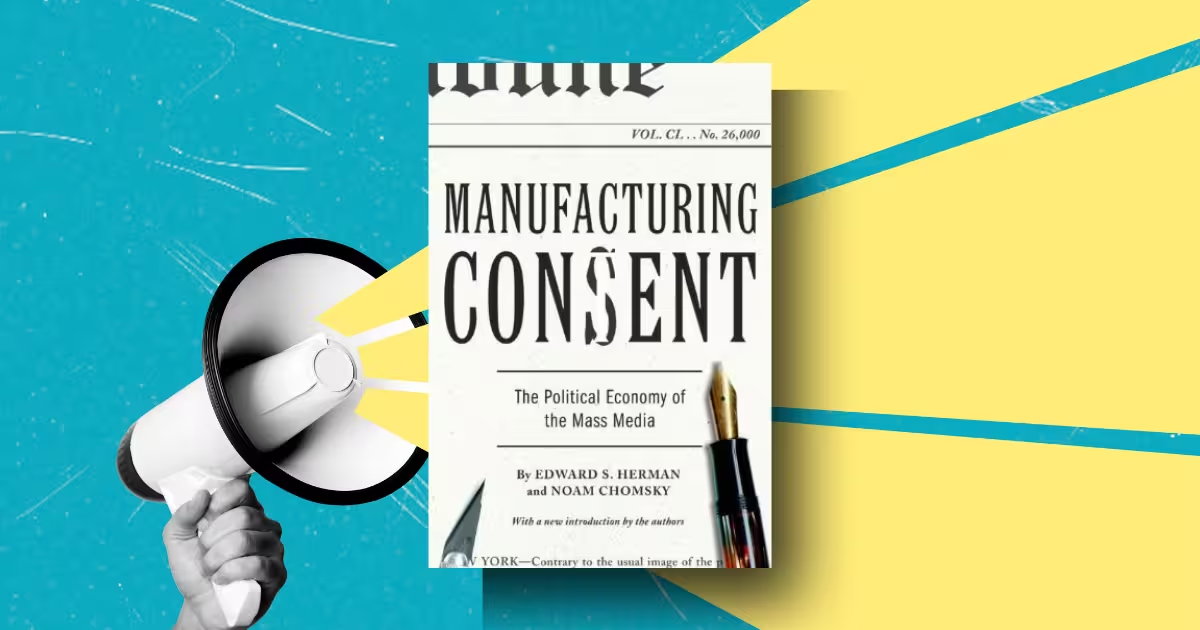
According to Edward S. Herman and Noam Chomsky in their seminal 1988 work, Manufacturing Consent: The Political Economy of the Mass Media, there is a systematic, predictable, and deeply troubling reason for these discrepancies.
Manufacturing Consent presents a powerful, and for many, an unsettling thesis: the mainstream media in the United States function not as an independent watchdog, but as a propaganda system that serves the interests of the powerful elite.
This isn’t a conspiracy theory in the traditional sense. Herman and Chomsky argue that the media’s bias is not the result of a secret cabal pulling strings, but rather of a “guided market system” driven by structural filters that shape what we see, hear, and ultimately believe.
Published in 1988 and revised in 2002 with a new introduction, Manufacturing Consent is far from a historical artifact. In an age of deepfakes, algorithmic echo chambers, and “fake news,” its core argument is arguably more relevant than ever.
Overview
Manufacturing Consent is a dense, meticulously researched, and intellectually demanding work that argues the U.S. mass media are powerful ideological institutions that “manufacture consent” for the established order.
The authors propose a “Propaganda Model” with five key filters—ownership, advertising, sourcing, flak, and an ideological enemy—that systematically filter the news, ensuring it serves elite interests.
Manufacturing Consent backs up this theory with detailed case studies of media coverage, including the dichotomous treatment of “worthy” vs. “unworthy” victims, the framing of third-world elections, and the coverage of the Indochina wars.
It is a sobering and essential read for anyone who wants to understand how power operates in a modern democracy and how our perceptions of reality are actively shaped by forces beyond our immediate control.
Reader recommendation
Manufacturing Consent best for:
- Students of media studies, political science, and sociology. This book is a foundational text for understanding critical media theory.
- Critical thinkers and skeptics who question the narratives presented by mainstream news organizations.
- Activists and citizens who want to understand the mechanisms of power and propaganda to become more effective in challenging them.
- Anyone feeling a sense of “cognitive dissonance” between the world they see and the world the news describes.
Manufacturing Consent is suggested for:
- Readers looking for a light or easy read. The book is dense, academic, and often repetitive.
- Those seeking a “how-to” guide on media manipulation. It is an analysis of the system, not a practical manual.
- Journalists and media professionals who are unwilling to confront the idea that their industry is part of a larger system of power. The book’s conclusions are fundamentally challenging to the self-image of the press.
- Readers who prefer a purely contemporary analysis. While the model is timeless, many of the specific case studies are rooted in the 1970s and 1980s.
Table of Contents
Background
To understand Manufacturing Consent, you must first understand its context.
Walter Lippmann, a prominent journalist and political commentator, coined the phrase “the manufacture of consent” in his 1922 book, Public Opinion, describing it as a necessary mechanism for managing a complex society. Herman and Chomsky take this concept and turn it into a full-blown critique of the capitalist media system.
The book was initially published at the tail end of the Cold War (1988), a period of intense ideological conflict between the U.S. and the Soviet Union. This context is crucial because the fifth and final filter in their model is “anticommunism,” a powerful ideological force that was used to discipline the media and frame global events.
However, as they noted in the 2002 introduction, this filter has evolved.
With the fall of the Soviet Union, the “fear” of communism was replaced by other “evil dictators” and, more broadly, the near-religious belief in the “miracle of the market.”
The book is dedicated to the memory of Alex Carey, an Australian social psychologist whose work on propaganda was a major inspiration.
Chomsky himself has credited Herman as the primary architect of the book’s core structure, with Herman being responsible for the preface and chapters 1-4, and Chomsky for chapters 5-7.
Herman, a professor of finance at the Wharton School, brought a rigorous economic perspective to the analysis of media as a business.
Chomsky, the world-renowned linguist and political dissident, provided the deep moral outrage and historical knowledge to apply the model to U.S. foreign policy.
Manufacturing Consent Summary
The heart of Manufacturing Consent is the “Propaganda Model,” an analytical framework that explains the media’s performance not through intentional malice, but through the basic institutional structures within which they operate.
The authors argue that the “raw material of news” must pass through five successive “filters,” leaving only the “cleansed residue fit to print” that is acceptable for public consumption.
Filter 1: Ownership and Profit Orientation
The first and most foundational filter is the size, concentration, and profit orientation of the dominant media firms. The mass media are not public services; they are large corporations owned by wealthy individuals or conglomerates.
Herman and Chomsky provide extensive financial data to demonstrate this. In 1986, the twenty-four largest media giants had assets in the hundreds of millions to billions of dollars.
These companies are integrated into the market, with boards of directors interlocked with major banks and other corporations. This creates a powerful incentive to focus on the “bottom line” and to avoid content that might offend powerful shareholders or business partners.
As the book notes, “the control groups of the media giants are also brought into close relationships with the mainstream of the corporate community through boards of directors and social links.”
This structural reality ensures that the media’s fundamental interests are aligned with the corporate and financial elite, not the general public.
Filter 2: The Advertising License to Do Business
The second filter is the media’s reliance on advertising as their primary source of income. Because they are dependent on advertisers, media organizations are essentially selling audiences, not news.
This creates a powerful bias. Advertisers prefer to sponsor content that appeals to affluent consumers—the “quality” audience with buying power—and that puts them in a “buying mood.” Programming that is serious, complex, or politically controversial is often avoided because it might “interfere with the ‘buying mood'” or offend sponsors.
As the book states, advertisers “will want, more generally, to avoid programs with serious complexities and disturbing controversies that interfere with the ‘buying mood.'”
This is why television networks have historically favored light entertainment over hard-hitting investigative journalism; controversy is bad for business. The market, therefore, systematically pushes media toward a depoliticized and consumerist content.
Filter 3: Sourcing—The Symbiotic Relationship with Power
The third filter is the media’s heavy and often uncritical reliance on official sources provided by the government and large corporations. The media need a steady, reliable, and cost-effective flow of news.
Who provides that? The White House, the Pentagon, the State Department, and major corporations have massive public relations and information operations that dwarf any dissenting or independent source.
As the book points out, “reporters are predisposed to treat bureaucratic accounts as factual because news personnel participate in upholding a normative order of authorized knowers in the society.”
In other words, journalists have internalized the idea that “officials ought to know what it is their job to know.” This “bureaucratic affinity” means that the government doesn’t just provide a story; it defines the very framework within which the story is discussed. The use of anonymous “senior officials” as sources is a prime example.
They provide “information” on the condition of anonymity, which the media reports as fact, effectively allowing the government to plant a story without being held accountable. This “symbiotic relationship” is fundamental to the propaganda model.
Filter 4: Flak—The Enforcers of Orthodoxy
“Flak” refers to the negative responses to a media statement or program. This can take the form of letters, petitions, lawsuits, or political pressure. When it comes from powerful groups, flak can be costly and intimidating.
Herman and Chomsky identify several organizations whose primary function is to produce flak against the media.
These include Accuracy in Media (AIM), the Media Institute, and Freedom House. These groups, often funded by large corporations, relentlessly attack the media for perceived liberal bias or for being insufficiently supportive of U.S. foreign policy.
As the book explains, “The ability to produce flak, and especially flak that is costly and threatening, is related to power.” The threat of being sued, being hounded on air, or being labeled as “unpatriotic” serves as a powerful deterrent, discouraging journalists from stepping outside the bounds of acceptable debate.
This is the primary mechanism for disciplining the media.
Filter 5: Anticommunism (and its Modern Descendants)
The final filter is the ideology of anticommunism. The authors argue that this ideology serves as a “control mechanism” that helps “mobilize the populace against an enemy.”
During the Cold War, this was a potent filter.
A story that could be framed as a blow against Communism was inherently newsworthy and would be given prominent play. Conversely, a story that would embarrass a U.S. ally or complicate the fight against Communism was likely to be downplayed or suppressed.
As the book notes, in the 2002 introduction, this filter has evolved, now taking the form of the “war on terror” or the threat of “rogue states” and “evil dictators” like Saddam Hussein or Slobodan Milosevic.
The filter ensures that the media frame events in a way that supports the established power structure and its foreign policy goals.
Case Study in Action: The Dichotomy of “Worthy” and “Unworthy” Victims
To demonstrate how these five filters operate in the real world, the authors dedicate an entire chapter to the concept of “Worthy and Unworthy Victims.”
They argue that the media’s coverage of victims is not based on objective criteria, but on the political utility of the story.
A “worthy” victim is one who is victimized by an enemy of the U.S. state. Their suffering is amplified, detailed, and humanized to generate outrage and support for U.S. policy. An “unworthy” victim is one who is victimized by the U.S. or its client states.
Their suffering is minimized, decontextualized, and quickly forgotten. The book presents a stark and disturbing statistical comparison to prove this point.
Consider the 1984 murder of Polish priest Jerzy Popieluszko by the Polish secret police (an enemy state).
This event received massive coverage in the U.S. media. The New York Times published 78 articles on the case, 10 of which were on the front page. Time and Newsweek ran 29 articles combined, and CBS News produced 46 segments.
In contrast, the authors compare this to the coverage of over 100 religious victims (priests, nuns, and missionaries) murdered in Latin America by U.S.-backed client states during the same period.
This group included four U.S. churchwomen raped and murdered by the Salvadoran National Guard in 1980, and Archbishop Oscar Romero, assassinated while saying mass.
The findings are staggering.
The entire group of over 100 “unworthy” victims received less total coverage in the New York Times, Time/Newsweek, and CBS News than the single Polish priest. As the book notes, “the worth of the victim Popieluszko is valued at somewhere between 137 and 179 times that of a victim in the U.S. client states.”
But it wasn’t just the quantity of coverage that differed; it was the quality.
The Popieluszko case was reported with gruesome detail, focusing on his suffering and the outrage it provoked. His murderers were identified, and the question of “how high up” the chain of command the order went was aggressively pursued.
For example, the book describes the New York Times‘ account of the finding of Popieluszko’s body:
“The sources who saw the priest’s body on Tuesday, said it was badly bruised, indicating he had been beaten after he was kidnapped… The autopsy also showed that Father Popieluszko had been gagged at the mouth and apparently tied with a rope from neck to feet so that if he struggled he would strangle himself.”
In stark contrast, the murders of the four American nuns were reported tersely, often on the back pages.
There was no detailed reconstruction of their suffering, no humanization of the victims, and no aggressive pursuit of the high-level officials in El Salvador who had clearly orchestrated the cover-up. The authors contrast the gruesome Popieluszko account with the coverage of Archbishop Romero’s assassination:
“Archbishop Romero was killed by a sniper who got out of a red car… fired a single shot at the prelate and fled. The bullet struck the archbishop in the heart.”
The difference is striking. Popieluszko’s murder is presented as a brutal, barbaric act requiring justice and outrage. Romero’s murder is presented as a clinical, almost bureaucratic event. This powerful dichotomy, the authors argue, is not an accident; it is a direct result of the five filters at work.
Manufacturing Consent Analysis
Manufacturing Consent is nothing short of a masterpiece of political and media analysis. Its greatest strength is its theoretical framework—the Propaganda Model.
By stripping away the veneer of journalistic objectivity and focusing on the underlying economic and institutional structures, Herman and Chomsky provide a powerful and incredibly useful lens through which to understand media behavior.
The book is meticulously researched and heavily documented. The authors don’t just make assertions; they back them up with a wealth of statistical data, financial records, and detailed case studies.
The tables comparing the coverage of “worthy” and “unworthy” victims are sobering and undeniably persuasive. The case studies of the elections in El Salvador and Nicaragua are masterclasses in how the media can be used to legitimize a U.S.-backed regime and delegitimize a hostile one.
However, the book is not without its flaws. Its primary weakness is its dense, academic, and sometimes repetitive style. It reads like a university textbook, which can be off-putting for the general reader.
The sheer volume of information and the intricate detail of the case studies can be overwhelming. As one critic noted, it “lacks much of the flair and pacing of popular current affairs literature.”
Another criticism, highlighted by some reviewers, is that the book’s perspective is overly cynical. It portrays the media as a near-perfect machine for manufacturing consent, leaving little room for genuine journalistic integrity or the possibility of independent reporting.
While the authors acknowledge that “exceptions to their theory can and do occur,” the overwhelming emphasis is on the systemic nature of the bias.
Finally, some argue that the book is somewhat dated. While the Propaganda Model remains highly relevant, many of the specific case studies are rooted in the 1970s and 1980s.
The media landscape has changed dramatically since then, with the rise of the internet, social media, and 24-hour cable news. However, as the authors argue in their 2002 introduction, these changes have not rendered the model obsolete.
The central problem—the concentration of power and the commercial imperatives of the media—has only intensified.
Strengths and Weaknesses
My Positive Experience
What I found most compelling about Manufacturing Consent was the sense of clarity it provided. It’s a book that explains the world. It’s a book that, once you’ve read it, you can’t unsee its logic in action.
The Propaganda Model is a powerful tool for deconstructing any news story, whether it’s about a foreign election, a domestic crisis, or a celebrity scandal. It makes you a more critical and skeptical consumer of information.
The book’s relentless focus on structural, rather than personal, causes of media bias is its most important contribution. It moves the conversation away from a simplistic “the media is lying” to a more nuanced and accurate “the system is designed to produce a certain outcome.”
My Negative Experience
The book’s heavy, academic prose can be a significant barrier. It’s not a book you can casually read on the beach. I often found myself having to re-read passages to fully grasp the argument.
The sheer volume of detail in the case studies, while impressive, can sometimes obscure the central thesis. The tone can also be relentlessly pessimistic, leaving the reader feeling that the system is so corrupt and all-powerful that resistance is futile.
While this bleak conclusion may be accurate, it is not exactly inspiring. As one reviewer put it, the authors’ perspectives can be “overly cynical.”
Comparison with Similar Works
Manufacturing Consent sits alongside other foundational texts of media criticism, yet it takes a distinct approach.
Compared to Ben H. Bagdikian’s The Media Monopoly (1983): Both books are concerned with the dangers of media concentration.
However, Bagdikian’s work focuses more on the empirical data of ownership consolidation, providing a detailed map of who owns what.
Herman and Chomsky, while also providing extensive data, go further by building a theoretical model (the Propaganda Model) to explain how this concentration translates into a biased worldview.
Compared to Neil Postman’s Amusing Ourselves to Death (1985): Postman’s book is a cultural critique, arguing that television has turned serious public discourse into entertainment. Manufacturing Consent is a more explicitly political and economic critique.
It is less concerned with the medium of television and more concerned with the power structures that control it. Postman argues we are being distracted to death; Herman and Chomsky argue we are being manipulated.
Compared to Walter Lippmann’s Public Opinion (1922): Lippmann’s work is the intellectual grandfather of Manufacturing Consent.
He introduced the concept of the “manufacture of consent.”
However, Lippmann saw this as a necessary function of a complex society and believed it should be managed by a class of experts.
Herman and Chomsky are far more critical, viewing this “manufacture of consent” as a tool of class domination, not a neutral administrative function.
They do not see the “experts” as objective; they see them as part of the elite.
Conclusion
A Must-Read for the Critical Citizen
Manufacturing Consent is not a comfortable read. It is a challenge, a provocation, and a profound indictment of the very institutions we rely on to inform us. It forces you to confront the uncomfortable possibility that the news, which you may have always believed to be objective, is systematically distorted to serve the interests of a powerful few.
So, who should read this book?
Students of political science, media studies, and sociology will find it an indispensable and foundational text.
Journalists who are willing to engage in critical self-reflection will find it a valuable tool for understanding the pressures and constraints they face.
Citizens who want to understand the world around them and become more resistant to manipulation will find it an essential guide to media literacy.
Ultimately, Manufacturing Consent is a work of remarkable scholarship and moral clarity. It may be dense and at times difficult, but it offers a powerful and necessary truth.
As the authors conclude, a democratic political order requires “far wider control of and access to the media.” Until that day comes, this book remains one of our most important tools for navigating the complex and often deceptive world of mass media.
It is, as The New York Times Book Review called it, a “compelling indictment.”







