
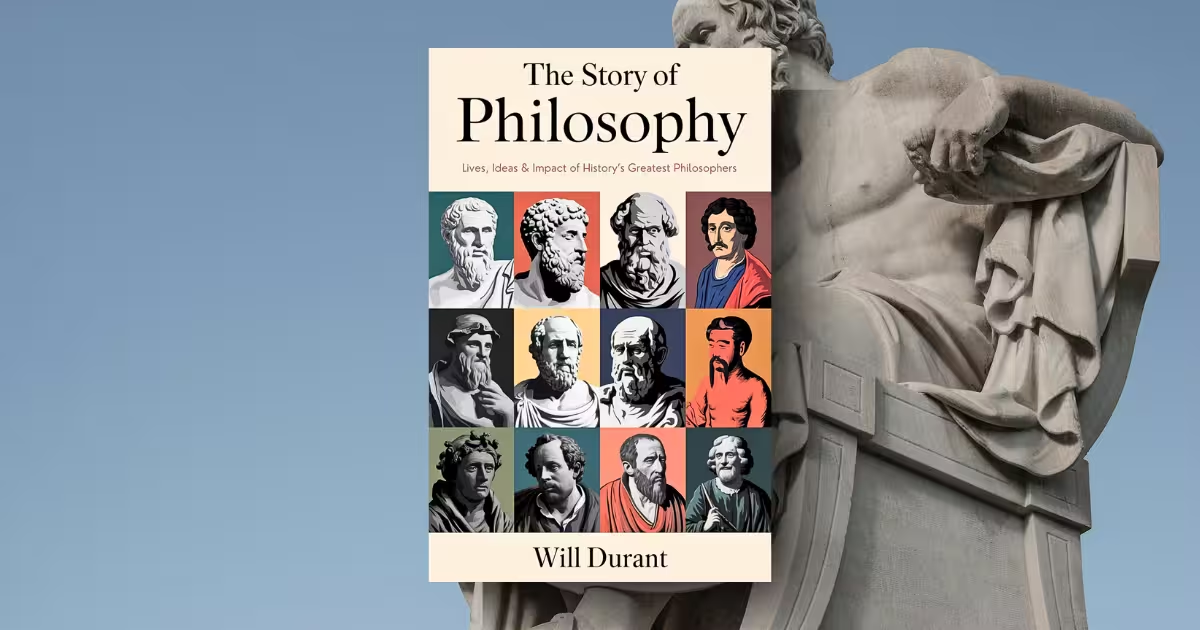
Do you ever find yourself staring at a shelf of philosophy books, wanting to understand the great minds that shaped our world, yet feeling utterly defeated by the dense jargon and impenetrable prose? The Story of Philosophy by Will Durant might just be the book that finally opens that door for you.
First published in 1926, this remarkable work has sold over 2 million copies in just a few years and ultimately reached 8 million copies, becoming an unexpected phenomenon that proved ordinary people were starving for wisdom.
But here’s the real question: nearly a century later, does Durant’s ambitious project still hold up, or has it become just another dusty relic on the library shelf?
Overview
Will Durant’s The Story of Philosophy is a sweeping, elegantly written introduction to Western philosophy that focuses not on abstract theories but on the lives of the philosophers themselves. Durant argues that philosophy is not a sterile academic exercise but a matter of “life and death”—a guide to living wisely.
He covers major figures from Plato to John Dewey, weaving biography, history, and philosophical ideas into a narrative that is both intellectually stimulating and deeply human.
While the book has significant omissions (Eastern philosophy, medieval scholasticism) and reflects the biases of its era, its core achievement—making philosophy accessible and exciting to the general reader—remains unmatched.
Reader recommendation
The Story of Philosophy is suggested for:
- Curious beginners who want a friendly, engaging introduction to philosophy
- Readers who prefer biography and storytelling over dry abstract analysis
- Anyone looking to understand the why behind philosophical ideas—the personal struggles and historical contexts that shaped them
- Lifelong learners who appreciate clear, elegant prose and a grand narrative sweep
The Story of Philosophy is not for:
- Advanced philosophy students seeking rigorous, technical analysis
- Readers who demand complete coverage (Eastern philosophy is entirely absent)
- Those who prefer a strictly objective, neutral presentation (Durant has clear favorites and biases)
- Anyone looking for a comprehensive reference work rather than a curated narrative
Table of Contents
1. Introduction
The Story of Philosophy: The Lives and Opinions of the World’s Greatest Philosophers by Will Durant was first published in May 1926 by Simon & Schuster. A revised second edition followed in 1933. Durant (1885–1981) was an American historian and philosopher who later won the Pulitzer Prize for his monumental The Story of Civilization.
What The Story of Philosophy Is About
The book is exactly what its subtitle promises: a journey through the lives and opinions of Western philosophy’s greatest figures. Durant covers Plato, Aristotle, Francis Bacon, Spinoza, Voltaire, Kant, Schopenhauer, Herbert Spencer, Friedrich Nietzsche, and concludes with contemporary thinkers like Henri Bergson, Benedetto Croce, Bertrand Russell, George Santayana, William James, and John Dewey.
But this is no dry textbook. Durant’s genius lies in his approach: he humanizes philosophy by centering the story around “certain dominant personalities”.
He gives you the man behind the ideas—their struggles, their loves, their failures, their historical context—before diving into their thought. As one reviewer noted, the book “springs, indeed, from the author’s personal desire to tell the story of a significant group of philosophers enjoyably and concretely, and with the purposes of living in view”.
The Central Thesis of The Story of Philosophy
Durant’s core argument is simple yet profound: philosophy is not a luxury for academics—it is a necessity for living well. In his introduction, he writes:
“There is a pleasure in philosophy, and a lure even in the mirages of metaphysics, which every student feels until the coarse necessities of physical existence drag him from the heights of thought into the mart of economic strife and gain.”
He believed that philosophy had become too specialized, too technical, too divorced from life. The specialists knew “more and more about less and less,” while the philosophers knew “less and less about more and more”. His mission was to bridge that gap—to bring philosophy back to the people.
“The first ‘outlines’ the first efforts at the humanization of knowledge, were Plato’s Dialogues.”
Durant saw himself as continuing that tradition: making wisdom accessible, relevant, and alive.
2. Background
The Intellectual Climate of the 1920s
To understand why The Story of Philosophy became such a phenomenon, you need to understand the world into which it was born. The 1920s were a time of immense intellectual ferment and anxiety. World War I had shattered faith in progress and reason. Science was advancing at a dizzying pace, but knowledge had become fragmented. As Durant observed in his preface:
“Human knowledge had become too great for the human mind. All that remained was the scientific specialist, who knew ‘more and more about less and less,’ and the philosophical speculator, who knew less and less about more and more.”
The gap between life and knowledge was widening. The common man was forced to choose between “a scientific priesthood mumbling unintelligible pessimism, and a theological priesthood mumbling incredible hopes”.
Durant saw an urgent need for mediators—people who could translate specialized knowledge into wisdom for the general public.
The Book’s Unlikely Origin
The Story of Philosophy began humbly. Durant had been approached by Emanuel Haldeman-Julius, publisher of the working-class-oriented Little Blue Book series, to write a booklet on Plato. These cheap pamphlets (often priced at just a few cents) were wildly popular, selling 27,000 copies by 1928. Encouraged by this success, Durant expanded his project into a full-length book.
When Simon & Schuster published it in 1926, they priced it at five dollars—a significant sum at the time. Nobody expected it to become a bestseller. Yet it sold 100,000 copies in its first year alone. Within a few years, it had reached 2 million copies, and ultimately 8 million. It was translated into dozens of languages, including Chinese, Czech, Danish, Dutch, Finnish, French, German, Hebrew, Hungarian, Italian, Japanese, Norwegian, Polish, Portuguese, Serbo-Croatian, Spanish, and Swedish.
The New Yorker reported that even Durant himself was surprised by the astounding sale of 50,000 copies. He had tapped into something deep: a hunger for meaning, for connection, for wisdom that could guide people through a confusing and often brutal world.
3. The Story of Philosophy Summary
This is not a book you skim. It’s a book you study—and I mean that in the best possible way. Durant himself warns you in the preface:
“Spinoza is not to be read, he is to be studied; you must approach him as you would approach Euclid.”
The same could be said for this book. But unlike Euclid, Durant makes the journey feel like a conversation with a brilliant, witty, and deeply humane guide.
Plato: The Philosopher-King and the Quest for Justice
Durant begins with Plato, and his treatment is extraordinary. He doesn’t just summarize the Republic—he makes you feel its urgency. Plato, remember, lived through the execution of his beloved teacher Socrates. That trauma shaped everything he wrote.
“It filled him with such a scorn of democracy, such a hatred of the mob, as even his aristocratic lineage and breeding had hardly engendered in him.”
Durant walks you through Plato’s central questions: What is justice? What is the ideal state? What is the nature of the soul? He explains Plato’s famous theory of Forms, his vision of the philosopher-king, his controversial proposals for communal living and eugenics. But he never loses sight of the human being behind the ideas.
One of the most moving passages in the entire book is Durant’s retelling of Socrates’ death. He quotes Plato’s Phaedo at length, including Socrates’ final words: “Crito, I owe a cock to Asclepius; will you remember to pay the debt?” Durant doesn’t just tell you this story—he makes you feel it.
You understand why Plato devoted his life to philosophy after witnessing such a death.
Aristotle: The First Scientist
Durant’s chapter on Aristotle is a masterclass in intellectual history. He presents Aristotle as the founder of science—the man who, almost single-handedly, created logic, biology, and political science. But he’s also honest about Aristotle’s limitations:
“For lack of a telescope Aristotle’s astronomy is a tissue of childish romance; for lack of a microscope his biology wanders endlessly astray.”
Yet Durant argues that Aristotle’s achievements, despite these handicaps, are staggering. He quotes Dante’s description of Aristotle as “the Master there of those who know”. For nearly two thousand years, Aristotle’s works were the foundation of Western education.
Durant’s summary of Aristotle’s ethics is particularly memorable. Aristotle’s famous “golden mean”—the idea that virtue lies between extremes—is presented not as a dull compromise but as a dynamic, practical guide to living well.
“The qualities of character can be arranged in triads, in each of which the first and last qualities will be extremes and vices, and the middle quality a virtue or an excellence. So between cowardice and rashness is courage; between stinginess and extravagance is liberality.”
Bacon: The Prophet of Science
Durant’s chapter on Francis Bacon is one of the most passionate in the book. Bacon was the man who “rang the bell that called the wits together” and announced that Europe had come of age. Durant sees Bacon as the prophet of modern science—the man who understood that knowledge is power, and that philosophy must be practical.
“Knowledge is power, not mere argument or ornament; ‘it is not an opinion to be held . . . but a work to be done.’”
Durant’s treatment of Bacon’s Novum Organum is a highlight. He explains Bacon’s critique of the “Idols of the Mind”—the fallacies that distort our thinking. These include the “Idols of the Tribe” (errors common to all humanity), the “Idols of the Cave” (individual biases), the “Idols of the Marketplace” (confusions caused by language), and the “Idols of the Theatre” (dogmatic philosophical systems).
Spinoza: The God-Intoxicated Man
Durant’s chapter on Spinoza is perhaps the most beautiful in the book. Spinoza was excommunicated from his Jewish community at the age of twenty-four for his heretical views. He spent the rest of his life grinding lenses, living modestly, and writing one of the most profound philosophical works ever composed: the Ethics.
Durant describes Spinoza’s philosophy as a kind of spiritual therapy. Spinoza taught that God and nature are one—that the universe is governed by immutable laws, and that true freedom comes not from defying these laws but from understanding them.
“The greatest good is the knowledge of the union which the mind has with the whole nature.”
Durant’s summary of Spinoza’s ethics is both clear and moving:
“A passion ceases to be a passion as soon as we form a clear and distinct idea of it.”
This is the core of Spinoza’s wisdom: understanding frees us from the tyranny of our emotions.
Voltaire: The Laughing Philosopher
Durant’s Voltaire is a whirlwind of energy and wit. He presents Voltaire as the embodiment of the Enlightenment—the man who fought superstition, intolerance, and tyranny with the weapons of reason and laughter.
“Never has a writer had in his lifetime such influence.”
Durant recounts Voltaire’s many adventures: his imprisonment in the Bastille, his exile in England, his love affair with the brilliant Marquise du Chatelet, his friendship and eventual break with Frederick the Great, and his relentless campaign against religious fanaticism.
The chapter on Candide is particularly delightful. Durant describes it as “the most terrible of all the intellectual weapons ever wielded by man, the mockery of Voltaire”. He quotes the famous ending: “All that is very well . . . but let us cultivate our garden.”
Kant: The Great Chinaman of Königsberg
Durant’s treatment of Kant is a masterful balancing act. He makes Kant’s notoriously difficult philosophy accessible without dumbing it down. He explains Kant’s “Copernican Revolution” in philosophy—the idea that the mind does not simply reflect reality but shapes it.
“Perceptions without conceptions,” says Kant, “are blind.”
Durant also captures the drama of Kant’s life: the meticulous little professor who never left his native Königsberg, yet whose ideas shook the foundations of philosophy. He recounts Kant’s courageous defense of free speech and his opposition to religious censorship, even when it meant defying the King of Prussia.
Schopenhauer: The Pessimist
Durant’s Schopenhauer is a study in contrasts. Schopenhauer was a bitter, misanthropic man who nevertheless wrote with unparalleled clarity and wit. Durant captures his philosophy—the world as Will and Idea—with vividness and sympathy.
“The intellect tires, the will never.”
Schopenhauer’s pessimism was not just intellectual; it was deeply personal. He had a difficult relationship with his mother, never married, and felt profoundly isolated. Yet his philosophy, for all its darkness, offered a kind of salvation: the possibility of escaping the endless cycle of desire through art, compassion, and asceticism.
Nietzsche: The Mad Prophet
Durant’s Nietzsche is the most dramatic chapter in the book. Nietzsche was a lonely, sickly man who wrote some of the most incendiary and influential books in Western philosophy. Durant presents him as a tragic figure—a man who attacked Christianity because he was, at heart, a deeply moral being.
“He attacked Christianity because there was so much of its moral spirit in him.”
Durant explains Nietzsche’s key ideas: the Will to Power, the Superman, the Eternal Recurrence, and the Transvaluation of All Values. He doesn’t shy away from Nietzsche’s excesses—his misogyny, his elitism, his glorification of war—but he also recognizes his genius.
“He spoke with bitterness, but with invaluable sincerity; and his thought went through the clouds and cobwebs of the modern mind like cleansing lightning and a rushing wind.”
The Contemporary Philosophers
The final chapters cover Bergson, Croce, Russell, Santayana, James, and Dewey. Durant is particularly sympathetic to William James and John Dewey, whom he sees as representing the pragmatic, democratic spirit of America. He describes Dewey as the philosopher who “gave philosophic form to the realistic and democratic temper of his people”.
4. The Story of Philosophy Analysis
The Story of Philosophy is, in truth, a marvelous achievement—one of those rare books that genuinely changes how you see the world. Durant has a gift for making complex ideas feel not just understandable but urgent. He writes with passion, clarity, and an infectious love for his subject.
What Makes This Book So Effective?
First, Durant’s biographical approach. He doesn’t just present ideas in the abstract; he shows you the lives behind them. You understand why Plato hated democracy, why Spinoza was excommunicated, why Nietzsche went mad. This makes the ideas feel real and consequential.
Second, Durant’s prose. He writes like a novelist, not a textbook author. His sentences are elegant, his metaphors are vivid, and his wit is sharp. He can summarize a complex philosophy in a single memorable phrase.
Third, Durant’s balance of respect and criticism. He admires his subjects, but he doesn’t worship them. He points out their flaws, their contradictions, their blind spots. This gives the book a critical edge that keeps it from becoming mere hagiography.
Where Does the Book Fall Short?
The omissions are significant. Durant admits in his preface that he has left out Chinese and Hindu philosophy entirely. He also omits medieval scholasticism, which he dismisses as “rather a distinguished theology than an honest philosophy”. These are serious gaps that limit the book’s scope.
There’s also Durant’s Eurocentrism. He was a product of his time, and it shows. He writes as if Western philosophy is the only philosophy worth considering. This is a limitation, not a fatal flaw, but it’s worth keeping in mind.
The book is also dated in some of its assumptions. Durant is unabashedly elitist in his politics—he admires Plato’s philosopher-kings and has little patience for democracy. He’s also, by modern standards, somewhat sexist. His chapter on Nietzsche contains the philosopher’s own misogyny without much critical pushback.
5. Strengths and Weaknesses
Strengths
| Strength | Explanation |
|---|---|
| Accessibility | Durant translates dense philosophical jargon into clear, engaging prose. |
| Biographical Depth | He brings philosophers to life as human beings with struggles, passions, and flaws. |
| Narrative Momentum | The book has a sweeping, almost novelistic quality that keeps you turning pages. |
| Critical Balance | Durant admires his subjects but doesn’t hesitate to point out their weaknesses. |
| Historical Context | He situates each philosopher in their time and place, showing how ideas emerge from specific conditions. |
Weaknesses
| Weakness | Explanation |
|---|---|
| Significant Omissions | No Eastern philosophy, no medieval scholasticism, no epistemology. |
| Eurocentrism | Durant treats Western philosophy as if it were the only philosophy. |
| Dated Assumptions | His elitism and occasional sexism reflect the biases of his era. |
| Selective Coverage | He focuses on his favorite philosophers and skims over others. |
| Lack of Rigor | This is a popular introduction, not a scholarly work. Specialists will find it superficial. |
6. Comparison with Similar Works
The Story of Philosophy belongs to a genre of popular philosophical introductions, but it stands out for its biographical approach and literary flair.
| Book | Author | Approach | Comparison |
|---|---|---|---|
| Sophie’s World | Jostein Gaarder | Novelistic, young adult | More engaging for teenagers, less comprehensive |
| A History of Western Philosophy | Bertrand Russell | Critical, opinionated | More rigorous, less biographical, more overtly polemical |
| The Great Philosophers | Bryan Magee | Interview-based, accessible | More recent, covers more diverse thinkers |
| Philosophy: The Basics | Nigel Warburton | Textbook-style, concise | More systematic, less narrative flair |
Russell’s History of Western Philosophy is the most obvious comparison. Both books are sweeping, opinionated introductions to Western thought. But Russell is more adversarial—he doesn’t just explain philosophers, he judges them. Durant is more sympathetic, more interested in understanding than in refuting.
7. Conclusion
Who Should Read “The Story of Philosophy”?
This book is for anyone who has ever wondered what philosophy is all about but felt intimidated by the jargon. It’s for the curious reader who wants to understand the big ideas that have shaped Western civilization—ideas about justice, truth, beauty, God, freedom, and the good life.
It’s also for anyone who loves biography and history. Durant’s focus on the lives of philosophers makes the ideas feel personal and immediate.
It’s not for advanced philosophy students seeking rigorous analysis, nor for readers who demand complete coverage of non-Western traditions.
Final Verdict
The Story of Philosophy is a groundbreaking work that helped popularize philosophy for generations of readers. It has its flaws—significant omissions, dated assumptions, a certain Eurocentrism—but its virtues far outweigh its weaknesses. Durant writes with clarity, passion, and wit, and he makes you feel that philosophy matters—that it’s not just an academic exercise but a guide to living well.
Nearly a century after its first publication, this book still has the power to inspire. As Durant himself wrote:
“We want to know that the little things are little, and the big things big, before it is too late; we want to see things now as they will seem forever—‘in the light of eternity.’”
The Story of Philosophy helps you do exactly that.







