
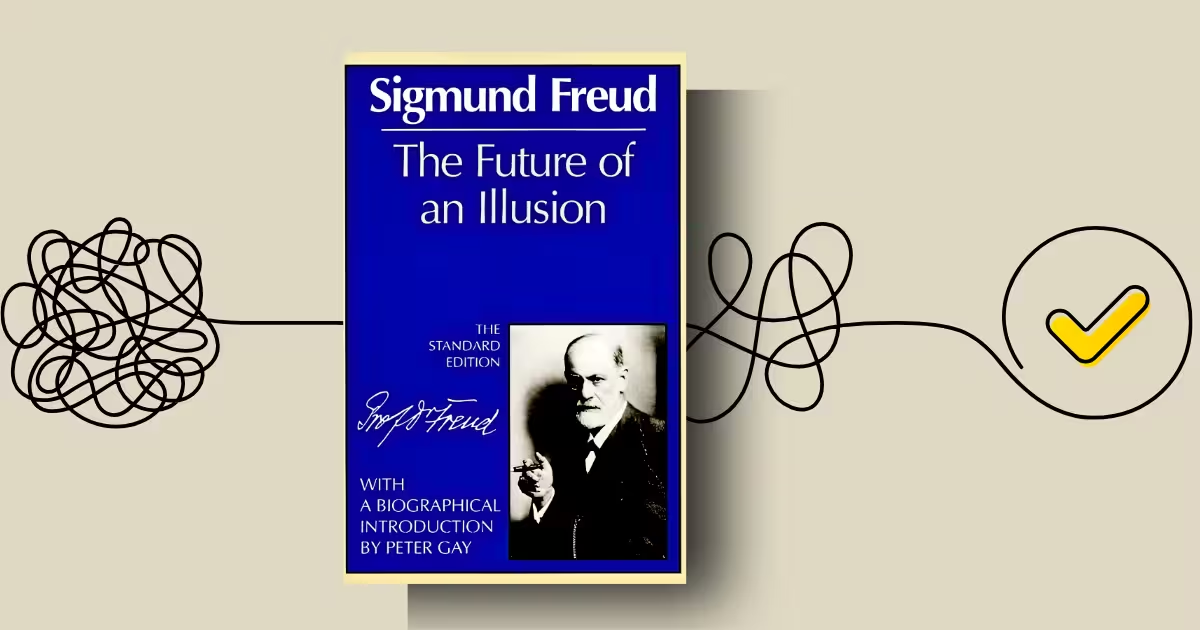
Do you believe in God because you genuinely know it’s true, or because you simply can’t bear the thought of a universe where nobody’s in charge? This question haunted me throughout every page of Sigmund Freud’s The Future of an Illusion, and I suspect it might haunt you too, once you see what this provocative book actually argues.
Overview
The Future of an Illusion is Sigmund Freud’s 1927 masterpiece where the father of psychoanalysis turns his clinical tools on religion itself. Freud argues that religious beliefs aren’t divinely inspired truths but psychological illusions, wish-fulfillments born from humanity’s deepest fears and helplessness.
He claims that God is essentially a projected father figure, religion is a collective obsessional neurosis, and civilization would be healthier if we outgrew our religious crutches. At just over 90 pages, it’s a dense, uncomfortable read that forces you to question everything you thought you knew about faith, reason, and human nature.
Raeder suggestion
I would suggest The Future of an Illusion to:
- Skeptics and atheists who want psychoanalytic ammunition for their arguments
- Psychology students trying to understand Freud’s later cultural theories
- Anyone who’s ever wondered why intelligent people believe in God
But I would not suggest The Future of an Illusion to:
- Devout believers who aren’t open to having their faith psychologically dissected
- Readers seeking spiritual comfort or religious affirmation
- Anyone expecting a neutral, balanced treatment of religion
- Those who prefer their philosophy without clinical jargon
- People who can’t handle their deepest psychological needs being called “illusions”
Table of Contents
1. Introduction
First published in 1927 by the Internationaler Psychoanalytischer Verlag in Leipzig, Vienna, and Zurich. The English translation by James Strachey was published in 1928 by Hogarth Press. The work was completed by September 1927 and published in November of the same year.
Freud, of course, needs little introduction. As the founder of psychoanalysis, he revolutionized our understanding of the human mind, introducing concepts like the unconscious, repression, and the Oedipus complex. By 1927, Freud was in his seventies, already world-famous and controversial.
He’d survived cancer of the jaw (which would eventually kill him twelve years later), fled Nazi-occupied Austria, and had spent decades developing his revolutionary theories.
This book sits at a fascinating crossroads in his career, what he called a “significant change” where his interest “returned to the cultural problems which had fascinated me long before, when I was a youth scarcely old enough for thinking”.
Context and Subject Matter
This book is essentially Freud applying psychoanalysis to the biggest question of all: why do humans believe in God? It’s part of a series of cultural studies he produced in his later years, including Totem and Taboo (1912-13), Civilization and Its Discontents (1930), and Moses and Monotheism (1939).
The genre is difficult to pin down. It’s part psychology, part philosophy, part cultural criticism, and part polemic. Freud isn’t trying to write a neutral academic treatise; he’s making an argument, and he’s not particularly subtle about it.
Purpose and Central Thesis
The central thesis is devastatingly simple: religious ideas are illusions: “fulfilments of the oldest, strongest and most urgent wishes of mankind”. They’re not truths discovered through reason or observation but psychological crutches we’ve invented to cope with our helplessness, fear of death, and need for a protective father figure.
Freud argues that religion serves three main psychological functions:
- It protects us against the terrifying forces of nature
- It reconciles us to the cruelty of fate, especially death
- It compensates us for the sufferings civilization imposes on us
But here’s the kicker: Freud believes we’re now mature enough to outgrow this illusion. Just as a child eventually stops believing in fairy tales, humanity can (and should) abandon religious belief and embrace science and reason instead.
2. Background
To understand this book properly, we need to grasp where Freud was coming from intellectually and personally.
The Shift to Cultural Criticism
By the 1920s, Freud had spent decades treating individual patients and developing his theories of the unconscious mind. But he’d always been interested in broader cultural questions. In his “Autobiographical Study,” he wrote that his interest “returned to the cultural problems which had fascinated me long before, when I was a youth scarcely old enough for thinking”.
The Future of an Illusion wasn’t written in isolation; it was part of a broader project. It directly precedes Civilization and Its Discontents (1930), which expands on many of these themes. And it builds on ideas from Totem and Taboo (1912-13), where Freud first explored the psychological origins of religion.
The Intellectual Climate
The 1920s were a time of enormous intellectual ferment. Darwin’s theory of evolution had already shaken religious faith for many. Nietzsche had declared “God is dead” decades earlier. Freud was joining a chorus of voices questioning traditional religion, but he brought something new to the table: the tools of psychoanalysis.
Freud wasn’t the first to criticize religion, and he’s honest about this. He notes that “other and better men have said before me in a much more complete, forcible and impressive manner” what he’s arguing. His unique contribution is the psychological framework, explaining why we believe, not just arguing that belief is unreasonable.
The Personal Context
Freud was writing as a secular Jew in a predominantly Christian Europe, and this context matters. He’d experienced anti-Semitism firsthand, and he was deeply skeptical of organized religion of any kind. He saw religion not as a source of moral guidance but as a source of intellectual dishonesty and psychological oppression.
There’s also something poignant about the timing. Freud was in his seventies, facing his own mortality (he’d already been diagnosed with the cancer that would eventually kill him). He was asking hard questions about death, meaning, and consolation, and coming up with answers that offered no comfort whatsoever.
3. The Future of an Illusion Summary
Let me walk you through what I actually learned from reading The Future of an Illusion; the key arguments, the structure, and why it matters.
Chapter I: Civilization and Its Discontents
Freud opens by defining what he means by “civilization”, and he’s deliberately broad. He includes “all the knowledge and capacity that men have acquired in order to control the forces of nature and extract its wealth for the satisfaction of human needs” as well as “all the regulations necessary in order to adjust the relations of men to one another”.
A key insight: Every civilization is built on “coercion and renunciation of instinct”. We can’t just do whatever we want because our instincts would lead us to destroy each other. Civilization requires us to give up some instinctual satisfactions in exchange for safety and cooperation.
Freud makes a striking observation here: “every individual is virtually an enemy of civilization”. We resent the restrictions civilization places on us, even though we need civilization to survive.
Another crucial point: The masses are “lazy and unintelligent; they have no love for instinctual renunciation, and they are not to be convinced by argument of its inevitability”. This is why civilization needs leaders – people who can “set an example and whom masses recognize as their leaders”.
Chapter II: The Mental Assets of Civilization
Freud introduces some important terminology here:
- Frustration: When an instinct cannot be satisfied
- Prohibition: The regulation that establishes this frustration
- Privation: The condition produced by the prohibition
He distinguishes between privations that affect everyone (like the prohibitions against incest and murder) and those that affect only certain groups (like class-based restrictions). The former are “the earliest” and “still form the kernel of hostility to civilization”.
A fascinating point: The super-ego – that internalized voice of conscience – is civilization’s greatest achievement. When external coercion becomes internalized, people become “vehicles” of civilization rather than its opponents. But this internalization is far from complete. “A majority of people obey the cultural prohibitions on these points only under the pressure of external coercion”.
Freud introduces the concept of cultural ideals, things like art and national pride that provide “narcissistic satisfaction”. Even oppressed classes can feel good about themselves by despising outsiders: “No doubt one is a wretched plebeian, harassed by debts and military service; but, to make up for it, one is a Roman citizen”.
And then comes the kicker: “No mention has yet been made of what is perhaps the most important item in the psychical inventory of a civilization. This consists in its religious ideas”.
Chapter III: Why We Need Religion
Freud asks why we’d ever want to abolish civilization, given how much it protects us. His answer: we forget how dangerous nature really is.
The humanization of nature: We personify natural forces because “impersonal forces and destinies cannot be approached”. By turning nature into gods, we make it something we can potentially influence, bargain with, or at least understand.
The father projection: Here’s where Freud gets really interesting (and controversial). He argues that our concept of God is essentially a projection of our relationship with our fathers. “The defense against childish helplessness is what lends its characteristic features to the adult’s reaction to the helplessness which he has to acknowledge”.
Religion’s three tasks:
- “Exorcize the terrors of nature”
- “Reconcile men to the cruelty of Fate, particularly as it is shown in death”
- “Compensate them for the sufferings and privations which a civilized life in common has imposed on them”
Over time, the emphasis shifted. As nature became more predictable, the gods’ moral function became more important. They became enforcers of civilization’s rules, watching over “the fulfilment of the precepts of civilization, which men obey so imperfectly”.
The religious worldview includes:
- Life serves a higher purpose
- There’s a benevolent Providence watching over us
- Death isn’t the end but a transition to something higher
- Justice will ultimately prevail, even if not in this life
Chapter IV: The Psychological Nature of Religious Ideas
This is the heart of The Future of an Illusion. Freud defines what he means by “illusion”, and it’s crucial to understand his definition.
“An illusion is not the same thing as an error; nor is it necessarily an error”. Columbus’s belief that he’d found a new route to the Indies was an illusion – the wish-fulfillment aspect is clear, even though he was wrong. But “illusions need not necessarily be false”. A middle-class girl might have the “illusion” that a prince will marry her – it’s possible, just unlikely.
The key distinction: “We call a belief an illusion when a wish-fulfillment is a prominent factor in its motivation”.
Religious doctrines are illusions because they’re exactly what we’d wish to be true: a loving father figure, cosmic justice, life after death, ultimate meaning. “It is a very striking fact that all this is exactly as we are bound to wish it to be”.
Freud acknowledges that religious doctrines can’t be proven false any more than they can be proven true. “We still know too little to make a critical approach to them”. But this doesn’t mean we should believe them. “Ignorance is ignorance; no right to believe anything can be derived from it”.
A devastating observation: When philosophers try to salvage religion by redefining God as a “vague abstraction,” they’re being dishonest. “They give the name of ‘God’ to some vague abstraction which they have created for themselves” and then “pose before all the world as deists”.
Chapter V: The Challenge of Giving Up Religion
Freud anticipates objections, and they’re powerful ones. If we tell people there’s no God, no divine justice, no afterlife, won’t they just do whatever they want? Won’t civilization collapse?
The objection: “Our civilization is built up on them [religious doctrines], and the maintenance of human society is based on the majority of men’s believing in the truth of those doctrines”.
Freud’s response: Religion hasn’t actually made people moral or happy. “It is doubtful whether men were in general happier at a time when religious doctrines held unrestricted sway; more moral they certainly were not”.
He points out how religion has always accommodated human weakness: “God’s kindness must lay a restraining hand on His justice. One sinned, and then one made a sacrifice or did penance and then one was free to sin once more”.
The scientific challenge: “Criticism has whittled away the evidential value of religious documents, natural science has shown up the errors in them, and comparative research has been struck by the fatal resemblance between the religious ideas which we revere and the mental products of primitive peoples and times”.
Chapter VI: A Rational Basis for Morality
Freud argues we should base civilization’s rules on rational, social grounds rather than religious ones.
His example: The prohibition against murder. Instead of saying “God forbids murder,” we should explain that murder makes communal life impossible. This would allow us to modify and improve rules rather than treating them as sacred and unchangeable.
Historical truth in religion: Freud acknowledges that religious doctrines contain “important historical recollections”, like the memory of the primal father’s murder. But these truths are “distorted and systematically disguised” so that “the mass of humanity cannot recognize them as truth”.
The stork analogy: “The case is similar to what happens when we tell a child that new-born babies are brought by the stork. Here, too, we are telling the truth in symbolic clothing”. But the child feels deceived when they learn the truth, and we’d be better off being honest from the start.
Chapter VII: Freud’s Critics Respond
Freud imagines a critic raising objections, and this is one of the most engaging sections of the book.
The critic says: You’re contradicting yourself. You say religious people won’t be convinced by your arguments, but you also warn that if people stop believing in God, they’ll stop obeying civilization’s rules.
Freud’s response: Believers are tied to religion by “affection” and won’t be swayed. But there are “countless other people who are not in the same sense believers. They obey the precepts of civilization because they let themselves be intimidated by the threats of religion”. It’s these people who will abandon morality once they realize religion isn’t true.
The critic says: Men can’t be guided by reason – they’re ruled by passions. Why try to replace emotional with rational motivation?
Freud’s response: Maybe men aren’t naturally this way. Maybe religious education is responsible for “the feeble intellectual powers of the average adult.” He asks: “Can we be quite certain that it is not precisely religious education which bears a large share of the blame for this relative atrophy?”
The critic says: People can’t live without religion. It’s like taking away a sleeping draught from someone who’s been taking it for years.
Freud’s response: That’s true of people raised with religion. But what about people raised differently? “Perhaps those who do not suffer from the neurosis will need no intoxicant to deaden it”.
His conclusion: “Men cannot remain children for ever; they must in the end go out into ‘hostile life.’ We may call this ‘education to reality'”.
Chapter VIII: The Final Exchange
The critic has one last go, and it’s a strong one.
The critic says: Your hopes are themselves illusions. You believe that generations not influenced by religion will naturally become rational. But “in this decisive respect human nature is hardly likely to change”.
The critic also argues: Any replacement for religion will have “all the psychological characteristics of religion – the same sanctity, rigidity and intolerance, the same prohibition of thought”.
Freud’s final response: “My illusions are not, like religious ones, incapable of correction. They have not the character of a delusion”. If experience shows he’s wrong, he’ll give up his expectations.
And his famous closing words: “The voice of the intellect is a soft one, but it does not rest till it has gained a hearing. “Our science is no illusion. But an illusion it would be to suppose that what science cannot give us we can get elsewhere”.
4. The Future of an Illusion Analysis
What Works
The honesty is bracing. Freud doesn’t pretend to be neutral. He’s making an argument, and he wants you to know it. This isn’t a dry academic treatise; it’s a polemic, and a passionate one at that.
The psychological framework is genuinely illuminating. Whether or not you agree with his conclusions, Freud’s analysis of why we believe is fascinating. The idea that God is a projected father figure, that religion offers wish-fulfillment, that belief is tied to emotional needs rather than rational evidence – these insights have real explanatory power.
The analogy between religion and childhood neurosis is provocative. Freud argues that “religion would thus be the universal obsessional neurosis of humanity”. This isn’t just an insult – it’s a genuine attempt to understand religion using the same tools he used to understand individual psychopathology.
He anticipates objections well. The imaginary dialogue in the final chapters shows Freud at his most engaging. He knows exactly what critics will say, and he addresses their concerns directly.
The prose is clear and forceful. Despite the complexity of the subject matter, Freud writes with remarkable clarity. James Strachey’s translation captures his direct, uncompromising style.
What’s Problematic
The arrogance is breathtaking. Freud assumes that he, a secular Jewish psychoanalyst in 1920s Vienna, has somehow seen through an illusion that billions of people across thousands of years have been fooled by. He never seriously considers that religious believers might have insights he lacks.
The evidence is thin. Freud’s arguments are largely theoretical. He doesn’t present much empirical evidence for his claims about religion’s psychological origins. He’s essentially reasoning from his clinical experience, but he doesn’t show his work.
He underestimates religion’s complexity. Freud treats religion as essentially a psychological phenomenon, wish-fulfillment, father projection, neurosis. But religion is also about community, meaning, ethics, ritual, and countless other dimensions that his analysis ignores.
The cultural bias is obvious. Freud is writing about “civilization” but he really means Western European civilization. He makes sweeping claims about human nature based on a very limited sample.
The optimism seems naïve. Freud’s faith in reason and science as replacements for religion strikes me as remarkably optimistic, especially given what was happening in Europe in 1927. Within a decade, the Nazis would be burning his books. Science and reason didn’t save Europe from barbarism.
The dismissal of religious experience is problematic. Freud simply assumes that religious experiences are delusions or projections. He never considers that they might reflect something real.
The Central Tension
Here’s what I find most interesting about The Future of an Illusion: Freud is arguing that we should outgrow religion, but he also acknowledges that most people are incapable of rational thought. “The masses are lazy and unintelligent”. If that’s true, how can we expect them to give up religion and embrace reason?
Freud’s answer seems to be: education, over generations. But this raises another question: if people are naturally irrational, how can education make them rational? And who gets to do the educating?
Freud’s dilemma: He’s an elitist who believes in democracy. He thinks the masses are incapable of ruling themselves, but he also thinks they should be freed from religious illusions. He never quite resolves this tension.
5. Strengths and Weaknesses
Strengths
The originality of the approach. Applying psychoanalysis to religion was genuinely innovative in 1927, and it remains a valuable perspective today.
The clarity of the argument. Despite its complexity, the book’s thesis is easy to understand: religion is a wish-fulfillment, a projection of childhood needs, and we’d be better off without it.
The intellectual honesty. Freud doesn’t pretend to have all the answers. He acknowledges the limitations of his arguments and the possibility that he might be wrong.
The historical importance. The Future of an Illusion (along with “Civilization and Its Discontents”) represents Freud’s most influential contribution to cultural criticism.
The provocativeness. Even if you disagree with everything Freud says, The Future of an Illusion forces you to think hard about why you believe what you believe.
Weaknesses
The lack of empirical evidence. Freud’s arguments are theoretical, not empirical. He doesn’t present much evidence for his claims.
The cultural narrowness. Freud’s analysis is based on Western European civilization and doesn’t account for the diversity of religious experience across cultures.
The dismissive tone. Freud treats religious believers as essentially deluded, without taking their experiences seriously.
The overly simple psychology. Freud reduces complex religious phenomena to a single psychological mechanism (father projection). This seems too simple.
The questionable optimism. Freud’s faith in reason and science as replacements for religion seems naïve, especially given the historical context.
6. Comparison with Similar Works
Civilization and Its Discontents (1930): This is the direct successor to The Future of an Illusion. It expands on many of the same themes but focuses more on the psychological costs of civilization itself, not just religion. If you liked The Future of an Illusion, you’ll find “Civilization and Its Discontents” even more interesting.
Totem and Taboo (1912-13): This earlier work explores the psychological origins of religion in more detail, focusing on totemism and the Oedipus complex. The Future of an Illusion builds on these ideas but is more focused on the present and future of religion.
Moses and Monotheism (1939): Freud’s final work on religion, written as he was fleeing the Nazis. It applies his theories to the origins of Judaism and is even more controversial than “The Future of an Illusion.”
The Varieties of Religious Experience by William James (1902): This is the polar opposite of Freud’s approach. James takes religious experience seriously and tries to understand it from the inside, rather than explaining it away. Reading these two books together gives you a sense of the range of possible approaches to religion.
The God Delusion by Richard Dawkins (2006): Dawkins is essentially doing what Freud did, but with the benefit of modern evolutionary biology. Both argue that religion is a delusion that we’d be better off without.
But Dawkins is more focused on empirical evidence, while Freud is more interested in psychological mechanisms.
7. Conclusion
Nearly a century after its publication, The Future of an Illusion remains startlingly relevant. The debates Freud engaged in – between faith and reason, religion and science, tradition and progress – are still with us. If anything, they’ve become more intense.
Freud’s central question is still unanswered: Can humanity outgrow its need for religious illusions? Or are we wired for belief in ways that reason can never fully overcome?
The Uncomfortable Truth
What makes The Future of an Illusion so uncomfortable is that Freud might be partly right. Religious beliefs often do serve psychological needs: comfort in the face of death, meaning in the face of chaos, protection in the face of helplessness. And these needs are real. The question is whether the religious answers are true or just comforting.
Freud’s challenge: If you believe in God, why do you believe? Is it because you’ve examined the evidence and found it convincing? Or is it because you can’t bear the alternative?
My Personal Take
Reading The Future of an Illusion was a genuinely unsettling experience. Not because I agree with everything Freud says; I don’t. But because he asks questions I’d rather not answer.
I found myself uncomfortable with his arrogance, his dismissiveness, his refusal to take religious experience seriously. But I also found myself thinking: what if he’s right? What if religion really is just a collective illusion, a psychological crutch we’ve invented because we can’t handle reality?
The Future of an Illusion‘s greatest strength is also its greatest weakness: it’s uncompromising. Freud doesn’t offer comforting half-measures. He tells you exactly what he thinks, and he doesn’t care if you don’t like it.
Recommendation
Who should read this book?
I’d recommend it to:
- Anyone interested in the psychology of religion
- Skeptics and atheists looking for intellectual ammunition
- Believers who want to understand the strongest arguments against their faith
- Students of psychology, philosophy, or cultural studies
- Anyone who’s ever wondered why we believe what we believe
I’d caution against it for:
- Devout believers who might find it deeply offensive
- Anyone looking for spiritual comfort or affirmation
- Readers who prefer their philosophy gentle and accommodating
Final Thoughts
The Future of an Illusion is not a book that will make you feel good about yourself or the world. It’s a book that will make you think, and think hard, about why you believe what you believe.
Freud’s final message: “Our science is no illusion. But an illusion it would be to suppose that what science cannot give us we can get elsewhere”.
Whether you agree with him or not, you have to respect the clarity of his vision. He saw religion as a childhood neurosis that humanity needed to outgrow. He might have been wrong. But he wasn’t vague.







