
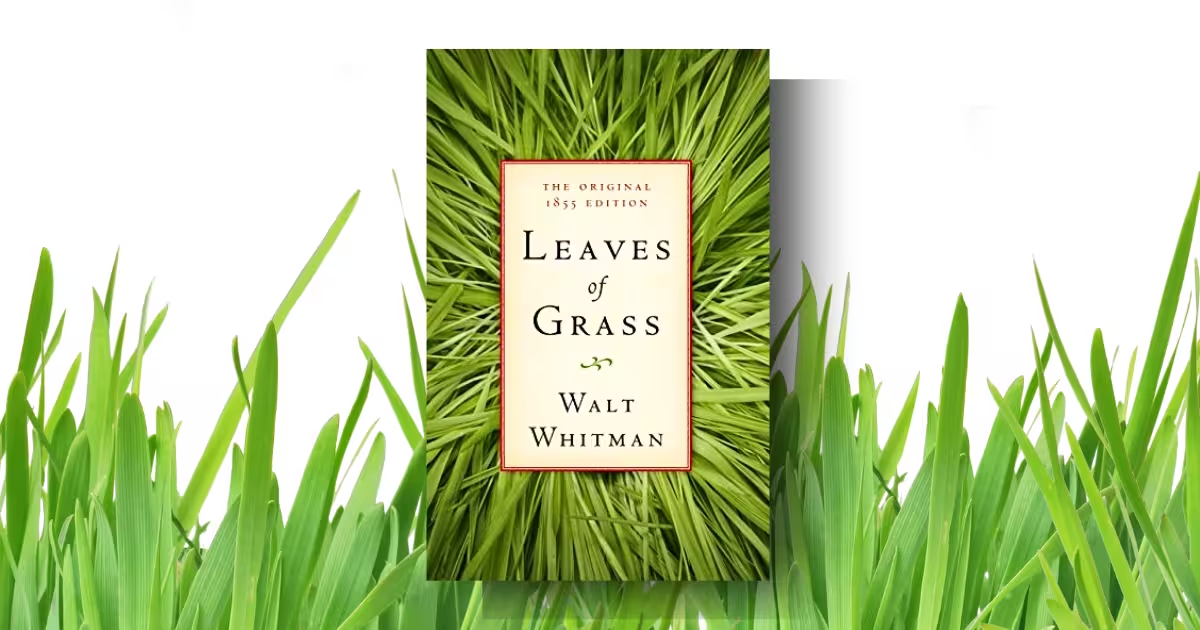
Did you know that Walt Whitman’s masterpiece started as a slim volume of just 12 poems, self-published on July 4, 1855, and grew into a collection of nearly 400 poems over nearly four decades? That transformation mirrors something I’ve come to appreciate about this book: it’s not just a collection of poems—it’s a living, breathing document that evolved alongside America itself.
Overview
Leaves of Grass is Walt Whitman’s lifelong poetic project celebrating the individual, democracy, nature, and the human body.
Beginning with 12 poems in 1855, it expanded to nearly 400 poems by the 1891-1892 “Death-bed” edition. Written in revolutionary free verse without traditional rhyme or meter, the collection includes masterpieces like “Song of Myself,” “I Sing the Body Electric,” and “When Lilacs Last in the Dooryard Bloom’d.”
Controversial for its frank treatment of sexuality and the body, the book was banned in Boston in 1882. Today, it’s recognized as one of the foundational works of American poetry.
Leaves of Grass is best for readers who appreciate expansive, philosophical poetry; those interested in American literary history; anyone seeking a bold celebration of individuality and democracy.
Leaves of Grass is not recommended for readers who prefer structured, rhymed poetry; those uncomfortable with explicit discussions of sexuality and the body; anyone looking for light, quick reading.
Table of Contents
Introduction
I still remember the first time I held a copy of Walt Whitman’s Leaves of Grass from a friend of mine who studies English language and literature. It was a used paperback I’d picked up at a thrift store for a couple of dollars, its pages yellowed and brittle. I’d heard about Whitman in school—the “good gray poet,” the bard of democracy—but nothing prepared me for what I found inside.
The book opens with these words: “I celebrate myself, and sing myself, / And what I assume you shall assume, / For every atom belonging to me as good belongs to you.” Reading that for the first time, I felt like I’d been grabbed by the collar and pulled into a conversation I didn’t know I needed to have.
Published anonymously on July 4, 1855, the first edition of Leaves of Grass contained just twelve untitled poems on 95 pages.
Whitman, a former printer, paid for and helped typeset the book himself at the Brooklyn printing shop of James and Andrew Rome, Scottish immigrants he’d known since the 1840s. About 795 copies were printed, but only a few hundred were bound in the trademark green cloth cover. Sales were dismal—most copies didn’t sell.
But Whitman wasn’t discouraged. He spent the next 37 years revising, expanding, and reshaping his work. By the time of the 1891-1892 “Death-bed” edition, the collection had grown to nearly 400 poems. He regarded each new edition as a fresh expression of his developing vision.
What makes Leaves of Grass so remarkable isn’t just its scope—it’s the audacity of its vision. Whitman set out to create something entirely new: an American poetry, written in an American voice, celebrating American democracy and the American individual.
As he wrote in his 1855 preface, “The Americans of all nations at any time upon the earth have probably the fullest poetical nature. The United States themselves are essentially the greatest poem.” (p. 72)
Background
To understand Leaves of Grass, you need to understand the world Whitman was writing in—and the world he was trying to create.
The 1850s were a time of profound change and anxiety in America. The nation was expanding westward, industrialization was transforming cities, and the slavery question was tearing the country apart. The Compromise of 1850 had temporarily defused tensions, but the Kansas-Nebraska Act of 1854 reignited the debate over slavery’s expansion. (p. 48) The country was headed toward civil war.
Whitman came from humble beginnings. Born on May 31, 1819, in West Hills, Long Island, he was the second of nine children. (p. 27) His father was a carpenter who struggled to support the family; his mother was barely literate but became one of Whitman’s greatest supporters. (p. 26) Walt left school at eleven and went to work as a printer’s apprentice. (p. 27) He spent years working for various newspapers in Brooklyn and Manhattan, reporting on crimes, fires, concerts, and the daily life of the city that would become his muse. (p. 51)
Whitman’s path to poetry was unconventional. Unlike many of his contemporaries—Emerson, Thoreau, Longfellow, Hawthorne—Whitman didn’t have a privileged education or family connections. (p. 39) He was a self-taught man who learned to love language from the ground up, setting type in printing shops, feeling the physical weight of words. (p. 43)
The intellectual climate was ripe for something new. Ralph Waldo Emerson had called for an American poet who would break free from European traditions. In his 1844 essay “The Poet,” Emerson wrote: “We have yet had no genius in America… with tyrannous eye, which knew the value of our incomparable materials.” Whitman took that call seriously.
Whitman’s personal life also shaped his poetry. In the late 1840s and early 1850s, he underwent what scholars call his “mysterious decade”—a period of personal transformation about which we know frustratingly little. (p. 46) He may have had a homosexual affair in New Orleans. (p. 47) He witnessed a slave auction. (p. 47) He fell in love with New York City, its noise and energy and diversity. (p. 52) All of these experiences found their way into Leaves of Grass.
Leaves of Grass Summary
The First Edition (1855)
When Whitman published the first edition of Leaves of Grass, he did something unprecedented: he didn’t put his name on the title page. Instead, the frontispiece featured an engraving of a man in work clothes, hat cocked, hands in pockets—a man who could have been anyone. The author’s name didn’t appear until halfway through the first poem. (p. 70)
The twelve poems in that first edition were untitled. They would later become known as:
- “Song of Myself” — the epic centerpiece of the collection
- “A Song for Occupations” — celebrating working people
- “To Think of Time” — meditations on mortality
- “The Sleepers” — a dreamlike exploration of the unconscious
- “I Sing the Body Electric” — a celebration of the physical form
- “Faces” — cataloging the diversity of human expressions
- “Song of the Answerer” — on the role of the poet
- “Europe: The 72d and 73d Years of These States” — on European revolutions
- “A Boston Ballad” — a protest against the Fugitive Slave Law
- “There Was a Child Went Forth” — on childhood and formation
- “Who Learns My Lesson Complete?” — on learning and wonder
- “Great Are the Myths” — celebrating myths and democracy
The book also included a lengthy preface that served as Whitman’s manifesto for a new American poetry. “This is what you shall do,” he wrote: “Love the earth and sun and the animals, despise riches, give alms to every one that asks… re-examine all you have been told at school or church or in any book, dismiss whatever insults your own soul.” (p. 78)
The Growth of a Masterpiece
Over the next four decades, Whitman kept adding to and revising Leaves of Grass. Key additions included:
In 1856 — the second edition added 20 new poems, including “Crossing Brooklyn Ferry” and “Song of the Open Road.” (p. 234) Whitman also included Emerson’s congratulatory letter as promotional material.
In 1860 — the third edition added the “Children of Adam” and “Calamus” clusters, some of Whitman’s most sexually explicit and personally revealing poems. (p. 234)
The Civil War years — Whitman moved to Washington, D.C., in 1863 to volunteer as a nurse in military hospitals. His experiences inspired Drum-Taps (1865), a collection of Civil War poems that was later incorporated into Leaves of Grass. (p. 235)
The Lincoln elegies — after Lincoln’s assassination, Whitman added “When Lilacs Last in the Dooryard Bloom’d” and “O Captain! My Captain!” to Sequel to Drum-Taps (1865-1866). (p. 235)
Later additions — the 1871 edition included “Passage to India,” celebrating technological progress. The 1876 “Centennial” edition was accompanied by a companion volume, Two Rivulets. (p. 235)
The final edition — the 1891-1892 “Death-bed” edition, containing nearly 400 poems, is the version most readers encounter today.
“Song of Myself” — The Heart of the Collection
“Song of Myself” is Whitman’s masterwork—a sprawling, ecstatic, 52-section poem that defies easy summary. It begins with the famous lines:
I celebrate myself, and sing myself,
And what I assume you shall assume
For every atom belonging to me as good belongs to you.
The poem follows the speaker (Whitman, or a version of him) through a series of experiences and meditations. He loafs on the grass, observes a spear of summer grass, and invites the reader to join him.
He catalogs American life—the butcher-boy, the blacksmiths, the runaway slave, the twenty-eight young men bathing by the shore. He celebrates the body and the soul, insisting they are not separate.
The poem is built on a series of paradoxes. Whitman celebrates himself, but only as a representative of all people. He claims to be “large” and to “contain multitudes.” He embraces contradiction:
“Do I contradict myself?
Very well then I contradict myself,
(I am large, I contain multitudes.)” (p. 333)
The poem’s famous “barbaric yawp” comes near the end: “I sound my barbaric yawp over the roofs of the world.” (p. 333) This isn’t just noise—it’s a declaration of independence, a claim that the poet’s voice matters, that every voice matters.
The poem ends with an invitation:
“Failing to fetch me at first keep encouraged,
Missing me one place search another,
I stop somewhere waiting for you.” (p. 334)
Whitman is telling us that the poem isn’t finished—it continues in each reader who engages with it.
“Crossing Brooklyn Ferry”
This poem, added in 1856, is one of Whitman’s most accessible and moving works. It’s set on the ferry that Whitman rode daily between Brooklyn and Manhattan. (p. 52)
The poem begins: “Flood-tide below me! I see you face to face!” (p. 402) Whitman addresses the river, the clouds, the crowds of passengers. He imagines future readers:
Closer yet I approach you,
What thought you have of me now, I had as much of you—I laid in my stores in advance,
I consider’d long and seriously of you before you were born. (p. 407)
This is Whitman’s great gesture toward the future—his belief that poetry can bridge time, that his words can speak to readers he’ll never meet. The poem uses the ferry ride as a metaphor for the shared human experience: we’re all crossing together, connected by the currents of life.
“I Sing the Body Electric”
One of the most controversial poems in the collection, “I Sing the Body Electric” is a celebration of the physical form. “The bodies of men and women engirth me, and I engirth them,” Whitman declares. (p. 337)
The poem catalogs body parts with an almost anatomical precision. (p. 345-346) It insists that the body is sacred, that there’s no shame in physicality. “If anything is sacred the human body is sacred,” Whitman writes. (p. 345)
The poem also contains a powerful passage about a slave auction, in which Whitman forces the reader to see the humanity of the enslaved person:
Gentlemen look on this wonder,
Whatever the bids of the bidders they cannot be high enough for it,
For it the globe lay preparing quintillions of years without one animal or plant. (p. 343)
“Calamus” and “Children of Adam” Clusters
These two clusters, added in 1860, represent Whitman’s most explicit treatment of sexuality. The “Children of Adam” poems celebrate heterosexual love and procreation. The “Calamus” poems celebrate “manly love”—what most critics now interpret as homosexual love.
In “Calamus,” Whitman writes: “I will write the evangel-poem of comrades and of love.” (p. 254) The poems are tender, aching, and deeply personal. In “I Saw in Louisiana a Live-Oak Growing,” the speaker breaks off a branch of a solitary tree and brings it home, “It makes me think of manly love.” (p. 371)
These poems were controversial in Whitman’s time—and, in some quarters, remain so today. But they’re also among his most heartfelt and emotionally direct works.
“When Lilacs Last in the Dooryard Bloom’d”
Whitman’s elegy for Abraham Lincoln is one of the great poems of grief in the English language. It was written after Lincoln’s assassination in April 1865.
The poem weaves together three symbols: the lilac (representing love and remembrance), the star (representing Lincoln), and the hermit thrush (representing the poet’s voice of mourning).
When lilacs last in the dooryard bloom’d,
And the great star early droop’d in the western sky in the night,
I mourn’d, and yet shall mourn with ever-returning spring. (p. 574)
The poem moves from personal grief to universal meditation. It culminates in a vision of death as a kind of deliverance:
Come lovely and soothing death,
Undulate round the world, serenely arriving, arriving,
In the day, in the night, to all, to each,
Sooner or later delicate death. (p. 581)
“O Captain! My Captain!”
This is Whitman’s most famous—and, paradoxically, his least characteristic—poem. Written as a conventional elegy with rhyme and meter, it was a departure from his usual free-verse style. (p. 529-530)
O Captain! my Captain! our fearful trip is done,
The ship has weather’d every rack, the prize we sought is won. (p. 584)
Whitman grew to dislike the poem, calling it “damned bad” and resenting that it was more popular than his more characteristic works. (p. 530) But it remains one of the most frequently quoted poems in American literature.
The Later Poems
Whitman’s later poems, collected in “Sands at Seventy” and “Good-Bye My Fancy,” reflect the aging poet’s perspective. They’re quieter, more reflective, often concerned with mortality and legacy.
In “A Backward Glance O’er Travel’d Roads,” written in 1888, Whitman looks back on his life’s work: “I have not gain’d the acceptance of my own time, but have fallen back on fond dreams of the future.” (p. 797) He knew he might not be understood in his own lifetime, but he trusted that future generations would find value in his work.
Leaves of Grass Analysis
Characters
Leaves of Grass doesn’t have characters in the conventional sense—it’s poetry, not fiction. But it does have a central persona: the “I” who speaks throughout the collection.
The Speaker (Whitman’s Poetic Persona)
Whitman’s speaker is a constructed identity—a version of himself, but also an everyman, a representative of all humanity. “Walt Whitman, a kosmos, of Manhattan the son,” he declares. (p. 290) He’s “Turbulent, fleshy, sensual, eating, drinking and breeding, / No sentimentalist, no stander above men and women or apart from them.” (p. 290)
The speaker is both intensely personal and universal. He shares his experiences, his thoughts, his desires—but always with the implication that they’re also your experiences, thoughts, desires. “I am large, I contain multitudes.” (p. 333)
The Reader
The other key “character” in Leaves of Grass is the reader. Whitman addresses his readers directly, inviting them into the poem, making them collaborators. “Stop this day and night with me and you shall possess the origin of all poems.” (p. 266)
This is one of Whitman’s most radical innovations: the reader isn’t passive but active, not a consumer but a participant. The poem isn’t complete until the reader engages with it.
Abraham Lincoln
Lincoln appears in several poems, most notably “When Lilacs Last in the Dooryard Bloom’d” and “O Captain! My Captain!” For Whitman, Lincoln represented the ideal of democratic leadership—the “redeemer president” who preserved the Union. (p. 62)
The Mother
Whitman’s mother, Louisa Van Velsor Whitman, appears throughout the collection as a symbol of nurturing love. “I say there is nothing greater than the mother of men.” (p. 287) In “The Sleepers,” he writes of his mother’s memories. (p. 675-676)
Themes and Symbolism
Democracy and Individuality
Whitman’s great theme is democracy—not just as a political system but as a spiritual and aesthetic principle. “The word Democratic, the word En-Masse,” he writes. (p. 237) He believes that every individual has value, that the common person is as worthy of celebration as the president.
But Whitman’s democracy isn’t about leveling—it’s about celebrating difference. “I resist anything better than my own diversity,” he declares. (p. 283) The individual matters precisely because they’re unique.
The Body and Sexuality
Whitman was revolutionary in his celebration of the body. “I believe in the flesh and the appetites,” he writes. (p. 292) He rejects the Puritan suspicion of the body, insisting that physical pleasure is not sinful but sacred.
He’s equally revolutionary in his treatment of sexuality. “Copulation is no more rank to me than death is.” (p. 292) He writes openly about sexual desire, including same-sex desire, at a time when such topics were taboo.
Nature and the Natural World
Whitman sees nature as a source of wisdom and inspiration. The grass—the “leaves of grass” of the title—is a symbol of democracy (it grows everywhere, for everyone) and of mortality (it grows from graves). “I believe a leaf of grass is no less than the journey-work of the stars.” (p. 299)
Death and Immortality
Whitman isn’t afraid of death. “To die is different from what any one supposed, and luckier.” (p. 271) He sees death as a natural part of the cycle of life, not an ending but a transformation. “And as to you Life I reckon you are the leavings of many deaths.” (p. 331)
The Poet’s Role
Whitman sees the poet as a prophet, a healer, a voice for the people. “Of all nations the United States with veins full of poetical stuff most need poets and will doubtless have the greatest and use them the greatest.” (p. 75) The poet’s job is to articulate what the people feel, to give voice to the voiceless.
Symbols
Grass — democracy, mortality, common humanity
The lilac — love, remembrance
The star — Lincoln, hope, guidance
The bird (thrush) — the poet’s voice, mourning
The sea — the unconscious, mystery, death and rebirth
The ferry — connection, shared experience, the journey of life
Leaves of Grass Evaluation
My Personal Experience
Reading Leaves of Grass for the first time was a revelation—and a struggle. I’ve never read anything quite like it. The poems are sprawling, uneven, sometimes repetitive. Whitman doesn’t seem to know when to stop. He’ll spend pages cataloging the contents of American life—farmers, mechanics, boatmen, mothers, prostitutes—and you start to wonder if there’s a point.
But then he’ll hit you with a line that stops you cold: “I believe a leaf of grass is no less than the journey-work of the stars.” Or: “Do I contradict myself? / Very well then I contradict myself, / (I am large, I contain multitudes.)”
Reading Whitman is like taking a long walk with a brilliant, slightly exhausting friend who can’t stop talking—but who occasionally says something so profound you have to sit down.
Strengths
Audacity — Whitman had the courage to imagine something new: an American poetry that broke with European tradition, that celebrated the common person, that embraced the body and sexuality. That audacity is still thrilling.
Inclusivity — Whitman tried to include everything and everyone in his poems. “I will not have a single person slighted or left away.” (p. 284) This is a radical act of democratic imagination.
Innovative Form — Whitman’s free verse, his use of catalogues, his long, breathless lines—all of these were revolutionary. He created a new way of writing poetry, and generations of poets have followed his lead.
Emotional Range — Whitman can be ecstatic, tender, grieving, angry, and philosophical—sometimes all in the same poem. He’s not afraid of emotion.
Weaknesses
Length — Leaves of Grass is long. Very long. Nearly 400 poems. Even Whitman’s admirers admit that the collection could use some editing.
Repetition — Whitman repeats himself. A lot. The same themes, the same images, the same phrases appear again and again. This can feel less like a deliberate artistic choice and more like a lack of self-editing.
Self-Indulgence — Whitman can be insufferably egotistical. “I celebrate myself.” “I dote on myself.” “I am an acme of things accomplish’d.” This isn’t always charming.
Inconsistency — Not all the poems are masterpieces. Some are forgettable. Whitman’s judgment about what to include wasn’t always reliable.
Impact and Controversy
Leaves of Grass has been controversial from the start. In 1882, the Boston district attorney declared the book obscene and forced publisher James Osgood to stop printing it. Osgood asked Whitman to remove “obnoxious” passages. Whitman refused. “The list, whole and several, is rejected by me,” he wrote.
The controversy hasn’t entirely faded. Conservative critics still object to Whitman’s frank treatment of sexuality, and in 1998, President Clinton giving a copy to Monica Lewinsky became a minor scandal. (p. 38)
But Leaves of Grass has also been embraced as one of the great works of American literature. It’s been called “America’s second Declaration of Independence.” It’s influenced generations of poets, from Allen Ginsberg to Langston Hughes.
Comparison with Similar Works
Ralph Waldo Emerson’s Essays — Whitman was directly influenced by Emerson, who called for an American poet. But where Emerson is intellectual and restrained, Whitman is emotional and expansive.
Song of the Open Road vs. Jack Kerouac’s On the Road — Kerouac’s beat classic owes a clear debt to Whitman’s poem of the same name. Both celebrate the freedom and romance of travel. But Kerouac’s vision is more cynical, darker; Whitman’s is more optimistic.
Walt Whitman vs. Emily Dickinson — These two great American poets of the 19th century are almost opposites. Dickinson is compressed, private, and inward-turning; Whitman is expansive, public, and outward-looking.
Leaves of Grass vs. The Bible — Whitman deliberately echoes biblical rhythms and phrases. He sees himself as a prophet, and his poems as a kind of scripture for the new American religion of democracy.
Personal Insight: 5 Lessons from Leaves of Grass
1. Embrace Contradiction
“I am large, I contain multitudes,” Whitman writes. (p. 333) This is the heart of his wisdom: we don’t have to be consistent. We can hold opposing ideas, conflicting emotions, different selves. Whitman’s celebration of contradiction is liberating—it frees us from the pressure to be one thing.
2. The Body Matters
Whitman insists that the body is sacred, that physical pleasure is not sinful, that sexuality is part of our humanity. In a culture that still struggles with these issues, Whitman’s message is as relevant as ever. “If anything is sacred the human body is sacred.” (p. 345)
3. Democracy Is Spiritual
For Whitman, democracy isn’t just a political system—it’s a spiritual commitment. It means believing that every person has value, that every voice deserves to be heard. “I will accept nothing which all cannot have their counterpart of on the same terms.” (p. 291)
4. Death Is Part of Life
Whitman doesn’t fear death. He sees it as part of the natural cycle, a transformation rather than an ending. “To die is different from what any one supposed, and luckier.” (p. 271) This isn’t morbid—it’s freeing. If death is natural, we can stop being afraid of it.
5. Poetry Is for Everyone
Whitman believed that poetry wasn’t just for the educated elite—it was for everyone. He wrote in the language of common people, about common people, for common people. “This is the meal equally set, this the meat for natural hunger.” (p. 284)
Leaves of Grass Quotable Lines
“I celebrate myself, and sing myself, / And what I assume you shall assume, / For every atom belonging to me as good belongs to you.” (p. 264)
“Do I contradict myself? / Very well then I contradict myself, / (I am large, I contain multitudes.)” (p. 333)
“I believe a leaf of grass is no less than the journey-work of the stars.” (p. 299)
“If anything is sacred the human body is sacred.” (p. 345)
“To die is different from what any one supposed, and luckier.” (p. 271)
“I sound my barbaric yawp over the roofs of the world.” (p. 333)
“Failing to fetch me at first keep encouraged, / Missing me one place search another, / I stop somewhere waiting for you.” (p. 334)
“Resist much, obey little.” (p. 245)
“I am the poet of the Body and I am the poet of the Soul.” (p. 287)
“Not I, not any one else can travel that road for you, / You must travel it for yourself.” (p. 326)
Conclusion
Leaves of Grass is not an easy book. It’s long, repetitive, self-indulgent, and sometimes infuriating. But it’s also visionary, courageous, and deeply moving. Whitman set out to create an American epic—a poem that would capture the spirit of a new nation, a new kind of democracy, a new way of being human. And he succeeded.
What makes Leaves of Grass so remarkable is its faith—faith in democracy, faith in the individual, faith in the body, faith in America. Whitman believed that ordinary people were capable of greatness, that the United States could fulfill its promise of freedom and equality, that poetry could heal and inspire. That faith is inspiring, especially in our own cynical age.
The book has been controversial for nearly 170 years, and it will continue to be controversial. That’s part of its power. Whitman refuses to be comfortable, to be safe. He demands that we think, feel, and question.
If you haven’t read Leaves of Grass, I encourage you to try. Don’t feel obligated to read it all—dip in and out. Start with “Song of Myself.” Read “Crossing Brooklyn Ferry.” Find the poems that speak to you. Whitman won’t mind. He wrote for you.







