
Does your argument ever fall apart mid-sentence? Do you walk away from debates knowing you were right—but unable to prove it?
I have been there more times than I care to admit. That sinking feeling when someone questions your reasoning, and you know they are wrong, yet you cannot articulate why. It is frustrating, humbling, and frankly, a little embarrassing.
Then, as I came across Aristotle’s Organon, everything changed.
Not because it gave me a clever roadmap. Because it showed me how thinking actually works. And here is the kicker: this book was written in the 4th century BCE. That is over 2,300 years ago. Yet the mental machinery Aristotle mapped out in these six treatises still runs the way we argue, prove, and discover truth today.
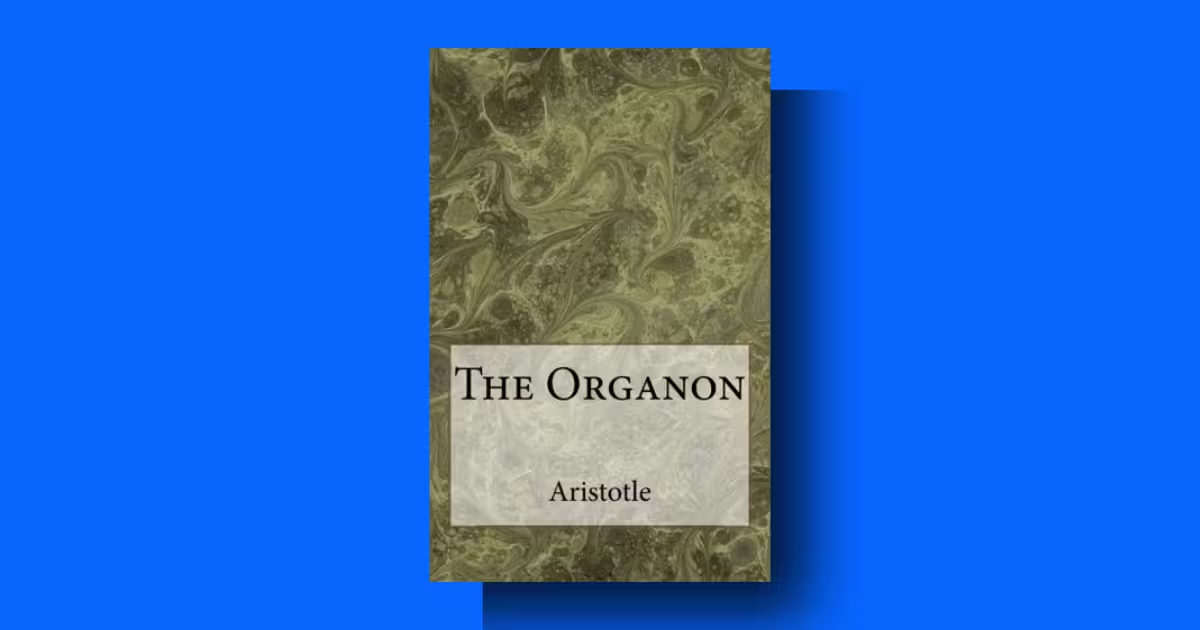
According to the Encyclopaedia Britannica, the Organon is “a collection of six works by Aristotle that form the foundation of Western logic”. Aristotle did not call it that himself—the name Organon means “tool” or “instrument,” and it was given by his followers, the Peripatetics, who argued that logic was not a science in itself but an instrument for all sciences.
Let me be honest with you: this is not a beach read. It is dense, occasionally tedious, and Aristotle is not exactly throwing punchlines. But if you care about how humans reason—whether you are a student, a writer, a lawyer, a scientist, or just someone who wants to win arguments fairly—this book is the foundation you did not know you were missing.
Table of Contents
Overview
The Organon is Aristotle’s complete logical works, compiled into six treatises: Categories, On Interpretation, Prior Analytics, Posterior Analytics, Topics, and On Sophistical Refutations. Together, they form the first systematic study of logic in Western history.
Here is what I learned in plain English:
How to classify everything: The Categories breaks down all human thought into ten basic types: substance, quantity, quality, relation, place, time, position, state, action, and passion.
How to form propositions: On Interpretation teaches you how statements work: affirmations, denials, universals, particulars, and why some future statements are tricky (hello, sea-battle problem).
How to build airtight arguments: The Prior Analytics introduces the syllogism: two premises, one conclusion, and rules that guarantee truth if the premises are true.
How to prove things scientifically: The Posterior Analytics shows how demonstration works: starting from first principles and building knowledge systematically.
How to argue persuasively: The Topics gives you the “places” or strategies for constructing arguments from probabilities—what most people believe or what experts say.
How to spot bad arguments: On Sophistical Refutations catalogues logical fallacies so you can avoid being fooled—and stop fooling yourself.
Aristotle’s logic uses deduction to infer conclusions from premises. That sounds simple. But trust me, the depth of what he built is staggering. The Stanford Encyclopedia of Philosophy notes that Aristotle “established a system of rules and strategies for such reasoning” that was genuinely novel in his time.
As Aristotle himself wrote, “on the subject of deduction we had absolutely nothing else of an earlier date to mention, but were kept at work for a long time in experimental researches”.
Reader recommendation
Organon can be recommended to:
- Philosophy students: This is literally the foundation of Western logic. You cannot understand the history of philosophy without it.
- Critical thinkers: If you want to sharpen your reasoning, this is the original workout.
- Writers and debaters: Understanding syllogisms and fallacies will make your arguments tighter.
- Scientists and researchers: The Posterior Analytics is essentially Aristotle’s philosophy of science.
- Anyone tired of losing arguments: This book gives you the tools to dissect any claim.
I would not recommend Organon to:
- Casual readers: This is not light reading. It is dense, academic, and requires focus.
- People who hate ancient texts: Aristotle references his predecessors constantly. If you cannot handle Plato and the Presocratics, you will struggle.
- Those seeking quick tips: The Organon is a system, not a list of hacks. You have to put in the work.
- Impatient minds – Some sections are tedious. Aristotle repeats himself. He assumes you are paying close attention.
Organon Summary
Let me walk you through what I actually took away from each treatise. I want you to feel like you have read the book after this section.
1. Categories: The Ten Boxes of Everything
Aristotle opens with a bold claim: every thing we can talk about falls into one of ten categories. These are:
- Substance (what a thing is—like “man” or “tree”)
- Quantity (how much—like “two feet long”)
- Quality (what kind—like “white” or “just”)
- Relation (how it connects—like “double” or “half”)
- Place (where—like “in the marketplace”)
- Time (when—like “yesterday”)
- Position (how situated—like “sitting” or “standing”)
- State (what it has—like “shod” or “armed”)
- Action (what it does—like “cuts” or “burns”)
- Passion (what it undergoes—like “is cut” or “is burned”)
Why does this matter? Because every proposition and problem you encounter will fall into one of these categories. Aristotle writes: “accident, and genus, and property, and definition will always be in one of these categories”.
I found this incredibly useful. When someone makes a claim, I now ask myself: what category does this belong to? Are they talking about a substance, a quality, a relation? This simple act clarifies confusion immediately.
2. On Interpretation: How Statements Work
This treatise is about propositions—declarative sentences that can be true or false. Aristotle breaks down affirmations and denials, universals and particulars. He introduces the famous “square of opposition” that shows how these types of propositions relate.
But here is where it gets wild: Aristotle tackles the problem of future contingents. He asks: if I say “there will be a sea-battle tomorrow,” is that statement true or false today? If it is true now, then the battle is already determined. If false, it cannot happen. Aristotle concludes that future events are not yet determined, so such statements are not simply true or false—they are contingent.
This blew my mind. A guy in 4th century BCE Greece was wrestling with the same issues of determinism and free will that we still debate today.
3. Prior Analytics: The Birth of the Syllogism
This is the heart of the Organon. Aristotle defines the syllogism as “a discourse in which, certain things being laid down, something different from the posita happens from necessity through the things laid down”.
In plain English: if you accept certain premises, a conclusion must follow. Here is the classic example:
- All men are mortal.
- Socrates is a man.
- Therefore, Socrates is mortal.
That is a syllogism. Aristotle worked out all the valid forms (the “moods” and “figures”) and showed how to test arguments for validity. The Stanford Encyclopedia explains that Aristotelian deductions are the foundation of formal logic.
I cannot overstate how powerful this is. Once you understand syllogistic reasoning, you can tear apart bad arguments with surgical precision. You can also build your own arguments so that they are unassailable—provided your premises are true.
4. Posterior Analytics: Scientific Demonstration
If the Prior Analytics is about validity, the Posterior Analytics is about truth. Aristotle asks: how do we know things with certainty? His answer: through demonstration from first principles that are necessarily true and knowable directly.
He argues that not everything can be proven—you need starting points. These are not innate; we acquire them through experience and intuition. Aristotle’s view is that the mind discovers the intelligible in the sense-perceived world, rather than recalling pre-existing ideas as Plato thought.
This treatise is essentially Aristotle’s philosophy of science. He deals with the four kinds of causes—efficient, material, formal, and final—and explains how we acquire first principles.
5. Topics: The Art of Dialectical Argument
Here is where things get practical. The Topics gives you “places” (topoi) to find arguments. These are not about certain truth but about probabilities—what seems true to most people, to experts, or to the wise.
Aristotle writes: “a dialectic proposition is an interrogation, probable either to all, or to the most, or to the wise; and to these, either to all or most, or to the most celebrated”.
This is the book for everyday debate. When you cannot prove something with absolute certainty—which is most of the time—you argue from what is probable. The Topics gives you strategies to construct and dismantle arguments in any field.
Aristotle also notes that dialectic is useful for three things: exercise, conversation, and philosophical science. He writes: “being able to dispute on both sides, we shall more easily perceive in each the true and the false”. This is why studying logic makes you smarter—it forces you to see both sides.
6. On Sophistical Refutations: Spotting Fallacies
Finally, Aristotle catalogues the ways arguments can go wrong. He distinguishes between real syllogisms and “contentious” ones that appear to be valid but are not.
He writes: “a contentious syllogism is one which is constructed from apparent, but not real probabilities, and which appears to consist of probabilities, or of apparent probabilities”.
This is the original book on logical fallacies. Aristotle shows you how to detect equivocation, ambiguity, and false reasoning. He even acknowledges that his work on this was original: “Nothing existed at all” on this subject before him.
Organon Analysis
Let me be straight with you. The Organon is a masterpiece, but it is not an easy read. I will tell you what I loved and what frustrated me.
What Works
Aristotle’s systematic approach is breathtaking. He did not just throw out ideas—he built a complete framework. The progression from terms (Categories) to propositions (On Interpretation) to syllogisms (Prior Analytics) to demonstration (Posterior Analytics) to dialectic (Topics) to fallacies (Sophistical Refutations) is logical and comprehensive.
His influence is undeniable. According to Britannica, Aristotle’s logical works “have helped shape the development of logic for over two millennia”. The Organon was the standard logic textbook in Western and Islamic education for centuries.
The practical value is immense. I use syllogistic reasoning almost daily now. When I read the news, I spot fallacies. When I write, I structure my arguments more clearly. When I debate, I know exactly where the weak points are.
Some passages are surprisingly modern. Aristotle’s discussion of future contingents, his categories, and his analysis of language feel relevant even today.
What Does Not Work
It is dry. There is no way around it. Aristotle is not a storyteller. He is a systematizer. The prose is dense, repetitive, and occasionally mind-numbing. As one Goodreads reviewer put it, “it is never chatty, chummy, or friendly”.
Some sections are outdated. The Categories is more metaphysics than logic, and its ten-fold classification has been largely superseded. Large portions are tedious and of “very uneven importance”.
It assumes you are paying close attention. Aristotle uses technical terms without always defining them clearly. You need to read slowly, sometimes re-reading passages multiple times.
The translation matters. I read the Owen translation, which is available in the PDF. It is serviceable but archaic. Modern translations are more accessible.
Strengths and Weaknesses
Strengths
Foundational. This is where Western logic begins. You cannot understand the history of philosophy without it.
Systematic. Aristotle builds logic from the ground up, from terms to propositions to syllogisms to demonstration.
Practical. The Topics and Sophistical Refutations give you tools you can use in real arguments.
Influential. The Organon shaped logic, science, and philosophy for over 2,000 years.
Comprehensive. No major aspect of reasoning is left untouched.
Weaknesses
Dense and dry. This is not engaging reading. It is work.
Outdated in places. Some sections are no longer relevant to modern logic.
Repetitive. Aristotle often says the same thing multiple times.
Requires background knowledge. You need to understand Plato and the Presocratics to get some references.
Translation issues. Older translations can be hard to follow.
Comparison with Similar Works
The Organon stands alone as the first systematic work on logic. But how does it compare to other foundational texts?
Plato’s dialogue: Plato used dialectic as a method of inquiry but did not systematize it. Aristotle took Plato’s approach and turned it into a formal discipline.
Francis Bacon’s Novum Organum: Bacon explicitly rejected Aristotle’s Organon and offered his own as a replacement. Bacon argued for induction over syllogism, but he was building on Aristotle’s framework.
Kant’s Critique of Pure Reason: Kant engaged with Aristotelian logic and recognized its importance, though he criticized it for being incomplete.
Modern logic textbooks: Contemporary logic owes a debt to Aristotle, but modern symbolic logic (Frege, Russell, etc.) has largely superseded Aristotelian syllogistic.
What sets the Organon apart is its breadth. It is not just about formal validity—it is about how humans actually reason, argue, and discover truth. No other work covers so much ground in one place.
Conclusion
Here is my honest recommendation.
If you are a philosophy student, you must read the Organon. It is non-negotiable. This is the foundation of your field.
If you are a critical thinker, a writer, a lawyer, a scientist, or anyone who argues for a living, you will benefit from this book. It will sharpen your mind and give you tools you did not know you needed.
If you are a casual reader looking for entertainment, skip it. You will be bored.
But if you are willing to put in the work, the Organon will reward you. It will teach you how to think clearly, argue fairly, and spot nonsense instantly. That is a superpower in any era.
As Aristotle himself wrote, “the instruments by which we shall be well provided with syllogisms are four: one to assume propositions, the second to be able to distinguish in how many ways each thing is predicated, the third to discover differences, and the fourth the consideration of the similar”.
Those four tools are still just as useful today as they were 2,300 years ago.
Pick up the Organon. Take your time. Read it slowly. Argue with it. You will come out the other side a better thinker.







