
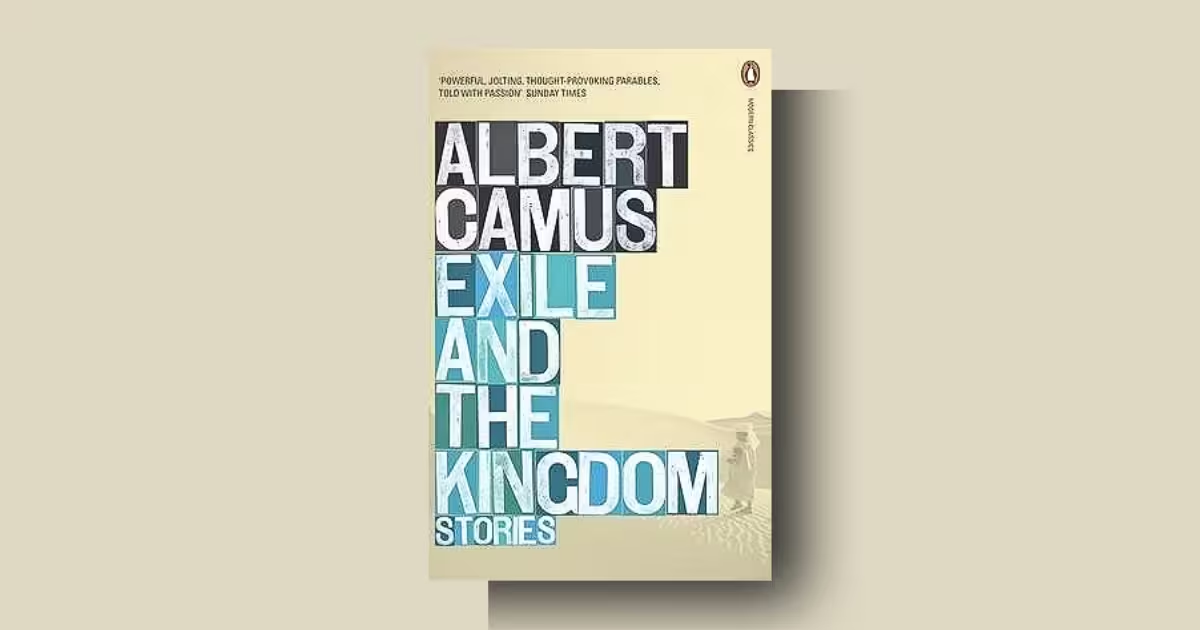
Did you ever look around at your perfectly normal life and wonder if you are actually living in a cage? I found myself asking this exact question in 2024 when a staggering 58% of surveyed adults reported feeling completely disconnected from their local communities, which drove me to pick up a worn 1957 copy of a specific French masterpiece.
As a reader navigating our hyper-connected but profoundly lonely modern world, I want to share exactly why this collection of stories shattered my perspective on human isolation.
Overview
Albert Camus’ 1957 collection Exile and the Kingdom (L’Exil et le royaume) explores six characters grappling with deep alienation—their “exile”—and their brief, fragile moments of human connection or spiritual clarity—their “kingdom.”
Core Concepts
Exile: Emotional detachment, cultural displacement, or existential isolation from society and oneself.
The Kingdom: Rare moments of transcendence, solidarity, or authentic connection with nature and humanity.
The Six Stories at a Glance
1. “The Adulterous Woman”: A lonely wife breaks her emotional isolation during a night under the vast Algerian desert sky, experiencing a quiet spiritual awakening.
2. “The Renegade”: A fanatic Catholic missionary, broken and tortured by a brutal desert tribe, abandons his faith to worship absolute evil.
3. “The Silent Men”: Laborers return to work after a failed strike, unable to bridge the emotional divide between themselves and their grieving boss.
4. “The Guest”: An isolated teacher in colonial Algeria is forced to turn in a prisoner, but gives the man the freedom to choose his own fate instead.
5. “The Artist at Work”: A famous painter retreats from the suffocating demands of society into a dark loft, leaving behind a blank canvas with a word that reads either “solitary” or “solidary.”
6. “The Growing Stone”: A French engineer in Brazil helps a local cook carry a massive stone during a procession, discovering genuine belonging by sharing another man’s physical burden.
Camus argues that while the modern world naturally drives us toward isolation and absurd suffering, our only escape is choosing human solidarity over self-absorbed detachment.
Table of Contents
1. Introduction
- Title: Exile and the Kingdom (Original French: L’Exil et le royaume)
- Author: Albert Camus
- Publication Details: First published in 1957, this is a collection of six short stories. The edition I referenced was translated by Justin O’Brien and published by Penguin Books.
2. Background
Albert Camus wrote these stories during a period of intense political and personal turmoil. By 1957, the Algerian War of Independence was escalating brutally. Camus, a French-Algerian (pied-noir), found himself caught between his love for his native Algeria and his ties to mainland France.
He was awarded the Nobel Prize for literature that same year. The historical context of French Colonial North Africa drips from the pages, providing a tense, arid backdrop for characters who are fundamentally displaced in their own lives.
3. Exile and the Kingdom Summary
To fully grasp the magnitude of Exile and the Kingdom, I will break down the narrative of the stories in detailed installments. Camus constructs a world where physical geography mirrors the internal landscapes of the characters.
The Adulterous Woman
The narrative follows Janine and her husband Marcel as they travel by bus through a freezing, sand-swept Algerian plateau. Marcel is a dry-goods merchant seeking to bypass middlemen and sell directly to Arab merchants.
Janine is a heavy-set, middle-aged woman who married Marcel primarily to avoid growing old alone. The journey is miserable. The bus is filled with silent Arabs in burnouses, and a French soldier with a jackal-like face who makes Janine feel uncomfortable.
When they reach the oasis town, the reality of the desert shatters Janine’s romanticized expectations of palm trees and soft sand; she finds only biting cold and stone. Marcel is singularly focused on business, complaining about the locals and haggling aggressively.
Feeling utterly alienated, Janine convinces Marcel to visit the fort overlooking the town.
Up on the terrace, she looks out over the vast, empty desert and the nomadic camps. She experiences a profound, overwhelming sense of a “kingdom” that has been promised to her but remains just out of reach. That night, unable to sleep in their frigid hotel room, she leaves her husband’s side, sneaks out into the freezing night, and returns to the terrace.
Under the falling stars, she presses herself against the parapet and experiences a transcendent, almost physical union with the night and the universe, weeping copiously upon her return to bed.
The Renegade
This story is a feverish, first-person internal monologue of a Catholic missionary whose tongue has been cut out by the brutal tribe he intended to convert. Sitting in the scorching desert rocks with a stolen rifle, he waits to ambush the new missionary sent to replace him.
He recounts his past as a stubborn, narrow-minded youth from the Massif Central who joined the seminary seeking absolute power over “savages”. He traveled to the remote, dazzlingly white city of salt, Taghâsa, expecting to subdue the locals with his righteous suffering.
Instead, the inhabitants subjected him to unimaginable torture. They locked him in the House of the Fetish, beat him, and forced him to witness horrific rituals. After they mutilated his mouth, his mind broke.
He abandoned his Christian God and fully submitted to the Fetish, worshiping the absolute power of evil and malice. When he learns a new chaplain is coming under a military truce, he is terrified that the purity of this evil kingdom will be compromised. He shoots the approaching missionary, but is immediately attacked and crucified by his own “masters” who fear military retaliation. As he dies, a voice within him whispers of mercy, leaving him in a final state of agonizing doubt.
The Silent Men
We are introduced to Yvars, a forty-year-old cooper with a crippled leg, riding his bicycle to work on a cold morning. He and his fellow workers are returning to the barrel-making shop after a failed twenty-day strike.
The cooperage industry is dying due to the rise of tankers, and their boss, M. Lassalle, has stubbornly refused to grant them a wage increase. Defeated and humiliated, the men arrive at the shop to find the doors closed, forcing them to wait until the foreman, Ballester, lets them in.
They resume their labor in complete silence. When Lassalle enters the shop and tries to engage them in normal conversation, the workers refuse to speak. Later, Lassalle calls Yvars and Marcou (the union delegate) into his office.
Through the walls, they hear Lassalle’s young daughter crying from a sudden illness. Lassalle formally reiterates that he cannot raise their wages. Despite the boss’s visible distress over his sick child later in the day, the men remain completely mute, trapped between their natural human empathy and their lingering, bitter anger.
The Guest
Daru is an isolated schoolteacher living in a remote plateau schoolhouse during a harsh winter. An old Corsican gendarme arrives, bringing an Arab prisoner who has killed a relative in a dispute.
The gendarme orders Daru to escort the prisoner to the police station in the next town, as the authorities are stretched thin due to impending rebellion.
Daru is disgusted by the crime but equally revolted by the idea of turning the man over to the colonial authorities. He treats the prisoner as a guest, eating with him and offering him a bed. The next day, Daru walks the man to a crossroads. He points one way toward the police and prison, and the other way toward the nomadic tribes who will offer him shelter.
Daru leaves the choice to the prisoner and walks away. When he looks back, he sees the Arab walking toward the prison. Returning to his classroom, Daru finds a threat written on his blackboard by the prisoner’s allies, leaving him completely alone and misunderstood.
The Artist at Work
Gilbert Jonas is a painter who achieves sudden, immense popularity.
He is a passive, gentle man who attributes his success to his “star.” As he becomes famous, his small apartment is overrun by disciples, critics, and hangers-on.
He is entirely consumed by the demands of society, leaving him no space or time to actually paint. His supportive wife, Louise, tries to manage the chaos, but Jonas slowly loses his inspiration.
To escape the noise, Jonas builds a small loft just beneath the ceiling of his hallway. He retreats there entirely, refusing to come down, living in the dark and claiming he is working on something brilliant.
Eventually, he collapses from exhaustion. When his friend investigates the canvas Jonas had been staring at, he finds it completely blank except for a single word written in tiny letters in the center. The word is either “solitary” or “solidary”, leaving it perfectly ambiguous whether the artist requires isolation or community.
The Growing Stone
D’Arrast, a French engineer of robust build, arrives in a Brazilian coastal town to build a dam.
He is escaping a dark, unspecified past in Europe.
He befriends the locals, including a ship’s cook who has made a vow to Jesus to carry a massive, hundred-pound stone on his head during a local religious procession, thanking God for saving him from a shipwreck. As the grueling procession takes place in the blistering heat, the cook’s strength fails him.
He falls repeatedly and cannot carry the stone any further. D’Arrast steps in, hoists the massive stone onto his own head, and carries it. However, instead of taking it to the church altar as the vow demanded, D’Arrast diverts his path and throws the stone into the center of the cook’s impoverished hut.
The locals gather around the stone in the hut, and they invite D’Arrast to sit with them. For the first time, he feels a sense of true belonging.
4. Exile and the Kingdom Analysis
4.1. Characters
The characters in this collection are ordinary people stripped of their illusions.
Janine (The Adulterous Woman): She represents the middle-class complacency that suffocates the human spirit. Her physical heaviness contrasts with her desperate need for spiritual lightness. Her “adultery” is not physical, but a spiritual betrayal of her mundane life through her communion with the desert night.
The Renegade: He is a terrifying portrait of ideological extremism. His character demonstrates how the desire for absolute moral superiority easily flips into the worship of absolute brutality when subjected to trauma. His transition from Christian missionary to Fetish worshipper shows the fragility of performative goodness.
Yvars (The Silent Men): Yvars embodies the quiet dignity and exhaustion of the working class. He is not an agitator, but a craftsman mourning the loss of his youth and the devaluation of his skills. His silence is his only remaining weapon against a system that treats him as a disposable asset.
4.2. Exile and the Kingdom Themes and Symbolism (Full Spoiler Full Discussion)
Camus expertly weaves the central tension between “Exile” (alienation, loneliness, the absurdity of the universe) and the “Kingdom” (solidarity, meaning, spiritual fulfillment).
The Indifferent Landscape: In every story, nature is a dominant, aggressive force. The freezing winds and stones of the Algerian plateau in The Adulterous Woman, and the searing sun and salt in The Renegade, symbolize a universe that does not care about human suffering.
Physical Afflictions as Spiritual States: Yvars’s crippled leg and the missionary’s missing tongue represent their inability to move forward or communicate in a world that has broken them.
The Burden of Choice: Whether it is Daru leaving the Arab at the crossroads, or D’Arrast choosing where to drop the heavy stone, the characters must navigate the terrifying freedom of defining their own morality without divine guidance.
5. Exile and the Kingdom Evaluation
Exile and the Kingdom is a poignant, monumental work that forces you to examine the structural integrity of your own life.
Strengths/Positive experiences with Exile and the Kingdom: The descriptive prose is magnificent. Camus creates physical environments so vivid that you can feel the grit of the sand and the heat of the salt. The psychological depth of characters like Janine is executed perfectly, making internal epiphanies feel like major plot twists.
Weaknesses/Negative experiences with Exile and the Kingdom: The pacing can be challenging. Because the narratives rely heavily on internal monologue and atmospheric tension rather than traditional plot points, readers seeking narrative momentum might find stories like The Renegade claustrophobic and repetitive.
Comparison with Similar Works: Exile and the Kingdom shares the existential dread of Jean-Paul Sartre’s The Wall and the nightmarish bureaucratic alienation of Franz Kafka’s The Metamorphosis. Yet, Camus offers a sliver of physical, earthly beauty that Sartre often ignores.
6. Personal Insight with Contemporary Educational Relevance
The most important angle of Exile and the Kingdom is its examination of The Architecture of Isolation. We live in an era of unprecedented connectivity, yet loneliness is classified as a global health epidemic by organizations like the WHO.
Camus shows us that true exile is not geographical; it is the state of living automatically, without genuine connection to oneself or one’s labor (as seen with Yvars and his fellow coopers).
Here are five essential lessons we can draw for contemporary life:
Acknowledge Your Exile: Before you can find belonging, you must admit where you are merely going through the motions, much like Janine realizing her marriage was built on the fear of aging.
Beware of Ideological Purity: The missionary in The Renegade proves that a desperate need for absolute certainty often leads to cruelty and fanaticism. Real morality requires accepting nuance.
Labor Needs Dignity: The breakdown of communication in The Silent Men perfectly mirrors modern union strikes and wage disputes. When workers are stripped of their dignity, the entire social contract fails.
Nature Cures the Ego: Janine’s communion with the night sky is a reminder that stepping into vast, natural spaces puts our petty anxieties into immediate perspective.
Solidarity is a Choice: We are not owed a “Kingdom.” We must build it through deliberate acts of empathy, even when the world remains silent.
7. Exile and the Kingdom Quotes
“Everywhere, henceforth, life was suspended, except in her heart, where, at the same moment, someone was weeping with affliction and wonder.”
“But who can always sleep alone? Some men do, cut off from others by a vocation or misfortune, who go to bed every night in the same bed as death.”
“Order and method, the tongue says, and then goes on talking of other matters simultaneously, yes, I always longed for order.”
“Only evil can reach its limits and reign absolutely, it must be served to establish its visible kingdom…”
“He clenched his teeth; his small, dark, and wrinkled face with its delicate features had become hard. ‘We’re going back to work. That’s enough.'”
8. Conclusion
My overall impression of Exile and the Kingdom is that it remains a masterclass in philosophical storytelling. I highly recommend it for readers of literary fiction, students of existentialism, and anyone who has ever felt like a stranger in their own home.
Ultimately, Camus suggests that while the universe is indifferent to our struggles, the warmth we generate through shared human resilience is the only kingdom we will ever truly need.







