
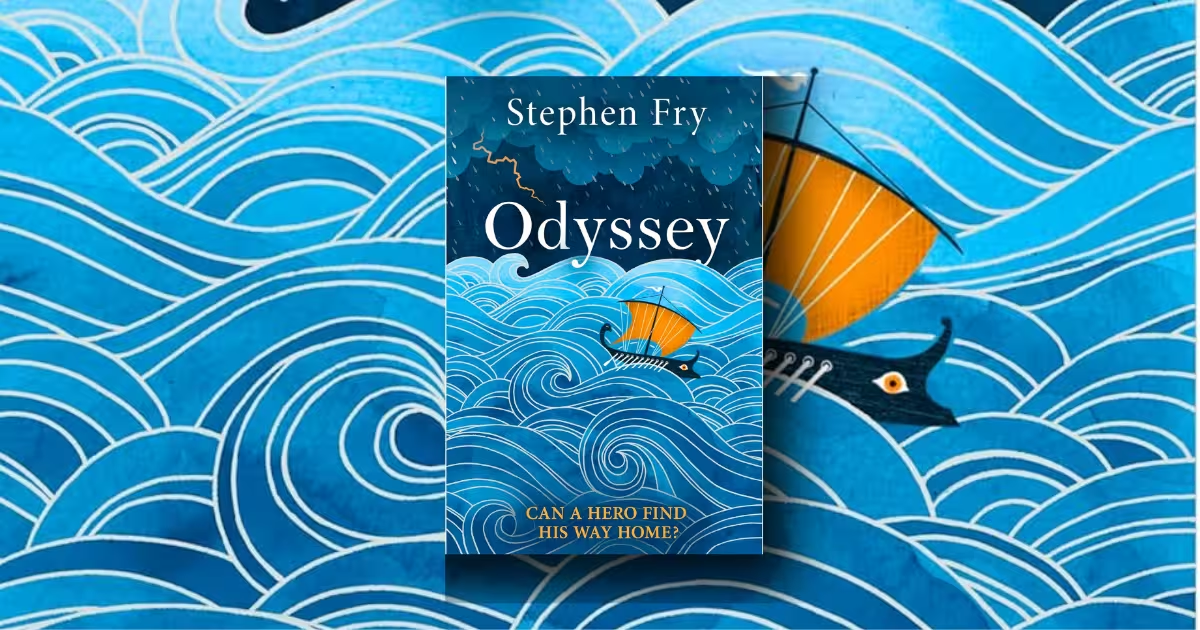
Did you know that the word “nostalgia” comes from the Greek nostos (homecoming) and algia (pain or longing)? Stephen Fry’s Odyssey doesn’t just retell Homer’s epic; it makes you feel that ancient ache for home in your bones. After finishing this book, I found myself rethinking what “home” actually means, and I suspect you will too.
Overview
Odyssey is Stephen Fry’s fourth and final installment in his internationally bestselling Greek myths series, published by Michael Joseph in September 2024. It retells Homer’s Odyssey, the story of Odysseus’s ten-year journey home from the Trojan War—with Fry’s signature wit, warmth, and modern sensibility.
The book covers not just Odysseus’s adventures with monsters, witches, and gods, but also the parallel stories of Agamemnon’s murder, Orestes’ revenge, and Aeneas’s founding of Rome.
Fry adds a substantial “Further Adventures” section that explores post-Homeric myths and the enduring legacy of the Odyssey in literature and culture. While some critics note it’s the “least faithful” to Homer, it remains an entertaining, accessible, and deeply human retelling that stands alone even if you haven’t read the previous books.
Reader recommendation
Odyssey is perfect for:
- Readers who love Greek mythology but find Homer’s original daunting
- Fans of Stephen Fry’s witty, conversational storytelling style
- Anyone interested in how ancient stories connect to modern life
- Audiobook listeners, Fry narrates it himself with perfect comic timing
- Those who enjoyed Mythos, Heroes, or Troy and want the complete set
Odyssey is not suggested to:
- Purists seeking a strict, line-by-line translation of Homer
- Readers who prefer dark, subversive feminist retellings like Madeline Miller’s Circe
- Those looking for deep psychological complexity, Fry keeps things light and accessible
Table of Contents
1. Introduction
Title: Odyssey: The Sunday Times bestselling final part of the acclaimed Greek myths series
Author: Stephen Fry
Publisher: Michael Joseph (Penguin)
Publication Date: 26 September 2024 (hardback), 10 October 2024
Odyssey is the fourth book in Stephen Fry’s bestselling series that began with Mythos (2017), continued with Heroes (2018), and Troy (2020). Like its predecessors, it became a Sunday Times bestseller immediately upon release in October 2024.
The book is both a standalone retelling of Homer’s epic and the concluding chapter of Fry’s grand project to make Greek mythology accessible to modern readers.
2. Background
Homer’s Odyssey is one of the two foundational epics of Western literature, composed around the 8th century BC. It tells the story of Odysseus (known to the Romans as Ulysses), king of Ithaca, and his decade-long journey home after the Trojan War. Along the way, he faces the Cyclops Polyphemus, the witch Circe, the Sirens, and the monsters Scylla and Charybdis, while his wife Penelope fends off over a hundred suitors back home.
The poem is not just an adventure story—it’s a profound meditation on nostos (homecoming), identity, endurance, and the relationship between mortals and gods. As Fry notes in his introduction, the Odyssey stands apart from the Iliad because it’s “a profoundly human story,” though “there are gods and monsters enough to be encountered still.”
Fry’s retelling comes at a time when Greek mythology is experiencing a renaissance in popular culture, from Madeline Miller’s Circe and The Song of Achilles to video games like Hades and TV shows like Blood of Zeus. Fry’s contribution is distinct because he combines scholarly knowledge with the accessible, warm, and often hilarious voice that has made him a beloved figure in British culture for decades.
3. Odyssey Summary
Part One: The Gods Look Down and the Storm
The book opens not with Odysseus, but with the goddess Athena watching the smoke rise from the ruins of Troy. She is haunted by a feeling of dread.
The Greeks have won, but their victory has been savage and dishonorable. The worst crime is committed by Ajax the Lesser, who rapes the Trojan princess Cassandra in Athena’s own temple. Odysseus calls for Ajax to be stoned, but the Greeks refuse to act.
Athena, furious, demands that Zeus send a storm to punish the Greeks. Poseidon, god of the sea, is also angered by the Greeks’ impiety. Meanwhile, Hera has her own agenda—she wants a storm to destroy Aeneas, the Trojan prince whose descendants are fated to destroy her beloved city of Carthage.
The storm scatters the Greek fleets. Menelaus and Helen are blown to Egypt, where Menelaus wrestles the shape-shifting sea god Proteus and learns that Odysseus is trapped on the island of Ogygia with the nymph Calypso. Agamemnon, however, makes it home to Mycenae—only to be murdered by his wife Clytemnestra and her lover Aegisthus while he bathes.
Part Two: The Judgement of Paris and the Trojan Horse
Fry provides a brief recap for readers new to the series. The Trojan War was triggered by the Judgement of Paris, when the young Trojan prince chose Aphrodite as the most beautiful goddess in exchange for Helen, the most beautiful mortal woman. After ten years of siege, Odysseus devised the plan of the wooden horse, which allowed the Greeks to infiltrate and destroy Troy.
Part Three: Telemachus’s Journey
Back in Ithaca, Odysseus’s son Telemachus is now a young man of twenty. His mother Penelope is besieged by 108 suitors who are eating the family out of house and home. With the help of Athena, who appears to him disguised as the traveler Mentes, Telemachus sets sail to Pylos and Sparta to seek news of his father.
In Pylos, he meets the aged Nestor, who fought alongside Odysseus at Troy but has no news of him. In Sparta, Menelaus and Helen welcome him warmly. Helen recognizes Telemachus immediately, she sees “a young Odysseus” in his face. Menelaus tells Telemachus the story of how he wrestled Proteus and learned that Odysseus is alive but trapped on Ogygia.
Part Four: Odysseus and Calypso
On Ogygia, Odysseus has been held captive by the nymph Calypso for seven years. She loves him and has offered him immortality, but he longs only for home. Zeus, pressured by Athena, finally sends Hermes to order Calypso to release Odysseus. Reluctantly, she agrees and helps him build a raft.
Part Five: The Wanderings
Odysseus sets sail, but Poseidon, still enraged over Odysseus blinding his son Polyphemus, sends a storm that destroys the raft. Odysseus is saved by the goddess Leucothea, who gives him a magical veil that allows him to swim to the island of Scheria, home of the Phaeacians.
There, he is found by Princess Nausicaa, who brings him to her parents, King Alcinous and Queen Arete. At a feast, Odysseus is asked to tell his story. He recounts his adventures:
The Cicones: After leaving Troy, Odysseus and his men raided the city of Ismarus but stayed too long and lost seventy men in a counterattack.
The Lotus-Eaters: Some of his men ate the magical lotus fruit and lost all desire to return home.
The Cyclops: Odysseus and twelve men entered the cave of Polyphemus, a one-eyed giant who ate six of them. Odysseus told the Cyclops his name was “Nobody,” blinded him with a sharpened stake, and escaped by hiding under the bellies of sheep. As he sailed away, Odysseus taunted the Cyclops and revealed his true name, prompting Polyphemus to curse him and call upon his father Poseidon.
Aeolus: The king of the winds gave Odysseus a bag containing all the winds except the west wind, which would blow him home. But his men, thinking the bag contained treasure, opened it, releasing the winds and blowing them back to Aeolia.
The Laestrygonians: These man-eating giants destroyed eleven of Odysseus’s twelve ships and killed all but Odysseus and his crew.
Circe: The enchantress turned Odysseus’s men into pigs, but with the help of Hermes, Odysseus overcame her and forced her to restore them. They stayed with Circe for a year, and she bore him a son, Agrius. She also advised him to visit the underworld to consult the prophet Tiresias.
The Underworld: Odysseus traveled to the land of the dead, where he spoke with Tiresias, who warned him not to harm the cattle of Helios and foretold his eventual death. He also spoke with the ghost of his mother Anticlea, who told him of Penelope’s faithfulness and his father’s decline. He saw Agamemnon’s ghost, who warned him against trusting women, and Achilles, who said he would rather be a living peasant than king of the dead.
The Sirens: Odysseus had his men plug their ears with wax and tie him to the mast so he could hear the Sirens’ song without being lured to his death.
Scylla and Charybdis: Odysseus chose to sail closer to Scylla, who snatched and ate six of his men, rather than risk the whirlpool Charybdis.
The Cattle of Helios: On Thrinacia, Odysseus’s men, led by Eurylochus, slaughtered the sacred cattle of the sun god while Odysseus was praying. Zeus punished them by destroying their ship with a thunderbolt. Only Odysseus survived.
Odysseus then drifted to Ogygia, completing his story.
Part Six: Return to Ithaca
The Phaeacians, deeply moved by Odysseus’s tale, provide him with a ship and treasure and sail him home to Ithaca. He falls asleep on the journey and wakes up on the shores of Ithaca, not recognizing the island because of a mist sent by Athena.
Athena appears to him and reveals that the palace is overrun with suitors. She disguises him as a ragged beggar. He seeks out his loyal swineherd Eumaeus, who welcomes him. There, he reunites with his son Telemachus, who has returned from Sparta. Odysseus reveals his identity, and together they plan to kill the suitors.
Part Seven: The Slaying of the Suitors
Disguised as a beggar, Odysseus enters his palace. He is mocked and abused by the suitors, but he endures it. He is recognized only by his old nurse Euryclea, who sees the scar on his leg from a boar hunt in his youth.
Penelope, unaware that the beggar is her husband, proposes a contest: whoever can string Odysseus’s bow and shoot an arrow through twelve axe-heads will marry her. None of the suitors can string the bow. Odysseus, still in disguise, takes it, strings it easily, and shoots through all twelve axe-heads.
He then reveals himself and, with Telemachus, Eumaeus, and Philoetius, proceeds to slaughter all 108 suitors. Antinous is the first to die, killed by an arrow through the throat. Eurymachus follows. The hall runs red with blood.
Part Eight: The Reunion
Penelope, who has been asleep through the slaughter (Athena’s doing), is told by Euryclea that Odysseus has returned. She is skeptical and tests him by asking about their bed—which Odysseus built around an olive tree, making it immovable. He passes the test, and they are finally reunited.
Part Nine: Further Adventures
Fry includes a substantial “Further Adventures” section that goes beyond Homer. He explains the Telegony, a lost epic in which Odysseus is accidentally killed by Telegonus, his son by Circe. He also discusses Virgil’s Aeneid, which follows Aeneas’s journey to Italy and the founding of Rome, fulfilling the prophecy that Troy’s descendants would one day conquer Greece.
Fry reflects on the legacy of the Odyssey, from James Joyce’s Ulysses to the Coen Brothers’ O Brother, Where Art Thou?, and considers what the story of homecoming means in the modern world.
4. Odyssey Analysis
4.1. Characters
Odysseus: Fry presents Odysseus as a complex figure, brilliant, resourceful, and endlessly curious, but also proud, arrogant, and unfaithful. Fry doesn’t shy away from Odysseus’s flaws.
He calls himself “curious” rather than just “clever,” acknowledging that his desire to know more often leads to disaster. Fry also notes, with characteristic wit, that Odysseus fathered children with women whose names all begin with “C”—Circe, Calypso, and Callidice—raising questions about his marital fidelity by modern standards.
As Fry writes, “Trying to present the Odyssey as the story of a faithful, loving husband yearning for his beloved wife is all very well… we have to appraise Odysseus against standards of marital fidelity and monogamy rather different from our own.”
Penelope: Fry’s Penelope is more than just the faithful wife waiting at home.
She is cunning in her own right, using the weaving and unweaving of Laertes’ shroud to delay the suitors for three years. She tests Odysseus with the secret of their bed to confirm his identity, showing she is not easily fooled. Fry gives Penelope her due as a strategist equal to her husband.
Telemachus: The book follows Telemachus’s journey from a shy, insecure boy to a confident young man who fights alongside his father. Fry’s Telemachus is more sympathetic than Homer’s version, Fry notably omits the hanging of the twelve enslaved women who slept with the suitors, a detail that some critics found softened the character.
Athena: Fry’s Athena is a complex divine figure. She is Odysseus’s protector, but she is also capable of great cruelty, as when she demands that Zeus punish the Greeks for Ajax’s crimes.
Fry describes her as feeling “a blend of horror and disappointment” after the fall of Troy, wondering if “mortals were beginning to infect the gods with the perverse self-indulgence of inner feelings.”
The Suitors: Fry portrays the suitors as arrogant, entitled, and ultimately deserving of their fate. Antinous is the ringleader, cruel and manipulative; Eurymachus is slick and charming but treacherous. They are drawn with enough color to make their deaths satisfying.
4.2. Odyssey Themes and Symbolism
Homecoming (Nostos): The central theme of the book is the longing for home. Fry explores this through Odysseus’s physical journey, Penelope’s emotional waiting, and Telemachus’s search for his father.
The epigraph from C.P. Cavafy’s poem “Ithaca” sets the tone: “When you start on your way to Ithaca, pray that the journey be long, rich in adventure, rich in discovery.”
Identity and Disguise: Odysseus spends much of the book disguised as a beggar, an old man, or “Nobody.” This theme of disguise raises questions about identity—who is Odysseus when stripped of his name and status? Is he still a king, a hero, a husband?
Gods and Mortals: Fry emphasizes that the gods are “like children”—impatient, tantrum-prone, and self-centered. Yet mortals are still subject to their whims. The relationship between humans and gods is one of the book’s central tensions: humans strive for autonomy, but the gods constantly interfere.
Justice and Revenge: The slaughter of the suitors raises uncomfortable questions about justice. Is Odysseus justified in killing 108 men? Fry doesn’t offer easy answers. He includes the trial of Orestes as a counterpoint—a moment when human justice, rather than divine vengeance, is allowed to prevail.
The Power of Storytelling: The Odyssey is itself a story about storytelling. Odysseus narrates his own adventures to the Phaeacians, and his tales are what win him their aid. Fry’s retelling is a meditation on why stories matter—they connect us, teach us, and help us understand ourselves.
5. Odyssey Evaluation
Odyssey is a delightful, witty, and accessible conclusion to Stephen Fry’s Greek myths series. It’s not a groundbreaking work of scholarship or a subversive retelling, it’s exactly what it promises: a modern, engaging, and often hilarious version of Homer’s epic that makes the ancient story feel fresh and relatable.
As one reviewer put it, “The intent is to educate people on the story of the Odyssey through the brilliant, sharp, witty mind of Stephen Fry, not to provide a subversive Greek Retelling.”
Strengths
Fry’s Voice: The book is written in Fry’s unmistakable style—witty, erudite, and warmly conversational. He has a gift for making complex mythology feel like a chat with a clever friend.
Accessibility: Fry assumes no prior knowledge. His introduction and cast of characters make the book accessible even to readers new to Greek mythology.
Humor: The book is genuinely funny. Fry’s asides—like noting that Odysseus fathered children with women whose names begin with “C”—add levity to the often grim story.
The “Further Adventures” Section: Fry’s exploration of what happens after Homer’s epic ends is fascinating. He discusses the lost Telegony, Virgil’s Aeneid, and the Odyssey‘s influence on modern literature and film.
Audiobook Performance: Fry narrates the audiobook himself, and his performance adds another layer of enjoyment.
Weaknesses
Deviation from Homer: Some critics have noted that Fry’s retelling is “the least faithful to the original epic.” He omits certain uncomfortable details—like Telemachus hanging the enslaved women—and sometimes attributes Penelope’s ideas to Odysseus.
Oversimplification: Fry’s light, humorous tone sometimes flattens the complexity of the characters. His Agamemnon comes across as a doting father, despite having sacrificed his daughter Iphigenia.
Pacing: The middle section—Odysseus’s wanderings—can feel like a checklist of adventures. Fry is at his best when he lingers on characters and relationships.
Impact
Odyssey resonated with me emotionally in ways I didn’t expect. Odysseus’s longing for home, his endurance through unimaginable suffering, and his ultimate reunion with Penelope felt profoundly moving. But I was also struck by the book’s darker moments, the slaughter of the suitors is brutal and uncomfortable, and Fry doesn’t entirely sugarcoat it.
The book also made me think about the nature of storytelling. As Fry writes in his appendix, “In a world where absolute data and information are the vital currency… we do well to remember the power of story, myth, ceremony, ritual and symbol.” In an age of AI and information overload, the ancient stories still matter.
Comparison with Similar Works
Madeline Miller’s Circe: Miller’s novel is a feminist retelling from Circe’s perspective—dark, psychological, and subversive. Fry’s Odyssey is lighter, more traditional, and focuses on Odysseus.
Emily Wilson’s Translation of the Odyssey: Wilson’s translation is a scholarly, line-by-line rendering that prioritizes fidelity. Fry’s version is a creative retelling that prioritizes readability and entertainment.
James Joyce’s Ulysses: Joyce’s modernist masterpiece uses the Odyssey as a framework for a day in Dublin. Fry’s book is much more straightforward, but he acknowledges Joyce’s influence in his appendix.
6. Personal Insight: Five Lessons from the Odyssey for Today
Lesson 1: Home Is Not a Place—It’s a State of Being
Odysseus spends ten years trying to get back to Ithaca, but when he finally arrives, he doesn’t recognize it. He has to be told by Athena that he’s home.
This suggests that home isn’t just a physical location; it’s something we carry inside us. In our own lives, we often think happiness lies in the next achievement, the next purchase, the next destination.
But the Odyssey reminds us that home is where the heart is, and we can find it even when we feel lost.
Lesson 2: The Journey Matters More Than the Destination
Cavafy’s poem, which Fry uses as an epigraph, advises: “Pray that the journey be a long one, rich in adventure, rich in discovery.” Odysseus’s journey is full of suffering, but it’s also what makes him who he is. Without the wandering, he wouldn’t be the wise, experienced man who finally returns to Penelope. In our own lives, the struggles and detours are often what shape us most.
Lesson 3: Loyalty and Endurance Are Forms of Heroism
Penelope waits for Odysseus for twenty years. She fends off 108 suitors, weaves and unweaves a shroud, and never gives up hope. Her heroism is quieter than Odysseus’s, but no less remarkable. The Odyssey reminds us that endurance—staying true to our values and our loved ones through hardship—is a form of courage.
Lesson 4: Pride Comes Before a Fall
Odysseus’s biggest mistake is taunting Polyphemus and revealing his true name. This act of pride costs him ten more years of wandering. The Odyssey is full of warnings about hubris—excessive pride that offends the gods. In our own lives, humility and restraint are often wiser than boastfulness.
Lesson 5: Stories Connect Us Across Time
The Odyssey has been told and retold for nearly 3,000 years. It has inspired everyone from Virgil to James Joyce to the Coen Brothers. Fry’s retelling is another link in that chain. Stories, Fry argues, are “the power of story, myth, ceremony, ritual and symbol” that we need in an age of data and information.
They connect us to our past, to each other, and to our shared humanity.
7. Odyssey Quotes
Here are some of the most memorable passages from the book:
On the gods: “It is common to portray us mortals as the children of the gods, but in reality it is the gods who are children. Like children, the gods have no patience. Like children, they erupt into tantrums when their desires are thwarted.”
On storytelling: “Don’t sing of heroes. There are no heroes in this tale. Only men and women. And gods… always gods.” — Odysseus to Demodocus
On identity: “My name is ‘NOBODY’. Nobody. My family, friends and comrades all call me ‘Nobody’.” — Odysseus to Polyphemus
On longing: “Home is the sailor, home from sea, And the hunter home from the hill.” — Robert Louis Stevenson, used as epigraph
On the nature of the journey: “When you start on your way to Ithaca, pray that the journey be long, rich in adventure, rich in discovery.” — C.P. Cavafy
On Penelope’s cunning: “For over three years she did this. But then a slave girl went and spilled the beans. The suitors made mother finish the cloth under this treacherous girl’s supervision.”
On Odysseus’s return: “Odysseus the Wanderer had reached his native shore.”
On the end of the mythic age: “Humankind moved on from the gods, the gods no longer appeared before us or demanded sacrifice of us, no longer mated with us, commanded us, cursed us or cast us up to the heavens as constellations. Except they are still here.”
8. Conclusion
Odyssey is a fitting conclusion to Stephen Fry’s Greek myths series. It’s not a scholarly translation or a subversive retelling—it’s a warm, witty, and accessible version of one of the greatest stories ever told. Fry’s voice is the star of the show: erudite but never pretentious, funny but never disrespectful.
The book is best enjoyed as an audiobook, with Fry’s narration adding another layer of charm. It’s also a wonderful entry point for readers new to Greek mythology, as Fry assumes no prior knowledge and provides helpful context throughout.
For fans of the series, Odyssey delivers a satisfying conclusion to the epic journey that began with Mythos. For newcomers, it stands alone as an engaging and thought-provoking retelling of Homer’s masterpiece.
As Fry writes in his final reflection: “We contain them all: the cheek and cheerfulness of Hermes, the wisdom of Athena, the rage of Ares, the homeliness of Hestia, the craft of Hephaestus, the pride and propriety of Hera, the majesty of Zeus and the capricious inconsistency, beauty, savagery, insight, glory and madness of the whole blessed pantheon.”
In other words, the gods are still with us—not on Mount Olympus, but inside us. And that, perhaps, is the most important lesson of all.







