
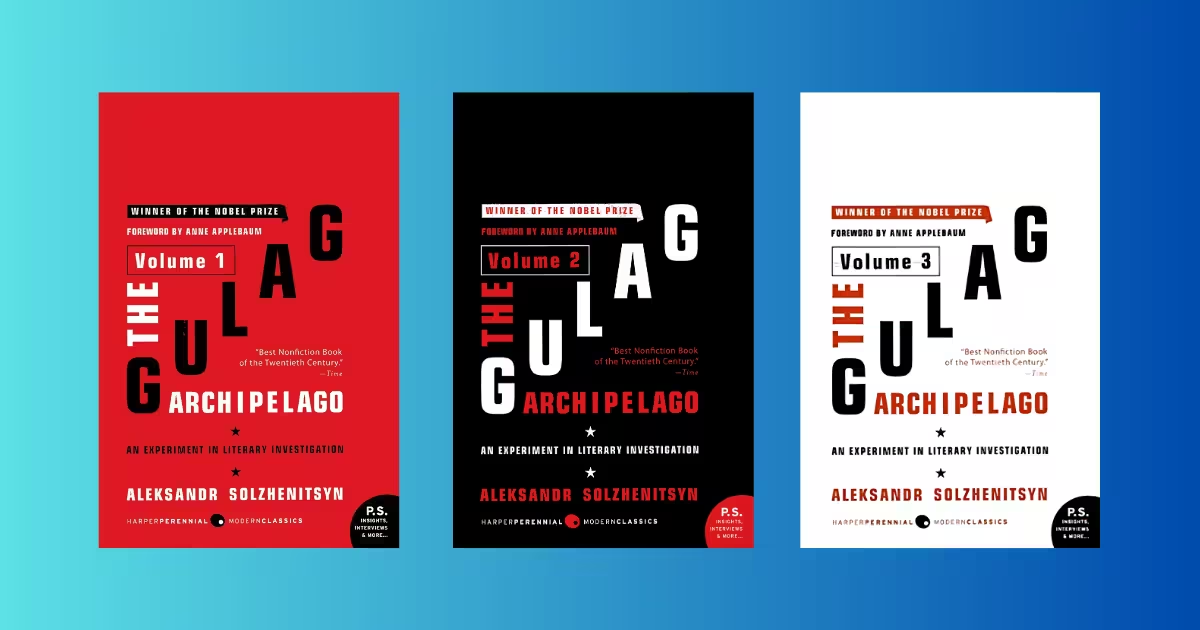

Did one book really help wear down an empire from the inside? The Gulag Archipelago came closer to that than almost anything else written in the twentieth century, and getting through all three volumes changed the way I think about obedience, ideology, and how ordinary systems turn ordinary people into instruments of cruelty.
Quick Facts
| Title | The Gulag Archipelago, 1918-1956: An Experiment in Literary Investigation |
| Author | Aleksandr Solzhenitsyn |
| Genre | Nonfiction, memoir, history, political testimony |
| Written | In secret, 1958 to 1968 |
| First published | December 28, 1973, Paris, by YMCA-Press |
| English translation | Vol. 1 and 2 by Thomas P. Whitney (Harper & Row, 1974 and 1975); Vol. 3 by Harry Willetts (Harper & Row, 1978) |
| Structure | 7 parts across 3 volumes |
| Awards / recognition | Solzhenitsyn won the 1970 Nobel Prize in Literature; the book is widely marketed as Time’s “Best Nonfiction Book of the 20th Century” |
| Sales | More than 30 million copies, in over 35 languages |
Overview
The Gulag Archipelago is Aleksandr Solzhenitsyn’s three-volume account of the Soviet forced-labor camp system, built from his own eight years in prison and exile plus testimony he gathered from 227 fellow survivors, a number he states directly in his original preface.
It is not a novel, and it is not a conventional history book either.
Solzhenitsyn called it an “experiment in literary investigation,” and that description still fits better than any label a marketing department could invent. It traces the system from Lenin’s earliest decrees in 1918 through Stalin’s terror and up to Khrushchev’s 1956 speech denouncing Stalin, following the entire journey a prisoner went through: arrest, interrogation, transport, camp life, and, for the fortunate ones, release.
I am reviewing the complete unabridged translation here, all three volumes, not the shorter one-volume abridgment that most casual readers pick up, and that distinction matters more than you would think.
Reader recommendation
The Gulag Archipelago is suggested for:
- Readers of twentieth-century history, political science, or philosophy who want a primary source rather than a summary of one
- Fans of witness literature such as Primo Levi or Elie Wiesel, who want to see how a single mind processes atrocity carried out by an entire government machine
- Anyone trying to understand how ideology, not just individual cruelty, builds and sustains a system like this
- Patient readers who can commit weeks, not days, to a demanding book
The Gulag Archipelago may disappoint:
- Anyone who wants a fast, plot-driven read, since The Gulag Archipelago has no plot in the conventional sense
- Readers who want rigorous quantitative demography with tight statistical margins; for that, pair this book with an archival historian
- Readers who are currently in a fragile place emotionally, since the subject matter is sustained and unrelenting
- Anyone expecting a neutral, dispassionate tone; this is testimony and argument together, not a detached academic monograph
Table of Contents
Introduction
The Gulag Archipelago, 1918-1956: An Experiment in Literary Investigation is Aleksandr Solzhenitsyn’s nonfiction account of the Soviet Union’s network of prisons, transit camps, and forced-labor colonies.
Solzhenitsyn wrote it secretly between 1958 and 1968, hiding sections of the manuscript with trusted friends across Moscow so that no single arrest could destroy the whole project. It first appeared in Russian on December 28, 1973, published in Paris by YMCA-Press.
The English translation followed as three separate volumes: Volume 1 and Volume 2 were translated by Thomas P. Whitney and published by Harper & Row in 1974 and 1975, and Volume 3 was translated by Harry Willetts and published in 1978.
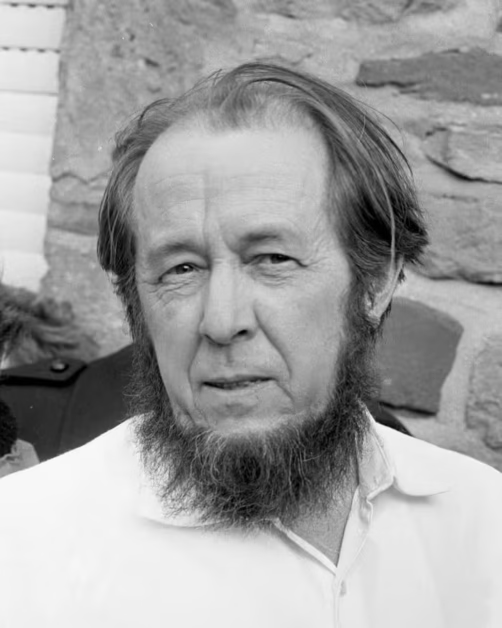
Solzhenitsyn’s own background gives The Gulag Archipelago a kind of authority that few writers on this subject can claim.
He served as a Red Army artillery captain in the Second World War, was arrested in February 1945 for criticizing Stalin in a private letter to a friend, and spent eight years in labor camps followed by internal exile.
He was awarded the 1970 Nobel Prize in Literature for “the ethical force with which he has pursued the indispensable traditions of Russian literature,” an honor he received before The Gulag Archipelago was even published in the West.
He died in Moscow in August 2008 at the age of 89, having returned to Russia in 1994 after eighteen years of exile in Vermont.
The Gulag Archipelago‘s central argument is twofold.
First, Solzhenitsyn traces the machinery of arrest, interrogation, and forced labor back to Lenin’s original 1918 decrees, arguing directly against the idea, common among Western sympathizers at the time, that the camp system was a Stalinist deviation from an otherwise sound revolutionary project.
Second, and more personally, he argues that evil is not something confined to a hostile “them.” In one of the book’s most quoted passages, from Volume 2’s chapter “The Ascent,” he writes that “the line separating good and evil passes not through states, nor between classes,” and not between political groups either, but “right through every human heart.”
That single idea does more to explain the book’s staying power than any plot summary could.
Background
A few details about how The Gulag Archipelago survived make the reading experience heavier, not lighter.
Solzhenitsyn worked on the manuscript in pieces, often at the dacha of the world-famous cellist Mstislav Rostropovich, who was well-connected enough to keep the KGB somewhat at bay.
In August 1973, the KGB interrogated one of Solzhenitsyn’s typists, Elizaveta Voronyanskaya, and learned the location of a hidden copy of the text. Days after her release, she was found hanged in her apartment stairwell.
When Solzhenitsyn learned of her death, he decided he could no longer wait, and he authorized publication in the West rather than risk losing the work entirely.
The Gulag Archipelago landed in Paris a few days after Christmas in 1973 and detonated almost immediately.
Six weeks later, on February 12, 1974, Solzhenitsyn was arrested, stripped of his Soviet citizenship, and flown out of the country the next day. Inside the USSR, The Gulag Archipelago could not be published openly, so it circulated for sixteen years through samizdat, the underground, hand-copied distribution network that Soviet readers used to pass forbidden texts.
The first officially sanctioned excerpts appeared in the literary journal Novy Mir in 1989, during the glasnost period, and a complete single-volume Russian edition followed in 1990.
Beginning in 2009, Russian schools adopted an abridged edition, prepared by Solzhenitsyn’s widow Natalia Solzhenitsyna, as required reading, and then-president Vladimir Putin called the book “much-needed,” according to Reuters.
The Gulag Archipelago Summary
Volume I
What This Book Actually Is
Solzhenitsyn calls it “An Experiment in Literary Investigation”. He wrote it between 1958 and 1968, but he held back from publishing it for years. The first volume came out in Paris in 1973, and the Soviet press immediately attacked it.
The Gulag Archipelago is based on Solzhenitsyn’s own eleven years in prisons, camps, and exile, plus testimony from 227 survivors. It’s not a dry historical account.
It’s a collection of voices, stories, and raw experiences.
The title uses the word “archipelago” as a metaphor. The Gulag wasn’t one single place. It was a network of camps scattered across the Soviet Union, like islands in a vast sea. Solzhenitsyn describes it as “an almost invisible, almost imperceptible country” inhabited by the “zek people” (prisoners). It’s a country that existed right alongside ordinary Soviet life, invisible to most people.
Before I even got to Chapter 1, the dedication hit me hard. Solzhenitsyn writes:
“I dedicate this to all those who did not live to tell it. And may they please forgive me for not having seen it all nor remembered it all, for not having divined all of it.”
Those words set the tone for everything that follows. This isn’t a detached academic work. It’s a responsibility Solzhenitsyn took on because he survived and others didn’t. He knew he couldn’t capture everything, but he had to try.
The Machinery of Arrest
The first chapter is called “Arrest.” Solzhenitsyn describes it as “a breaking point in your life, a bolt of lightning which has scored a direct hit on you.” He writes:
“The Universe has as many different centers as there are living beings in it. Each of us is a center of the Universe, and that Universe is shattered when they hiss at you: ‘You are under arrest.'”
What struck me was the sheer variety of arrest methods. Some happened at night, some during the day. Some were theatrical, people being lured to fake meetings or offered vacation tickets. Some were absurdly random. In 1937, a woman came to the Novocherkassk NKVD to ask about a neighbor’s baby. They told her to sit down, and after two hours, they arrested her too. They had quotas to fill.
Solzhenitsyn points out something uncomfortable: most people didn’t resist. They went quietly, hoping it was a mistake. He writes:
“You still believe that the Organs are humanly logical institutions: they will set things straight and let you out.”
He then asks a haunting question:
“What would things have been like if every Security operative, when he went out at night to make an arrest, had been uncertain whether he would return alive?”
The answer, he suggests, is that the system would have collapsed. But people didn’t resist. They submitted. And he includes himself in that judgment.
The Waves of Arrests
One of the most chilling sections is Chapter 2, “The History of Our Sewage Disposal System.” Solzhenitsyn traces the mass arrests decade by decade. The scale is staggering. From 1929 to 1930, about 15 million peasants were driven out into the taiga and tundra. These weren’t trials with evidence.
A decree from the village soviet was enough.
The 1937-38 wave is the one most people remember, but Solzhenitsyn argues it wasn’t even the main one. He calls it “only one, perhaps, of the three biggest waves”. The wave of 1944-46 dumped entire nations down “the sewer pipes”—Chechens, Ingush, Kalmyks, Crimean Tatars, Germans from the Volga region, and millions of returning prisoners of war.
The numbers are almost impossible to process. According to estimates, between 15 and 20 million prisoners passed through the camps. Another source suggests about 18 million from 1929 until Stalin’s death in 1953. Solzhenitsyn himself says in the text that at any one time, there were probably not more than 12 million in the camps.
The Interrogation: Breaking the Human Spirit
Chapter 3, “The Interrogation,” was the hardest part for me to read. Solzhenitsyn lays out the methods used to extract confessions. He lists them systematically: sleep deprivation, standing for days without rest, kneeling for hours, starvation, extreme heat and cold, beatings with rubber truncheons, and psychological torture.
One method he describes is particularly disturbing: threatening to arrest family members. The interrogator would play recordings of a woman screaming and tell the prisoner it was his wife. Or they’d show him through a glass door a woman with her head bowed, making him believe his loved one had been arrested.
Another method was forcing prisoners to stand for hours. Solzhenitsyn writes:
“Sometimes even one day of standing is enough to deprive a person of all his strength and to force him to testify to anything at all.”
He also describes the “bridling” method used at Sukhanovka:
“A long piece of rough toweling was inserted between the prisoner’s jaws like a bridle; the ends were then pulled back over his shoulders and tied to his heels. Just try lying on your stomach like a wheel, with your spine breaking—and without water and food for two days!”
What made these methods so effective wasn’t just the physical pain. It was the isolation. Solzhenitsyn writes:
“The loneliness of the accused! That was one more factor in the success of unjust interrogation! The entire apparatus threw its full weight on one lonely and inhibited will.”
He also makes a point that stayed with me. He asks: how can you stand your ground when you’re weak, hungry, sleep-deprived, and your family is threatened? His answer:
“From the moment you go to prison you must put your cozy past firmly behind you. At the very threshold, you must say to yourself: ‘My life is over, a little early to be sure, but there’s nothing to be done about it. I shall never return to freedom.’ … Only the man who has renounced everything can win that victory.”
The Bluecaps: Ordinary People Who Became Executioners
Chapter 4, “The Bluecaps,” examines the people who ran the system. Solzhenitsyn doesn’t paint them as monsters. He asks a difficult question:
“Where did this wolf-tribe appear from among our people? Does it really stem from our own roots? Our own blood?”
He answers honestly:
“Let everyone ask himself: ‘If my life had turned out differently, might I myself not have become just such an executioner?’ It is a dreadful question if one really answers it honestly.”
He recalls how in 1938, Komsomol officials tried to recruit him into the NKVD school. He refused, but he admits he can’t take credit for any moral clarity. It was something inside him that rebelled—”not our minds that resisted but something inside our breasts”.
Then he reflects on his own time as an army officer. He remembers ordering a soldier to march up and down after taps as punishment, just as he’d been trained. He writes:
“Pride grows in the human heart like land on a pig.”
The point is that the line between good and evil isn’t as clear as we’d like to believe. Solzhenitsyn puts it this way:
“If only it were all so simple! If only there were evil people somewhere insidiously committing evil deeds, and it were necessary only to separate them from the rest of us and destroy them. But the line dividing good and evil cuts through the heart of every human being.”
The Law as a Weapon
Chapters 8 through 10 examine how the legal system was twisted into a tool of oppression. Solzhenitsyn analyzes Article 58 of the Criminal Code, which covered “counterrevolutionary crimes.” It had fourteen sections, and they were interpreted so broadly that practically anything could be a crime.
Section 10 covered “Anti-Soviet Agitation.” Solzhenitsyn writes:
“The famous extensions of this famous section were as follows: The scope of ‘agitation containing an appeal’ was enlarged to include a face-to-face conversation between friends or even between husband and wife, or a private letter.”
He also examines the public trials of the 1920s and 1930s. The Promparty trial of 1930 was a particularly grotesque example. Eight defendants confessed to leading a massive conspiracy that didn’t exist. Solzhenitsyn notes that the prosecutor, Krylenko, said:
“If we should admit even for one second that these people were telling untruths, then why were they arrested and why did they all at once start babbling their heads off?”
The logic was circular. You were arrested, so you must be guilty. And if you confessed, that proved your guilt.
The Supreme Measure: Death
Chapter 11 covers the death penalty. Solzhenitsyn provides historical context. Under Tsar Elizabeth, she didn’t execute anyone for twenty years. The Tsarist system executed about 894 people over eighty years (1826-1906). In the first eighteen months after the Revolution, the Cheka alone executed 8,389 people.
Solzhenitsyn writes about death rows in the 1930s. He describes cells where prisoners waited for weeks or months, packed together, freezing, starving. One man spent 140 days in a death cell in 1938.
He also writes about what it was like to wait for execution.
Prisoners would lie awake all night, listening for footsteps. Every time the lock rattled, hearts would stop. And then the door would open for some trivial reason, and everyone would feel relief.
One prisoner, Vasily Vlasov, who was sentenced to death in the Kady case, refused to write a petition for pardon. When his sentence was commuted to twenty years, he said:
“It is strange. I was condemned for lack of faith in the victory of socialism in our country. But can even Kalinin himself believe in it if he thinks camps will still be needed in our country twenty years from now?”
The Journey to the Camps
Part Two covers the transportation of prisoners. Solzhenitsyn describes the “Stolypin” cars, passenger cars converted into cages. In a compartment meant for six people, they’d cram thirty or more. People would lie on top of each other for days. Some died on the way.
He writes about the “red cattle cars” used for mass transports. In winter, prisoners would freeze. In summer, they’d suffocate. Food and water were deliberately rationed to prevent prisoners from needing the toilet, which would slow down the journey.
One passage that struck me was his advice to prisoners:
“Own only what you can always carry with you: know languages, know countries, know people. Let your memory be your travel bag. Use your memory! Use your memory!”
The Question of Responsibility
Throughout the book, Solzhenitsyn keeps coming back to the question of who is responsible. He doesn’t let the victims off the hook. He doesn’t let himself off the hook. He writes about his own failure to resist during his arrest, his own moments of cowardice.
He also addresses the people who participated in the system. He writes:
“It is clear enough that those men who turned the handle of the meat grinder even as late as 1937 are no longer young. They are fifty to eighty years old. They have lived the best years of their lives prosperously, well nourished and comfortable, so that it is too late for any kind of equal retribution.”
But he doesn’t call for vengeance. He calls for acknowledgment:
“We will not do any of the things they did! But for the sake of our country and our children we have the duty to seek them all out and bring them all to trial! Not to put them on trial so much as their crimes. And to compel each one of them to announce loudly: ‘Yes, I was an executioner and a murderer.'”
He also warns about forgetting:
“Those same hands which once screwed tight our handcuffs now hold out their palms in reconciliation: ‘No, don’t! Don’t dig up the past! Dwell on the past and you’ll lose an eye.’ But the proverb goes on to say: ‘Forget the past and you’ll lose both eyes.'”
Volume II
First published in the West in 1974, this second volume covers Parts III and IV of Solzhenitsyn’s monumental work. Part III is titled “The Destructive-Labor Camps,” and Part IV is called “The Soul and Barbed Wire”. The title of Part III itself is a bitter play on words; the official Soviet term was “corrective-labor camps,” but Solzhenitsyn exposes them for what they truly were: institutions designed for destruction, not correction.
The book opens with a devastating observation: those who suffered most deeply in this system are already dead and cannot tell us anything. As Solzhenitsyn puts it, “All I had was a peephole into the Archipelago, not the view from a tower”. Yet what he shows us through that peephole is staggering.
The Birth of the Archipelago
Solzhenitsyn traces the origins of the camp system back to the very first days of the Bolshevik revolution. He writes that the Archipelago “was born with the shot of the cruiser Aurora”, the signal that began the October Revolution. Lenin himself, as early as December 1917, was already proposing “forced labor” as a punishment.
The first concentration camps appeared in August and September 1918.
Solzhenitsyn points out that this term, “concentration camps”, was applied to Soviet citizens for the first time in 1918. Before that, it had been used for prisoners of war. Now it meant something far more sinister: “extrajudicial precautionary concentration” of one’s own people.
By 1923, there were already 355 camps holding 68,297 prisoners. By 1927, overcrowding had reached 177 prisoners for every 100 allotted places. The system was already growing, metastasizing like cancer.
The Solovetsky Islands: The First Laboratory
The Solovetsky Islands in the White Sea became the prototype for everything that followed. Solzhenitsyn describes how a flourishing monastery was transformed into a camp, the “pride of the workers’ and peasants’ Republic”.
I was struck by the story of the camp’s first commander, Kurilko, who would greet new arrivals with speeches like:
“You have not been sent here for correction! You can’t straighten out a hunchback!” He promised them, “I’ll make you suck the snot from corpses!”
The cruelty was systematic.
Prisoners were forced to sit on poles all day, unable to touch the ground with their feet. They were rolled down 365 steep stone steps while tied to logs. They were bound naked to trees in summer and left to the mosquitoes. They were forced to spend nights in the snow.
What makes this even more horrifying is the context.
Solzhenitsyn notes that in 1923, most prisoners had terms of only three years. It seemed temporary. But as he writes,
“this whole cat-and-mouse trick of the law was still not understood: to pin down and let go, and pin down again and let go again”.
The Belomor Canal: Building With Bones
Perhaps the most chilling section of the book deals with the White Sea-Baltic Canal. Stalin ordered it built in just twenty months. Solzhenitsyn writes that “100,000 died off, a number equal to the number of those who made up the full working force on the canal”. Other estimates suggest a quarter of a million died in total.
The canal was built with almost no machinery. Prisoners dragged boulders with nets pulled by horses. They built wooden cranes because there was no steel. They worked in subzero temperatures, sometimes for sixty-two hours without stopping.
And for what? Solzhenitsyn visited the canal decades later and found it essentially abandoned. It was too shallow for submarines to pass through except on barges. The whole thing—the suffering, the deaths—had been for nothing.
How the System Worked
Solzhenitsyn explains the three pillars that supported the camp system: the differentiated ration pot, the work brigade, and two sets of bosses.
The differentiated ration meant that prisoners’ food depended entirely on their work output. If you fulfilled less than 30% of the norm, you got just 10.5 ounces of bread a day. If you exceeded 100%, you got more, but even the highest rations were barely enough to survive.
The brigade system was perhaps the most insidious.
Prisoners were organized into groups, and if one person failed to meet the norm, the entire brigade suffered. As Solzhenitsyn writes, “Your comrades keep watch on you better than any jailers!”
And then there were the two sets of bosses—the camp administration and the production administration—each competing to squeeze more out of the prisoners.
Life as a Native
Solzhenitsyn describes the daily existence of camp inmates with excruciating detail. The food was barely edible. A typical ration was “nineteen and a quarter ounces of bread fit for a feast and an earthenware bowl with something hot and black. This is ‘black cabbage soup’, made from nettles”.
The clothing was inadequate. Prisoners wore whatever they arrived in until it fell apart. Sometimes they were given “pea jackets one color and their sleeves another”. Footwear might be “a piece of old automobile tire, tied right on the bare foot with a wire”.
Death was everywhere. Solzhenitsyn writes about pellagra victims “with blue-black pimples like peas” covering their bodies. He describes how “the big, white, bloated lice reminded you of plump suckling piglets”.
Women in the Camps
The chapter on women prisoners is devastating. Solzhenitsyn writes that women were often subjected to humiliating inspections upon arrival. “The male trusties stood on either side of a narrow corridor and passed the newly arrived women through the corridor naked”.
Women who refused to cooperate with male trusties were sent to general work, where many died. Those who did cooperate could secure better positions but at an unbearable cost. Solzhenitsyn describes a woman who “bit him on the neck while making love” before her real husband was due to visit, hoping to pass the mark off as a cold.
The state even encouraged prisoners to divorce their incarcerated spouses. A 1944 decree made it easier for free citizens to divorce imprisoned partners.
The Trusties and the Stool Pigeons
Not all prisoners were equal. Some became “trusties”, prisoners who collaborated with the administration in exchange for better conditions. Solzhenitsyn estimates that nine-tenths of surviving long-term prisoners from the 58 (political) article had been trusties at some point.
The trusties lived separately, ate better food, and had power over other prisoners. But Solzhenitsyn doesn’t condemn them entirely.
“All who suffered, all who were squeezed, all who were forced to make a cruel choice ought rather to be vindicated than accused”.
Then there were the stool pigeons, informers who reported on their fellow prisoners. Solzhenitsyn describes how the security officers would recruit them by asking, “Are you a Soviet person?” If you said yes, you were expected to collaborate. If you said no, you were an enemy.
The Children
Perhaps the most horrifying chapter deals with children in the camps. In 1935, Stalin decreed that children as young as twelve could be sentenced to the full range of punishments, including execution. By 1941, even crimes committed “as a result of carelessness” could land a child in camp.
Solzhenitsyn describes children as young as fourteen being sentenced to eight years for stealing a pocketful of potatoes. These children, thrown into adult camps, quickly learned the thieves’ code and became brutalized beyond recognition.
What I Learned About the Human Spirit
Despite everything, Solzhenitsyn finds something redemptive in the camps. He writes that prison “nourished my soul there, and I say without hesitation: ‘Bless you, prison, for having been in my life!’”
This isn’t about forgiving the system. It’s about recognizing that suffering can transform a person. Solzhenitsyn writes that he came to understand “that the line separating good and evil passes not through states, nor between classes, nor between political parties either, but right through every human heart”.
He also warns against the lie that “the result is what counts”. The camps were justified by their supposed productivity, but that productivity was built on human suffering. “It is not the result that counts!” Solzhenitsyn insists. “It is not the result—but the spirit!”
Volume III
When I first picked up Volume 3 of Aleksandr Solzhenitsyn’s masterpiece, I wondered what could possibly be left to say after the first two volumes had already laid bare the brutal machinery of Soviet terror.
What I found instead was something unexpected: a story of resistance.
As Solzhenitsyn himself writes in the preface, “to those readers who have found the moral strength to overcome the darkness and suffering of the first two volumes, the third volume will disclose a space of freedom and struggle”.
This final volume, covering the years from World War II through 1956, documents something the Soviet regime feared even more than the revelation of its atrocities: “the revelation of the fight which is conducted against it with a spiritual force unheard of”.
Part V: The Destructive-Labor Camps
The Return of Katorga
The volume opens with Stalin’s 1943 decision to resurrect an old Tsarist institution: katorga, hard labor camps designed not just to punish but to destroy. Solzhenitsyn explains that on April 17, 1943, “Stalin reintroduced” katorga, creating camps where prisoners were “to be done to death”.
The first of these murder camps was Mine No. 17 at Vorkuta.
Prisoners were housed in “tents,” seven meters by twenty, meant to hold eighty people but crammed with two hundred. They worked twelve-hour shifts with no rest days, “cordoned off by guards with dogs, beaten whenever anybody felt like it, urged on to greater efforts by Tommy guns”.
The first “alphabet” at Vorkuta—twenty-eight letters with numbers from 1 to 1000 attached—”all passed under the earth within a year”.
The Human Cost of Collaboration
One of the most striking sections examines those who collaborated with the Germans during World War II.
Solzhenitsyn refuses easy judgment.
He asks: what about the schoolteachers abandoned by the retreating Soviet army? “What were the kids to do, not kids of fifteen, who could earn a wage, or join the partisans, but the little kids? Learn their lessons, or live like sheep for two or three years to atone for the Supreme Commander’s mistakes?”
He points to the Bronevitsky case, an engineer who had been imprisoned, tortured, and beaten by the Soviet system, who then accepted the position of burgomaster under German occupation. Solzhenitsyn asks: “They had unjustly taken his job from him, given him work that was beneath him, locked him up, tortured him, beaten him, starved him, spat in his face; what was he supposed to do?”
The numbers are staggering: in the Bialystok salient in July 1941, among 340,000 prisoners there were 20,000 deserters. Half the Soviet prisoners of war in a camp near Tilsit—12,000 men—signed a declaration that “the time had come to convert the war into a civil war”.
The Peasant Plague
Perhaps the most devastating section of the volume deals with the forced collectivization and deportation of millions of peasants. Solzhenitsyn calls it “a small matter. Fifteen million souls. Fifteen million lives”.
The purge began in 1929-1930 with “dekulakization”, the systematic destruction of the peasant class. Solzhenitsyn describes the journey itself: “strings of carts rolled endlessly through the village of Kochenevo (Novosibirsk oblast), flanked by convoy troops, emerging from the snowbound steppe and vanishing into the snowbound steppe again”.
He recounts the fate of one settlement: “In 1930, 10,000 families (60,000-70,000 people) passed through Tomsk and from there were driven farther… Machine-gunners manned barriers on both paths and let no one through from the death camp. Desperate people came out to the barriers begging to be let through, and were shot on the spot”.
“They died off—every one of them,” Solzhenitsyn writes.
Nations in Exile
The volume documents the wholesale deportation of entire peoples: Volga Germans (1941), Chechens, Ingush, Karachai, Balkars, Kalmyks, Crimean Tatars (1944), and others.
The method was brutally efficient:
“Armed divisions enter the doomed people’s locality by night and occupy key positions. The criminal nation wakes up and sees every settlement ringed with machine guns and automatic rifles. And they are given twelve hours… to get ready”.
Of the Chechens, Solzhenitsyn writes:
“There was one nation which would not give in, would not acquire the mental habits of submission—and not just individual rebels among them, but the whole nation to a man. These were the Chechens”.
Solzhenitsyn’s Own Exile
The volume includes Solzhenitsyn’s personal account of his own release and exile. After eight years in the camps, he was sent to Kok-Terek in Kazakhstan. He describes the moment he first walked freely:
“I am walking along by myself! With no automatic rifles threatening me, from either flank or from the rear. I look behind me: no one there! If I like, I can take the right-hand side, past the school fence, where a big pig is rooting in a puddle. And if I like, I can walk on the left, where hens are strutting and scratching immediately in front of the District Education Department.
I walk the two hundred meters to the Department, and my spine, which seemed bent for eternity, is already just a little straighter, my manner already a little more relaxed. In the course of those two hundred meters I have graduated to the next higher civil estate.
I go in, wearing an old woolen tunic from my days at the front, and my old, my terribly old twill trousers. My shoes are camp issue, pigskin, and the obtrusive ends of my underpants are not entirely hidden in them.”
He found work as a teacher, and writes: “Shall I describe the happiness it gave me to go into the classroom and pick up the chalk? This was really the day of my release, the restoration of my citizenship”.
Stalin Is No More
The Kengir Uprising
The centerpiece of the final volume is the extraordinary account of the 1954 Kengir uprising. For forty days, prisoners in a Special Camp in Kazakhstan held out against their guards, a rebellion that lasted from May 16 to June 25, 1954.
The prisoners used balloons and kites to communicate with the outside world. They raised a white flag with a black border and a red cross, the international maritime signal meaning “Ship in distress! Women and children on board”.
Their demands included: punishment of guards who had murdered prisoners, removal of number patches and window bars, an eight-hour working day, unrestricted correspondence, and review of their cases.
The rebellion was crushed by tanks and assault troops on June 25. “Six hundred” were killed or wounded according to some accounts, “more than seven hundred” according to camp records.
The Architecture of the Archipelago
In one of the most chilling passages, Solzhenitsyn recounts his meeting with officials about camp conditions. When he suggested that prisoners should be treated better, one official, a “sword-bearer” with an MVD badge, told him bluntly: “That’s not what the camps are about. A camp is a place of retribution!”
Solzhenitsyn concludes: “Rulers change, the Archipelago remains”.
The Law Today
The final chapter examines the Soviet legal system. Solzhenitsyn writes: “The Law in our country, in its might and its flexibility, is unlike anything called ‘law’ anywhere else on earth”.
He notes that “Soviet Law has forgotten all about the sin of bearing false witness—and simply does not regard it as a crime”. Perjurers “enjoy long and honorable careers, and live to be noble elders”.
The Gulag Archipelago Quotes
I. The Foundation and Central Metaphor
1. The Dedication
“I dedicate this to all those who did not live to tell it. And may they please forgive me for not having seen it all nor remembered it all, for not having divined all of it.”
Why: Establishes the unbearable weight of witness—humility before the millions who cannot speak.
2. The Defining Proverb
“Dwell on the past and you’ll lose an eye. Forget the past and you’ll lose both eyes.”
Why: The moral engine of the entire work—remembering is not revenge, it is survival.
3. The Archipelago Defined
“We, too, were from that powerful tribe of zeks, unique on the face of the earth, the only people who could devour prehistoric salamander with relish… that amazing country of Gulag which, though scattered in an Archipelago geographically, was, in the psychological sense, fused into a continent.”
Why: The central metaphor—an invisible country within a country, inhabited by the damned.
4. The Camps as the “Liver” of the State
“The camps are not merely the ‘dark side’ of our postrevolutionary life. Their scale made them not an aspect, not just a side, but very nearly the very liver of events.”
Why: A key thesis—the Gulag was not an aberration but a central, functioning organ of the Soviet system.
II. The Knock on the Door
5. Arrest Shatters the Universe
“The Universe has as many different centers as there are living beings in it. Each of us is a center of the Universe, and that Universe is shattered when they hiss at you: ‘You are under arrest.'”
Why: Captures the cosmic, existential violence of a knock on the door.
6. The Eternal Question
“‘Me? What for?’ And this is a question which, though repeated millions and millions of times before, has yet to receive an answer.”
Why: The absurdity of innocence confronting totalitarian power.
III. The Moral Line
7. The Line Through Every Heart
“If only it were all so simple! If only there were evil people somewhere insidiously committing evil deeds, and it were necessary only to separate them from the rest of us and destroy them. But the line dividing good and evil cuts through the heart of every human being.”
Why: The most anthologized passage—rejects the myth of pure villains and pure victims.
8. The Willing Executioner
“Confronted by the pit into which we are about to toss those who have done us harm, we halt, stricken dumb: it is after all only because of the way things worked out that they were the executioners and we weren’t. If Malyuta Skuratov had summoned us, we, too, probably would have done our work well!”
Why: The final, uncomfortable truth—the potential for evil lives in every human heart.
9. Do Not Cast the First Stone
“Brother mine! Do not condemn those who, finding themselves in such a situation, turned out to be weak and confessed to more than they should have… Do not be the first to cast a stone at them.”
Why: Mercy for the broken—because none of us knows what we would do.
IV. Survival and Moral Choice
10. The Fork of Camp Life
“This is the great fork of camp life. From this point the roads go to the right and to the left. One of them will rise and the other will descend. If you go to the right—you lose your life, and if you go to the left—you lose your conscience.”
Why: The most profound moral observation—the impossible choice forced upon every prisoner.
11. How to Survive Interrogation
“From the moment you go to prison you must put your cozy past firmly behind you… ‘My life is over… Only my spirit and my conscience remain precious and important to me.’ Confronted by such a prisoner, the interrogation will tremble.”
Why: The only strategy for victory—total inner renunciation.
12. Inner Freedom
“The day of ‘liberation’! As if there were any liberty in this country! Or as if it were possible to liberate anyone who has not first become liberated in his own soul.”
Why: True freedom is not granted by the state but is an inner condition.
V. The System Exposed
13. The Brutal Logic of Genesis
“Didn’t Marx and Engels teach that the old bourgeois machinery of compulsion had to be broken up, and a new one created immediately in its place? … How, in establishing the dictatorship of the proletariat, could they delay with a new type of prison?”
Why: Exposes the cynical continuity of state violence from the Revolution itself—the Gulag was not a “mistake.”
14. “We Didn’t Love Freedom Enough”
“If… if… We didn’t love freedom enough. And even more—we had no awareness of the real situation. We spent ourselves in one unrestrained outburst in 1917, and then we hurried to submit. We submitted with pleasure!”
Why: A searing self-indictment of complicity.
15. Article 58 Embraces Everything
“In all truth, there is no step, thought, action, or lack of action under the heavens which could not be punished by the heavy hand of Article 58.”
Why: The legal architecture of totalitarian terror—criminalizing existence itself.
16. The System of Dehumanization
“No matter how clear-cut the declarations of the class teaching… still, it was impossible to picture to oneself the annihilation of each concrete two-legged individual possessing hair, eyes, a mouth, a neck and shoulders.”
Why: “Class” was a crucial abstraction enabling ordinary people to commit atrocities.
VI. The Destruction of a People
17. The Peasant Plague
“This chapter will deal with a small matter. Fifteen million souls. Fifteen million lives. They weren’t educated people, of course. They couldn’t play the violin.”
Why: Devastating irony that opens the chapter on the destruction of the peasantry.
18. The “Mamki” (Mothers Destroyed)
“And all of a sudden one mother screamed something more shrilly than the rest, jumped up, swung her child by the legs and audibly banged his head on the cement floor… They just didn’t understand that it was not a mother—but a mamka.”
Why: The ultimate destruction of the human soul—where even the maternal instinct is perverted.
19. The Death of Fifteen Million
“About the silent, treacherous Plague which starved fifteen million of our peasants to death… there are no books. No bugles bid our hearts beat faster for them.”
Why: The erasure of peasant suffering from history.
VII. The Indictment
20. “Our Swinish Faces”
“Contemporaries! Fellow citizens! Do you recognize here your own swinish faces?”
Why: The final, confrontational challenge—you are complicit, and you must acknowledge this.
21. The Duty to Bring Executioners to Trial
“We have the duty to seek them all out and bring them all to trial! Not to put them on trial so much as their crimes. And to compel each one of them to announce loudly: ‘Yes, I was an executioner and a murderer.'”
Why: Justice is not revenge—it is the foundation of any future society.
22. The Unforgotten vs. The Idol
“No, I have no intention of forgiving everyone. Only those who have fallen. While the idol towers over us on his commanding eminence… just let me have the heaviest stone!”
Why: Distinguishes between forgiving the broken and opposing tyranny.
23. The Gulag Is Right Next Door
“We have never given a thought to what lies behind them… But there is where the Gulag country begins, right next to us, two yards away from us.”
Why: The horror of proximity—the system hidden in plain sight.
24. Truth Will Burst Forth
“If the first tiny droplet of truth has exploded like a psychological bomb, what then will happen in our country when whole waterfalls of Truth burst forth? And they will burst forth. It has to happen.”
Why: Written in the 1960s, this was prophecy—and it came true.
25. Why the System Persists
“Rulers change, the Archipelago remains. It remains because that particular political regime could not survive without it. If it disbanded the Archipelago, it would cease to exist itself.”
Why: A chilling summation of why the system persists—it is not a flaw but a necessity.
My Take on The Gulag Archipelago
Reading The Gulag Archipelago changed my understanding of what human beings can endure—and what they can achieve. Solzhenitsyn shows us that even in the most brutal circumstances, people found ways to resist, to preserve their humanity, and to fight back.
The Gulag Archipelago is not just a historical document but a moral one. Solzhenitsyn asks: “How can a society hope to avoid future abuses if it fails to identify past injustices and punish those responsible?”
His answer is clear: without accountability, without memory, the Archipelago will remain. As he writes in his final lines: “There is no law”.
This volume, completing the trilogy that Time magazine called the Best Nonfiction Book of the Twentieth Century, is a testament to the power of truth-telling. Solzhenitsyn dedicated the book “to all those who did not live to tell it”. By reading it, we honor them.
The Gulag Archipelago is not an easy book, and it was never meant to be one. It reads less like a memoir and more like a legal indictment written partly in blood and partly in gallows humor, and that combination is exactly what makes it work as literature rather than only as history.
Solzhenitsyn does not organize the material the way a textbook would.
He groups it thematically, with chapters like “The History of Our Sewage Disposal System” and “The Ships of the Archipelago,” and that structure forces you to sit with one aspect of the system at a time instead of racing through a chronology. It is a demanding choice, and by the middle of Volume 2 I understood why so many readers say they had to put the book down for a while before picking it back up.
On the question of whether Solzhenitsyn supports his claims with evidence, the honest answer is mixed, and I think a good review owes you that nuance instead of pretending the book is beyond criticism.
As testimony, it is extraordinarily well supported. Solzhenitsyn draws on his own imprisonment, on smuggled Soviet legal codes and court records, and on the accounts of 227 fellow prisoners he names in his original preface. As a demographic or statistical history, though, it is weaker, and serious historians have said so directly.
UCLA historian J. Arch Getty wrote in his book Origins of the Great Purges that Solzhenitsyn’s method of documentation was “methodologically unacceptable in other fields of history” and added that the book offers little new analytical framework for specialists studying the 1930s.
Historian Stephen Wheatcroft made a similar point about the numbers specifically, arguing that Solzhenitsyn’s high camp population estimates functioned as a political challenge thrown at Soviet authorities rather than as a rigorously sourced count, and that once Soviet archives opened after 1991, historians’ estimates moved considerably lower.
Even Solzhenitsyn’s first wife, Natalya Reshetovskaya, told a newspaper in 1974 that she considered the book “folklore” rather than historical research. None of that erases what the book accomplishes as witness literature, but a reader deserves to know both sides before treating every number in it as settled fact.
Strengths and Weaknesses
What worked for me:
The moral authority of firsthand experience. Solzhenitsyn is not reconstructing this from archives alone; he lived years of it.
The literary craft. Even in translation, the shifts between bitter irony, restrained grief, and outright rage give the prose a rhythm that plain historical writing rarely has.
The advice on inner survival scattered throughout, like his instruction from Volume 1 that a prisoner should “own only what you can always carry with you,” meaning memory, language, and relationships rather than possessions. Lines like that landed harder for me than most self-help writing I have read.
Its documented influence. This is a book that dissidents, historians, and heads of state still argue about fifty years later, which is a rare kind of staying power for any work of nonfiction.
What didn’t work as well:
Density and digression. Long sections quoting Soviet legal codes and extensive translator’s notes slow the momentum, especially in Volume 2.
The numbers problem described above. If you want precise, archive-backed casualty figures, this is not your primary source, and Solzhenitsyn himself was writing under conditions where verification was often impossible.
A single, forceful point of view rather than a synthesis of multiple perspectives, which is understandable given the circumstances of its writing but worth knowing going in.
Some generalized statements about national and ethnic groups that read as dated by today’s standards, a fair criticism that several modern reviewers have also raised.
How It Compares to Similar Books
If you want the archival, statistics-driven counterpart to Solzhenitsyn’s testimony, Anne Applebaum’s Gulag: A History, which won the Pulitzer Prize in 2004, is the natural companion.
Applebaum estimates that some 18 million people passed through the camp system between 1929 and 1953, with about 4.5 million never returning, and she draws those figures from post-Soviet archives rather than samizdat testimony.
For Holocaust-adjacent witness literature with a similar first-person moral weight, Primo Levi’s If This Is a Man sits in the same tradition, and Varlam Shalamov’s Kolyma Tales offers a more fragmented, short-story approach to the same Soviet camp system from a fellow survivor’s perspective.
If the full trilogy feels like too large a first step, Solzhenitsyn’s own earlier and much shorter novel, One Day in the Life of Ivan Denisovich, compresses the same world into a single day and makes a reasonable entry point.
I included The Gulag Archipelago on my running list of the 100 best nonfiction books that changed the world, and it holds its place there for good reason.
Frequently Asked Questions
Is The Gulag Archipelago based on a true story?
Yes. It is a nonfiction account built from Solzhenitsyn’s own imprisonment plus testimony from 227 other survivors that he credits directly in his preface, along with legal documents and Soviet archival material available to him at the time.
How many people died in the Soviet Gulag system?
Estimates vary by source and by which years are counted. Anne Applebaum’s archival research puts the toll at roughly 4.5 million deaths out of about 18 million who passed through the system between 1929 and 1953, while some historians argue for a lower archival figure closer to 1.5 to 1.7 million camp deaths and others, such as Golfo Alexopoulos, argue for at least 6 million.
Solzhenitsyn’s own contemporaneous estimates were higher still, and historians now treat them as a rhetorical challenge rather than a precise count.
Is The Gulag Archipelago hard to read?
Yes, both emotionally and structurally. It is organized by theme rather than strict chronology, runs to roughly 1,800 pages across the unabridged three-volume English translation, and does not soften its subject matter.
What is the main message of The Gulag Archipelago?
That the Soviet camp system grew directly out of Lenin’s founding decrees rather than existing only as a Stalinist aberration, and that the capacity for both good and evil runs through every individual person rather than dividing neatly between groups.
Should I read the abridged version or the full three volumes?
The one-volume Authorized Abridgement, prepared with Solzhenitsyn’s approval, is a reasonable starting point if you want the core argument without the full time investment. This review is based on the complete unabridged translation, which includes far more of the legal history, the camp-by-camp detail, and the digressive asides that give the fuller picture.
Conclusion
I would recommend The Gulag Archipelago to any reader who wants to understand the twentieth century rather than just read about it. It rewards patience, and it does not perform, in the way that some popular history does, by simplifying a system that was not simple.
General readers with an interest in history, politics, or moral philosophy will get the most out of it, especially if they pair it with Applebaum’s more archival account for balance.
Specialists in Soviet demography already know to treat Solzhenitsyn’s numbers as testimony rather than statistics. Casual readers looking for a light or quick read should look elsewhere, but for anyone willing to put in the time, this book earns every one of its 1,800 pages.