
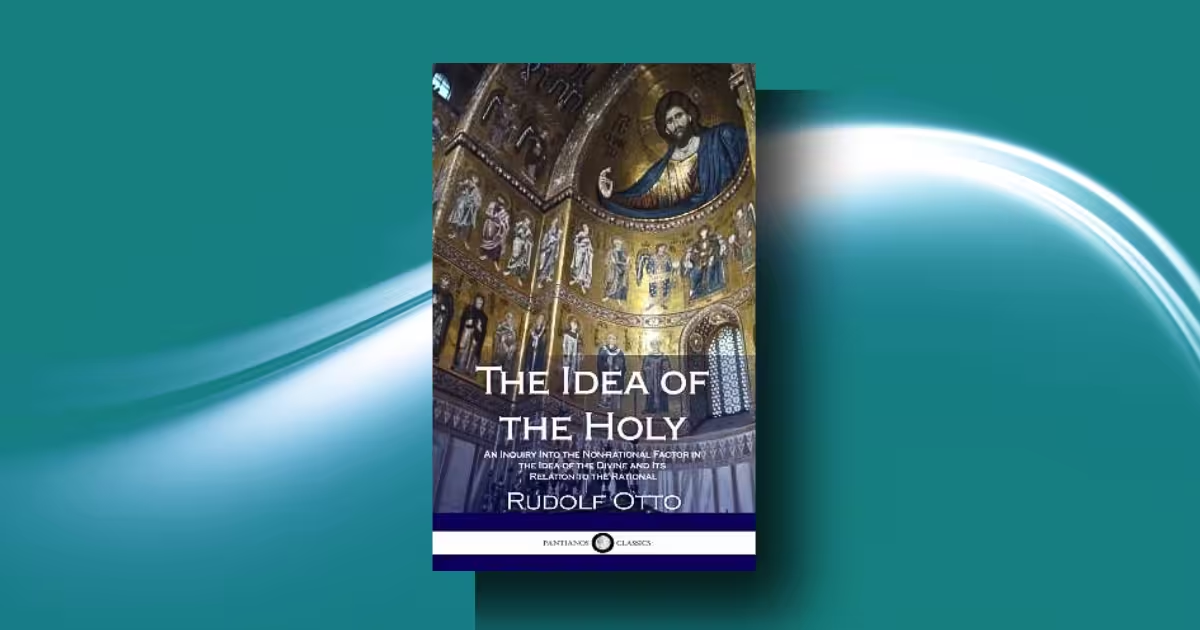
Why does a simple sunset or an ancient cathedral sometimes make your skin crawl, not with fear, but with something far stranger?
That unsettling mixture of awe, terror, and inexplicable attraction isn’t just a fleeting emotion. According to Rudolf Otto, it’s the very heartbeat of religious experience. And in his groundbreaking 1917 work, The Idea of the Holy, he gives this feeling a name: the numinous.
Overview
The Idea of the Holy (German: Das Heilige) is a landmark in the philosophy of religion. Rudolf Otto argues that the essence of religion isn’t found in ethics, doctrines, or arguments for God’s existence.
It’s found in a unique, non-rational experience he calls the “numinous”, a profound sense of awe and fascination before a “wholly other” reality.
This experience, which he breaks down into mysterium tremendum et fascinans (awe-inspiring and fascinating mystery), is the core of all genuine religion. Otto shows how this raw feeling gets “rationalized” and “moralized” over time, shaping our concepts of God, sin, and salvation.
Reader recommendation of The Idea of the Holy
The Idea of the Holy is recommended for:
- Students of theology, philosophy, or religious studies
- Anyone who has ever felt “something more” in a moment of profound silence or beauty
- Readers interested in the psychology and phenomenology of religious experience
- Those who find traditional apologetics unsatisfying and want a deeper, experiential basis for faith
The Idea of the Holy is not recommended to:
- Readers looking for a quick, casual read (this book demands focus and reflection)
- Those who reject any non-rational or emotional basis for truth
- Anyone seeking a purely historical or sociological account of religion
Table of Contents
1. Introduction
Book Title: The Idea of the Holy: An Inquiry into the Non-Rational Factor in the Idea of the Divine and Its Relation to the Rational
Author: Rudolf Otto
Original German Title: Das Heilige. Über das Irrationale in der Idee des Göttlichen und sein Verhältnis zum Rationalen
First Published (German): 1917
First English Translation: 1923
Author’s Lifespan: September 25, 1869 – March 6, 1937
Rudolf Otto was a German Lutheran theologian and philosopher of religion. He studied at the universities of Erlangen and Göttingen and held academic posts at Göttingen, Breslau, and finally Marburg in 1917. Otto wasn’t just an armchair theologian; he was deeply engaged with the world’s religions, translating Hindu texts and writing comparisons of Christian and Indian religions. He was also a proponent of meshing science and religion together. This breadth of knowledge and experience gives The Idea of the Holy its unique authority.
Context of The Idea of the Holy
The Idea of the Holy emerged in a specific historical and intellectual context. Post-World War I Europe was disillusioned. Traditional, rationalistic theology seemed inadequate to address the profound suffering and meaninglessness of the era.
Otto’s work, which emphasized a direct, non-rational experience of the divine, resonated deeply. It fit the needs of thoughtful, religious Christians who were searching for something more authentic than dry dogma.
The book is a work of philosophy and phenomenology of religion. It’s not a work of theology in the traditional sense, nor is it a history of religion. Instead, it’s an inquiry into the nature of religious experience itself.
Otto’s central concern is to identify and analyze the unique, irreducible element that makes an experience religious as opposed to merely moral, aesthetic, or emotional.
Purpose of The Idea of the Holy
Otto’s central thesis is that the “holy” or “sacred” is a complex category that contains both rational and non-rational elements. The rational elements are those attributes of God we can grasp conceptually: Spirit, Reason, Purpose, Good Will, Supreme Power, Unity, Selfhood.
But Otto argues that the essence of the holy is not exhausted by these rational concepts. There is a “non-rational” or “supra-rational” core, which he calls the numinous.
He writes:
“Holiness’, ‘the holy’, is a category of interpretation and valuation peculiar to the sphere of religion… it contains a quite specific element or ‘moment’ which sets it apart from ‘the Rational’… and which remains inexpressible… in the sense that it completely eludes apprehension in terms of concepts.”
Otto’s purpose is to “suggest this unnamed Something to the reader as far as we may, so that he may himself feel it”.
He’s not trying to define the numinous in a way that can be intellectually mastered; he’s trying to evoke it in the reader’s own experience. As he says, “our X cannot, strictly speaking, be taught, it can only be evoked, awakened in the mind”.
2. Background
To understand The Idea of the Holy, it’s helpful to know who Otto was responding to. In the 19th century, thinkers like Friedrich Schleiermacher had already emphasized the importance of feeling in religion. Schleiermacher famously described religion as a “feeling of absolute dependence”. Otto respects this insight but finds it insufficient.
He argues that the “feeling of dependence” is too general; it could apply to a child’s dependence on its parents or a citizen’s dependence on the state. What makes religious dependence religious is its specific qualitative character, the sense of being in the presence of a “wholly other” reality that is both terrifying and fascinating.
Otto was also reacting against the rationalism of much 19th-century theology, which tended to reduce religion to ethics or to a set of intellectually defensible propositions. He wanted to recover the raw, emotional, and mysterious core of religious experience that he felt had been lost.
3. The Idea of the Holy Summary
The Numinous: The Heart of the Holy
Otto’s central contribution is his coinage of the term “numinous” from the Latin numen (divine power). He explains:
“I shall speak then of a unique ‘numinous’ category of value and of a definitely ‘numinous’ state of mind, which is always found wherever the category is applied. This mental state is perfectly sui generis and irreducible to any other.”
The numinous is “the holy” minus its moral and rational aspects. It’s the raw, unadulterated feeling of being in the presence of something “wholly other” (German: das ganz Andere).
The Elements of the Numinous: Mysterium Tremendum et Fascinans
Otto breaks down the numinous experience into three key elements, captured in the famous Latin phrase mysterium tremendum et fascinans.
1. Tremendum (Awefulness)
This is the daunting, terrifying aspect of the numinous. It’s not ordinary fear; it’s a unique kind of dread, a “creature-feeling” of abasement and nothingness in the face of overwhelming power.
Otto illustrates this with the story of Abraham:
“When Abraham ventures to plead with God for the men of Sodom, he says (Genesis xviii. 27): ‘Behold now, I have taken upon me to speak unto the Lord, which am but dust and ashes.’ There you have a self-confessed ‘feeling of dependence,’ which is yet at the same time far more than, and something other than, merely a feeling of dependence.”
He calls this “creature-consciousness” or “creature-feeling”—the emotion of a creature “abased and overwhelmed by its own nothingness in contrast to that which is supreme above all creatures”.
The tremendum has three sub-aspects:
- Awefulness: The sense of unapproachable majesty and wrath. Otto notes that the “Wrath of God” in the Bible is not simply moral anger but a numinous quality, “like a hidden force of nature”.
- Overpoweringness (majestas): The experience of absolute power before which the self feels utterly insignificant. This is the source of the “creature-feeling”.
- Energy or Urgency: The numinous is not passive; it’s a dynamic, compelling force. Otto sees this in the “living God” of the Bible, in contrast to the static God of philosophers.
2. Mysterium (Mysteriousness)
This is the “wholly other” aspect of the numinous—that which is completely beyond our understanding and familiar categories.
Otto writes:
“Taken in the religious sense, that which is ‘mysterious’ is—to give it perhaps the most striking expression—the ‘wholly other’ (Θάτερον, anyad, alienum), that which is quite beyond the sphere of the usual, the intelligible, and the familiar, which therefore falls quite outside the limits of the ‘canny,’ and is contrasted with it, filling the mind with blank wonder and astonishment.”
This is not just something we don’t yet understand; it’s something that is in principle incomprehensible. It evokes “stupor”—a blank, dumbfounded wonder.
3. Fascinans (Fascination)
This is the most surprising element. The numinous is not only terrifying and mysterious; it’s also intensely attractive and alluring.
“The daemonic-divine object may appear to the mind an object of horror and dread, but at the same time it is no less something that allures with a potent charm, and the creature, who trembles before it, utterly cowed and cast down, has always at the same time the impulse to turn to it, nay even to make it somehow his own.”
This is the element of “grace,” “mercy,” and “beatitude” in religious experience. It’s the bliss that “passes understanding,” the peace that the world cannot give.
Creature-Feeling and Sin
Otto distinguishes between the “creature-feeling” (a sense of nothingness before majesty) and the feeling of sin (a sense of moral unworthiness). The former is the raw, non-moral reaction to the numinous. The latter arises when this numinous disvalue becomes “schematized” or interpreted in moral terms.
“Mere ‘unlawfulness’ only becomes ‘sin,’ ‘impiety,’ ‘sacrilege,’ when the character of numinous unworthiness or disvalue goes on to be transferred to and centred in moral delinquency.”
This is why, Otto argues, mere morality cannot understand sin. Sin is not just a moral failing; it’s a numinous pollution, a profaneness before the holy. This, in turn, creates the need for atonement and redemption—not just moral improvement, but a cleansing from this numinous impurity.
Schematization
Otto uses the term “schematization” to describe the process by which the raw, non-rational numinous experience gets interpreted and filled with rational and moral meaning.
“The non-rational numinous fact, schematized by the rational concepts… yields us the complex category of ‘holy’ itself, richly charged and complete and in its fullest meaning.”
For example:
- The tremendum (awefulness) is schematized by concepts of justice and moral will, becoming the “wrath of God.”
- The fascinans (fascination) is schematized by concepts of goodness, mercy, and love, becoming “grace.”
- The mysterium (mysteriousness) is schematized by the absoluteness of God’s attributes.
This schematization is not a distortion; it’s a necessary development. Without it, religion would remain a crude, inarticulate feeling. But without the numinous core, religion would become mere rationalism or moralism.
The Numinous in the Bible and Luther
Otto traces the numinous through the Old and New Testaments. He sees it powerfully in the “wrath” and “jealousy” of Yahweh, in the “creature-feeling” of Job, and in the overwhelming mystery of the divine presence.
In the New Testament, he finds the numinous in the “kingdom of God” as a “wholly other” reality, in the awe and fear of the disciples, and in the agony of Gethsemane. He argues that Jesus’ teaching about the Fatherhood of God does not diminish this numinous awe but rather intensifies it, presenting the paradox of the “Holy One” who is also a “heavenly Father”.
In Luther, Otto finds a powerful expression of the numinous in the doctrine of predestination, the “hidden God” (Deus absconditus), and the “tremenda majestas” (awe-inspiring majesty). Luther’s faith, Otto argues, is not a calm, rational assent but a desperate clinging to grace in the face of the terrifying mystery of God.
Divination
Otto introduces the concept of “divination” to explain how we recognize the holy when we encounter it. Divination is not logical proof or inference; it’s a kind of spiritual intuition or “surmise” (German: Ahndung).
He writes:
“Let us call the faculty, of whatever sort it may be, of genuinely cognizing and recognizing the holy in its appearances, the faculty of divination.”
This faculty, Otto argues, is an a priori capacity of the human spirit. It’s not something we learn; it’s something we have innately, a predisposition to recognize and respond to the numinous. This is why, for example, a person can hear the Gospel and immediately feel its truth, not because they’ve been convinced by arguments, but because the Spirit within them bears witness to the Spirit in the message.
4. The Idea of the Holy Analysis
Reading The Idea of the Holy is like having a blindfold removed. For years, I had felt something in religious experience that I couldn’t quite articulate—a sense of awe and terror that didn’t fit neatly into categories of “love” or “morality.”
Otto gave me the language for that experience. He showed me that my feelings weren’t just “irrational” or “emotional”; they were pointing to something real, something fundamental about the nature of the divine.
Otto is a master of phenomenological description. He doesn’t just tell you what the numinous is; he evokes it, drawing on literature, scripture, and personal experience to make you feel it for yourself.
His writing is dense and sometimes difficult, but it’s also deeply poetic. You can sense his own profound religious conviction on every page.
Evaluation of The Idea of the Holy
Otto effectively supports his arguments with a wealth of evidence from religious history, scripture, and personal testimony.
He draws on examples from the Old and New Testaments, from Luther, from mystics like Meister Eckhart and Jakob Böhme, and from non-Christian religions like Hinduism and Buddhism. He shows that the numinous is a universal human experience, albeit one that finds its highest expression in Christianity.
The book fulfills its stated purpose: to inquire into the non-rational factor in the idea of the divine and its relation to the rational. Otto successfully demonstrates that the holy is a complex category that cannot be reduced to ethics or reason alone.
He provides a powerful framework for understanding religious experience that has influenced generations of theologians and scholars of religion.
However, the book is not without its critics. Some have accused Otto of psychological reductionism—of reducing God to a human feeling. Others have argued that his emphasis on the non-rational opens the door to irrationalism and fanaticism.
There’s also a concern that his concept of the “wholly other” can be used to justify a kind of religious exclusivism, where one’s own experience of the numinous is seen as the only valid one.
5. Strengths and Weaknesses
Strengths
Original and Influential Concept: The term “numinous” and the analysis of mysterium tremendum et fascinans are Otto’s lasting contributions to the study of religion. They have become foundational concepts in the phenomenology of religion.
Deep Phenomenological Insight: Otto provides a remarkably accurate and evocative description of religious experience. He captures the unique quality of awe, terror, and fascination that many people have felt but struggled to put into words.
Bridging Rational and Non-Rational: Otto avoids the extremes of both pure rationalism and pure emotionalism. He shows that both elements are essential to a complete understanding of the holy. This makes his work more nuanced and convincing than many one-sided accounts.
Interdisciplinary Approach: Otto draws on theology, philosophy, psychology, and comparative religion. This gives his work a breadth and depth that is rare in the field.
Weaknesses
Dense and Difficult Prose: The book is not an easy read. Otto’s writing can be abstract and convoluted. He coins many new terms and expects the reader to follow his complex train of thought. This makes it inaccessible to casual readers.
Potential for Subjectivity: Otto’s method relies heavily on introspection and personal experience. This raises questions about the objectivity of his claims. How can we be sure that his description of the numinous is accurate for everyone?
Lack of Empirical Grounding: Otto doesn’t provide much empirical evidence for his claims. He relies on philosophical argument and phenomenological description rather than on psychological or sociological data. This makes his work vulnerable to criticism from a more empirically minded perspective.
Possible Bias: As a Christian theologian, Otto may have been biased toward interpreting the numinous experience in a Christian framework. His claim that Christianity represents the highest expression of the numinous could be seen as a form of religious chauvinism.
The Problem of “Wholly Other”: The concept of the “wholly other” can be problematic. If God is completely other, how can we have any knowledge of him? Otto tries to address this by arguing that we can have a “feeling” of the numinous, but this raises questions about the reliability of such feelings.
6. Comparison with Similar Works
The Idea of the Holy stands alongside other classic works in the philosophy and phenomenology of religion:
Friedrich Schleiermacher, On Religion: Speeches to its Cultured Despisers (1799): Schleiermacher also emphasized feeling as the basis of religion, but Otto argued that Schleiermacher’s “feeling of absolute dependence” was too generic and missed the specific qualitative character of the numinous.
William James, The Varieties of Religious Experience (1902): James, like Otto, was interested in the raw data of religious experience. He collected numerous firsthand accounts of conversion, mysticism, and other religious phenomena.
However, James was more of a psychologist and pragmatist, while Otto was more of a philosopher and theologian. Otto’s work is more systematic and theoretical.
Mircea Eliade, The Sacred and the Profane (1957): Eliade, a later phenomenologist of religion, built on Otto’s work. He explored the ways in which the sacred manifests itself in myths, symbols, and rituals.
Eliade’s concept of hierophany (the manifestation of the sacred) is similar to Otto’s concept of the numinous, but Eliade placed more emphasis on the social and cultural dimensions of religion.
7. Conclusion
The Idea of the Holy is not a book you read; it’s a book you wrestle with. Otto challenges you to look beyond the surface of religious belief and practice, to delve into the raw, unmediated experience that lies at the heart of all religion.
He gives you a language for that experience, a way to understand the awe, the terror, and the fascination that you may have felt but never fully grasped.
This book is essential reading for anyone who wants to understand religion on its own terms—not as a set of doctrines to be believed or a set of rituals to be performed, but as a profound and transformative encounter with the “wholly other.”
Otto’s work is a reminder that the holy is not just an idea; it’s a reality that can be felt, and in that feeling, we touch something beyond ourselves.
“Awe is the best of man: howe’er the world’s Misprizing of the feeling would prevent us, Deeply we feel, once gripped, the weird Portentous.” , Goethe, Faust (as cited by Otto)







