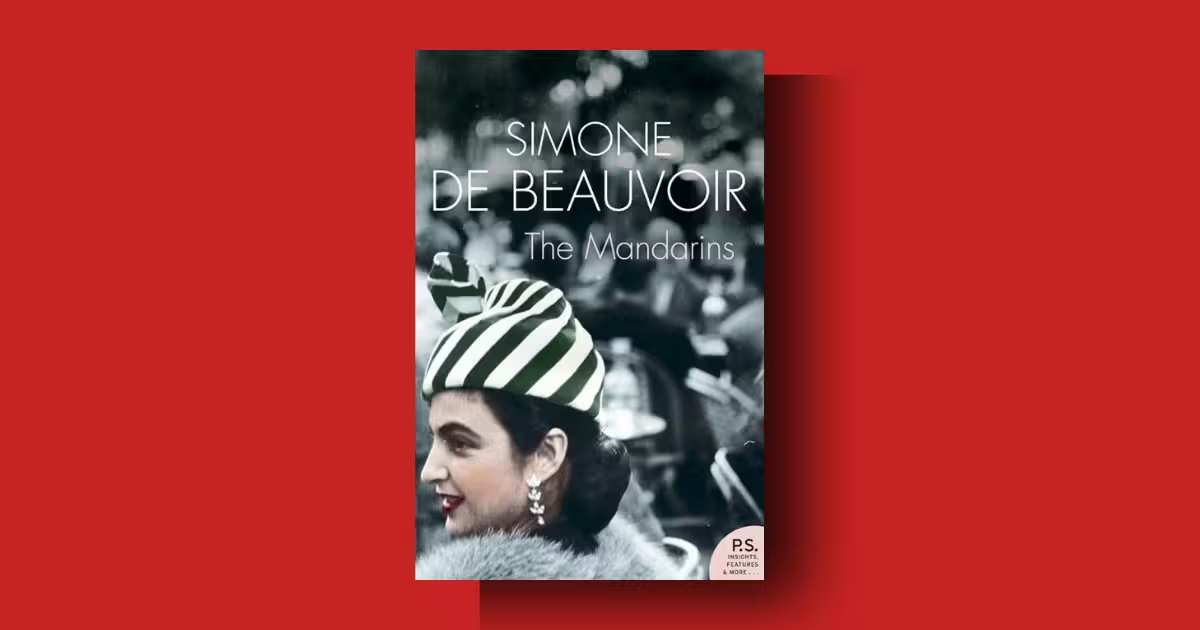
Did you ever question why modern political exhaustion feels so intensely personal? As a reader who regularly navigates the endless ideological debates of our current era, I found a perfect mirror to our collective fatigue in The Mandarins, a novel published decades ago, that captures exactly what happens when the fight for justice meets the reality of human flaw.
Overview
Simone de Beauvoir’s The Mandarins follows a tight-knit circle of French leftist intellectuals in post-WWII Paris as they transition from wartime resistance to the harsh political realities of liberation.
Centered on newspaper editor Henri Perron, philosopher Robert Dubreuilh, and psychoanalyst Anne Dubreuilh, the novel examines the collapse of political idealism as the group fractures over Cold War polarization, Soviet labor camps, and journalistic integrity.
Alongside their ideological struggles, the characters face severe personal crises, including failing marriages, doomed love affairs, and existential despair, ultimately forcing them to reconcile their high-minded ideals with human compromise and the choice to keep living.
The Mandarins is best for readers who love character-driven political dramas, existential philosophy, and messy, real-life relationships. But not for those who want an action-packed thriller or prefer to keep their politics and romance cleanly separated.
Table of Contents
1. Introduction
- Title: The Mandarins
- Author: Simone de Beauvoir
- Publication Details: Published originally in French in 1954, winning the prestigious Prix Goncourt. Leonard M. Friedman provided the English translation in 1956.
2. Background
The novel takes place in Paris immediately following the liberation in 1944. Leftist intellectuals in France were attempting to define their societal role in a post-World War II landscape. The term “mandarins” refers to the educated intellectual class trying to influence the masses, mirroring the scholars of imperial China.
3. The Mandarins Summary
The Christmas of Liberation
The Mandarins opens on a freezing Christmas night in 1944, right after the liberation of Paris. Henri Perron, the editor of the underground resistance newspaper L’Espoir, walks through the streets and looks up at a clear, black crystal dome overhead.
The German collapse has finally begun, and Henri is filled with a joyous realization that he will finally be able to leave France and travel to Portugal.
For four years, he has functioned like a machine for the resistance, and now he desperately wants to be a man again and write a light novel. When he arrives at the apartment of Paula, his partner of ten years, he is met with her suffocating devotion.
Paula is terrified of the future and admits she asked the concierge to clear out a tiny room in the back of the cellar as a hiding place, fully expecting the Germans to return and shoot him. She wears a violet dress, trying desperately to cling to their past when he called her the most beautiful of all women in the mirrored halls of the Musee Grevin.
The party begins as Robert and Anne Dubreuilh arrive. Robert immediately tries to pull Henri into a new political faction called the SRL, aiming to unite the non-communist left. Henri resists this pressure, stating that politics is not exactly his meat and that he refuses to let his newspaper become regimented by any predetermined program.
Soon, other friends from the resistance arrive, including Lambert, Vincent, Sezenac, and Chancel. They arrive singing cheerful songs about the enemy being on the run, and Lambert and Vincent jokingly duel with empty bottles. They drink American bourbon brought by the cynical intellectual Scriassine, who warns Henri that Robert’s political maneuverings are playing right into the hands of the communists.
Amidst the drinking and dancing, Henri converses with Nadine, the Dubreuilhs’ eighteen year old daughter. She is deeply cynical, complaining that she is just another butter ration and begging Henri to take her to Portugal with him. Henri politely declines, wishing only for his own freedom.
Later that night, Henri makes love to Paula in her red living room, feeling completely detached and horrified by her frantic devotion, realizing he no longer loves her.
The Ghosts of the Resistance
As the Christmas party continues, the narrative shifts to the internal monologue of Anne Dubreuilh. Anne is a psychoanalyst who struggles to sleep, haunted by the ever-present fear of death. She reflects on her strict Catholic upbringing and how, as a child, she imagined a white robe and two shimmering wings waiting for her in heaven.
When she lost her faith at the age of fifteen, she realized she was condemned to death, feeling like a mermaid who had renounced her immortal soul and turned to mere white foam on a deserted beach.
At the party, Anne looks at the survivors of the resistance and questions her purpose. She thinks of Sezenac, who used to strut down the boulevards of Paris with a rifle slung over his shoulder. She considers Chancel, who was condemned to death and exchanged for a German prisoner at the last moment. She remembers Vincent, who killed a dozen Nazi militiamen with his own hands.
Anne wonders how she can possibly help them as an analyst, noting that she quiets fears, harnesses dreams, and restrains desires to make people adjust themselves, but she no longer sees anything around her that makes sense. Her thoughts are heavily occupied by the memory of Diego, a young Spanish Jew who was deeply in love with her daughter Nadine.
Diego was full of life and preferred spending time with the Dubreuilhs rather than his wealthy father and his father’s opulent blonde mistress. Anne fondly remembers a day they spent at an amusement park, riding the roller coaster and devouring steaks, fried potatoes, and oysters with jam smeared on their faces.
Tragically, the Gestapo arrested Diego and his father.
A German named Felix promised to help them escape, and Anne and Nadine even spotted Diego through binoculars at the Drancy internment camp, where his woolly hair had been shaved off. Eventually, Felix coldly informed them that the prisoners had been killed a long time ago.
Anne watches her daughter Nadine laugh at the party, covering her immense grief, and Anne realizes that all the survivors are carrying the unbearable weight of those who were swallowed up in emptiness.
The Political Awakening and Schism
The narrative then moves forward into the subsequent years, charting the painful dissolution of the unity forged during the war. Robert Dubreuilh remains fiercely committed to his political movement, firmly believing that the political left must unify to have any real power in a post-war Europe dominated by the growing Cold War.
He advocates for a strategic alliance with the French Communist Party. Henri Perron, however, becomes increasingly skeptical of this approach. His primary concern is maintaining the independence and moral integrity of his newspaper. The ideological tension between the two friends reaches a boiling point over the issue of Soviet labor camps.
Reports begin to surface detailing the horrific reality of the gulags under Joseph Stalin. Scriassine, who had warned Henri at the Christmas party about the dangers of aligning with the communists, urges Henri to publish these findings. Robert vehemently opposes publication, arguing that exposing the Soviet Union will only serve to strengthen the capitalist right-wing and demoralize the French working class. Henri faces a brutal ethical dilemma.
He argues that remaining silent makes them complicit in atrocities. Robert counters that politics requires dirty hands and that idealism is a luxury they cannot afford.
Henri refuses to accept that lying to his readers is justified for the greater good. He ultimately decides that journalistic truth must supersede political strategy and publishes the reports. This decision causes a massive public uproar.
The communists fiercely attack Henri, branding him a traitor to the working class. By publishing the truth, his paper loses its communist readership and faces severe financial difficulties. Henri is left politically isolated, realizing that his wartime dreams of a pure, unified left were painfully naive. The political fallout completely shatters his deep friendship with Robert, illustrating the devastating personal cost of ideological divides.
Love and the American Escape
As the political landscape fractures, the characters’ personal lives also unravel. Henri finally breaks up with Paula, whose mental state deteriorates rapidly. Unable to accept that Henri no longer loves her, she develops severe delusions.
She spends her days interpreting imaginary secret codes in his newspaper articles, convinced he is still secretly communicating his love to her. Anne is forced to intervene, helping to place Paula in psychiatric care to treat her overwhelming paranoia.
Meanwhile, Anne experiences her own profound personal crisis. Feeling alienated from the hyper intellectual environment of Paris and emotionally distanced from her stable but passionless marriage to Robert, she travels to the United States. In Chicago, she meets Lewis Brogan, an American writer.
They embark on an intensely passionate and physical love affair that completely consumes her. For the first time in years, Anne feels alive, shedding the heavy responsibilities of her Parisian life. However, their relationship is fundamentally doomed by their differing circumstances. Lewis is rooted in his American life and writing, while Anne cannot bring herself to permanently abandon Robert and Nadine in France. The affair ends in a heartbreaking separation. Back in Paris, Henri finds comfort in an unexpected place.
He begins an affair with Nadine, who has grown into a sharp-tongued, pragmatic young woman. Unlike Paula’s suffocating devotion, Nadine offers Henri a completely unsentimental partnership. Unfortunately, Henri’s newspaper continues to hemorrhage money due to his political independence. Desperate to save his publication, Henri makes the ultimate moral compromise.
He agrees to testify in court on behalf of a former Vichy collaborator in exchange for financial backing. He lies under oath, completely betraying the ethical standards he held so highly during the war. This act of perjury haunts him, cementing his realization that the pure heroism of the resistance is dead.
The Final Compromise and the Choice to Live
The novel reaches its climax as the characters are forced to reckon with their compromised lives. Henri and Robert eventually reconcile. Both men have been humbled by their failures.
Robert’s political movement collapses due to its inability to maintain a truly independent stance alongside the communists. Henri realizes that without Robert’s friendship, his political and personal life is hollow. They acknowledge that the world is far more complicated than their early post-war dreams suggested, and they forgive each other. Henri completely commits to Nadine, and they marry. They have a child together, which brings a fragile but genuine sense of hope to their fractured social circle. Anne returns to Paris permanently, but she is utterly devastated by the loss of Lewis Brogan. Sinking into a deep depression, she begins to meticulously plan her own suicide.
She reflects on her life as an analyst who has been thoroughly analyzed, acknowledging her classic psychological traits, including her Oedipus complex and her ambivalent feelings toward her daughter. She sits in her apartment, completely convinced that her existence is meaningless and that death is the only logical escape from her emotional pain.
However, as she prepares to take her own life, she hears Robert and Nadine in the next room. She realizes that her suicide would permanently destroy them, passing her pain onto the people she loves most. In a powerful concluding moment, Anne chooses to live. It is not a joyous revelation, but a stoic acceptance of her responsibilities to others.
She accepts the inherent ambiguity and suffering of human existence, deciding that she must continue to participate in life, no matter how difficult it may be.
4. The Mandarins Analysis
4.1. The Mandarins Characters
Henri Perron: The editor of L’Espoir. He represents the idealist journalist forced to confront the muddy reality of post war politics. His journey from resistance hero to a man willing to commit perjury highlights the death of moral absolutism.
Robert Dubreuilh: An older, highly pragmatic philosopher. He believes in sweeping political movements and the necessity of aligning with communists to achieve working-class goals.
Anne Dubreuilh: A psychoanalyst struggling with severe existential dread. She serves as the intellectual and emotional anchor of the novel, torn between her rational duties in Paris and her passionate desires in America.
Paula Mareuil: Henri’s former partner. She embodies the danger of living entirely through another person. Her descent into paranoia shows what happens when love is treated as a religion.
Nadine Dubreuilh: The cynical, traumatized daughter of Robert and Anne. She masks her deep grief over her murdered boyfriend Diego with abrasive behavior and casual affairs.
Lewis Brogan: The American writer who captures Anne’s heart. Based heavily on Nelson Algren, he represents the raw, unpretentious vitality of America, completely detached from the suffocating intellectualism of Paris.
4.2. The Mandarins Themes and Symbolism
The Burden of Freedom: Every character struggles with the terrifying weight of their own choices. The novel constantly asks how individuals can create meaning in a universe that offers none.
Political Compromise: The story dismantles the idea of a pure political movement. Henri and Robert both learn that achieving real-world results often requires dirtying one’s hands.
Feminism and Autonomy: Through Anne and Paula, Beauvoir explores the traps women fall into when their identities are tied exclusively to men. Anne’s professional life and eventual choice to live for herself stand in sharp contrast to Paula’s psychological collapse.
5. The Mandarins Evaluation
The Mandarins is an outstanding and profoundly human masterwork that strips away the romanticism of revolution to expose the raw, beating heart of intellectual compromise.
Strengths pleasant experiences with book: The character psychology is remarkably vivid. I loved how the philosophical debates naturally flowed from the characters’ daily lives rather than feeling like academic lectures.
Weaknesses, negative experiences with book: The pacing drags significantly during the prolonged political arguments in the middle chapters. Some readers might find the sheer volume of ideological debate exhausting.
Impact controversy: The book resonated deeply with my own feelings of modern political fatigue. At the time of its release, its thinly veiled depictions of real figures like Jean Paul Sartre and Albert Camus caused quite a stir in French literary circles.
Comparison with similar Works: It shares a lot of DNA with Doris Lessing’s The Golden Notebook, as both novels tackle the fragmentation of left-wing politics and female identity.
6. Personal Observation with Contemporary Educational Relevance
The most striking theme in this novel is the absolute exhaustion of the activist class. Reading about Henri and Robert’s endless debates over the Soviet Union feels identical to scrolling through our current social media feeds. The specific ideologies have shifted, but the human cost of polarization remains exactly the same. According to a 2023 Pew Research Center study, roughly 65 percent of Americans report feeling always or often exhausted when thinking about politics.
This novel perfectly predicted that exact phenomenon decades ago. We are all living through a period of intense ideological schism, and Beauvoir provides a necessary roadmap for navigating it.
Here are five key lessons from the novel that apply to our modern world:
- Political purity is a dangerous illusion that eventually isolates you from the very people you want to help.
- Personal relationships frequently suffer the most under the crushing weight of strict ideological commitments.
- Endlessly debating a problem in an echo chamber does not bring you any closer to solving it.
- Activist burnout is a historical constant, not a unique feature of the twenty first century.
- Compromise, while often painful, is sometimes the only authentic path forward in a fractured society.
7. The Mandarins Quotes
“I’ll be dead for others and yet I’ll never have known death.”
“The earth splits open under our feet, and above our heads there is an infinite abyss.”
“I quiet fears, harness dreams, restrain desires; I make them adjust themselves. But to what? I can no longer see anything around me that makes sense.”
“Because, if there weren’t, what good were victories?”
“If someone asks who I am, I can always show him my case history; to become an analyst, I had to be analyzed.”
8. Conclusion
Simone de Beauvoir captures the precise moment when the euphoria of victory fades into the complicated reality of governing. I thought the book did a great job capturing how messy our brains really are.
I highly recommend this novel to fans of historical fiction, philosophy students, and anyone who feels overwhelmed by the current political climate.
This book matters because it refuses to offer easy answers. It forces us to confront our own hypocrisies and demands that we keep living and trying, even when the world makes absolutely no sense.