
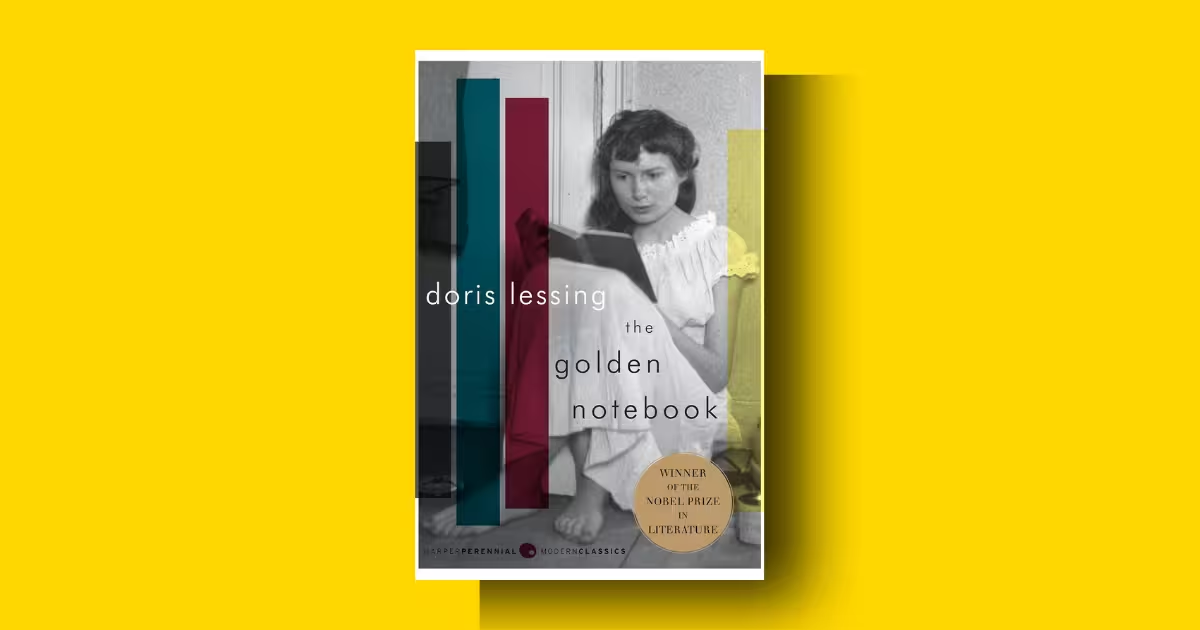

Did you ever feel like your life is split into compartments, the professional self, the political self, the lover, the mother, the writer, and none of these pieces quite fit together? That’s exactly the question Doris Lessing’s The Golden Notebook forces you to confront.
I decided to read this book because I kept hearing about it everywhere, on literary podcasts, in university syllabi, from friends who said it “changed their lives.”
And after reading it, I understood why. This isn’t just a novel; it’s a psychological autopsy of what it means to be a woman trying to live freely in a world that doesn’t quite know what to do with you.
Table of Contents
Overview
The Golden Notebook tells the story of Anna Wulf, a writer living in 1950s London, who keeps four notebooks to separate the different aspects of her life: her experiences in Africa, her political involvement, her emotional and creative life, and a daily diary.
The fifth notebook, the golden one, represents her attempt to integrate these fragmented selves.
Through Anna’s relationships with her friend Molly, her lover Michael, and her complex interactions with men, politics, and her own creative block, Lessing explores themes of female identity, communism’s disillusionment, mental breakdown, and the search for authentic selfhood.
The novel’s experimental structure mirrors the fragmentation it describes.
Reader recommendations for The Golden Notebook
The Golden Notebook is a great read for readers who appreciate literary experimentation, feminist literature, psychological depth, and novels that refuse to offer easy answers. If you’ve ever felt torn between different roles in your life, this book will speak to you directly.
The Golden Notebook is not suggested to you if you prefer plot-driven narratives, linear storytelling, or books where things “happen” in a conventional sense, this might frustrate you. The novel is dense, introspective, and at times painfully slow.
Also, if you’re looking for a straightforward “women’s liberation” manifesto with clear heroes and villains, you’ll be disappointed, Lessing’s vision is far more complex and uncomfortable than that.
Background and Historical Context
Published in 1962, The Golden Notebook arrived at a pivotal moment in Western history. The post-war consensus was crumbling. The Cold War was at its peak. The Soviet Union’s atrocities under Stalin were becoming widely known, causing profound disillusionment among Western leftists.
The feminist movement was gathering steam, though it hadn’t yet exploded into the public consciousness.
Lessing herself had been a member of the British Communist Party and left it in 1954, deeply affected by the revelations about Stalin’s crimes. She was also a divorced mother living in London, supporting herself through her writing. The novel draws heavily on her own experiences, her time in Southern Rhodesia (now Zimbabwe), her political involvement, and her struggles as a woman writer.
The book was initially met with mixed reviews.
Some critics called it a masterpiece; others dismissed it as self-indulgent or politically naive. Over time, however, it has become recognized as a landmark of twentieth-century literature, winning the 2007 Nobel Prize for Lessing and cementing her reputation as one of the most important writers of her generation.
The Golden Notebook Summary
Part One: Free Women 1
The novel opens in the summer of 1957 with Anna visiting her friend Molly in London. The two women, both in their thirties, are “free women”, divorced, independent, raising children on their own. They discuss their lives, their men, and their sense that “everything’s cracking up.”
Molly’s ex-husband Richard arrives. He’s now a wealthy businessman, and the conversation quickly turns to their son Tommy, who is twenty and aimless. Tommy enters, announcing he’s decided to turn down a job offer from his father. He’s read Anna’s notebooks, the four colored ones, and accuses her of being arrogant for keeping them private. This scene establishes the central tension: how do you live authentically when the world doesn’t reward authenticity?
Part Two: The Notebooks (Black, Red, Yellow, Blue)
The novel’s structure is unconventional. Between sections of the “Free Women” narrative, we read Anna’s four notebooks:
The Black Notebook covers Anna’s time in Central Africa during World War II. She lived there from 1939 to 1945. It records her memories of the Mashopi Hotel, where a group of young people—including Paul Blackenhurst, Jimmy McGrath, and Ted Brown, gathered during the war. Paul is an upper-class Englishman, charming and cold. Jimmy is a homosexual struggling with his identity.
Ted is a working-class idealist. Anna is there with Willi Rodde, a German refugee and communist who becomes her lover, though they have little real connection.
The group’s dynamics are complex and often cruel. Paul shoots pigeons for a pie, and the scene becomes a meditation on violence and meaninglessness. The war provides a backdrop of both excitement and horror. Anna later writes a novel based on these experiences, Frontiers of War, which becomes a bestseller, but she feels ashamed of it because she knows the “terrible lying nostalgia” that fueled it.
The Red Notebook documents Anna’s involvement with the British Communist Party. She joined in 1950. The entries describe meetings, ideological struggles, and the gradual disillusionment that leads her to leave the Party in 1954. She records the stories of comrades who are broken by the Party’s demands, and she reflects on how the Party’s dishonesty mirrors the dishonesty in her personal life.
The Yellow Notebook is a novel Anna is writing. It’s called The Shadow of the Third and tells the story of Ella, a character much like Anna herself. Ella has an affair with a married man, Paul Tanner, a psychiatrist. Their relationship lasts five years. The story explores how Ella becomes increasingly dependent on Paul, loses her creative drive, and ultimately is abandoned by him. The “third” in the title refers to the shadow of Paul’s wife, but also to the persona Ella creates to cope with her pain.
The Blue Notebook is Anna’s diary. It records her daily life, her struggles with her daughter Janet, her friendships, and her growing sense of fragmentation. She tries to keep it “objective” but finds that impossible. The diary becomes a record of her descent into what she calls an “anxiety state.”
Part Three: Free Women 2
Tommy, after reading Anna’s notebooks, attempts suicide. He shoots himself in the head. He survives but is blinded. Molly is devastated. Anna is consumed with guilt.
Tommy’s response to his blindness is remarkable—and disturbing. He becomes calm, organized, even happy. His mother and Anna watch him with a kind of horror because he seems to have found peace in his blindness that he never had when he could see.
Part Four: The Notebooks (Continued)
The notebooks continue to document Anna’s disintegration. The black notebook records her memories of Africa, including the dream-like incident with the grasshoppers and the pigeons. The red notebook contains more political disillusionment, including the story of Harry, a Trotskyist who goes to the Soviet Union expecting to be recognized as a hero and instead is treated as a nuisance.
The yellow notebook continues Ella’s story. Ella, like Anna, tries to recover from her lost love by having casual affairs. She sleeps with a Canadian script-writer, then with a man from Ceylon. Neither relationship satisfies her. She becomes increasingly bitter and isolated.
The blue notebook records Anna’s growing fear that she’s cracking up. She has nightmares about a destructive principle, a “malicious old man” who represents joy in causing pain. She meets an American, Nelson, who is sexually incapable. She becomes involved with him despite knowing it will end badly.
Part Five: Free Women 3
The narrative returns to Tommy. He has adjusted to his blindness. He’s now living in Molly’s house with Marion, Richard’s wife, who has left her husband to be with him. Their relationship is strange—Marion treats Tommy as a guru, and Tommy uses her as a kind of project. They become politically active together, attending demonstrations and getting arrested.
Anna visits them and has a strange conversation with Tommy. He tells her that he’s come to believe that “people need other people to be kind to them.” It’s a simple statement, but coming from Tommy, who previously seemed so cynical, it carries weight.
Part Six: The Notebooks (Final Sections)
The notebooks become increasingly fragmented. Anna covers her walls with newspaper clippings about war, violence, and destruction. She’s trying to make sense of a world that seems to be falling apart.
Saul Green enters the story. He’s an American writer, blacklisted in Hollywood, who rents a room in Anna’s flat. He’s in the middle of a breakdown, and his presence triggers Anna’s own descent into madness.
Part Seven: Free Women 4
Anna and Saul’s relationship becomes increasingly intense and destructive. They fight, they make love, they hate each other, they need each other. Anna becomes consumed with jealousy, reading Saul’s diaries, spying on him.
Saul tells Anna he needs to leave. He forces her to write the first sentence of a new novel: “The two women were alone in the London flat.” In return, she gives him the first sentence of his novel: “On a dry hillside in Algeria, a soldier watched the moonlight glinting on his rifle.”
Part Eight: The Golden Notebook
The golden notebook itself is a fifth notebook, a new one that Anna buys. It’s supposed to represent the integration of all the other notebooks. Saul writes in it, and Anna writes the first sentence of her new novel.
Part Nine: Free Women 5
The final section shows the resolution of the various threads. Molly gets married to a wealthy man. Tommy and Marion take over Molly’s house. Anna gets a job as a marriage counselor and plans to join the Labour Party. She’s moving toward something like conventionality.
The novel ends with Anna and Molly saying goodbye. Molly says, “It’s all very odd, isn’t it Anna?” Anna replies, “Very.” It’s a final note of uncertainty, suggesting that Anna’s integration may not be complete.
The Golden Notebook Analysis
Characters
Anna Wulf is the novel’s protagonist. She’s a writer who has published one successful novel but can’t write another. She’s a communist who has left the Party. She’s a mother who has sent her daughter to boarding school. She’s a woman who has loved and been abandoned.
Throughout the novel, she struggles to integrate these different aspects of herself. Her four notebooks represent this fragmentation. By the end, she’s trying to bring them together, but it’s not clear she succeeds.
What makes Anna compelling is her honesty. She’s not a hero. She’s sometimes petty, jealous, and self-destructive. But she’s also fiercely intelligent and committed to understanding herself. She says at one point, “I remain Anna because of a certain kind of intelligence. This intelligence is dissolving and I am very frightened.” That’s the core of her character: she’s defined by her mind, and when her mind starts to fail her, she feels like she’s losing herself.
Molly Jacobs is Anna’s best friend. She’s an actress, Jewish, and more worldly than Anna. She’s also divorced, with a son, Tommy. Molly represents a different kind of “free woman.” She’s more comfortable with her sexuality, more pragmatic, less self-torturing. But she’s also deeply unhappy. She says at one point, “What frightens me is, I never seem to be able to see anything pure in what people do.” That cynicism is her defense against pain.
Molly’s relationship with Anna is complicated. They love each other, but they also compete. Anna says, “after all, our real loyalties are always to men, and not to women.” This is one of the novel’s most unsettling insights: even the closest female friendships are shadowed by the primacy of male relationships.
Tommy is Molly’s son, and Richard’s. He’s twenty, intelligent, and deeply unhappy. He tries to kill himself because he can’t find meaning in life. His suicide attempt leaves him blind, but paradoxically, he becomes calmer and more purposeful. He says, “I’ve come to the conclusion that you’re wrong.
I think people need other people to be kind to them.” This is a statement of profound need, and profound disappointment. Tommy has been surrounded by people who love him, but he’s never felt truly seen.
Richard Portmain is Molly’s ex-husband. He’s a successful businessman who has become what he once despised: conventional, money-driven, emotionally stunted. Yet Lessing doesn’t make him a simple villain. He’s capable of insight, and he’s genuinely wounded by his failures. When Anna tells him he should have loved Marion, he seems genuinely confused. He’s a man trapped by his own limitations.
Saul Green appears late in the novel. He’s an American writer, blacklisted, mentally unstable. His relationship with Anna is both destructive and healing. He’s the only man who truly understands what she’s going through because he’s going through it too. Their relationship is based on mutual recognition: they’re both people who are “cracking up.”
He says, “We’re a team, we’re the ones who haven’t given in.” That sense of solidarity is what saves Anna, at least temporarily.
Michael is Anna’s lover. He’s a man she loved deeply, who left her. He’s never fully present in the novel; he exists mostly in Anna’s memory and in her yellow notebook, where he appears as Paul Tanner. His leaving triggers Anna’s breakdown.
She says, “I don’t think I’ve really got over Michael. I think it’s done for me.” Michael represents the possibility of love, and its impossibility.
The Golden Notebook Themes and Symbolism
Fragmentation vs. Wholeness is the novel’s central theme. Anna keeps four notebooks because she can’t hold all the parts of herself together in one place. The golden notebook represents her attempt to integrate these fragments. But the novel suggests that integration may be impossible—or at least, it may require a kind of simplification that Anna isn’t willing to accept.
Lessing writes, “I remain Anna because of a certain kind of intelligence. This intelligence is dissolving and I am very frightened.” The threat of dissolution is everywhere in the novel. Anna’s mind is her anchor, and when it starts to fail, she feels like she’s disappearing.
The Role of Women is another major theme. Anna and Molly are “free women”—they’re not dependent on men, they have careers, they raise children on their own.
But they’re not truly free. They’re still defined by their relationships with men. Anna says, “They still define us in terms of relationships with men, even the best of them.” The novel explores what it means to be a woman in a world that doesn’t quite know how to value you as a full person.
Politics and Disillusionment is a theme that runs through the red notebook. Anna and Molly were both communists. They believed in a better world. But they’ve become disillusioned. The Party lied to them, betrayed them, used them.
Anna says, “The reason why so many artists now take to politics, ‘commitment’ and so on is that they are rushing into a discipline, any discipline at all, which will save them from the poison of the word ‘artist’ used by the enemy.” Politics becomes a kind of refuge from the complexities of individual life, but it’s a false refuge.
Creativity and Writer’s Block is a theme that’s central to Anna’s character. She wrote one successful novel, but she can’t write another. She’s ashamed of the first one because she knows it came from a “poisoned” emotion: “the unhealthy, feverish illicit excitement of wartime, a lying nostalgia.” She can’t write another because she can’t find the right emotion to fuel it. Her writer’s block is a symptom of her larger inability to integrate her life.
Mental Illness is explored in the final sections of the novel. Anna’s “anxiety state” is a kind of breakdown. She loses her sense of time, she covers her walls with newspaper clippings, she’s consumed by jealousy. She says, “I’ve been inside madness.” But the novel doesn’t present madness as a simple tragedy. It’s also a kind of revelation. Anna’s breakdown forces her to confront the reality of the world—its violence, its meaninglessness, its cruelty.
She comes out of it with a new understanding of what it means to be human.
The Principle of Destruction appears in Anna’s dreams as a “malicious old man.” It represents the joy in causing pain, the pleasure in destruction. Anna says, “I dreamed the dream again, and this time it was more terrifying than anything I’ve experienced, because I felt the terror, the helplessness, in face of the uncontrolled force for destruction.”
This force is both inside Anna and outside her. It’s in the world—in war, in political betrayal, in cruelty—and it’s in her own psyche. Recognizing this force is part of her journey toward wholeness.
The Golden Notebook Evaluation
The Golden Notebook is an extraordinary novel—perhaps one of the most important books of the twentieth century. Its experimental structure, its psychological depth, and its willingness to confront uncomfortable truths make it a work of lasting significance.
Strengths
The structure is brilliant. The four notebooks allow Lessing to explore different aspects of Anna’s life without forcing them into a single narrative. The “Free Women” sections provide a frame, but they’re not the whole story. The notebooks create a sense of fragmentation that mirrors Anna’s experience.
The psychological realism is remarkable. Lessing doesn’t shy away from Anna’s flaws—her pettiness, her jealousy, her self-destructive tendencies. Anna is not always likeable, but she’s always real. The same is true of the other characters. Molly is sometimes cruel, Tommy is sometimes insufferable, Richard is sometimes pathetic. But they’re all human.
The political content is still relevant. The novel explores the disillusionment of the left in the 1950s, but the same issues—betrayal, ideological rigidity, the gap between ideals and reality, are still with us. The red notebook is a powerful document of political despair.
The exploration of female experience is groundbreaking. Lessing writes about sex, motherhood, and work in ways that were unprecedented for the time. She doesn’t romanticize women’s lives; she shows them as they are: complicated, frustrating, sometimes joyful, sometimes tragic.
Weaknesses
The novel is long and dense. Some readers may find it difficult to get through. The structure can be confusing, and the notebook sections sometimes feel repetitive.
The pacing is uneven. The “Free Women” sections are more conventional and easier to read; the notebooks are more challenging. The shift between them can be jarring.
Some characters are underdeveloped. Michael, for example, is more of a presence than a character. We know how Anna feels about him, but we don’t really know him. The same is true of some of the other men in the novel.
The ending is ambiguous. Anna’s “integration” is never fully achieved. She gets a job, she plans to join the Labour Party, she says goodbye to Molly. But the final note is uncertainty: “It’s all very odd, isn’t it Anna?” “Very.” This ambiguity is honest, but it may frustrate readers looking for a clear resolution.
Impact and Controversy
The Golden Notebook was controversial when it was published. Some critics praised it as a masterpiece; others dismissed it as self-indulgent or politically naive. The novel was also attacked by some feminists who felt it was too negative about women’s possibilities.
The controversy has faded over time, but the novel’s impact remains. It’s been translated into dozens of languages and has sold millions of copies. It’s taught in universities around the world. It’s influenced generations of writers, particularly women writers who were looking for new ways to tell their stories.
Comparison with Similar Works
The Golden Notebook is often compared to other novels about women’s lives and psychological fragmentation. Virginia Woolf’s Mrs Dalloway explores similar themes of identity and consciousness, though in a more lyrical style.
Simone de Beauvoir’s The Second Sex is a nonfiction exploration of women’s condition that influenced Lessing’s thinking. Margaret Atwood’s The Handmaid’s Tale is a more recent novel that explores women’s oppression, though in a more explicitly political way.
The novel is also part of a tradition of political fiction that includes George Orwell’s Homage to Catalonia, Arthur Koestler’s Darkness at Noon, and André Malraux’s Man’s Fate. All of these books explore the disillusionment of the left in the twentieth century.
Personal Insight with Contemporary Educational Relevance
The Golden Notebook has a particular resonance for me because it speaks to the experience of living in a fragmented world. Anna’s four notebooks—one for Africa, one for politics, one for her emotional life, one for daily life, feel like a metaphor for the way many of us live today.
We have different selves for different contexts: the work self, the family self, the social media self, the private self. And like Anna, we often feel that these selves don’t quite fit together.
Lessing’s novel suggests that this fragmentation is both a curse and a necessity. Anna can’t write a second novel because she can’t find a unified voice. But she also can’t live without the notebooks because they’re the only way she can hold herself together. The golden notebook—the attempt at integration—is both necessary and doomed to fail.
Five Lessons from The Golden Notebook
1. Honesty is the foundation of integrity. Anna’s journey is about learning to be honest with herself—about her political disillusionment, about her emotional needs, about her failures. She says, “What’s terrible is to pretend that the second-rate is first-rate.” That’s a lesson that applies to all of us.
2. Integration is a process, not a destination. Anna doesn’t achieve a perfect wholeness at the end of the novel. She’s still fragmented, still uncertain. But she’s moving toward something better. The golden notebook is a gesture toward integration, not its completion.
3. Creativity requires vulnerability. Anna can’t write because she’s afraid of exposing herself. She says, “You’re afraid of writing what you think about life, because you might find yourself in an exposed position.” That’s a fear that many writers, and many people, share.
4. Politics is not enough. Anna and Molly were both communists because they believed in a better world. But politics didn’t save them from personal unhappiness. The novel suggests that political commitment, however noble, can’t substitute for personal connection.
5. Women need to support each other. Despite their competition and their differences, Anna and Molly remain friends. They’re not always kind to each other, but they’re always there for each other. That’s the novel’s most hopeful message.
The Golden Notebook Quotes
“The point is, that as far as I can see, everything’s cracking up.”
“I remain Anna because of a certain kind of intelligence. This intelligence is dissolving and I am very frightened.”
“What’s terrible is to pretend that the second-rate is first-rate.”
“You’re afraid of writing what you think about life, because you might find yourself in an exposed position.”
“After all, our real loyalties are always to men, and not to women.”
“I’ve been inside madness.”
“People need other people to be kind to them.”
“We’re a team, we’re the ones who haven’t given in.”
Conclusion
The Golden Notebook is a demanding novel, but it’s also a deeply rewarding one. It asks difficult questions about identity, politics, creativity, and love. It doesn’t offer easy answers. But it offers something more valuable: an honest account of what it means to be a person trying to live authentically in a world that resists authenticity.
I recommend this book to anyone who’s ever felt fragmented, anyone who’s ever struggled to hold together the different pieces of their life, anyone who’s ever wondered what it means to be “free.” It’s not an easy read, but it’s an important one.