
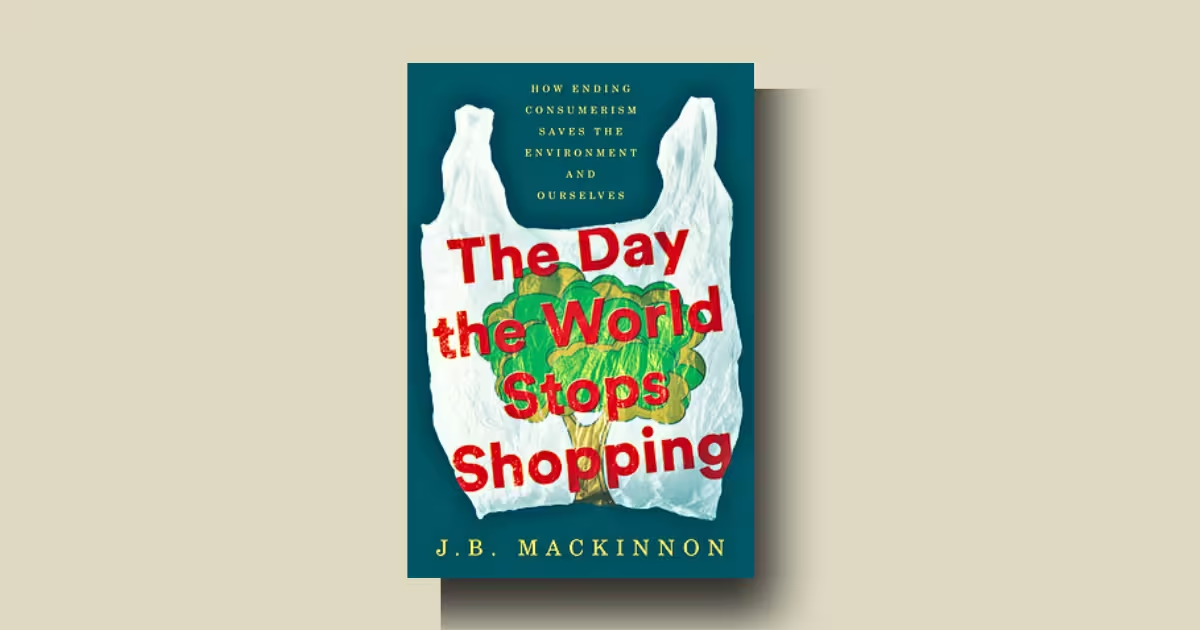
J.B. MacKinnon’s The Day the World Stops Shopping is a thought-provoking work of investigative journalism that presents a radical thought experiment: what would happen if global consumer spending suddenly dropped by 25%?
The book argues that our consumption habits have surpassed population growth as the primary driver of environmental destruction, yet our economy is built on the premise of endless growth.
Through a mix of expert interviews, historical analysis, and case studies from around the world, MacKinnon explores the immediate consequences of such a drop, the economic chaos it would trigger, and the eventual adaptation that could lead to a more sustainable and fulfilling way of life.
It is a compelling, deeply researched, and ultimately hopeful call to action that challenges us to reimagine our relationship with the things we buy.
Reader Recommendation
This book is a must-read for anyone who has ever felt overwhelmed by the sheer volume of “stuff” in their life, questioned the true cost of a “good deal,” or worried about the future of our planet.
It will particularly resonate with environmentalists, minimalists, students of economics and sociology, and anyone feeling burned out by consumer culture.
However, if you are looking for a simple, feel-good solution or are deeply committed to the idea that technology alone can save us, this book will challenge your assumptions and may leave you feeling unsettled. It is a book for those ready to “confront the consumer culture that dictates our lives” and imagine a different future.
Table of Contents
1. Introduction
The Day the World Stops Shopping: How Ending Consumerism Saves the Environment and Ourselves is a non-fiction book by the award-winning Canadian journalist and author J.B. MacKinnon.
Published in 2021 by Ecco, it is MacKinnon’s fifth book, following his bestselling work The 100-Mile Diet, which he co-authored with Alisa Smith and which helped catalyze the local food movement.
His writing has appeared in prestigious publications like The New Yorker, National Geographic, and The Atlantic, and he has won six National Magazine Awards.
Context of The Day the World Stops Shopping
The Day the World Stops Shopping sits at the intersection of environmental science, economics, and sociology. It is not a dry academic text but rather a work of narrative journalism that uses a “thought experiment” to explore a critical dilemma: our consumption is destroying the planet, yet our economy depends on it.
The book’s premise was given a real-world, albeit temporary, test during the COVID-19 pandemic when global lockdowns forced a sharp drop in consumer spending. MacKinnon uses this and other historical examples to build his argument.
Purpose of The Day the World Stops Shopping
The central thesis of the book is that we must stop shopping, but we can’t stop shopping. MacKinnon argues that the relentless pursuit of economic growth through ever-increasing consumption is pushing the planet past its limits.
The book aims to move past the paralysis of this dilemma by exploring what a world with significantly less consumption would actually look like. It is not just a warning about the consequences of our current path, but a detailed exploration of how we could adapt, survive, and even thrive in a post-consumerist society.
2. Background
To understand the significance of MacKinnon’s work, it’s helpful to consider the historical context. The idea of “consumerism” as a dominant social and economic force is relatively new. Before the Industrial Revolution, economic growth was exceedingly slow, and most people lived with far fewer possessions.
The post-World War II era saw a massive surge in household spending in wealthy nations, a period often called the “great acceleration”.
For decades, the solution to environmental problems was framed as “green growth”, the idea that we can continue to grow the economy while using technology to decouple it from environmental harm.
However, MacKinnon points out that this hasn’t worked. Despite gains in efficiency and the rise of renewable energy, we have yet to see a global decline in carbon emissions. The only times emissions have fallen have been during major economic downturns, when the world stops shopping.
This sets the stage for his central question: what if we deliberately slowed consumption?
3. The Day the World Stops Shopping Summary
MacKinnon structures his book by walking the reader through the stages of a world that stops shopping: the initial shock, the ensuing collapse, the adaptation, and the eventual transformation. Here are the key takeaways I found most compelling.
The Immediate Impact: First Days
MacKinnon’s thought experiment begins with a sudden, global 25% drop in consumer spending. This is a figure he chose as both “modest enough to be possible” and “dramatic enough to be earth-shattering”. The immediate effects would be widespread.
Industries Crumble: The book vividly describes how this would play out in the apparel industry. Paul Dillinger, VP of global product innovation at Levi Strauss & Co., explains that a week without shopping would be a “market event,” and a month would cause the industry to “fall apart”.
The shockwave would ripple from corporate headquarters in San Francisco to cotton mills in Bangladesh, affecting millions of workers.
Needs vs. Wants: In a consumer culture, our purchases are not just about utility but about expressing our identity. However, during economic downturns, people tend to cut back on similar things first.
MacKinnon points to the Great Recession as a guide: big-ticket items like RVs and boats are the first to go, followed by cars, while spending on “necessity goods” like cell phones and internet access often remains stable or even increases.
Inequality is Exposed: A 25% drop in consumption would not affect everyone equally. The book introduces the concept of the “ecological footprint” and “global hectares,” revealing that the average American consumes five times more than the planet can sustain.
A person in a rich country consumes 13 times as much as a person in a poor one. A world that stops shopping would demand deep cuts from the wealthy, while billions of people who are already under-consuming would be largely unaffected. MacKinnon points to Ecuador as a nation that has achieved a “one-planet” lifestyle while maintaining a high level of human development.
The Collapse: Economic and Social Upheaval
The book doesn’t shy away from the catastrophic consequences of stopping shopping. The global economy, built on growth, would plunge into a deep depression. Factories would close, supply chains would shatter, and millions would lose their jobs.
The End of Growth? MacKinnon argues that our obsession with GDP growth is a relatively recent phenomenon. He interviews economist Peter Victor, who uses computer models to show that a “stop shopping” scenario would lead to skyrocketing unemployment and debt.
However, Victor also demonstrates that with careful management, such as sharing work, shortening the work week, and redistributing wealth, it is possible to manage without growth.
Lessons from History: To understand what economic collapse looks like, MacKinnon turns to real-world examples. He examines the Finnish Depression of the 1990s, where a 14% drop in consumption led to breadlines and a wave of national shame.
More dramatically, he explores the collapse of the Soviet Union, where the economy shrank by a quarter over a decade. Sociologist Michael Burawoy, who was in Russia during the collapse, describes a period of “primitive disaccumulation” where people sold off their possessions just to survive.
Yet, he also notes the “strange exhilaration” of the disaster, as people turned to their dachas (country houses) to grow food, coming together to work and socialize.
The Blame Game: During economic disasters, the victims are often blamed for their own fates, while the systemic causes are overlooked. However, these crises can also relieve the status pressures associated with consumption. MacKinnon notes that during the Finnish Depression, displays of wealth became tasteless, and people felt liberated from the pressure to keep up with the Joneses.
Adaptation: A New Way of Living
The book’s most hopeful section explores how society would adapt to a permanently lower level of consumption.
A Different Kind of Time: MacKinnon makes a compelling case for the importance of “non-commercial time.” He examines the history of the Sabbath, a weekly day of rest and non-consumption, and argues that its decline has contributed to our modern “time famine.” The COVID-19 lockdowns, he notes, gave many people a taste of this slower pace of life, and a glimpse of “shinui”, a sensation of change.
The Deconsumer Identity: The book introduces the concept of “voluntary simplicity” and profiles people who have deliberately chosen to live with less for decades. These “simplifiers,” like Janet Luhrs and Deborah Caplow, report higher levels of well-being, less stress, and a greater sense of freedom.
The book draws on the work of psychologist Tim Kasser, who has spent 30 years researching materialism. Kasser’s research shows that materialistic values are bad for our mental health, leading to shallower relationships, less empathy, and lower overall well-being.
Advertising and Demarketing: In a world without shopping, advertising would be one of the first industries to collapse. The book explores the concept of “demarketing”, using marketing techniques to discourage consumption. Companies like Patagonia have pioneered this approach with campaigns like “Don’t Buy This Jacket,” which paradoxically boosted their sales by appealing to the growing “deconsumer” market.
Business for the Long Haul: MacKinnon contrasts the modern corporate obsession with endless growth with the philosophy of “henokiens”, family businesses that have survived for centuries. He profiles Toraya, a 420-year-old Japanese confectionery company, which prioritizes continuity and quality over expansion. As Mitsuharu Kurokawa, an heir to the company, puts it, they are “agrowth”, if growth happens, fine, but it’s not the goal.
A New Role: The Participant: The book argues that we need a new social identity to replace “consumer.” It highlights the “Every One Every Day” project in Barking and Dagenham, London, which aims to build a “participatory culture.”
The project creates spaces where people can learn, share, and create together, free from the pressures of the cash economy. One participant, Zoe Hallel, who suffered from agoraphobia, describes how the project transformed her life, giving her a sense of purpose and community.
Transformation: The Long View
The final section of the book looks at what a transformed world could look like decades or even centuries from now.
Saving the Whales: MacKinnon uses the plight of the North Atlantic right whale to illustrate the “sublethal” impacts of consumer culture. The noise from shipping, the chemical pollution, and the constant traffic of boats create an “acoustic hell” for these animals. During the quiet period after 9/11, researchers found that the whales had significantly lower stress hormones. The lesson is clear: when the human world retreats, the natural world advances.
Happiness and Authenticity: The book challenges the idea that more consumption leads to more happiness. It cites the Happy Planet Index, which shows that countries like Ecuador generate more happiness per unit of consumption than the US.
The author argues that the key to well-being is “congruence”, living in a way that is true to your values. For many, this means stepping off the “earn-and-spend” treadmill and finding satisfaction in simpler things.
The Digital Trap: Some might argue that we can shift our consumption to the digital realm, where it has less environmental impact. MacKinnon debunks this, noting that the digital world has a massive and growing energy and resource footprint. The internet consumes about 7% more energy annually, and the “rebound effect” means that efficiency gains often lead to more overall consumption, not less.
A World with Fewer People? The book visits Sado Island in Japan, a region that has experienced decades of population decline, a “depopulation dividend.” While the island’s economy has shrunk, its residents enjoy a high quality of life with less stress, more community, and a nature that is growing more abundant. This example suggests that a smaller, slower economy need not be a dystopia.
4. The Day the World Stops Shopping Analysis
The Day the World Stops Shopping is a masterful and deeply important piece of investigative journalism. MacKinnon’s ability to weave together personal anecdotes, rigorous research, and global case studies makes for a compelling and accessible read. He tackles a radical and often uncomfortable idea without sounding like a doomsday prophet, instead grounding his arguments in data and real-world examples.
The book’s strength lies in its refusal to offer easy answers. MacKinnon doesn’t just say “stop shopping”; he explores the terrifying economic implications and the practical steps we could take to manage them. He presents the paradox in all its complexity, acknowledging the “savage irony” that those who consume the least often suffer the most from the harms of consumption. This balanced, nuanced approach gives the book a rare and powerful credibility.
What I found most powerful was the book’s exploration of the psychological costs of consumerism. MacKinnon’s discussion of how advertising preys on our insecurities, the “ordeal of performance” driven by inequality, and the “quiet thrill” of living authentically, these are the ideas that stuck with me long after I finished the book.
5. Strengths and Weaknesses
Strengths:
Deeply Researched: The book is a treasure trove of facts and figures, all meticulously sourced. MacKinnon draws on interviews with a wide range of experts, from economists to psychologists to corporate executives.
Engaging Narrative: Despite the heavy subject matter, the book is a page-turner. MacKinnon’s use of the “thought experiment” framework, combined with vivid storytelling, makes complex ideas accessible.
Balanced and Nuanced: The book doesn’t shy away from the difficult questions. It acknowledges the chaos and suffering that a drop in consumption would cause, while still making a compelling case for why it’s necessary.
Hopeful but Realistic: MacKinnon doesn’t promise a utopia, but he offers a tangible and hopeful vision of a different future, grounded in examples of people and places already living with less.
Weaknesses (Criticism):
The “How” is Missing: As a thought experiment, the book doesn’t fully explain how we would actually make the transition from a consumer society to a deconsumer one. The author acknowledges this, stating that a world that stops shopping is “not something we will do, but something we have to make”. However, some readers may find this lack of a concrete action plan frustrating.
Generalizations: Some critics have noted that MacKinnon sometimes draws broad conclusions from specific case studies. While the examples are compelling, it’s debatable whether they can be scaled up to a global level.
Soft on Systemic Issues: The book takes an “economically/politically agnostic stance”, which some argue weakens its message. It doesn’t deeply engage with the power structures, like corporate lobbying and political donations, that actively perpetuate the consumerist system.
Pandemic Integration: The book was drafted largely before the pandemic, and while MacKinnon weaves in pandemic-related observations, some reviewers felt this integration could have been deeper.
6. Comparison with Similar Works
The Day the World Stops Shopping stands alongside other important works that challenge the foundations of modern consumer society.
Unlike The World Without Us by Alan Weisman, which imagines a world after humans disappear, MacKinnon’s book is about humans choosing to change their behavior. It’s a more active and hopeful vision.
Compared to Less is More by Jason Hickel or Doughnut Economics by Kate Raworth, MacKinnon’s book is less a work of economic theory and more of a narrative exploration. It provides the human stories and real-world examples that give these economic models life.
It shares common ground with Juliet Schor’s work on the “overspent American” and the psychology of consumerism, but MacKinnon extends the conversation to the global scale and the planetary emergency.
7. Conclusion
The Day the World Stops Shopping is not a comfortable book. It will challenge you, unsettle you, and force you to look at your own life and the world around you in a new, often harrowing light. Yet, it is also a surprisingly hopeful one.
By showing us the ruins of what we have and the possibilities of what could be, J.B. MacKinnon lights a “candlestick of hope in an otherwise gloomy future”.
The Day the World Stops Shopping is essential reading for anyone who has ever felt a nagging sense that there must be more to life than buying, working, and buying again. It is a powerful reminder that the things we own often end up owning us, and that the path to a better world might begin with a simple, radical act: choosing to live with less.







