
Did you know that the world’s richest 1 percent now own more wealth than the other 99 percent combined, while we’ve already crossed at least four planetary boundaries that keep Earth hospitable?
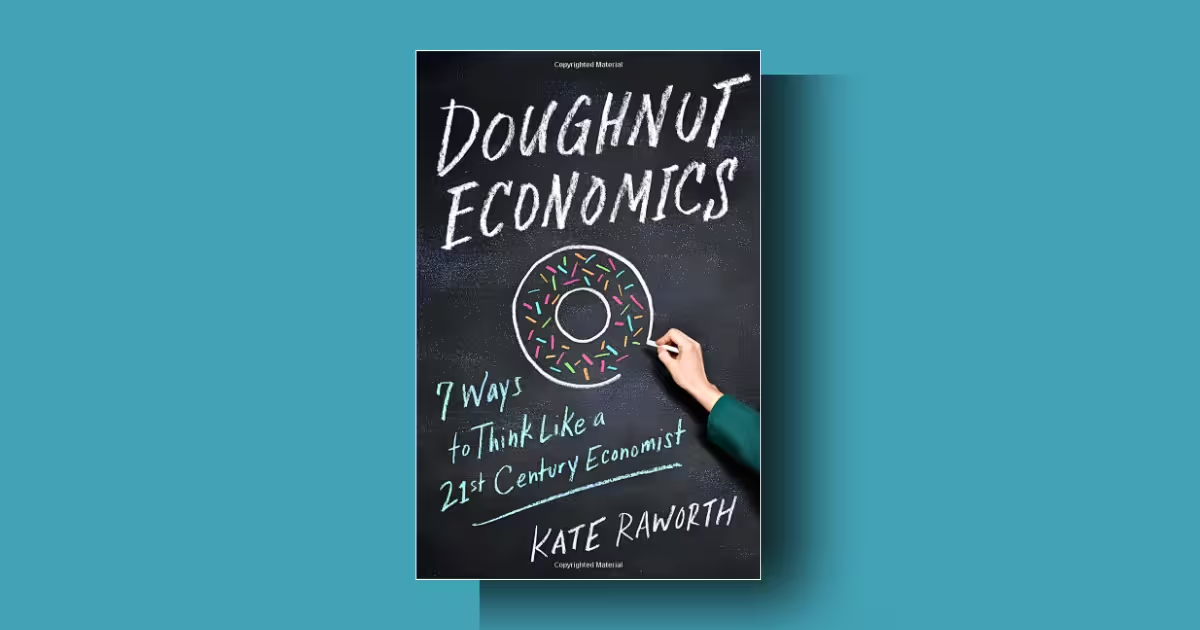
Kate Raworth’s Doughnut Economics stares straight into this uncomfortable reality and asks a question most economists have spent decades avoiding: what if we’ve been measuring the wrong thing all along?
Overview
Doughnut Economics: Seven Ways to Think Like a 21st-Century Economist is a Sunday Times bestseller that won the Transmission Prize in 2018 and was longlisted for the FT/McKinsey Business Book of the Year Award. It’s been called a Financial Times and Forbes Book of the Year.
George Monbiot went as far as calling Raworth “the John Maynard Keynes of the 21st century”.
The book’s core argument is simple but radical: for seventy years, economics has been obsessed with GDP growth as the ultimate measure of progress. That obsession has justified extreme inequalities and unprecedented destruction of the living world.
Raworth proposes replacing that single-minded pursuit with something far more ambitious: meeting the human rights of every person within the means of our life-giving planet.
She visualises this as a doughnut, a social foundation below which no one should fall and an ecological ceiling above which we shouldn’t go. The space between? That’s where humanity can actually thrive.
Who will actually love this book: Activists, policymakers, business leaders, students, and anyone who has ever felt that mainstream economics doesn’t match the world they actually see. If you’ve sat through an economics lecture and thought “this doesn’t make sense given what’s happening with climate change and inequality,” this book will feel like coming up for air.
Who might bounce off it: People looking for a traditional economics textbook with clear policy prescriptions and step-by-step implementation plans. Raworth is offering a mindset shift, not a detailed blueprint. If you need concrete answers about exactly how to transition away from GDP growth, you might find yourself wanting more.
Table of Contents
Introduction
Doughnut Economics: Seven Ways to Think Like a 21st-Century Economist
Published in 2017 by Chelsea Green Publishing (US) and Random House Business Books (UK). The author is Kate Raworth, an economist who teaches at Oxford University’s Environmental Change Institute.
Context of Doughnut Economics
Doughnut Economics is a work of economic reimagining, part critique, part manifesto, part visual guide to a different way of understanding how we produce, distribute, and consume.
Raworth draws on complexity economics, ecological economics, feminist economics, institutional economics, and behavioural economics to build her case. She’s not writing for other economists; she’s writing for anyone who wants to understand why the economy seems broken and what might actually work instead.
Raworth’s credentials matter here. She holds a first-class BA in Politics, Philosophy and Economics and an MSc in Economics for Development from Oxford. She spent years working with Oxfam, the United Nations Development Programme, and micro-entrepreneurs in Zanzibar.
She’s not an armchair critic, she’s someone who has spent decades watching how economic theory plays out in the real world, often disastrously.
Purpose of Doughnut Economics
The book’s central thesis is that twentieth-century economics, with its fixation on GDP growth, its cartoonish depiction of human nature as “rational economic man,” and its mechanical metaphors borrowed from Newtonian physics, is fundamentally unsuited to the challenges of the twenty-first century.
Raworth argues that we need to think like twenty-first-century economists: we need to change the goal from GDP to the Doughnut, see the big picture of an economy embedded in society and nature, nurture human nature rather than caricature it, get savvy with systems rather than equilibrium, design to distribute rather than wait for growth to even things up, create to regenerate rather than assume growth will clean up pollution, and become agnostic about growth rather than addicted to it.
Background
How Economics Lost Its Way
Raworth traces a fascinating intellectual history. The word “economics” comes from the Ancient Greek oikos (household) and nomos (rules or norms). Xenophon coined it to describe the art of household management. Aristotle distinguished economics from chrematistics, the art of acquiring wealth for its own sake. Somewhere along the way, that distinction got lost.
For much of the twentieth century, economics defined itself as a science of human behaviour but adopted a theory of behaviour, rational economic man, that eclipsed any real study of humans. The discussion of the economy’s goals simply disappeared from view. Into that vacuum stepped GDP growth.
Raworth shows how this happened step by step. Simon Kuznets, who invented national income accounting in the 1930s, warned from the start that “the welfare of a nation can scarcely be inferred from a measure of national income”. But economists and politicians tucked that caveat aside. By the 1960s, GDP growth had shifted from a policy option to a political necessity.
The Power of Pictures
One of the book’s most original contributions is its insistence on the power of visual framing. Raworth points out that economics has always been taught with diagrams, from the supply and demand curves to the Circular Flow diagram.
Paul Samuelson, whose 1948 textbook Economics became the best-selling textbook in America for nearly thirty years, understood this perfectly. He filled his book with diagrams, believing they gave students “a firmer grasp of many important principles”.
But those diagrams aren’t neutral. They shape what we can and cannot see. The Circular Flow diagram, for example, depicts the economy as a closed loop of income circulating between households and businesses. It makes no mention of the energy and materials on which economic activity depends, nor of the society within which those activities take place. Those omissions aren’t accidental, they’re foundational.
Doughnut Economics Summary
The Seven Ways to Think Like a 21st-Century Economist
Raworth structures the book around seven fundamental shifts in thinking. Here’s what each one means.
1. Change the Goal: From GDP to the Doughnut
The first shift is the most dramatic. Raworth argues that we’ve spent seventy years chasing the wrong goal. GDP measures the market value of goods and services produced within a nation’s borders, but it tells us nothing about whether people are actually thriving.
The Doughnut replaces GDP with a dual goal: meeting the human rights of every person within the means of our living planet. The inner ring, the social foundation, sets out twelve basics of life: sufficient food, clean water and sanitation, access to energy and education, healthcare, housing, minimum income and decent work, access to information and social support, gender equality, social equity, political voice, and peace and justice.
The outer ring, the ecological ceiling, is defined by nine planetary boundaries identified by Earth-system scientists led by Johan Rockström and Will Steffen. These include climate change (keep atmospheric CO₂ below 350 parts per million), biodiversity loss, nitrogen and phosphorus loading, land conversion, freshwater withdrawals, ocean acidification, chemical pollution, air pollution, and ozone layer depletion.
Between these two sets of boundaries lies the Doughnut itself: the safe and just space for humanity.
Raworth points out that we’re currently transgressing both sides of the Doughnut. Billions still lack life’s essentials, while we’ve already crossed at least four planetary boundaries. The concentration of CO₂ in the atmosphere now exceeds 400 parts per million, well above the 350 ppm boundary. Species extinction is occurring at least ten times faster than is deemed safe. Synthetic fertilisers are being added to soils at more than twice safe levels.
2. See the Big Picture: From Self-Contained Market to Embedded Economy
The second shift is about how we draw the economy itself. For seventy years, macroeconomics has been defined by the Circular Flow diagram: households supply labour and capital to businesses, which produce goods and services that households buy, creating a closed loop of income.
Raworth argues this picture is dangerously incomplete. It leaves out the energy and materials on which economic activity depends, the society within which those activities take place, and the living world that sustains us all.
She replaces it with the Embedded Economy diagram, which nests the economy within society and within nature. This new picture recognises four realms of provisioning: the household, the market, the commons, and the state. All four are means of production and distribution, and they work best when they work together.
The household, Raworth emphasises, is not peripheral. Feminist economists have long pointed out that mainstream economics is obsessed with waged labour while skipping right over the unpaid work that makes it all possible.
In sub-Saharan Africa and South Asia, millions of women and girls spend hours each day walking miles carrying water, food, or firewood, all for no pay. In a 2002 study of Basle, Switzerland, the estimated value of unpaid care in households exceeded the total cost of salaries in all of the city’s hospitals, daycare centres, and schools combined.
3. Nurture Human Nature: From Rational Economic Man to Social Adaptable Humans
The third shift tackles the cartoon character at the heart of mainstream economics: rational economic man, or Homo economicus. This creature is self-interested, isolated, calculating, fixed in tastes, and dominant over nature. He’s been drawn and redrawn over two centuries, starting as a portrait, becoming a caricature, and ending as a cartoon.
Raworth traces this intellectual history. Adam Smith, often cited as the father of rational economic man, actually had a much richer view of human nature.
He wrote that “How selfish soever man may be supposed, there are evidently some principles in his nature, which interest him in the fortune of others, and render their happiness necessary to him”. But Smith’s successors stripped away that complexity.
By the 1920s, Frank Knight had endowed economic man with perfect knowledge and perfect foresight, godlike traits that turned him into a cartoon.
Raworth replaces this cartoon with a new portrait based on five shifts:
From self-interested to socially reciprocating: We are conditional cooperators, we tend to cooperate so long as others do too, and we’re ready to punish defectors even if it costs us. The Ultimatum Game demonstrates this: responders typically reject unfair proposals even if it means walking away with nothing.
From fixed preferences to fluid values: Psychologist Shalom Schwartz has identified ten basic personal values recognised across cultures, self-direction, stimulation, hedonism, achievement, power, security, conformity, tradition, benevolence, and universalism. These values aren’t fixed; they shift as we move between different roles and contexts.
From isolated to interdependent: We follow social norms and are deeply influenced by what others do. A study of 14,000 teenagers found that a song’s popularity was partly determined by its quality but also significantly influenced by what others thought of it.
From calculating to approximating: Herbert Simon showed that human rationality is “bounded.” We use heuristics, mental shortcuts, to make decisions in a fast-moving and uncertain world. Gerd Gigerenzer has demonstrated that these heuristics often lead to better decisions than exact calculations.
From dominant to dependent: Rather than presiding at the pinnacle of nature’s pyramid, humanity is woven deep into nature’s web. As Aldo Leopold put it, we need to transform how we see ourselves “from conqueror of the land-community to plain member and citizen of it”.
4. Get Savvy with Systems: From Mechanical Equilibrium to Dynamic Complexity
The fourth shift is about how we understand the economy’s behaviour. Mainstream economics has been dominated by metaphors borrowed from Newtonian physics: the market as a mechanism, prices as a pendulum, equilibrium as the natural state.
Raworth argues this is the wrong kind of science. Warren Weaver, director of natural sciences at the Rockefeller Foundation, identified three kinds of problems in his 1948 article “Science and Complexity”: problems of simplicity (a falling apple), problems of disordered complexity (molecules in a gas), and problems of organised complexity (a sizeable number of variables interrelated in an organic whole). Economic questions, Weaver recognised, fall into this third category.
Systems thinking offers a better approach. At its heart are three simple concepts: stocks and flows, feedback loops, and delay. Stocks are things that can build up or run down, water in a bath, fish in the sea, money in the bank. Feedback loops come in two varieties: reinforcing loops amplify what’s happening (the more you have, the more you get), while balancing loops counter it.
Raworth applies systems thinking to three pressing problems:
Finance: Hyman Minsky’s financial-instability hypothesis shows that stability breeds instability. During good times, banks, firms, and borrowers gain confidence and take on greater risks, pushing up asset prices. This reinforces confidence until the bubble bursts. The 2008 financial crash was a classic Minsky moment.
Inequality: The “Success to the Successful” trap means that winners in one round reap rewards that raise their chances of winning again. The board game Monopoly demonstrates this perfectly, and it was originally designed as a critique of concentrated property ownership. Computer simulations like Sugarscape show that even small chance differences can rapidly amplify into vast inequalities.
Climate change: John Sterman’s “carbon bathtub” metaphor shows that CO₂ concentration in the atmosphere will only fall if new emissions flow in more slowly than CO₂ is drawn out. In 2009, annual inflows were 9 billion tons compared to outflows of just 5 billion tons.
5. Design to Distribute: From “Growth Will Even It Up Again” to Distributive by Design
The fifth shift tackles inequality head-on. For decades, the Kuznets Curve whispered a powerful message: inequality has to get worse before it can get better, and growth will eventually even it up. Simon Kuznets himself was cautious about his findings, admitting they came “perilously close to pure guesswork”. But economists and policymakers took the curve as law.
Raworth shows that the Kuznets Curve is a myth. When sufficient time-series data became available in the 1990s, the pattern turned out to be that there is no pattern. Some countries saw inequality rise then fall then rise again; others saw it fall then rise; in others it only rose or only fell. The East Asian “miracle” from the mid-1960s to 1990 combined rapid economic growth with low inequality and falling poverty rates.
Worse, inequality is damaging in multiple ways. More unequal countries tend to have more teenage pregnancy, mental illness, drug use, obesity, prisoners, school dropouts, and community breakdown.
Democracy is jeopardised when inequality concentrates power in the hands of the few. Inequality fuels status competition and conspicuous consumption, increasing ecological degradation. Economists at the IMF have found strong evidence that inequality undercuts GDP growth.
Instead of waiting for growth to reduce inequality, because it won’t, Raworth argues we need to create economies that are distributive by design. This means redistributing not just income but also wealth: who controls land, the power to create money, enterprise, technology, and knowledge.
6. Create to Regenerate: From “Growth Will Clean It Up Again” to Regenerative by Design
The sixth shift tackles environmental degradation. Just as the Kuznets Curve promised that inequality would eventually fall, the Environmental Kuznets Curve promised that pollution would eventually clean up. Grossman and Krueger’s 1995 study found that pollution first rose then fell as GDP increased.
Raworth shows this is also a myth.
First, the curve only applied to local air and water pollutants, not to global greenhouse gas emissions, biodiversity loss, soil degradation, or deforestation. Second, when a nation’s global material footprint is taken into account, adding up all the biomass, fossil fuels, metal ores, and construction minerals used worldwide to create the products it imports, the success story evaporates. From 1990 to 2007, as GDP grew in high-income countries, so did their global material footprints.
The problem is degenerative industrial design: take, make, use, lose. Extract Earth’s minerals, metals, biomass, and fossil fuels; manufacture them into products; sell them to consumers who throw them “away”. This linear system runs counter to the living world, which thrives by continually recycling life’s building blocks.
Raworth proposes regenerative design instead, based on the circular economy. Biological nutrients (soil, plants, animals) and technical nutrients (plastics, synthetics, metals) are used again and again through cycles of reuse and renewal.
Waste becomes food. This isn’t just theoretical, companies like Caterpillar have increased gross profit on re-manufactured product lines by 50 percent while cutting water and energy use by around 90 percent.
7. Be Agnostic about Growth: From Growth Addicted to Growth Agnostic
The seventh shift is the most challenging. Raworth poses a conundrum: “No country has ever ended human deprivation without a growing economy. And no country has ever ended ecological degradation with one”.
She argues that we need to become agnostic about growth, designing economies that promote human prosperity whether GDP is going up, down, or holding steady. This means breaking the financial, political, and social addictions to growth.
Financial addiction: The search for “gain” drives shareholder returns, speculative trading, and interest-bearing loans, lodging dependency on GDP growth deep within the financial system. Raworth suggests exploring demurrage, a small fee incurred for holding money so it tends to lose rather than gain in value.
Political addiction: Governments depend on GDP growth for tax revenue without raising taxes, for full employment, and for geopolitical power. Raworth suggests reframing taxes, ending tax loopholes and offshore havens, shifting taxation from income to wealth, introducing a basic income, and shortening the standard working week.
Social addiction: Consumer culture keeps us on a treadmill, continually seeking identity through what we buy. Raworth suggests banning advertising to children, banning street billboards, and finding something to aspire to beyond ever-growing income.
Doughnut Economics Analysis
Raworth has written something genuinely unusual: an economics book that’s both intellectually rigorous and visually compelling. The Doughnut diagram is the kind of simple, powerful image that sticks in your mind, and that’s the point.
As Raworth argues, “The most powerful tool in economics is not money, nor even algebra. It is a pencil. Because with a pencil you can redraw the world”.
The book’s greatest strength is its synthesis. Raworth draws on complexity economics, ecological economics, feminist economics, institutional economics, and behavioural economics, schools of thought that have often remained separated in silos. She weaves them together into a coherent vision that’s greater than the sum of its parts.
She also writes with a clarity that’s rare in economics. The book is full of concrete examples: the Ultimatum Game, the MONIAC hydraulic computer, the Sugarscape simulation, the C-ROADS climate model. These aren’t abstract thought experiments; they’re real tools that real people have used to understand real problems.
But the book has limitations. Some critics, including inequality researcher Branko Milanović, have accused Raworth of “we-ism”, assuming that everyone shares the same objectives. The book is light on the politics of transition. How do you actually move from where we are to the Doughnut? Raworth acknowledges this is a work in progress, but readers looking for concrete policy prescriptions may be frustrated.
The book also sometimes feels utopian. Raworth’s vision of regenerative and distributive economies is inspiring, but she doesn’t fully grapple with the power dynamics that would resist such a transformation. As one Goodreads reviewer put it, “The book talks about doughnut economics as a design challenge, but the invitation for this challenge might never come”.
Strengths and Weaknesses
What Works
The visual framing is brilliant. The Doughnut diagram is simple, memorable, and powerful. It gives people a way to visualise what sustainable development actually means.
The synthesis is ambitious and largely successful. Raworth brings together insights from multiple schools of economic thought that have often remained isolated.
The writing is clear and accessible. Raworth avoids jargon and explains complex ideas with concrete examples.
The critique of GDP growth is devastating. Raworth shows how we ended up chasing a metric that was never designed to measure what matters.
The seven ways framework is practical. These aren’t abstract principles; they’re concrete shifts in thinking that anyone can apply.
What Doesn’t
The politics are underdeveloped. Raworth acknowledges that power is pervasive, but she doesn’t fully grapple with how to overcome resistance to the changes she proposes.
The transition is vague. How do we actually move from where we are to the Doughnut? Raworth offers principles but not a roadmap.
The book can feel utopian. The vision is inspiring, but it sometimes seems disconnected from the political realities of the moment.
The critique of mainstream economics can feel sweeping. Raworth is right that economics has problems, but she sometimes paints with too broad a brush.
Comparison with Similar Works
Doughnut Economics sits alongside several other recent books that have challenged mainstream economic thinking:
Tim Jackson’s Prosperity without Growth (2009) makes a similar argument about the limits of GDP growth but focuses more on the psychology of consumerism and the politics of transition.
Thomas Piketty’s Capital in the Twenty-First Century (2014) provides a detailed empirical analysis of inequality but doesn’t offer the same kind of visual framework or systems thinking.
Mariana Mazzucato’s The Entrepreneurial State (2013) challenges the narrative of private sector innovation and shows the state’s crucial role, but focuses more narrowly on innovation policy.
Herman Daly’s Steady-State Economics (1977) laid the groundwork for ecological economics but is more technical and less accessible.
What sets Doughnut Economics apart is its visual framing and its synthesis of multiple schools of thought. Raworth isn’t just criticising mainstream economics; she’s offering a positive alternative that people can actually visualise.
Conclusion
Doughnut Economics is one of those rare books that can genuinely change how you see the world. Raworth doesn’t just critique mainstream economics, she offers a compelling alternative, complete with a visual framework that makes the alternative tangible.
Who should read this book: Anyone who has ever felt that the economy doesn’t work for people or the planet. Students of economics who want to understand what’s missing from their textbooks. Policymakers who are looking for a framework that goes beyond GDP.
Business leaders who want to build regenerative and distributive enterprises. Activists who need a positive vision to campaign for.
Who might not love it: People looking for detailed policy prescriptions. Those who want a traditional economics textbook. Anyone who believes that GDP growth is the only path to human flourishing.
Raworth’s central insight is that economics isn’t about discovering laws, it’s about design. We created the economy we have, and we can redesign it. The Doughnut shows us what we’re aiming for: a world where everyone’s needs are met within the means of our living planet.
That’s not a small ambition.
But as Raworth points out, we’re the first generation to understand the damage we’ve been doing to our planetary household, and probably the last generation with a chance to do something transformative about it. The question isn’t whether we can afford to rethink economics.
The question is whether we can afford not to.







