
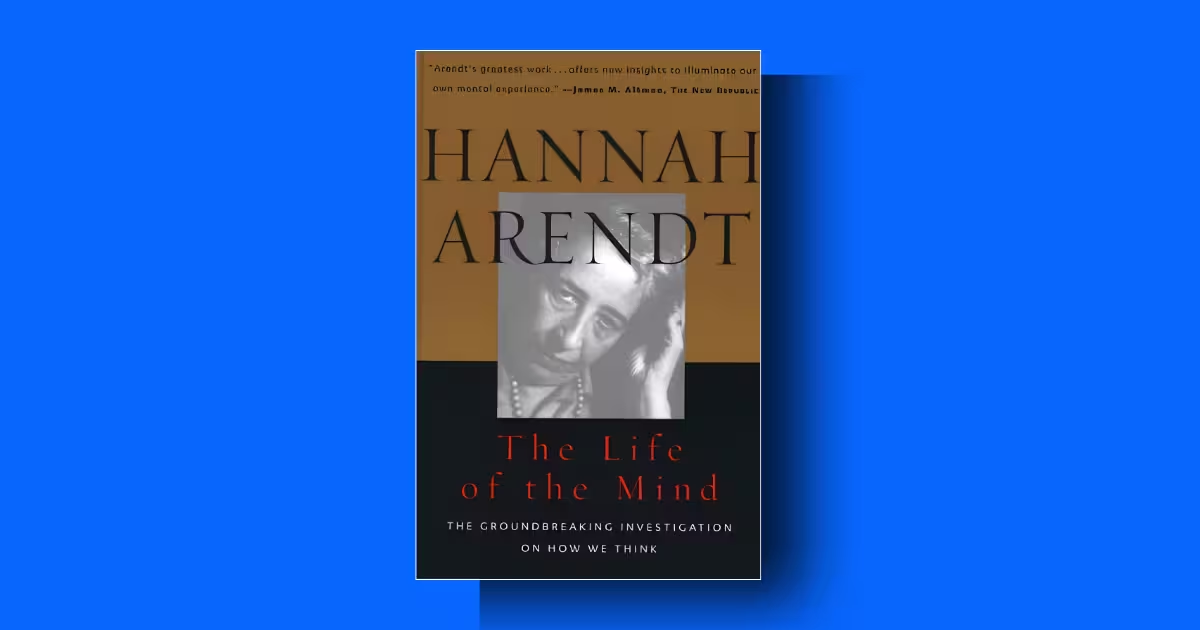
Do you ever catch yourself going through the motions of daily life without ever stopping to ask yourself what any of it actually means? That hollow feeling of just “getting by” is exactly what Hannah Arendt spent her final years trying to understand. The Life of the Mind isn’t just another philosophy book you’ll feel guilty about not finishing.
It’s the last testament of a woman who watched her world collapse, who reported on one of history’s greatest monsters, and who became convinced that the ability to think— genuinely, uncomfortably think— might be the only thing standing between civilization and chaos.
I came to this book skeptical. Arendt’s reputation precedes her, The Origins of Totalitarianism, Eichmann in Jerusalem, her controversial affair with Heidegger. I expected dense, impenetrable academic prose. What I found instead was a woman wrestling with the most fundamental questions of human existence, and doing so with an urgency that felt almost personal.
Overview
The Life of the Mind is Hannah Arendt’s final, unfinished work, published posthumously in 1978 after her sudden death from a heart attack on December 4, 1975. She was 69 years old. The book originated as her Gifford Lectures at the University of Aberdeen in Scotland, delivered across 1973 and 1974.
Arendt was the first woman ever appointed as a Gifford Lecturer, joining a distinguished roster that included William James, Henri Bergson, John Dewey, and Alfred North Whitehead.
The book was intended to cover three fundamental mental activities: Thinking, Willing, and Judging. Arendt completed the first two sections; the third, “Judging,” existed only as lecture notes when she died. Her friend and literary executor, Mary McCarthy, edited the manuscript for publication. The combined one-volume edition runs over 500 pages.
At its core, the book asks a deceptively simple question: What are we actually doing when we think? And why does it matter, not just for philosophers, but for everyone?
The answer, Arendt argues, is that thinking isn’t about acquiring knowledge or solving problems. It’s about meaning. And a life without thinking, she warns, isn’t fully alive. Unthinking people, she writes, “are like sleepwalkers”.
Reader Recommendation for The Life of the Mind
Who will actually love this book: If you’ve ever stayed up late staring at the ceiling, wrestling with questions you can’t quite articulate, Why am I here? What makes a life meaningful? Why do good people do terrible things?, this book will speak directly to you.
It’s for people who feel a nagging dissatisfaction with surface-level explanations and want to understand why we think the way we do.
Who should probably bounce: If you’re looking for practical advice, self-help, or a quick read, this isn’t it. The language is dense, the arguments are complex, and the book demands patience. Some readers find the second section on “Willing” significantly less engaging than the first.
One reviewer admitted they “wandered” through parts of it. That’s honest. It’s not an easy book. But for those willing to put in the work, the rewards are extraordinary.
One reader called it “a 6 star book”. Another said it gave them “wonderful time”. The New York Times Book Review called it “the most intriguing and thought-provoking book that Hannah Arendt wrote”. The Boston Globe described Arendt as possessing “the most intelligent mind of the twentieth century”.
I’d add this: it’s a book that changed how I understand my own mind. And that’s rare.
Table of Contents
1. Introduction
Book: The Life of the Mind (Combined 2 Volumes in 1)
Author: Hannah Arendt (1906–1975)
Publication: The book was published posthumously in 1978, edited by Mary McCarthy. It was originally delivered as the Gifford Lectures at the University of Aberdeen in 1973–1974. The combined one-volume edition was published by Harcourt Brace Jovanovich.
Context of The Life of the Mind
The Life of the Mind is Arendt’s final work, the culmination of a lifetime of thinking about politics, evil, and what it means to be human. Arendt was a German-born Jewish political theorist who fled Nazi Germany in 1933. She studied philosophy at the University of Heidelberg under Karl Jaspers.
Her earlier works, The Origins of Totalitarianism (1951), The Human Condition (1958), and Eichmann in Jerusalem (1963), established her as one of the twentieth century’s most influential political philosophers.
In Eichmann in Jerusalem, she coined the phrase “the banality of evil”. That phrase, and the controversy it sparked, is the direct origin of The Life of the Mind.
Purpose of The Life of the Mind
The book has two primary origins, both deeply personal.
First, Arendt attended the trial of Adolf Eichmann in Jerusalem. She expected to find a monster. Instead, she found an ordinary, even boring man, someone whose evil seemed to stem not from malice but from thoughtlessness. As she writes in the introduction:
“I was struck by a manifest shallowness in the doer that made it impossible to trace the uncontestable evil of his deeds to any deeper level of roots or motives. The deeds were monstrous, but the doer…was quite ordinary, commonplace, and neither demonic nor monstrous.”
This led her to ask a question that haunts the entire book: “Might the problem of good and evil, our faculty for telling right from wrong, be connected with our faculty of thought?”
Second, Arendt had spent years examining the vita activa, the active life of labor, work, and action, in her earlier book The Human Condition. She realized she had neglected the vita contemplativa, the life of the mind. The Life of the Mind was her attempt to correct that imbalance.
2. Background
To understand The Life of the Mind, you need to understand the historical moment that produced it.
Arendt wrote in the shadow of totalitarianism. She had witnessed the rise of Nazi Germany, the Holocaust, and the systematic destruction of European Jewry. She had seen how ordinary people could become complicit in unimaginable evil. The question that consumed her wasn’t How could Hitler do this? It was How could everyone else let him?
Her answer, in Eichmann in Jerusalem, was devastating: most people didn’t think about what they were doing. They followed orders. They used clichés. They hid behind bureaucratic language. Evil, she concluded, could be banal, not because it wasn’t monstrous, but because the people committing it weren’t monsters. They were thoughtless.
This insight was controversial. Critics accused her of minimizing evil. But Arendt wasn’t minimizing it. She was trying to understand it. And understanding it, she believed, required examining the very faculty that had failed: the faculty of thought.
By the early 1970s, Arendt was in her late sixties. She had survived exile, heartbreak, and scandal. She had watched her mentor, Martin Heidegger, embrace Nazism. She had been attacked by friends and critics alike. And yet she kept writing, kept thinking, kept asking the hard questions.
The Life of the Mind was her final attempt to make sense of it all.
3. The Life of the Mind Summary
Part One: Thinking
The first volume of The Life of the Mind is the more celebrated of the two. One reader called it “the most important philosophical work I have ever read”. Another said it “still remains a 5/5”.
Arendt begins with a fundamental observation: we live in a world of appearances. Everything we experience, everything we see, hear, touch, taste, smell, is an appearance. But appearances, she argues, are not the whole story. They point to something beneath, something hidden. The philosopher’s task is to withdraw from the world of appearances and contemplate what lies behind them.
She writes:
“The two-world theory belongs among the metaphysical fallacies but it would never have been able to survive for so many centuries if it had not so plausibly corresponded to some basic experiences.”
But here’s where Arendt parts company with the philosophical tradition. She doesn’t believe thinking leads to truth. She believes it leads to meaning. The distinction is crucial.
The intellect (Verstand in Kant’s terminology) is concerned with knowledge, with what we can know and verify. Reason (Vernunft), on the other hand, is concerned with questions that can never be definitively answered: What is justice? What is freedom? What is the meaning of life?
Arendt writes:
“The need of reason is not inspired by the quest for truth but by the quest for meaning. And truth and meaning are not the same.”
This is the central insight of the book. We don’t think to find answers. We think because we need to think. It’s a fundamental human drive, as natural as breathing. And when we stop thinking, when we let clichés and conventions do our thinking for us, we lose something essential. We become sleepwalkers.
Arendt draws on a stunning range of sources to make her argument: Plato, Aristotle, Kant, Hegel, Nietzsche, Heidegger, and Augustine, among others. She examines the nature of appearance, the relationship between body and soul, the role of language in thought, and the strange experience of the “thinking ego”, that part of us that withdraws from the world and carries on a silent dialogue with itself.
She also introduces the figure of Socrates as the ideal thinker. Unlike the philosophers who came after him, Socrates didn’t produce a system of thought. He didn’t write books. He just asked questions. He examined opinions. He forced people to think.
Arendt writes:
“Socrates…is not a philosopher (he teaches nothing and has nothing to teach) and he is not a sophist, for he does not claim to make men wise. He only points out to them that they are not wise, that nobody is.”
Socrates discovered something profound: the thinking self is never truly alone. It’s always in dialogue with itself. Arendt calls this the “two-in-one”, the split between the self that asks questions and the self that answers them.
This dialogue is what makes thinking possible. And it’s also what makes morality possible. When you think, you have to live with yourself. You have to be able to face the person you become in your own thoughts. Socrates put it this way: “It is better to be wronged than to do wrong” , because if you do wrong, you have to live with a wrongdoer. And that’s unbearable.
Arendt writes:
“The criterion of Socratic thinking is agreement, to be consistent with oneself…its opposite, to be in contradiction with oneself, actually means becoming one’s own adversary.”
Part Two: Willing
The second volume examines the faculty of will. This is the part of the mind that deals with the future, with projects, intentions, and the capacity to begin something new.
Arendt begins by noting something surprising: the ancient Greeks had no concept of the will. For them, freedom was about ability, the “I-can”, not about choice, the “I-will.” Freedom meant being able to move as you wished, not being paralyzed or enslaved. It was a physical condition, not a mental one.
The will, as a distinct faculty, was discovered later, in the Christian era. The Apostle Paul, in his Letter to the Romans, describes the experience of wanting to do good but being unable to do it:
“I do not do what I want, but I do the very thing I hate.”
This is the experience of the divided will. The will commands, but it’s not always obeyed, even by itself. Augustine called it a “monstrosity”: the mind commands the body, and the body obeys; but the mind commands itself, and it resists.
Arendt traces the history of this faculty through Augustine, Thomas Aquinas, Duns Scotus, and Nietzsche. She shows how the will became increasingly central to modern philosophy, and increasingly problematic.
The will is paradoxical. It’s supposed to be free, but freedom is terrifying. If I can choose anything, I can also choose wrongly. If I’m responsible for my actions, I’m also responsible for my failures. No wonder philosophers have tried to explain the will away.
Arendt writes:
“The touchstone of a free act is always our awareness that we could also have left undone what we actually did.”
This awareness is both liberating and burdensome. It’s what makes us human, and what makes us anxious.
The second volume is considered less accessible than the first. But it’s essential for understanding Arendt’s overall project. Without the will, there’s no action. Without action, there’s no change. Without change, there’s no hope.
The Unfinished Third Part: Judging
Arendt died before she could complete the section on judging. But her notes and lecture materials suggest what she intended.
Judgment, for Arendt, is the faculty that deals with particulars. It’s what allows us to say, “This is beautiful” or “This is wrong” without relying on general rules. It’s the faculty of the spectator, the person who watches and evaluates without being directly involved.
Arendt was deeply influenced by Kant’s Critique of Judgment. Kant argued that judgment is based on taste, a kind of immediate, non-cognitive sense of what pleases or displeases. But Arendt radicalized this idea. She argued that judgment is political. It’s what allows us to understand events we didn’t participate in. It’s what allows us to make sense of history.
She writes (in her notes on Kant):
“The revolution…finds in the hearts of all spectators (who are not engaged in this game themselves) a wishful participation that borders closely on enthusiasm.”
This is Arendt’s final, unfinished thought: that thinking, willing, and judging are all necessary for a fully human life. Thinking gives us meaning. Willing gives us agency. Judging gives us perspective. Together, they constitute the life of the mind.
4. The Life of the Mind Analysis
Let me be honest: The Life of the Mind is not an easy book. It’s dense. It’s demanding. It assumes a familiarity with the Western philosophical tradition that many readers (including me, at first) don’t have. There were moments when I felt lost, when I had to re-read paragraphs several times, when I wondered if I was smart enough to understand what Arendt was saying.
But I kept going. And I’m glad I did.
What makes the book remarkable isn’t just its intellectual depth. It’s its urgency. Arendt isn’t writing for other philosophers. She’s writing for anyone who’s ever wondered why the world seems so broken, why good people do terrible things, why we so often feel like we’re just going through the motions.
The book is, in a sense, a defense of thinking itself. In an age of distraction, of constant stimulation, of easy answers and instant gratification, thinking is hard. It’s uncomfortable. It requires solitude. It requires patience. It requires facing difficult questions without any guarantee of finding answers.
But Arendt argues that it’s worth it. Not because thinking will make us better people, she’s too honest for that, but because a life without thinking isn’t fully alive.
“A life without thinking is quite possible; it then fails to develop its own essence, it is not merely meaningless; it is not fully alive. Unthinking men are like sleepwalkers.”
That line has stayed with me. I’ve caught myself, more than once, going through the motions, checking my phone, scrolling through social media, responding to emails, without actually thinking about any of it. And I’ve wondered: am I sleepwalking?
Arendt’s answer is that we all do it. It’s normal. It’s even necessary, we can’t think about everything all the time. But if we never think, if we never stop and ask ourselves what we’re doing and why, we risk becoming like Eichmann: ordinary people who commit extraordinary evil because they never stopped to consider what they were doing.
5. Strengths and Weaknesses
What Works
The central argument is powerful and urgent. Arendt’s claim that thinking is connected to morality, that thoughtlessness is a prerequisite for evil, is as relevant today as it was in 1978. In an age of political polarization, algorithmic echo chambers, and social media outrage, the ability to stop and think critically is more important than ever.
The historical breadth is impressive. Arendt draws on philosophers from Plato to Heidegger, synthesizing their ideas into a coherent argument. Her discussions of Augustine, Kant, and Nietzsche are particularly illuminating.
The writing, while dense, is often beautiful. Arendt has a gift for memorable phrases. “Unthinking men are like sleepwalkers.” “Truth and meaning are not the same.” “Thinking, existentially speaking, is a solitary but not a lonely business.” These lines linger.
The personal stakes are clear. This isn’t an abstract academic exercise. Arendt is writing about something that matters, something that cost her friends, her reputation, and possibly her peace of mind.
What Doesn’t
The book is unfinished. The third section on judgment exists only in notes and lecture transcripts. We’ll never know what Arendt would have said. That’s frustrating.
The second volume is weaker than the first. Even Arendt’s admirers admit that the section on willing is less engaging. One reviewer called it “lackluster”. Another admitted they “wandered” through parts of it.
The language can be impenetrable. Arendt assumes a lot of her readers. If you’re not familiar with Kant’s distinction between Verstand and Vernunft, or with Augustine’s theory of the will, you’ll struggle. Some readers find the book “challenging” in the worst sense.
Arendt’s arguments aren’t always consistent. One reviewer noted that she was “not always consistent” and that her arguments were “not always supported by footnotes or references to secondary sources”. This is a fair criticism. Arendt writes with authority, but she doesn’t always back it up.
6. Comparison with Similar Works
The Life of the Mind belongs to a tradition of philosophical inquiry into the nature of consciousness and thought. It’s most directly comparable to:
Kant’s Critique of Pure Reason. Arendt explicitly builds on Kant’s distinction between understanding (Verstand) and reason (Vernunft). But where Kant is concerned with knowledge, Arendt is concerned with meaning.
Heidegger’s Being and Time. Arendt studied with Heidegger and was deeply influenced by him. But she rejects his mysticism and his dismissal of politics. For Heidegger, thinking is about Being. For Arendt, thinking is about being human.
Augustine’s Confessions. Arendt wrote her doctoral thesis on Augustine. His exploration of the will, its divided nature, its struggle with itself, is central to her argument.
Hannah Arendt’s own earlier works. The Life of the Mind is in dialogue with The Human Condition. Where The Human Condition examined the vita activa (labor, work, action), The Life of the Mind examines the vita contemplativa (thinking, willing, judging).
What sets The Life of the Mind apart is its insistence that thinking is practical. It’s not an escape from the world. It’s a way of engaging with it more honestly.
7. Conclusion
The Life of the Mind is a flawed masterpiece. It’s incomplete. It’s uneven. It’s often difficult. But it’s also one of the most important books I’ve ever read.
Arendt’s central argument, that thinking is connected to morality, that thoughtlessness is a prerequisite for evil, has only become more urgent. In an age of disinformation, polarization, and political extremism, the ability to stop and think critically is essential. Not just for philosophers. For everyone.
Arendt herself put it best:
“If the ability to tell right from wrong should turn out to have anything to do with the ability to think, then we must be able to ‘demand’ its exercise from every sane person, no matter how erudite or ignorant, intelligent or stupid, he may happen to be.”
That’s the challenge of this book. It demands that we think. Not for answers, but for the sake of thinking itself.
My recommendation: Read it if you’re willing to work. Read it if you’re tired of easy answers. Read it if you want to understand why the world is the way it is, and what you can do about it.
But don’t read it if you’re looking for a quick fix. This isn’t self-help. It’s self-examination. And that’s harder.
Related Works and Further Reading
Books by Hannah Arendt:
- The Origins of Totalitarianism (1951)
- The Human Condition (1958)
- Eichmann in Jerusalem (1963)
- On Violence (1970)
Related Philosophy:
- Immanuel Kant, Critique of Pure Reason (1781) and Critique of Judgment (1790)
- Martin Heidegger, Being and Time (1927)
- Augustine of Hippo, Confessions (c. 400)
- Friedrich Nietzsche, Beyond Good and Evil (1886) and The Will to Power (posthumous)
Biographies and Studies:
- Elisabeth Young-Bruehl, Hannah Arendt: For Love of the World (1982)
- Richard J. Bernstein, Hannah Arendt and the Jewish Question (1996)
- Samantha Rose Hill, Hannah Arendt (2021)
Films:
- Hannah Arendt (2012), directed by Margarethe von Trotta, a biographical film focusing on her coverage of the Eichmann trial







