The Wikipedia AI traffic decline is no longer a rumor buried in a fundraising banner. It is a number the Wikimedia Foundation confirmed itself: human pageviews down roughly 8 percent year over year, discovered only after engineers unmasked bots that had been disguising themselves as readers. The banner asking for $2.75 on top of every article is the visible symptom.
The real story is what is causing the drop, AI tools trained on Wikipedia’s own text now answer questions before anyone clicks through to the source that wrote them.
Table of Contents
At a Glance
- Wikipedia’s human pageviews fell roughly 8% year over year, a decline the Wikimedia Foundation only spotted after upgrading its bot-detection systems and unmasking traffic that had been disguised as human visits.
- AI search tools and chatbots are the main driver: they answer questions using Wikipedia’s own content without sending readers to the page, a pattern also hitting publishers broadly, per Pew Research data.
- At the same time, bandwidth used by AI scraper bots training on Wikipedia’s images and video jumped 50% since January 2024, with bots now responsible for about 65% of the site’s most resource-heavy traffic.
- Wikipedia’s entire funding model runs on donations from readers who see a banner while visiting, so fewer visits mean fewer donors, fewer volunteer editors, and rising strain on a nonprofit already footing the bill for the AI systems built on its work.
- Wikipedia is not shutting down. But the model built for an internet where humans clicked through to the source is now colliding with one where AI answers first and cites later, if at all.
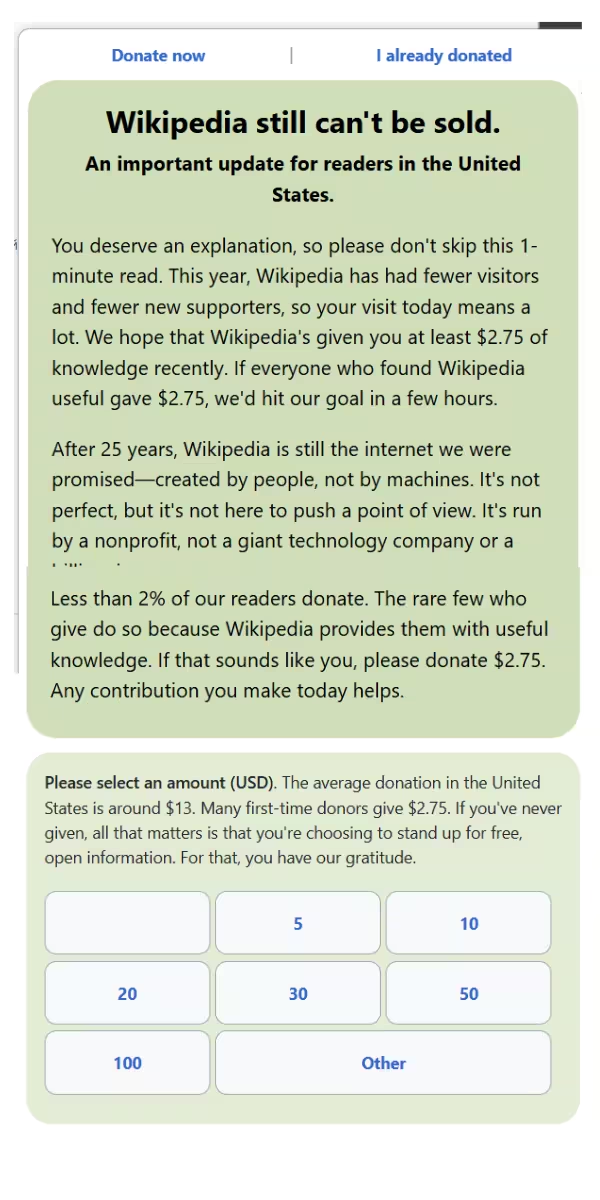
The banner on Wikipedia this year reads like a warning label. It tells readers that fewer people are visiting the site, fewer of them are becoming new supporters, and less than 2 percent of readers ever donate at all. The suggested first gift is $2.75, roughly the price of a cup of tea, framed as the cost of a “thank you” for knowledge already used.
It is a plea dressed as an update, and the update is the real story. Wikipedia is not running out of readers because people stopped wanting answers. It is running out of readers because AI now gives them the answer before they ever reach the page.
Three headlines have circulated about this same problem: that the internet is eating Wikipedia and asking humans to foot the bill, that AI has made Wikipedia both more valuable and more exposed, and that AI learned everything it knows from Wikipedia and now the question is who pays to keep it running. Of the three, the last one is the sharpest fit.
It names the actual mechanism, a debt of training data that was never repaid in traffic, rather than just describing the mood.
Wikipedia AI traffic decline: The 8 percent that gave the story away
In October 2025, the Wikimedia Foundation reported something that looked, at first, like good news gone wrong. Traffic appeared to be climbing through the middle of 2025, until engineers upgraded their bot-detection systems and found that a large share of that growth was not human at all.
It was automated traffic dressed up to pass as people. Once the disguised bots were filtered out, the real picture emerged: human pageviews had fallen roughly 8 percent compared with the same months in 2024.
Marshall Miller, a senior product lead at the Foundation, was blunt about the cause. He said search engines are increasingly using generative AI to answer users directly rather than linking out to sites like Wikipedia.
That is the mechanism in one sentence. Google’s AI Overviews, ChatGPT, and voice assistants are not stealing readers by competing with Wikipedia. They are absorbing Wikipedia’s own sentences and handing them back to users one step removed from the source, so the click that used to end on Wikipedia now ends inside a chat window.
This is not unique to Wikipedia. Pew Research data showed that referral traffic from Google Search to publishers has been shrinking most weeks, with losses outnumbering gains roughly two to one, and close to 60 percent of Google searches now end without a click to any outside site.
Danielle Coffey, who leads the News/Media Alliance representing thousands of publishers, put the industry’s frustration in stark terms: “It’s parasitic, it’s unsustainable, and it poses a real existential threat.”
Wikipedia is simply the largest and most quoted casualty of a pattern hitting the entire open web.
The bill nobody sent
While human visits were falling, machine visits were doing the opposite. In April 2025, Wikimedia’s site-reliability team disclosed that bandwidth used for downloading images and video from Wikimedia Commons had jumped 50 percent since January 2024, and the surge was not driven by curious readers.
The Foundation found that at least 65 percent of the most resource-intensive traffic hitting its core servers came from bots, even though bots account for only around 35 percent of total pageviews. Automated scrapers do not behave like human readers who mostly request the same popular, easily cached pages.
They crawl everything, including obscure entries that force expensive trips back to central databases, which is why a smaller share of total traffic can still generate the majority of the strain.
The Foundation’s own 2025-2026 annual plan now sets an explicit target to cut crawler-generated traffic and bandwidth use by 20 percent. That is a nonprofit built on donated bandwidth budgeting for the cost of feeding commercial AI systems it never billed.
Wikimedia Enterprise, the Foundation’s paid API for large-scale reusers launched in 2021, was meant to close that gap by charging companies that harvest Wikipedia at scale. So far, Google is the most visible confirmed customer, signed up since June 2022.
Most of the largest AI labs that trained on Wikipedia’s text are not confirmed payers, and the program has not generated enough revenue to offset what the scraping actually costs.
A model built for an internet that no longer exists
Wikipedia’s finances were never built to survive this. The site carries no ads by founder Jimmy Wales’s design, so its budget has always depended on banner campaigns that catch readers already on the page, plus grants and a smaller stream of year-round giving. That structure only works if enough people keep arriving at Wikipedia.org to see the ask.
Every leg of the stool, in the Foundation’s own description, depends on visits: readers become the rare donors, readers become the volunteers who notice a gap and click “edit,” and editors stay motivated by knowing their work is actually being read.
An internal Wikipedia community report from January 2026 described the chain plainly, arguing that fewer readers means fewer potential editors, and that the readership crisis and the contributor crisis are the same crisis wearing two names.
| Metric | 2016 | 2025 | Change |
|---|---|---|---|
| Global internet users | 3.27 billion | 6.0 billion | +83% |
| Wikipedia/Wikimedia annual page views | 194 billion | 177 billion | −9% |
| New registrations/month | 317,000 | 202,000 | −36% |
| Monthly edits | 15.6 million | 21.4 million | +37% |
| Edits per new user | 49.0 | 105.7 | +116% |
| Mobile share of English Wikipedia traffic | 62% | 74% | +12 percentage points |
The most striking figure is therefore not simply that Wikipedia’s traffic fell 9%. It is that the internet grew 83% while Wikipedia’s page views fell 9%. The report describes this as a 92-percentage-point divergence.
That is the trap in the donation banner sitting on top of every article right now. It is not a sign that Wikipedia is about to disappear. Wikipedia is not shutting down, and the Foundation has made no such announcement.
But the banner is a genuine signal of financial pressure, because the demographic it depends on, casual browsers who stumble onto a page and feel moved to give, is precisely the group that AI answer engines are diverting before they ever land there.
Valuable and vulnerable are the same sentence
The second working title on the table, framing AI as making Wikipedia simultaneously more valuable and more vulnerable, is not wrong. It is arguably the more elegant paradox.
Every major AI company trained its models on Wikipedia’s text because nothing else online matches its combination of scale, citation discipline, and neutral tone. That reliance has only deepened as AI firms compete on factual reliability, and Wikipedia remains, as the Foundation itself has argued, one of the only sources of its size held to real standards of verifiability.
The dependency is real, and it is growing.
But “valuable and vulnerable” describes a condition. It does not point to a debt. The framing that AI learned from Wikipedia and now owes it an answer to who pays keeps the moral weight of the situation in view: value was extracted from a specific place, by specific companies, using a specific dataset, and the extraction happened without a funding mechanism attached.
That is closer to what is actually unfolding than a general observation about paradox.
It also matches what Wikipedia’s own staff are now saying openly, that AI trains on Wikipedia, users ask AI instead of visiting, AI answers, nobody visits, and donation revenue falls, with no established next step to close that loop.
What happens if nothing changes
None of the companies whose products now answer questions with Wikipedia’s own research have found it commercially convenient to redirect users back to the source.
A handful of technical proposals exist, among them frameworks for AI systems to cite and link back to original pages, but none of the largest platforms have committed to implementing them at scale.
Meanwhile, the Foundation is left managing both ends of the squeeze at once: paying more to serve bots that consume disproportionate server resources, while collecting less from the human visitors who used to fund that infrastructure.
The donation banner asking for $2.75 is not really competing with a billionaire benefactor or a hostile buyout, despite what “Wikipedia still can’t be sold” implies to a casual reader. It is competing with a chatbot that already gave you the answer for free, five minutes ago, without ever mentioning where it came from.