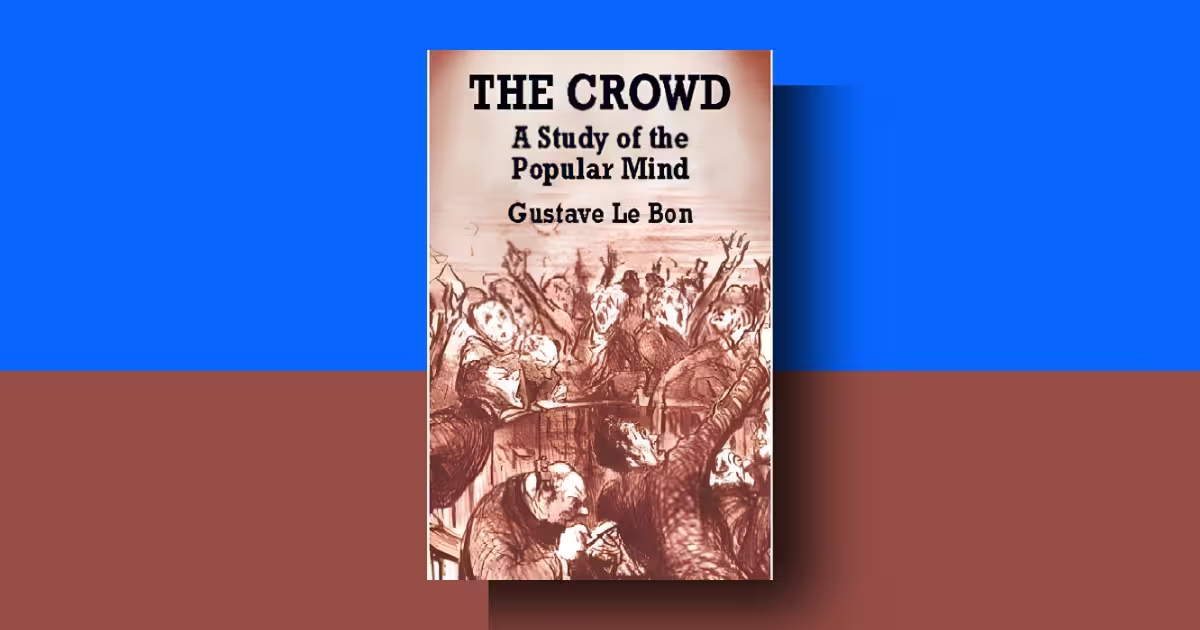

I read Gustave Le Bon’s The Crowd: A Study of the Popular Mind expecting to be a dusty Victorian relic. What I found instead was a book that reads like it was written last week about your Twitter feed, the mob outside a courthouse, and the last three elections you voted in. Le Bon, a French polymath who lived from 1841 to 1931, published this work in 1895, and it went on to influence everyone from Freud to Hitler to Mussolini.
Whether that’s a testament to its brilliance or its danger depends on what you do with it. This book is about crowd psychology in its rawest form: why individuals lose their moral compass in groups, how leaders manipulate masses through affirmation and repetition, and why civilizations rise and fall on the back of popular illusions.
The central argument is brutally simple. When people gather in what Le Bon calls a “psychological crowd,” they don’t average out their intelligence. They lose it entirely. A collective mind forms, one that is impulsive, credulous, and capable of both extraordinary heroism and mindless savagery.
The crowd is always intellectually inferior to the isolated individual, Le Bon writes, but from the point of view of feelings and acts, it may be better or worse depending on the suggestion it receives. This isn’t just 19th-century speculation. It’s a framework that explains riots, revolutions, viral misinformation, and yes, your uncle’s Facebook posts.
Table of Contents
Summary
- What it is: A foundational 1895 text on crowd psychology by French polymath Gustave Le Bon.
- Core thesis: Individuals in crowds lose conscious personality, becoming part of a collective mind that is impulsive, suggestible, and intellectually inferior to the sum of its parts.
- Key concepts: Mental unity of crowds, contagion, suggestion, prestige, affirmation-repetition, and the religious shape of all crowd convictions.
- Who it influenced: Freud, Hitler, Mussolini, and countless political operatives who used it as a manual for mass manipulation.
- Why it still matters: It explains social media mobs, political rallies, viral outrage, and the erosion of individual judgment in group settings.
- Caveat: Le Bon’s racial and gender biases are dated and often offensive. The framework is valuable; the prejudices are not.
- Best for: Students of psychology, political operatives, marketing professionals, and anyone trying to understand why people act differently in groups.
About the Author and the Book
Gustave Le Bon wasn’t a psychologist in the academic sense. He was a physician, anthropologist, and sociologist who studied crowds as a naturalist studies specimens. He traveled widely, observed revolutions firsthand, and synthesized his findings into this slim but dense volume.
His credentials for writing this book included direct observation of the Paris Commune of 1871, a period of such violent upheaval that it left an indelible mark on his thinking about how crowds behave under stress.
The book was first published in French as “La Psychologie des foules” in 1895 and translated into English in 1896. It has never gone out of print. Dover Publications released an unabridged edition in 2002, which is the version I read. The text runs just 139 pages, but every page carries weight.
Le Bon wrote with the confidence of a man who believed he had discovered the laws governing human behavior in groups, and whether or not he was right, his observations are impossible to dismiss.
The Crowd Summary and Key Arguments
Part One: The Mind of Crowds
Le Bon begins by distinguishing between a simple gathering and what he calls a “psychological crowd.” A thousand people standing in a train station aren’t a crowd in his sense. But a thousand people united by a shared emotion, a common idea, or a compelling leader become something else entirely. They form a single being, subject to what he calls the law of mental unity.
The individual in this state undergoes a transformation. He descends several rungs on the ladder of civilization, Le Bon writes. Isolated, he may be a cultivated individual; in a crowd, he is a barbarian, a creature acting by instinct.
This isn’t metaphor. Le Bon argues that the crowd member enters a state resembling hypnosis, where conscious personality vanishes and unconscious forces take over. The brain activity is paralyzed; what remains is what he calls medullar activity, the reflexive, instinctual response.
Three causes create this state. First, the individual in a crowd gains a sense of invincible power from sheer numbers.
He can yield to impulses he would suppress alone. Second, contagion spreads emotions and actions through the crowd like a virus. Third, and most important, suggestibility takes hold. The crowd member becomes an automaton, incapable of being guided by his own will.
“The disappearance of the conscious personality, the predominance of the unconscious personality, the turning of feelings and ideas in an identical direction by means of suggestion and contagion, the tendency to immediately transform the suggested ideas into acts; these are the principal characteristics of the individual forming part of a crowd.”
The consequences are profound. Crowds are impulsive, mobile, and irritable. They cannot premeditate. They are credulous, accepting the wildest legends as fact. They feel everything with exaggerated intensity. They tolerate no doubt, no contradiction, no discussion. And yet, Le Bon notes, they are also capable of heroism, self-sacrifice, and devotion to an ideal that isolated individuals rarely display.
Part Two: The Opinions and Beliefs of Crowds
Le Bon then turns to how crowds form beliefs. He divides the factors into remote and immediate causes. The remote factors are race, tradition, time, institutions, and education. Of these, race is the most powerful. It represents the accumulated heredity of a people, the soil in which all other influences grow. Traditions are the synthesis of the race’s soul, and crowds cling to them with obstinate tenacity.
Time is the great creator and destroyer; it alone can establish beliefs and erode them. Institutions, Le Bon argues, have almost no effect. They are effects, not causes. A nation doesn’t choose its institutions; its character determines them.
Education gets particular attention, and Le Bon is scathing about the French system of his day.
He argues that instruction based on memorization and examinations doesn’t make people more moral or happier. It creates dissatisfied individuals who can’t find work and become enemies of society. He cites statistics showing that criminality increases with the spread of a certain kind of education, and that anarchists are often recruited from prize-winning students. This observation has only become more relevant in the century since.
The immediate factors are images, words, illusions, experience, and reason.
Words and formulas have a magical power, Le Bon says, independent of their real meaning. Terms like democracy, liberty, and equality are vague but evoke powerful images that vary by age and race. The statesman’s job, he notes, is often to change words while keeping things the same, because the crowd can’t endure things under their old names.
“The masses have never thirsted after truth. They turn aside from evidence that is not to their taste, preferring to deify error, if error seduce them. Whoever can supply them with illusions is easily their master; whoever attempts to destroy their illusions is always their victim.”
This is the most quoted passage from The Crowd, and it’s the one that should worry you. Le Bon isn’t saying that crowds are stupid. He’s saying that the mechanisms by which crowds form beliefs have nothing to do with truth or reason.
They are driven by images, emotions, and the need for hope, which can always be exploited by those who understand the machinery.
Part Three: The Classification of Crowds
The final section divides crowds into types. Heterogeneous crowds include street mobs, juries, and parliamentary assemblies.
Homogeneous crowds include sects, castes, and classes. Le Bon examines criminal crowds, noting that what looks like murder from the outside is often experienced by the participants as a patriotic duty. The September Massacres of 1792, in which 1,200 to 1,500 prisoners were killed over five days, were carried out by ordinary shopkeepers and artisans who believed they were saving the nation. They demanded medals for their service.
Juries, he argues, are a perfect example of the crowd mind in action. Their verdicts are independent of their composition. Whether composed of educated professionals or small tradesmen, they show the same tendencies: open to sentimental appeals, impressed by prestige, indulgent to crimes of passion, and harsh on crimes that threaten society. A good lawyer doesn’t argue; he observes the jury, identifies the influential members, and wins them over with suggestion and flattery.
Electoral crowds are similar. The candidate needs prestige above all else. He must flatter the elector, make extravagant promises, and attack his opponent with unscrupulous affirmations. The elector never checks whether the candidate fulfilled his promises. The vote is an expression of the race’s unconscious aspirations, not a reasoned decision.
This is why Le Bon concludes that universal suffrage, despite its obvious weaknesses, can’t be replaced. Even a restricted suffrage would produce the same results, because crowds always tend to the same level.
Parliamentary assemblies are the most complex form. They display the crowd’s intellectual simplicity, irritability, and suggestibility, but with limits.
On local matters, members have fixed opinions that no argument can shake. On general matters, they waver, torn between the suggestions of their leaders and the invisible pressure of their electors. The leaders, men with prestige and narrow convictions, are the true masters. Their eloquence consists of affirmation, repetition, and vivid images, not logic.
“The leader is seldom in advance of public opinion; almost always all he does is to follow it and to espouse all its errors.”
The Crowd Analysis
Le Bon’s stated purpose is to study crowds “in a purely scientific manner,” without being influenced by opinions, theories, or doctrines. He largely fails at this.
His own racial and cultural biases saturate the text. He ranks races on a hierarchy of civilization, claims that Latin crowds are feminine and emotional while Anglo-Saxon crowds are masculine and rational, and dismisses entire peoples as incapable of self-government. These passages are uncomfortable to read today, and they undermine his claim to scientific objectivity.
Yet the framework he built remains useful. His descriptions of crowd behavior have been repeatedly validated by modern social psychology.
The phenomenon he called “contagion” is now studied as emotional contagion. His “suggestibility” is understood as deindividuation. His “prestige” is related to authority bias and charismatic leadership. The specifics of his racial theories are wrong, but the mechanisms he identified are real.
The Crowd also suffers from a lack of systematic evidence. Le Bon uses anecdotes and historical examples to support his claims, but he doesn’t follow the scientific method he claims to employ.
He selects facts that fit his conclusions and ignores those that don’t. His statistics, where he provides them, are dated and often cherry-picked. This is not a work of rigorous research. It is a work of observation and intuition by a brilliant and prejudiced observer.
Strengths and Weaknesses
What Works
The core insight, that individuals in crowds lose their conscious personality and become subject to suggestion, is profound and correct. It explains phenomena from lynchings to stock market bubbles to online harassment campaigns.
Le Bon’s analysis of the mechanisms of persuasion, affirmation, repetition, contagion, and prestige, is practically useful. Anyone who has run a marketing campaign, a political rally, or a social media strategy will recognize his methods. His observations on the relationship between leaders and crowds are particularly sharp. The leader doesn’t lead; he follows the crowd’s unconscious aspirations while appearing to guide them. The crowd needs a master, and the master needs the crowd.
What Doesn’t
The racial hierarchy is indefensible. Le Bon was a product of his time, and his time was deeply racist. He uses race as the primary explanatory variable for everything, from political systems to artistic achievement, and his conclusions are often absurd.
He claims that the Anglo-Saxon race is superior in initiative and enterprise, while Latin races are prone to centralization and dictatorship. He dismisses Hindus and Africans as inferior. These views were common in 1895, but that doesn’t make them true or worth preserving.
The book also overgeneralizes. Le Bon treats crowds as monolithic entities with consistent characteristics, ignoring the role of context, culture, and individual variation. A peaceful protest and a violent mob are both crowds, but they behave very differently. Le Bon’s framework doesn’t distinguish between them.
Comparison with Similar Works
If you want a more rigorous and updated take on crowd psychology, look at The Social Animal by Elliot Aronson. It covers similar ground, from conformity to persuasion to groupthink, but with modern research and a more careful approach to evidence.
For a more focused treatment of how mobs form and what they do, The Lucifer Effect by Philip Zimbardo is excellent. Zimbardo was the psychologist behind the Stanford Prison Experiment, and he explores how ordinary people become capable of terrible acts in group settings.
For a more optimistic view of crowds, you could try Here Comes Everybody by Clay Shirky. Shirky argues that the tools of the internet allow crowds to organize and create in ways that were previously impossible. He’s interested in what groups can do when they are decentralized and self-directed, rather than what they do when they are manipulated by leaders. It’s a useful counterpoint to Le Bon’s pessimism.
But Le Bon is the starting point. Everyone who writes about crowds after him is either building on his framework or reacting against it. If you want to understand the lineage, you have to read the original.
Reader Recommendations
Who will love The Crowd:
Political operatives and campaign managers. Le Bon’s manual for manipulating crowds is still in use. Reading it will make you better at your job and more cynical about it.
Marketing and advertising professionals. The chapters on affirmation, repetition, and prestige are foundational to understanding consumer behavior.
Psychology and sociology students. This is a key text in the history of your field, and you need to know it to understand where the discipline came from.
Anyone who has been part of a crowd that did something they regretted. This book will explain what happened to you, and why it wasn’t entirely your fault.
History buffs interested in revolutions. Le Bon’s observations on the French Revolution are particularly useful, even if his interpretations are often wrong.
Who should skip it:
Readers who cannot tolerate dated and offensive racial theories. The racism is pervasive and central to Le Bon’s argument. If you can’t bracket it, this book will infuriate you.
Anyone looking for a modern, evidence-based treatment of crowd behavior. This is a historical document, not a contemporary psychology textbook.
People who want practical, actionable advice without the theoretical baggage. Le Bon is more interested in explaining than in prescribing.
Conclusion
The Crowd: A Study of the Popular Mind is a book that deserves its reputation. It is flawed, biased, and occasionally wrong. It is also one of the most influential works of social psychology ever written, and it remains disturbingly relevant to the world we live in.
The crowd, Le Bon writes, is always intellectually inferior to the isolated individual. Whether that’s true in every case is debatable, but the mechanisms he identifies for how crowds form beliefs, make decisions, and fall under the sway of leaders are real.
If you want to understand why people act differently in groups than they do alone, why political movements can sweep through populations like plagues, and why the most rational person you know can become a fanatic on social media, this book will give you a framework.
It won’t answer every question, and it won’t do your thinking for you, but it will change how you see the people around you. And that’s more than most books manage.
Related Reading
- Book: The True Believer by Eric Hoffer (1951) – An exploration of the psychology of mass movements.
- Book: Extraordinary Popular Delusions and the Madness of Crowds by Charles Mackay (1841) – The precursor to Le Bon’s work.
- Book: Propaganda by Edward Bernays (1928) – How Le Bon’s ideas were applied in marketing and public relations.
- Film: The Wave (2008) – A German drama showing how easily a group can fall into fascism.