
Last updated on April 23rd, 2026 at 11:40 am
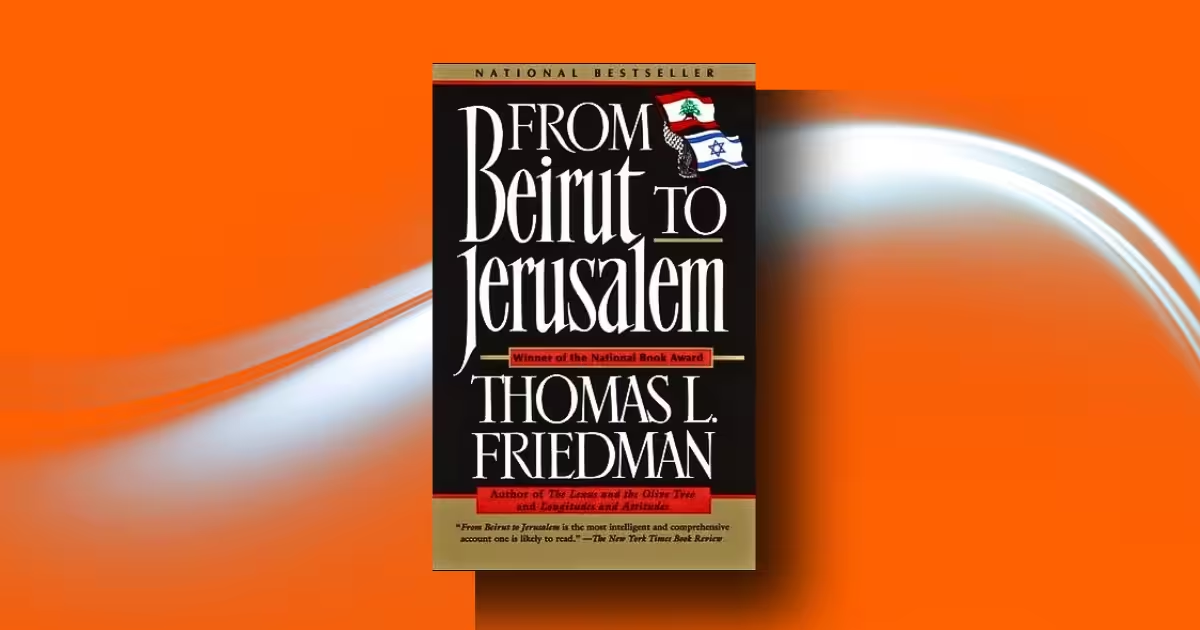
Is it really possible to untangle the chaotic web of Middle Eastern politics without losing your own sanity in the process? From Beirut to Jerusalem by Thomas L. Friedman inquires the answers to the questions.
From Beirut to Jerusalem is best for history enthusiasts, political junkies, digital publishers looking for masterclasses in storytelling, and anyone wanting a front-row seat to the psychological and physical battlegrounds of the Middle East.
Not for readers seeking a brief, sterilized, or politically correct overview of the Israeli-Palestinian conflict, or those who prefer black-and-white morality tales over gritty, nuanced realities.
Table of Contents
1. Introduction
Title: From Beirut to Jerusalem
Author: Thomas L. Friedman
Publisher: Farrar, Straus and Giroux
Publication Date: 1989
Here in Bangladesh, I spend a massive amount of time analyzing search intent, decoding texts, and identifying what makes content truly resonate on a global scale.
I have a deep interest in literary and cinematic analysis, particularly works that build cross-cultural bridges. Thomas L. Friedman’s From Beirut to Jerusalem is exactly that kind of groundbreaking, traffic-stopping masterpiece. Published in 1989, this book won the National Book Award and chronicles Friedman’s ten years as a correspondent for United Press International and The New York Times in the Middle East.
Friedman, a two-time Pulitzer Prize-winning journalist, takes us on a profoundly human journey through a region where the past constantly haunts the present.
The central thesis of the book is that underneath the modern facade of parliaments, treaties, and nation-states, the Middle East is still heavily governed by ancient, tribal survival instincts.
Friedman proposes that to understand this volatile region, one must look past the diplomatic rhetoric and recognize the raw, untamed forces driving its people. He argues that the region is caught in a struggle between the new nations they are trying to build and the ancient passions dragging them back into the past.
2. Background and Context
Friedman’s own journey is as compelling as the history he reports. He grew up in Minneapolis, Minnesota, in a typical middle-class Jewish family. A trip to Israel in 1968, shortly after the Six-Day War, fundamentally altered the trajectory of his life.
He was utterly captivated by the region’s people and conflicts, transforming from a boy who dreamed of being a professional golfer into a devoted student of the Middle East.
He later studied Arabic in Cairo and pursued a master’s degree in Modern Middle East Studies at St. Antony’s College, Oxford University.
This academic foundation collided with harsh reality in June 1979, when Friedman and his wife, Ann, boarded a Middle East Airlines flight to Beirut.
He quickly realized that all his textbook knowledge was inadequate for the chaotic, blood-soaked streets of Lebanon’s civil war. Nothing had prepared him for the road ahead.
3. From Beirut to Jerusalem Summary
To save you the trouble of parsing through all 500+ pages yourself, I have broken down the core elements of Friedman’s narrative. The book is effectively divided into two halves: his time in Beirut and his subsequent transfer to Jerusalem.
Part I: Beirut and the Abyss
When Friedman arrived, Lebanon—once affectionately known as the Switzerland of the Middle East—was tearing itself apart. The roots of this civil war date back to the very foundation of the country.
In 1943, Lebanon’s Christian and Muslim leaders agreed on an unwritten “National Pact” to share power. The President would always be a Maronite Christian, the Prime Minister a Sunni Muslim, and the Speaker of Parliament a Shiite. However, by the 1970s, rapid demographic growth among the Muslims, particularly the Shiites, turned the country upside down.
The Christians, refusing to relinquish their dominant grip on power, formed private militias; the Muslims did the same, and the country plunged into an abyss of violence.
Friedman describes Beirut as the darkest corner of human behavior, an urban jungle where not even the law of the jungle applied. Surviving there required a wild imagination, because danger could manifest in completely unprecedented ways.
I was particularly struck by his anecdote of witnessing a man being kidnapped in broad daylight while stuck in traffic. The incident took only seconds, and the sheer terror in the victim’s eyes left a lasting scar on Friedman.
Lebanon was a city of versions, where truth was entirely subjective. It was a place where a dinner hostess on Christmas Eve, amidst a raging artillery battle, could casually ask her guests, “Would you like to eat now or wait for the cease-fire?”. People coped by playing mind games, calculating the odds of their own survival, or inventing elaborate conspiracy theories to impose order on the random chaos.
Hama Rules:
One of the most terrifying concepts Friedman introduces is “Hama Rules.” In February 1982, the Syrian government of Hafez al-Assad brutally suppressed a Muslim Brotherhood rebellion in the Syrian city of Hama.
The regime killed an estimated 10,000 to 25,000 of its own citizens and literally bulldozed entire neighborhoods. Friedman uses this massacre to define the ruthless, winner-take-all political tradition of the Middle East. It is a world where autocrats realize that showing mercy is viewed as weakness; you either crush your enemy completely, or they will crush you.
The Teflon Guerrilla:
Friedman’s analysis of the Palestine Liberation Organization (PLO) and Yasir Arafat is equally profound. He refers to Arafat as “the ultimate Teflon guerrilla,” noting that no matter how many military defeats the PLO sustained, Arafat always survived. Arafat’s genius was that he resurrected the Palestinian cause from obscurity, giving his people independence, unity, and relevance on the world stage.
However, Friedman points out that the PLO’s time in Beirut corrupted the movement. Instead of fighting a grassroots war, the PLO became an overweight bureaucracy with silver Mercedes limousines, more interested in Lebanese turf wars than liberating Palestine.
The Israeli Invasion:
In June 1982, Israel invaded Lebanon to drive out the PLO and the Syrians. Friedman covered the horrors of this invasion extensively. He paints a tragic picture of the Sabra and Shatila massacres, where Lebanese Phalangist militiamen slaughtered hundreds of Palestinians while the Israeli army surrounded the camps. The sheer brutality of the war shattered the myths many held about the region.
The invasion culminated in the assassination of Lebanon’s President-elect, Bashir Gemayel, in September 1982, which unraveled Israel’s entire grand strategy for Lebanon.
Part II: Jerusalem and the Fault Line
In 1984, Friedman was transferred to Jerusalem. Driving overland from Beirut to Israel, he encountered a jarring shift. He passed a sign on the Israeli highway that warned: BEWARE OF CROSSWINDS. It was a stark contrast to Beirut’s chaos, representing an ordered, structured society. Yet, Friedman soon realized the crosswinds were political.
Israel was a nation paralyzed by a profound internal debate over its identity following its capture of the West Bank and Gaza Strip in the 1967 Six-Day War. The Jewish state was divided into four main camps:
- Secular Zionists, who wanted a modern, democratic state and viewed religion as secondary.
- Religious Zionists, who believed the modern state and the synagogue were wholly compatible.
- Messianic Zionists (like the Gush Emunim), who believed settling the entire biblical land of Israel would bring about the Messiah.
- Ultra-Orthodox Haredim, who rejected secular Zionism and sought to recreate the isolated, deeply religious ghettos of Eastern Europe.
Because these groups could not agree on what kind of nation Israel should be, the government became gridlocked, maintaining the status quo of military occupation.
The Earthquake (The Intifada):
This paralysis was violently disrupted in December 1987, when the Palestinian uprising, or intifada, erupted in the West Bank and Gaza. Friedman describes this as an earthquake along the demographic fault line between Jews and Arabs.
The Palestinians, tired of being ignored by the Arab world and humiliated by the Israeli occupation, took matters into their own hands. By throwing stones instead of using firearms, the Palestinians engaged in massive civil disobedience, making the occupation incredibly painful for Israel.
This grassroots rebellion fundamentally shifted the balance of power, forcing the world—and the PLO leadership in Tunis—to pay attention to the demands of the Palestinians living under occupation.
4. From Beirut to Jerusalem Analysis
Speaking strictly from my own perspective, reading this book feels like sitting down with an exceptionally articulate war correspondent who has seen the absolute worst of humanity, yet refuses to lose his sense of hope. Friedman’s narrative is a poignant, monumental achievement in journalism.
What he excels at is slicing through the suffocating political jargon to expose the raw human nerves underneath. He effectively supports his arguments not just with dates and treaties, but with powerful micro-interactions. For instance, he recounts how Palestinian youths threw stones not out of a calculated political strategy, but out of a deeply ingrained, volcanic rage against decades of humiliation.
However, the book does have its blind spots. Friedman occasionally forces a symmetry between the Israeli and Arab experiences that doesn’t always hold up to strict historical scrutiny. Furthermore, his American liberal lens sometimes leads him to oversimplify the deeply entrenched theological absolutism of the region.
He hopes for a rational, democratic compromise in a part of the world where, as he himself documents through “Hama Rules,” compromise is frequently viewed as a fatal weakness.
5. Strengths and Weaknesses
Strengths:
Vivid Storytelling: Friedman’s use of personal anecdotes is legendary. From the tragic story of his own apartment building in Beirut being blown in half by a bomb to the absurdity of the Commodore Hotel’s parrot imitating incoming artillery shells, his eye for detail is unmatched.
Accessibility: He takes one of the most convoluted political landscapes in the world and translates it into relatable, human terms. You do not need a Ph.D. in Middle Eastern studies to grasp the tribal dynamics he outlines.
Raw Honesty: He does not spare anyone from criticism. He is equally candid about the corruption of the PLO, the brutality of the Syrian regime, the mafia-like nature of the Christian Phalangists, and the arrogance and denial of the Israeli political establishment.
Weaknesses:
Outdated Optimism: Written in the late 1980s, the book’s final chapters possess a cautious optimism about the peace process that history, unfortunately, has not validated.
Pacing: The transition between the high-adrenaline, chaotic Beirut chapters and the more philosophical, domestically focused Jerusalem chapters can feel slightly jarring. The tone shifts from a thriller to a sociology lecture.
6. Comparison with Similar Works
When evaluating From Beirut to Jerusalem, it naturally invites comparison to Robert Fisk’s Pity the Nation. While Fisk offers a vastly more detailed, albeit highly partisan, historical account of the Lebanese Civil War, Friedman focuses more on the psychological and cultural underpinnings of the conflict.
Furthermore, Edward Said notoriously criticized Friedman’s work, arguing that it presented an arrogant, orientalist view of the Arab world.
However, while Said’s critique has academic merit, it ignores the undeniable authenticity of Friedman’s street-level reportage.
Friedman wasn’t writing a sterile academic thesis; he was writing a frontline diary of madness.
7. Conclusion
If you are going to read only one book to understand the visceral, emotional realities of the Middle East, From Beirut to Jerusalem remains the gold standard. It is indispensable for anyone looking to comprehend why the headlines from this region look the way they do today.
I highly recommend this book to general audiences, digital content creators looking to study narrative structure, and anyone who wants to peer behind the curtain of global diplomacy.
It will leave you deeply unsettled, profoundly educated, and immensely grateful for the boring predictability of a peaceful life.







