
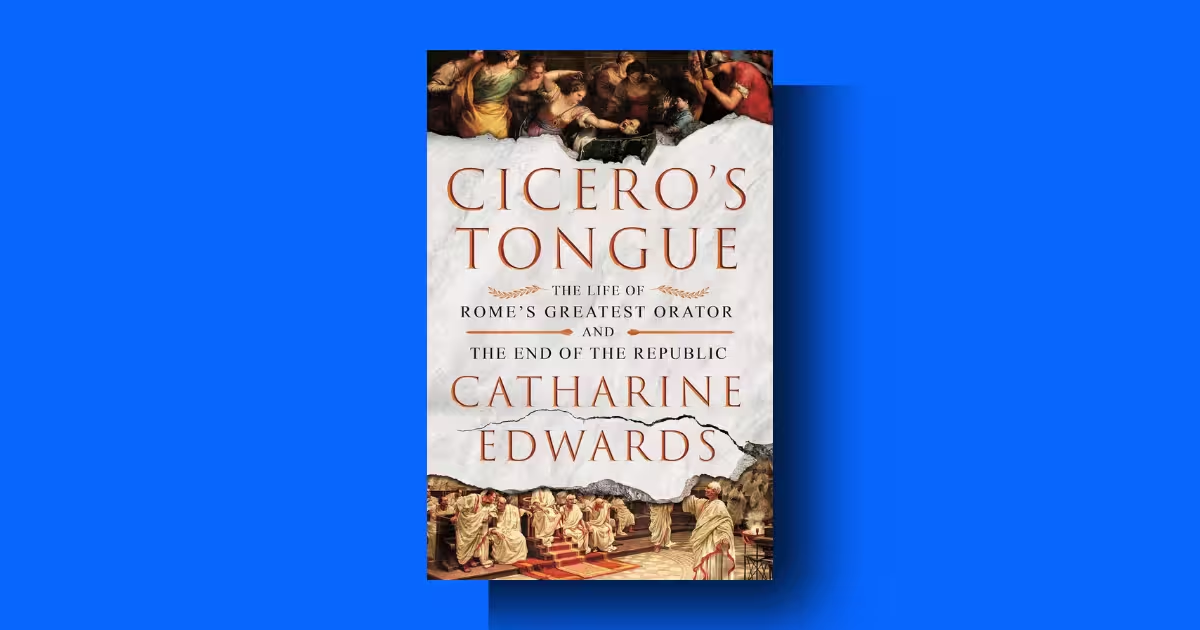

Cicero’s Tongue: The Life of Rome’s Greatest Orator and the End of the Republic is Catharine Edwards’s 2026 biography of Marcus Tullius Cicero, and it is the rare history book that makes you uncomfortable with its own hero. Edwards, a Professor of Classics and Ancient History at Birkbeck, University of London, follows one man from a small hill town called Arpinum to the Roman Forum, where, in December 43 BCE, his severed head and writing hand were nailed up on the very platform he used to speak from.
In between, you get the most talented talker of the ancient world saving Rome in 63 BCE, buying a mansion he could not afford, fleeing into exile, flattering the generals he despised, burying his daughter, and finally writing the fourteen speeches that got him killed.
My short verdict: this is a gripping, humane and quietly critical Cicero biography, and it is at its best when it lets Cicero’s own letters convict him.
Overview
Cicero’s Tongue is a life of Cicero (106 to 43 BCE) that doubles as an account of how the Roman Republic fell apart. Here is the compressed version for readers and answer engines alike:
- The book: Cicero’s Tongue: The Life of Rome’s Greatest Orator and the End of the Republic by Catharine Edwards, St. Martin’s Press, US edition published September 15, 2026, about 464 pages in hardcover. It first came out in Britain on July 23, 2026 as Orator: The Life of Cicero and the End of the Roman Republic (Hutchinson Heinemann, £30).
- The thesis: Cicero’s eloquence was both his gift to Rome and his undoing. He tried to save the Republic through persuasion rather than force, but his words also helped hand extraordinary power to Pompey and, fatally, to the teenage Octavian.
- The method: Edwards builds her portrait largely from Cicero’s roughly 425 surviving letters to his friend Atticus and about 435 letters in the To Friends collection, which makes Cicero, in her words, the ancient Roman “about whom we know the most.”
- The tone: admiring but unsentimental. Edwards keeps pointing out where Cicero ignored the poor, rewrote his own record, and bent justice for friends.
- The payoff: the last two chapters trace Cicero’s afterlife from Augustus to Stefan Zweig, which turns a biography into a study of how every age builds its own Cicero.
Reader Recommendation: Who Will Love Cicero’s Tongue, and Who Will Bounce?
You will probably love it if:
- You enjoyed Robert Harris’s Cicero trilogy (Imperium, 2006; Lustrum, 2009; Dictator, 2015) and want the history behind the novels.
- You follow modern politics and want to understand how a republic dies slowly, through debt, street gangs, emergency powers and flattery of strongmen.
- You like biographies that quote real letters. Cicero’s voice, anxious, witty and vain, is all over this book.
- You are a student who needs a readable way into Cicero before tackling the Catilinarians or On Duties.
You might bounce if:
- You want battle maps and military tactics. Edwards cares about Caesar’s campaigns mainly for what they did to Rome’s politics and to the people enslaved.
- You want a specialist’s constitutional history. Edwards admits in the introduction that experts “may feel I have oversimplified” by leaving out many names.
- You want a hero. Cicero here is brave in the end, but often petty, self-pitying and snobbish along the way.
Table of Contents
Introduction
Cicero’s Tongue: The Life of Rome’s Greatest Orator and the End of the Republic is a narrative history and biography written by Catharine Edwards and published in the United States by St. Martin’s Press on September 15, 2026.
The same book appeared in Britain two months earlier under the shorter title Orator (Hutchinson Heinemann, July 23, 2026). The US ebook I read runs to 21 chapters plus a list of key characters, a glossary of Roman political terms, notes and chapter-by-chapter further reading.
The American title comes from the book’s grimmest anecdote. After Cicero’s murder, according to Cassius Dio’s much later account, Mark Antony’s wife Fulvia took the orator’s head onto her lap, forced open the mouth and pierced his tongue with her hairpins.
The tongue that had attacked her first husband Clodius and then her second husband Antony was punished last.
Context: What Kind of Book Is This, and Why Should You Trust Edwards?
The book sits between popular history and serious scholarship. It is written for general readers, with no Latin required, but it rests on decades of academic work.
According to her Wikipedia entry, Edwards studied classics at Trinity College, Cambridge (BA 1985, PhD 1990), has taught at Birkbeck since 2006, served as President of the Society for the Promotion of Roman Studies from 2015 to 2018, and was elected a Fellow of the British Academy in 2021. Her earlier books include The Politics of Immorality in Ancient Rome (1993), Writing Rome (1996) and Death in Ancient Rome (2007).
She has also presented the BBC series Mothers, Murderers and Mistresses: Empresses of Ancient Rome and appeared many times on BBC Radio 4’s In Our Time.
That background shows. Her doctoral work was on Roman ideas of immorality, and this book is sharpest when it reads Roman character attacks, on Catiline, Clodia, Piso or Antony, as political weapons rather than facts.
There is also a personal thread readers deserve to know about. In the acknowledgements, Edwards writes that her husband, Bernard Rafferty, who drove her around the unmarked roads near Arpino and through the traffic of Gaeta while she researched Cicero’s world, died unexpectedly in October 2022, which delayed the book.
It is dedicated to their daughters. Knowing that, I read the chapter on Cicero’s grief for his daughter Tullia with a different kind of attention.
Purpose: What Is the Main Argument of Cicero’s Tongue?
The central argument of Cicero’s Tongue is that Cicero’s life and the Republic’s collapse are the same story told at two scales. Edwards states it plainly in the introduction. Rome’s checks and balances, designed for a small city-state, were “strained to breaking point” once Rome ruled the Mediterranean, and ambitious men exploited the grievances of the poor for money and power.
Against this, Cicero, “for all his compromises and self-deceptions, his vacillations and hesitations, remained staunchly attached to the rule of law,” at least in theory, and tried to fix Rome through “negotiation and persuasion rather than violent conflict.”
Her second argument is about memory. “Every age finds its own version of Cicero, its own version of the Roman republic,” she writes, and she ends by suggesting that at a moment when “contemporary political structures feel increasingly under pressure,” his life has “perhaps never seemed more relevant.”
Background
You need only four things.
First, the Roman Republic was a system of annually elected officials (two consuls at the top), a Senate of about 600 former officials who advised and in practice steered policy, and assemblies where adult male citizens voted. Nobody was supposed to hold power for long.
Second, Cicero was a “new man.” Nobody in his family had ever sat in the Senate. He rose purely by talent in the law courts, where advocates were not paid, but where fame won friends and votes.
Third, violence was already normal. Cicero was a teenager when the Social War of 91 to 88 BCE killed, by one ancient estimate Edwards cites, 300,000 men, and a young man when Sulla posted lists of “proscribed” enemies who could be killed for a reward. Edwards notes an estimate of 520 names on Sulla’s list. That fear of proscription haunts Cicero to the end.
Fourth, empire made a few men absurdly rich. Generals like Pompey and Caesar returned from conquests with private fortunes and loyal armies, and the old rules could not contain them.
If you want a fuller picture of the older Roman system, I covered Theodor Mommsen’s classic account in my review of The History of Rome, Volume 1, and Mommsen’s savage verdict on this exact period in The History of Rome Vol. V. Edwards, as you will see, pushes back hard against Mommsen.
Cicero’s Tongue Summary
I have grouped Edwards’s 21 chapters into eight movements. If you read this section carefully, you will know what I learned from the book, including how it ends.
1. How Did Cicero Get from Arpinum to Rome? (Chapters 1 to 3)
Cicero was born in 106 BCE in Arpinum, a small town about 110 kilometres south-east of Rome whose people had held full Roman citizenship only since 188 BCE. His father was wealthy and well educated but sickly and outside politics. We know almost nothing about his mother, Helvia, beyond one story in a letter from his brother Quintus: she sealed up empty wine jars so the slaves could not sneak drained ones onto the pile.
The boys were sent to study in the Palatine house of Lucius Licinius Crassus, Rome’s leading orator. Edwards shows how Cicero, writing On the Orator decades later, quietly made himself look like a natural member of that aristocratic circle. His treatise Brutus praises Crassus as the peak of Latin eloquence, then hints that someone with even more philosophy, law and history could surpass him. Edwards’s dry comment: “False modesty was never Cicero’s problem.”
Chapter 2, “Blood in the Forum,” covers the trauma of his youth: the Social War, Sulla marching on Rome, Marius’s massacre, the head of a serving consul displayed on the speaker’s platform, and Sulla’s proscriptions.
The courts shut down. When they reopened in 81 BCE, Cicero, then about 25, walked in already polished. Describing himself at that age, he wrote that he was “very slender and far from robust, my neck long and thin.”
His breakthrough came in 80 BCE, defending Sextus Roscius, accused of killing his father. The real villain, Cicero argued, was Chrysogonus, a freed slave and agent of Sulla who had slipped the dead man’s name onto the proscription list and bought his estates, worth 6 million sesterces, which Edwards says could feed 3,000 families at subsistence for a year. Cicero’s famous question was “Cui bono?” (“Who profited?”). Edwards notes two things I found telling.
At the time, Cicero carefully insisted Sulla knew nothing. Years later he claimed he had defended Roscius “against the power of Lucius Sulla when he was acting the tyrant.” Cicero edited his own past from the start.
Chapter 3 follows him to Athens and Rhodes in 79 BCE, where he studied philosophy with followers of Plato and the Stoics, and cemented his lifelong friendship with Titus Pomponius, whom he nicknamed Atticus, “the Athenian.” Back in Italy he built a little Athens at his Tusculum villa, with two “gymnasia” named the Lyceum and the Academy, filled with Greek statues Atticus bought for him.
2. How Did Cicero Become Famous? The Verres Trial (Chapter 4)
Elected quaestor at 30, the youngest legal age, Cicero served in Sicily in 75 BCE, gained a lifetime Senate seat, and even found the lost tomb of Archimedes, marked by a sphere and a cylinder, among the brambles outside Syracuse.
In 70 BCE the Sicilians hired him to prosecute their former governor, Gaius Verres, for extortion. Cicero rushed around the island in winter collecting evidence, broke convention by putting witnesses up front, and crushed Rome’s top advocate, Hortensius. Verres fled into exile in Massilia before the second speech was even delivered, but Cicero published it anyway.
The catalogue of crimes is shocking: statues stolen from temples, a councillor stripped naked and tied to a statue overnight in winter rain, farmers ruined by fake grain quotas, and a Roman citizen named Gavius crucified facing Italy. Cicero quoted witnesses saying Verres had planned his three years as governor in three parts, one year’s profits for himself, one for his lawyers, and “the whole of the great third year” for his judges.
Edwards does not let Cicero off lightly, though. In another trial he dismissed provincial witnesses as the “capricious evidence of barbarians.” Just four years after Verres, he told a public meeting that Romans were “bitterly” hated abroad for the conduct of their governors in general, which quietly admits Verres was closer to normal than exceptional. Cicero wanted better governors, not a fairer empire.
3. How Did a “New Man” Win the Consulship? (Chapters 5 and 6)
Chapter 5 follows the rise of Pompey, made consul at 35 without holding any lower office, and Cicero’s calculated support for him. In 67 BCE Pompey received a Mediterranean-wide command against the pirates; Edwards reports that his campaign took only fifty days, captured 71 ships, received the surrender of 306 more and seized 120 towns and forts. In 66 BCE Cicero, as praetor, gave his first speech to the people backing Pompey’s command against King Mithridates. Edwards notes the irony: the man who later railed against one-man power here argued for concentrating it in one pair of hands.
The electioneering handbook attributed to his brother Quintus gets a lovely section. Its mantra for Cicero: “I am ‘new’; I seek the consulship; this is Rome.” It advises daily crowds of escorts, remembering names, and even keeping the household slaves loyal, since gossip starts at home. In the summer of 64 BCE Cicero attacked his rivals Catiline and Gaius Antonius as “two daggers, unsheathed against the republic,” and topped the poll. He was the first man in decades to reach the consulship without a senator for a father or grandfather.
Chapter 6, “Consul,” is the heart of the book. On his first day in office, 1 January 63 BCE, Cicero killed a land-reform bill sponsored by the tribune Rullus, which would have settled poor citizens and veterans on farmland. He told the urban poor it would drain them off to swamps and deserts. Edwards is blunt about this: judging from these speeches, “he failed completely to appreciate the existential problems faced by so many in the city and countryside.”
Then came Catiline. Defeated again in the elections of July 63 BCE and facing bankruptcy, Catiline had promised to abolish debts, telling supporters that “only a man who was poor himself would be found a trustworthy protector of the poor.”
Cicero, tipped off by an informant named Fulvia (not Antony’s later wife), survived an assassination attempt at his own door on 7 November. On 8 November he summoned the Senate to the Temple of Jupiter Stator and delivered the speech that schoolchildren memorised for two thousand years: “How far then, Catiline, will you go on abusing our patience?”
Catiline left Rome for his army in Etruria. On 3 December, Gallic envoys carrying incriminating letters were seized at the Mulvian bridge. Five conspirators, including the senior official Lentulus, were arrested. On 5 December the Senate debated. Julius Caesar argued for life imprisonment and warned that Sulla’s terror had also begun with popular executions. Cato demanded death. Cicero argued that “an enemy of the Republic cannot in any respect be regarded as a citizen.” The Senate voted for execution, and Cicero personally led Lentulus down into the Tullianum prison, where the men were strangled.
Catiline died fighting in January 62 BCE, “far in advance of his men amid a heap of his dead enemies,” in Sallust’s words. Cicero was hailed “father of the fatherland” and received the first public thanksgiving ever given for non-military service.
He never stopped mentioning it. In his last speech against Catiline he had already claimed: “but I alone for having saved it.”
4. Why Did Cicero Fall So Fast? The House, the Scandal, the Exile (Chapters 7 to 9)
Chapter 7 is about real estate, and it is one of the most revealing in the book. In 62 BCE Cicero bought a Palatine mansion from Marcus Crassus for 3.5 million sesterces, enough, Edwards writes, to feed 7,000 people for a year. He borrowed heavily, possibly from a man he was about to defend, and certainly from his old consular colleague Antonius, to whom he had handed the rich province of Macedonia.
He joked that he was “so deeply in debt that I should be glad to join a plot, if anyone would have me.” Meanwhile Pompey, returning from the east, gave him only a cool note of congratulation, and Cicero could not understand why.
Chapter 8, “A Very Roman Scandal,” covers December 62 BCE, when the aristocrat Publius Clodius was caught disguised as a female musician at the all-female Bona Dea rites in Julius Caesar’s house. Caesar divorced his wife, famously because “the wife of Caesar must be above suspicion.” Cicero testified that Clodius was in Rome that day, destroying his alibi.
The jury acquitted Clodius 31 to 25, allegedly after massive bribery. Cicero’s joke in the Senate, that the 31 gave Clodius no credit because “they got their money in advance,” earned applause and a lifelong enemy.
Chapter 9 is the catastrophe. In 60 BCE Pompey, Caesar and Crassus formed their informal alliance; Cicero turned down Caesar’s offers to join. In 59 BCE, Clodius had himself adopted into a plebeian family by a man younger than himself so he could become tribune.
In 58 BCE he passed a free monthly grain ration for citizens, then a law outlawing anyone who had executed a Roman citizen without trial. Pompey, who had promised to protect Cicero, reportedly slipped out of a back door to avoid seeing him. Cicero fled and was banned from coming within 400 miles of Rome. His Palatine house was looted, torn down, and replaced by a shrine to Liberty.
The exile letters are wrenching. “I mourn the loss not only of the things and persons that were mine but of my very self. What am I now?” He told Atticus he regretted being talked out of suicide.
His wife Terentia, whose letters do not survive, held the family together in Rome, sheltering in the Temple of Vesta and lobbying for his recall. After sixteen months, a popular vote brought him home. He landed at Brundisium on 5 August 57 BCE, where his daughter Tullia met him on her birthday, and entered Rome on 4 September to cheering crowds.
5. What Did Cicero Do in the Dark 50s BCE? (Chapters 10 to 12)
The 50s are the years of humiliation. At the conference at Luca in 56 BCE the three strongmen patched up their alliance, and Pompey warned Cicero to stop criticising Caesar. Cicero caved, writing privately: “Good night to principle, sincerity and honour.” He praised Caesar’s Gallic war in the Senate and, under pressure, even defended his sworn enemy Gabinius. He described Rome’s condition as power handed “not to the people but to three exorbitant individuals.”
Chapter 10, “Enslavement and Empire,” is where Edwards’s modern scholarship matters most. She explains that slaves may have made up 15 to 25 per cent of Roman Italy’s population on a conservative reckoning, and reports that Caesar’s Gallic campaign was said to have killed a million people and enslaved another million. Cicero thanked his brother for promising him slaves from Gaul. We never learn their names. Even his beloved secretary Tiro, freed in 53 BCE, has no recorded birth year or parents, although Tiro probably edited the letters that make this whole biography possible.
Chapter 11 covers street violence. The trial of Caelius in 56 BCE shows Cicero demolishing Clodius’s sister Clodia as little better than a prostitute, with hints of incest, which Edwards reads as a masterclass in misogynist courtroom comedy.
Crassus died at Carrhae in June 53 BCE; Julia, Caesar’s daughter and Pompey’s wife, died in childbirth in 54 BCE, removing the family tie between the two men. Then, on 18 January 52 BCE, Clodius was killed on the Appian Way by the gang of Cicero’s friend Milo. Clodius’s supporters cremated his body in the Senate House and burned it down.
Cicero’s defence of Milo failed; the polished published version, On behalf of Milo, was largely written afterwards. Milo later joked from exile that he was glad the real speech was short, or he would never have tasted the mullets of Marseille.
Chapter 12, “Reflecting on the Republic,” turns to Cicero’s political philosophy: On the Orator (55 BCE), On the Republic (finished 51 BCE) and On the Laws. His definition of a commonwealth, preserved by Augustine, is “an assemblage of people in large numbers associated in an agreement with respect to justice and a partnership for the common good.” He argued for a mixed constitution, for Natural Law, and against kingship.
Edwards’s gloss on his idea of freedom is one of the best lines in the book: “Liberty does not mean having a just master. It means having no master.” She also points out what the dialogues leave out: how citizens far from Rome could ever vote, the huge private armies of generals, and where the money of empire actually went.
6. What Happened in Cilicia and the Civil War? (Chapters 13 to 15)
In 51 BCE Cicero reluctantly became governor of Cilicia, in south-eastern Türkiye. One letter from Atticus reached him in a record 46 days; another took about five months. He governed fairly by Roman standards, refused to send panthers for his friend Caelius’s games, won a small battle in the Amanus mountains on 13 October 51 BCE, and took the obscure fortress of Pindenissum after a two-month siege.
His troops hailed him imperator, and he began to dream of a triumph, which Edwards notes was realistic: of nine Cilician governors over fifty years who asked for one, six got it. Cato voted against even a thanksgiving.
Yet Cicero still came home more than 2 million sesterces richer without breaking any rules. And when Marcus Brutus’s agent Scaptius demanded 48 per cent-style extortionate interest from the city of Salamis in Cyprus (Edwards describes the rate only as extortionate), Cicero refused him soldiers but let him collect. Edwards’s verdict: “Roman friendships could always trump considerations of justice.”
He landed at Brundisium on 24 November 50 BCE into a Republic heading for war. Caesar crossed the Rubicon around 10 January 49 BCE. Cicero agonised for months, owing Caesar 800,000 sesterces while loving Pompey.
He finally sailed to Pompey’s camp on 7 June 49 BCE, hated what he found there (Pompey’s men talked eagerly of proscriptions), and after Caesar’s crushing victory at Pharsalus in August 48 BCE, where Caesar claimed 15,000 Pompeians died, went home. Pompey was stabbed to death on landing in Egypt.
Chapter 15 covers the painful years of accommodation. Cicero waited nearly a year in Brundisium for Caesar’s pardon, quarrelled with his brother Quintus, and divorced Terentia after about thirty years of marriage. After Cato’s suicide at Utica, Cicero wrote a pamphlet praising him; Caesar answered with an Anti-Cato.
In September 46 BCE Cicero broke more than four years of public silence to praise Caesar’s pardon of Marcellus, who was then murdered in Greece before he could come home. Caesar even visited Cicero for dinner in December 45 BCE. Cicero’s review of the evening is one of the funniest lines in the book: his guest was “not the kind of person to whom one says: ‘Do come again when you are next in the neighbourhood.'”
7. How Did Grief Turn Cicero into a Philosopher? (Chapter 16)
In February 45 BCE, weeks after giving birth, Tullia died at the Tusculum villa. She was in her early thirties. Her baby son soon followed. Cicero had once called her “the image of my face and speech and mind.” His brief second marriage to the young Publilia, whom he wed at about 60, collapsed because, Plutarch says, she seemed pleased at Tullia’s death.
Cicero hid in his villa at Astura, planned a shrine to Tullia, wrote a Consolation addressed to himself, and then produced eleven philosophical works in 45 and 44 BCE, including the Tusculan Disputations, On Ends, Academica, On the Nature of the Gods and On Divination. He had earlier told a friend: “I have already grieved for the state more deeply and longer than any mother for her only child.” Edwards argues, convincingly for me, that his private grief and his political grief cannot be separated.
His aim in these books was huge: to bring philosophy into Latin and make Rome Greece’s heir in thought as well as power.
8. How Did Cicero Die, and What Came After? (Chapters 17 to 21)
On the Ides of March 44 BCE, about sixty conspirators led by Brutus and Cassius stabbed Caesar 23 times at the foot of Pompey’s statue. Cicero, then 62, was not invited. Antony later claimed Brutus raised his bloody dagger and called out Cicero’s name. Cicero cheered the killing but despaired at what followed; the plot, he wrote, was “handled with the courage of men and the policy of children.”
In the aftermath he wrote On Friendship and On Duties, addressed to his son Marcus in Athens, whose student letters show more interest in parties than Plato. Then, on 2 September 44 BCE, he delivered the first of his Philippics against Mark Antony, named after Demosthenes’ speeches against Philip of Macedon. There would be fourteen.
Antony blamed Cicero for everything from Clodius’s murder to Caesar’s. Cicero summed up the new situation to Cassius: “We could not tolerate a master, so we are in bondage to our fellow slave.” Edwards adds a lovely detail: the sentences in the Philippics are noticeably shorter than in his earlier speeches, because the ageing orator’s lungs were weaker.
To beat Antony, Cicero promoted Caesar’s 18-year-old heir Octavian, calling him a “heaven-sent youth” and “my Caesar.” Antony was beaten at Mutina in April 43 BCE, but both consuls died, and Cicero reportedly quipped that the young man should be praised, honoured and then given “the push.”
Octavian heard. In August 43 BCE, at nineteen, he marched on Rome and took the consulship. By 27 November, Octavian, Antony and Lepidus had formed the triumvirate and published a proscription list; the introduction gives more than 2,000 names in total, and Appian’s figure, quoted in chapter 19, was 300 senators and 2,000 equestrians. Antony insisted on Cicero, his brother, his son and his nephew.
Quintus and his son were betrayed by a slave and killed. Cicero tried to escape by sea from Astura, turned back seasick, reportedly saying “I shall die in the country I so often saved,” and was caught on the woodland path from his villa at Formiae by soldiers guided by a freedman of his own brother. He put his head out of the litter and offered his neck. His head and the hand that wrote the Philippics were displayed on the rostra, and Fulvia took her revenge on the tongue.
The last two chapters follow Cicero’s afterlife: Augustus calling him “a learned man and a lover of his country”; Seneca mocking his endless boasting about the consulship; Quintilian declaring that “Cicero is now considered the name not of a human being but of eloquence”; Jerome dreaming that God told him, “You are a follower of Cicero, not of Christ”; Petrarch finding the letters to Atticus in Verona in 1345 and being horrified by how human they were; Robert Walpole on a medal in a toga.
Edmund Burke casting Warren Hastings as Verres from 1788; Voltaire playing Cicero in his own play in 1749; revolutionary French speakers of the 1790s quoting Cicero more than twice as often as any other classical author; John Adams translating the first Catilinarian with his son on the Atlantic in 1778; Mommsen’s scorn in the 1850s; and Stefan Zweig’s 1940 essay “The Head upon the Rostrum,” written in exile before his suicide in 1942. The book closes on the letters themselves, which still let us watch “a political cataclysm unfold.”
Cicero’s Tongue Analysis
Cicero’s Tongue is a humane, clear-eyed and often gripping biography, and it is the most honest popular portrait of Cicero I have read. Edwards admires him, but she never stops asking who paid for his achievements: the Sicilian farmers, the urban poor he told to stay put, the slaves he never named, Clodia in the dock.
Does Edwards support her arguments with evidence? Mostly, yes, and with unusual transparency. She constantly flags where the only source is Cicero himself (“or so Cicero claims”) and where later writers like Plutarch, Appian and Cassius Dio, writing centuries afterwards, may be embroidering.
She treats the Catiline conspiracy fairly: she notes the modern suggestion that Cicero largely invented it, then points out that Sallust, no fan, also saw it as a real threat. On disputed letters between Brutus and Cicero, she tells you which scholars doubt them. That is exactly how popular history should handle evidence.
Does the book fulfil its purpose? It does. The promised “Cicero’s-eye view” of the Republic’s end is delivered through the letters, and the final two chapters on reception add something most Cicero biographies skip.
The Critic’s reviewer, Ioannes Chountis de Fabbri, called it “an excellent starting point,” while noting it does not depart far from older portraits such as Elizabeth Rawson’s of 1975. I agree on both counts. Its contribution is synthesis and voice rather than a new thesis, and for general readers that is plenty.
My feeling at the end was closer to grief than admiration, which I suspect is what Edwards intended.
Strengths and Weaknesses of Cicero’s Tongue
What I Found Strong
- The letters carry the book. Cicero’s jokes, panic and self-pity make him the most knowable person in the ancient world, and Edwards lets them breathe.
- Money is everywhere. The sesterces figures (6 million for Roscius’s estates, 3.5 million for the house, 25 million for Caesar’s debts by the end of 62 BCE) make Roman politics feel like what it was: a debt machine.
- Slavery and empire are not footnotes. Chapter 10 is a model of how to fold recent scholarship into a narrative without lecturing.
- Balanced on Clodius and Catiline. Edwards notes that modern scholars see Clodius’s grain law as real help for the poor, not just demagoguery.
- The reception chapters. From Jerome’s nightmare to Zweig’s exile, they turn a life into a mirror.
What Disappointed Me
- Thin on institutions and war. Readers wanting a close account of Roman law or of Pharsalus will need another book. The Critic’s reviewer made a similar point about limited institutional detail.
- The date of Cicero’s death is inconsistent. The introduction says Cicero was killed on 7 December 43 BCE, the date also given in standard references such as Wikipedia, but chapter 19 says he “set off” down the path to the dock “On 9 December 43 BCE.” It is a small slip, but in a book this careful it jumped out at me. I cannot confirm whether the hardcover corrects it.
- Some repetition. Cicero’s boasting about 63 BCE is a real theme, but the book restates it many times.
- Women stay shadowy. This is the sources’ fault more than Edwards’s, and she says so, but Terentia and Tullia remain frustratingly outside the frame.
- Few new arguments. If you already know Rawson or Everitt, expect a fresher tone rather than a new Cicero.
Books Like Cicero’s Tongue: How Does It Compare?
- Anthony Everitt, Cicero: The Life and Times of Rome’s Greatest Politician (Random House US edition, 2002). Everitt is warmer toward Cicero and more of a political thriller. Edwards is cooler and far stronger on slavery, gender and the provinces.
- Elizabeth Rawson, Cicero: A Portrait (1975). The scholarly benchmark The Critic compared Edwards against. Rawson is denser; Edwards is easier and more modern in its concerns.
- Robert Harris, the Cicero trilogy (Imperium, 2006; Lustrum, 2009; Dictator, 2015). Novels narrated by Tiro. The Observer, quoted by Edwards’s UK publisher Penguin, compared Orator favourably with them. Read Harris for drama, Edwards for what really happened.
- Tom Holland, Rubicon: The Triumph and Tragedy of the Roman Republic (2003). Edwards lists it in her own further reading. Holland covers the whole collapse with more narrative sweep; Cicero is one player among many.
- Mary Beard, SPQR: A History of Ancient Rome (2015). Edwards recommends Beard’s first chapter, “Cicero’s Finest Hour,” for the crisis of 63 BCE. Beard was also one of Edwards’s teachers at Cambridge.
- Theodor Mommsen, The History of Rome. The anti-Cicero classic that Edwards spends part of her last chapter answering. See my review of Mommsen’s Volume V for the other side. You might also enjoy my list of 30 best historical fiction books if Harris’s Rome is your way in.
Conclusion
Yes, if you care about how republics die. Cicero’s Tongue is suitable for general readers with no background in Latin or ancient history, thanks to its glossary, key characters list and plain prose, and it is useful for students and teachers who need a trustworthy modern biography of Cicero. Specialists will find little new, though they may enjoy the reception chapters and the careful handling of slavery and gender.
What stays with me is the paradox in the title. Cicero’s tongue won him the consulship, destroyed Catiline, broke Verres and shamed Antony. It also flattered Pompey into dangerous power, mocked Clodius into lifelong enmity, and praised a teenager into a throne. The Spectator’s reviewer, Tom Payne, called the book “surprisingly page-turning,” and I found it so.
By the last pages, when Fulvia’s hairpins go through that tongue, you understand exactly why she needed to do it, and exactly why Rome kept talking about him anyway.
My rating: 4.5 out of 5.
References and Sources
- Catharine Edwards, Cicero’s Tongue: The Life of Rome’s Greatest Orator and the End of the Republic (St. Martin’s Press, 2026), US ebook, eISBN 9781250328472. All quotations above are taken from this edition; chapter numbers are given in the text.
- Goodreads listing for Cicero’s Tongue (publication date September 15, 2026; 464 pages)
- Penguin UK, Orator by Catharine Edwards (UK publication July 23, 2026; 464 pages; £30; praise from Tom Holland, The Observer, The Times, Emma Southon)
- Tom Payne, “Why Cicero’s life and times have never seemed more relevant,” The Spectator, July 25, 2026
- Ioannes Chountis de Fabbri, “The Cicero we need now,” The Critic, August 31, 2026
- Wikipedia, Catharine Edwards (historian)
- Wikipedia, Cicero (standard date of death, 7 December 43 BCE)
- Wikipedia, Imperium (Harris novel) and Dictator (Harris novel)
- Goodreads, editions of Anthony Everitt’s Cicero