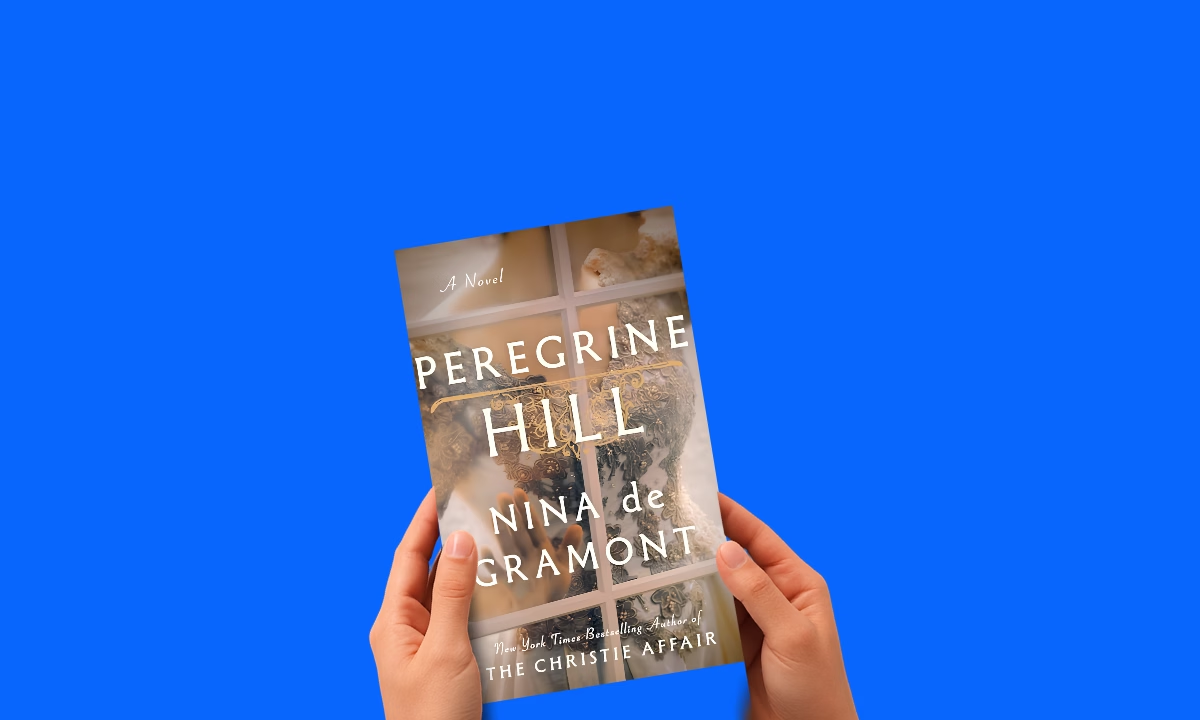
Peregrine Hill by Nina de Gramont is a new Gilded Age novel about a girl sold to a rich old man, or something sharper? It is sharper. The marriage is only the cover story. The real engine is two young women, a countess’s granddaughter and a Lower East Side maid, who use a magazine to talk back to the man who owns them.
Read it if you want a quick, clever historical novel with a slow-burning mystery at the back. Skip it if you need every plot thread tied off in the open.
At a glance
- What it is: a historical novel set in New York and Newport, 1901 to 1903, with an epilogue that jumps to 1907 and beyond.
- Core plot: eighteen-year-old Mariah Bishop is married to sixty-three-year-old John Whitten to save her family. She and her maid Hetty secretly write magazine stories about him.
- The ending in one line: Whitten dies in his bed after a dinner with Mariah’s grandmother, andPeregrine Hill strongly implies the grandmother is responsible.
- Best for: readers of The Christie Affair, Gilded Age fiction and mother and daughter stories.
- My rating: 4.3 out of 5.
Introduction
Peregrine Hill is a novel by Nina de Gramont, published by Simon & Schuster on November 10, 2026, in a 320-page hardcover (Simon & Schuster). De Gramont wrote the bestselling The Christie Affair. Peregrine Hill got a starred review in BookPage, which praised its parties, balls, secret romances and “questionable deaths” (BookPage).
I read it as the story of a girl who is traded like property and keeps writing anyway.
Quick Verdict
A sharp, quick-moving Gilded Age novel about a forced marriage, a secret writing partnership and a quiet act of family justice. Recommended for fans of historical fiction with teeth.
Should You Read It?
| Pros | Cons |
|---|---|
| Mariah and Hetty make a warm, believable pair | Paul and Ned are thinly drawn |
| The magazine-story plot is original and funny | The Isabelle and Jay kidnapping subplot strains belief |
| Isabelle is a flawed mother, not a villain | The final death is resolved by implication |
| Period detail feels lived in (telephones, motorcars, tenements) | The epilogue moves fast for a book this patient |
| Short chapters, strong momentum | Some readers will want more on Whitten’s inner life |
What Is It About?
After a shipwreck takes her father and three siblings, eighteen-year-old Mariah Bishop is married off to the very rich, much older John Whitten. Her mother pushes the match because the family is broke and Mariah has a secret. Locked inside a mansion with a spying secretary, Mariah and her maid Hetty Maloy start publishing stories about her husband in Harper’s Monthly.
Rating
4.3 / 5
Reader Recommendation
If you liked The Christie Affair for its voice and its refusal to let a real woman be a footnote, you will like Mariah. You will also enjoy this book if you love period houses, servants’ stairs and the small cruelties of rich households. Readers who dislike ambiguity at the end may bounce.
The final answer to “who did it” is a look, a walk and a snowfall, not a confession. People hunting for a romance should also look elsewhere. Mariah’s heart never softens toward her husband, and the book never pretends otherwise.
Background
De Gramont says Mariah was inspired by her own great-grandmother, Dona Maria Ruspoli, who was nineteen when she was married to the fifty-seven-year-old, twice-widowed Agenor de Gramont in 1908 (author’s letter in the book).
Peregrine Hill moves the story to America and starts it seven years earlier. The Gilded Age setting matters because telephones, motorcars and electric lights are arriving while women’s legal and economic lives stay stuck.
BookPage makes the same point about the era’s uneven “progress” (BookPage).
Peregrine Hill Plot Summary
Part One: After the Morrigan
Peregrine Hill opens in Hoboken in 1901. Isabelle Bishop, thirty-six, waits for John Whitten, a rich real estate man she hopes will marry her and save the family. Instead his secretary, Mr. Smythe, arrives.
He knows Isabelle’s eighteen-year-old daughter Mariah recently had a baby, and that Isabelle arranged an adoption. He says Whitten wants to marry Mariah, and he says it so politely that it sounds like a threat.
We learn the family’s history in flashbacks. In late 1899 the Bishops planned to spend New Year’s Eve at their lake house in Maine. Mariah stayed behind because her mother had a fever. Her father Daniel, sister Evelyn and brothers Leo and Samuel boarded the steamer Morrigan. It sank in a storm and no bodies were found. Money was already gone.
Jay Hopkins, an art student, then seduced Mariah in a garden shed, vanished when she became pregnant, and later wrote only to ask what would happen to the baby. Isabelle moved Mariah to Hoboken and arranged for the baby to be handed to a couple in New York.
Whitten, who is sixty-three, hosts them at his Newport house on the Fourth of July. He is jolly, vain and sure of himself. Two women around him matter. Lavinia Van Wye is a widow who hoped to be his third wife, and she watches the Bishops with envy and sympathy.
Her grandson Ned Cutting, a newly minted lawyer, flirts with Mariah to hide his love for Lavinia’s former maid, Hetty Maloy. Hetty is now Whitten’s parlor maid in his new Fifth Avenue mansion, the Peregrine Hill of the title.
Isabelle presses Mariah to accept. Mariah writes to Jay and learns he is engaged to a rich girl, Clara Stork. The night before the wedding, her grandmother Granny, the Countess de Forge, tells her that Whitten is old and will die. The wedding takes place in September 1901, a week after President McKinley is shot. Mariah says “I do” very quietly.
On the wedding night Mariah locks herself in the dressing room, waits for Whitten to fall asleep and runs through the dark to her mother’s house. Isabelle sends her back. Mariah finally understands that the “fair-haired woman” a fortune teller named Miss Marva once warned her about is her own mother. Back at the mansion, Smythe tells her she has proven she needs watching.
Part Two: The Blackford Widower
Whitten takes Mariah to London on honeymoon. Back home she is watched by Smythe wherever she goes. Mariah steals Whitten’s cane and spectacles in small acts of revenge. She learns she is pregnant. When Whitten goes to London for a wedding, she slips away to Boston to find Miss Marva. She meets old friends, and Jay tells her that he has found their daughter, Charlotte, in New York. Mariah refuses to want her. When she returns, Smythe has killed her dog Bisou as punishment. Whitten says it was a misunderstanding.
Hetty becomes Mariah’s closest ally. She finds a story Mariah has written about a rich old husband and a girl who dies by suicide, and she edits it. Mariah and Hetty agree to publish it as “The Blackford Widower” under the name H. M. Charles. Hetty brings it to Mr. Price, an editor at Harper’s Monthly. He buys it. It appears in September 1902 and gossips guess it is about a Boston banker. The women split the money. Hetty dreams of sending her sick father west for mountain air.
In Newport, Mariah finds Miss Marva again by placing an ad. She pays with seventy dollars. Miss Marva hands her a packet of powder that will “torture” Whitten without killing him. Mariah sprinkles it into his dinner, and it leaves him unable to make love to her.
Meanwhile, her mother has started an affair with Jay Hopkins, whom she meets for walks to watch Charlotte in Washington Square Park. Lavinia reads the story and guesses the author, but she cannot bring herself to expose Mariah.
Part Three: The Villain and the Ghost
In November 1902 Mariah gives birth to a son, Danny. She loves him at once. Smythe becomes humiliated after stepping in dog mess, and he is ordered to stay at the house. At a Valentine’s Day ball hosted by her friend Lady Cornelia Barrett, Mariah sees her mother and Jay together in a winter garden. Isabelle has realized she is pregnant by Jay.
They plan to take Charlotte and run.
The next morning Smythe confronts Hetty on the servants’ stairs. He knows about the Blackford stories and says so. Hetty steps back, and Smythe falls to his death with her cleaned shoes in his hands. Granny is the only witness.
It is left ambiguous whether it was an accident or something more. Whitten, in grief, finds the magazine in Smythe’s desk, accuses Mariah of knowing the author and collapses from his heart. Ned and Hetty’s romance comes out when Lavinia catches them kissing. Ned takes Hetty to meet her family in the tenement, and the visit goes badly.
Meanwhile, Jay and Isabelle have stolen Charlotte. A police matron, Mrs. Goodwin, visits Mariah. Mariah realizes where her mother has gone and takes a night steamer and train to Maine.
At Sebago Lake she finds her family’s old house, now owned by strangers, with Jay, Isabelle and Charlotte inside. Mariah waits until midnight, then walks in and puts her sapphire necklace, her rings and some money on the table. Isabelle looks at it, at Charlotte, and closes the bedroom door.
Mariah takes Charlotte back to New York and leaves her at a police station. Charlotte makes sure she is noticed.
Back at the mansion, Hetty has been offered a job in the advertising department at Harper’s, with some unofficial editing on the side. She and Ned part with love but no future. Lavinia now visits Whitten daily and plans to have Mariah committed to an asylum with a doctor’s signature. Whitten, still on morphine, agrees to everything.
At a dinner downstairs, Granny asks Whitten about his first two wives, and he drinks wine his nurse has forbidden. He mumbles that “Lavinia is seeing to it” and that he cannot make promises about Mariah’s future. The next morning, Whitten is found dead in his bed. The doctors write “cardiac disease.”
Epilogue
In June 1907, in Aix-en-Provence, Isabelle lives as Madame Laurent with Jay and their two children, Phillippe and Sylvie. A letter from Mariah arrives. It says only that Granny died on April 26. Isabelle waits for a signature that never comes.
Hetty’s family is sent to Estes Park with Mariah’s money. Her mother is not among the 146 workers killed in the 1911 shirtwaist factory fire.
Hetty becomes an editor, eventually at Harper Books for Boys and Girls. Miss Marva, now calling herself Shirley, lives at Peregrine Hill from time to time.
Mariah moves to Paris and spends the Whitten fortune. She comes back to New York during the war, finishes a novel called The True Story of Catherine Howard, and publishes it as Mariah Bishop. In 1921, in Florence, she sees a young woman with strawberry-blond hair and too many freckles, and she whispers “Charlotte.”
The last pages are a scene she never wrote down. On the morning Whitten died, she saw Granny walk out of the house in the snow, with Evelyn’s ghost blowing a kiss from the lawn. Granny does not look back. She lifts one hand in a wave. The reader is left to understand that the countess finished what the stories started.
Analysis and Critique
Characters
Mariah Bishop is Peregrine Hill‘s center. She starts as a girl who learned “lightness” from her family, and she keeps performing it to survive. Her best weapon is writing. She burns her pages in candle flames at first, which is a nice image of a voice that is not allowed to exist.
When Hetty tells her to keep them, she begins to write for readers.
Her cruelty to Whitten (stealing his cane, adding powder to his food) is petty and satisfying, and the book knows it.
Hetty Maloy is Peregrine Hill‘s quiet star. She is twenty-three, looks thirteen, speaks carefully and loves books. She is a half-Jewish Irish daughter of a would-be writer. Her scenes at home, with a sick father and an exhausted mother, ground the book’s class argument. She is also its best editor. Her instinct to cut the sparrows from the wedding scene and let Mrs. Blackford “be the birds” is the novel’s best craft moment.
Isabelle is the mother as antagonist, and de Gramont refuses to make her simple. She sold her daughter. She also grieves her three drowned children with a nearly physical pain, and she watches Charlotte in the park because it is the only thing that quiets her.
Her late-book turn, when she takes Jay and Charlotte to Maine, is frightening because it is so human.
John Whitten is a loud, lovable bully who cannot imagine his wife as a person. Peregrine Hill makes him pitiable and awful at once.
Lavinia Van Wye is the sharpest supporting character. She is a rival, an observer and sometimes an ally, and a moral failure when it counts.
Smythe is a cold, bodiless threat. Granny is the best surprise, a half-senile countess who turns out to be the only one with a plan.
Ned and Paul are the weakest. They are kind, good-looking men who offer rescue, and the book rejects both offers. That is the right choice thematically, though neither feels fully alive.
Themes and Symbolism
Marriage as a transaction. The motto “In this family, we marry for love” opens the book and is broken in the first chapter. The entire plot is a test of that sentence.
Writing as escape. The Blackford stories are Mariah’s real rebellion. They publish her anger under a man’s name and make a living of it. De Gramont’s letter at the end says Mariah “finds a way to give her unjust predicament a voice,” and the plot shows it working.
Fire and burning. Mariah burns her pages. Isabelle remembers a family story about a mother whose sleeve caught fire holding a baby. The fire at the shirtwaist factory in the epilogue is a historical echo of a world that burns women’s labor.
Birds and cages. Peregrine falcons are in the house’s name, a taxidermied falcon sits in a hall, and the sparrows at the wedding altar are trapped in glass. Hetty’s note that readers see a bird in a cage and want to set it free explains the whole book.
Ghosts and lives. Miss Marva’s idea that the “fair-haired woman” has thwarted Mariah in other lives gives the mother and daughter conflict an almost mythic weight. Evelyn’s redheaded ghost appears at turning points. It is a clean, restrained use of the supernatural.
Modernity and its limits. Telephones, electric lamps, motorcars and a planned elevator suggest progress. Yet the elevator is installed mostly because Smythe fell down the stairs, and a rich man still owns his wife.
Evaluation
Peregrine Hill is a velvet trap of a novel: all upholstery and parlor talk, with a hinge that swings shut on the reader around the halfway mark.
Strengths
The voice is crisp and funny, the chapters are short, and the friendship between Mariah and Hetty feels real. The mystery of how Whitten dies stays alive until the last paragraph. The period detail avoids lecture.
Weaknesses
Isabelle and Jay’s affair and kidnapping plot is hard to credit. Jay is a charming cipher. Ned and Paul feel like plot devices. The final death is solved by implication, which will satisfy some readers and frustrate others.
Comparison With Similar Works
Readers who loved de Gramont’s The Christie Affair, a 2022 Reese’s Book Club pick, will recognize the sly, female-centered take on history.
Another reviewer places Peregrine Hill beside Daisy Goodwin’s The American Heiress and Shana Abé’s An American Beauty (Mariella Hunt). Edith Wharton’s The House of Mirth is the classic ancestor, though de Gramont lets her heroine win.
Personal Insight With Contemporary Relevance
The angle I keep coming back to is the family “rescue” that is really a sale. Mariah is eighteen, so she is not legally a child in the book. Still, the logic is the one modern advocates describe. A family has a financial problem.
A girl has a secret.
A richer, older man offers a way out, and consent is a formality.
That is not only history. California has become the 18th state to ban child marriage, yet child marriage remains legal in 32 states (Outlook India). Unchained At Last found that nearly 315,000 children were legally married in the US between 2000 and 2021 (Stateline via News-Tribune). Equality Now reports that 86% were girls, most married to adult men (Equality Now).
Five lessons I took from Peregrine Hill:
- Ask who profits from a “rescue.” Isabelle calls the match an opportunity, and the family gets the roof.
- Secrets are leverage. Whitten’s hold on Mariah is her past, so shame is a tool.
- Money of your own changes the room. Mariah’s $142.25 from Harper’s is the first cash she controls.
- A pen name is protection, not cowardice. H. M. Charles lets two women say what they cannot sign.
- Help means an exit. Mariah gives Hetty a flat, a career push and a family trip west, and that is why Hetty’s story ends well.
Quotable Lines and Passages
- Chapter 1: “In this family, we marry for love.” It is Isabelle’s father’s motto, and the book dismantles it.
- Chapter 3: Miss Marva tells Mariah she must either go with her family or stop them from going. Mariah does neither, and the guilt shapes everything after.
- Chapter 9: Isabelle tells Mariah that secrets do not pour from a bucket, they leak, so she must marry now.
- Chapter 25: Hetty’s note that readers see a bird in a cage and want to free it, so Mrs. Blackford should be the birds.
- Chapter 56: Isabelle studies Mariah’s letter about Granny’s death and notices the missing “Love, Mariah.”
- Chapter 58: Asked if Whitten was cruel, Mariah always answers that at least she kept her head.
Conclusion
Peregrine Hill gave me what I wanted from a Gilded Age novel and a little more. It is entertaining, quick and angry, and it ends with a smile. Its emotional core is not romance but the repair of three broken relationships: a mother and daughter, two friends, and a girl and her own voice.
I recommend it to fans of The Christie Affair, readers of period fiction with a feminist edge, and anyone who enjoys stories about servants who know more than their masters. If you want a clear, single-answer ending, you may feel shortchanged.
If you like to be trusted to read between the lines, it is a treat.
Peregrine Hill
Peregrine Hill by Nina de Gramont is a new Gilded Age novel about a girl sold to a rich old man, or something sharper? It is sharper. The marriage is only the cover story. The real engine is two young women, a countess's granddaughter and a Lower East Side maid, who use a magazine to talk back to the man who owns them.
URL: https://www.sopranu.com/peregrine-hill-nina-de-gramont-ending-explained/
Author: Nina de Gramont
43