
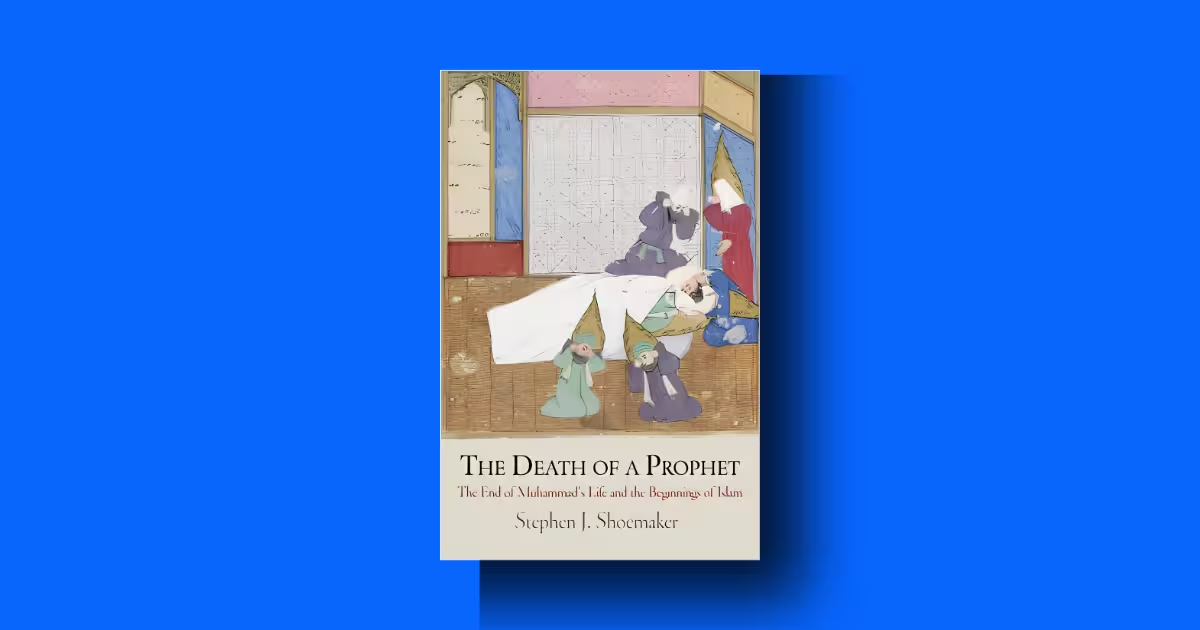

The Death of a Prophet: The End of Muhammad’s Life and the Beginnings of Islam is Stephen J. Shoemaker’s 2011 scholarly study arguing that the famous date for Muhammad’s death, 632 CE in Medina, is less secure than almost everyone assumes.
Shoemaker lines up eleven sources from the seventh and eighth centuries, Christian, Jewish, Samaritan and one Muslim, that describe the Prophet as still alive and leading his followers when the Arab armies entered Roman Palestine around 634.
His conclusion is modest on paper and explosive in practice: the earliest evidence puts Muhammad’s death somewhere between 632 and 635. The real target is bigger than a date. If the date moved, Shoemaker argues, it moved because early Islam itself changed, from a movement expecting the end of the world, centered on Jerusalem, into an Arabian imperial faith centered on Mecca and Medina.
I finished this book unsettled, a little irritated in places, and certain I would be arguing with it for years. That is usually the sign of a book worth your time.
Table of Contents
Brief summary
The Death of a Prophet argues that Muhammad may have died after the Arab invasion of Palestine began, not two years before it, and that the traditional Medina account was shaped later to fit a changed religion.
Author and publisher: Stephen J. Shoemaker, Professor of Religious Studies at the University of Oregon; University of Pennsylvania Press, series Divinations: Rereading Late Ancient Religion. Hardcover December 2011, paperback October 2015, 416 pages (Penn Press).
Core evidence: eleven non-canonical witnesses dated from 634 to the late eighth century, including the Doctrina Iacobi, the Khuzistan Chronicle (about 660), Jacob of Edessa (691/92), and a letter attributed to the caliph ʿUmar II.
Core method: tools from historical Jesus research, especially multiple independent attestation and the “criterion of embarrassment.”
Core claim about early Islam: Muhammad was an eschatological prophet who expected the Hour (the Final Judgment) very soon, possibly within his own lifetime.
Core claim about memory: once the Hour failed to arrive, the community shifted its holy land from Jerusalem to the Ḥijāz, and a death in Medina fit that new map better.
Bottom line on the date: Shoemaker concludes the evidence is best stated as either 632 to 635 or “at the very least circa 632” (p. 276).
My verdict: brilliant on method and on eschatology, weaker on Jerusalem and on some individual witnesses. Four stars out of five.
Reader Recommendation for The Death of a Prophet
You will love it if you:
read Tom Holland’s In the Shadow of the Sword or Fred Donner’s Muhammad and the Believers and wanted the footnotes argued out in full;
study the New Testament or early Christianity and want to see your methods tested on another tradition;
enjoy source criticism, where a single Hebrew verb or a misplaced line in a chronicle carries real weight;
are a student of late antiquity, Byzantium, or Syriac literature.
You will probably bounce if you:
want a readable biography of Muhammad (this is not one);
expect a verdict delivered with certainty (Shoemaker hedges constantly, and on purpose);
dislike academic prose, long endnotes, and names like Łewond and Agapius;
hold the sīra and ḥadīth as settled history and don’t want that questioned. Shoemaker says clearly that his study is “in no way aimed at casting doubt on the religious truth of the Islamic tradition” (p. 9), but the reading experience will still feel confrontational to many believers.
Introduction
The Death of a Prophet: The End of Muhammad’s Life and the Beginnings of Islam is a 2011 monograph by Stephen J. Shoemaker, published by the University of Pennsylvania Press. Shoemaker earned his PhD at Duke University in 1997 and teaches religious studies at the University of Oregon.
Before this book he was known mainly as a scholar of early Christian devotion to the Virgin Mary; his first book was The Ancient Traditions of the Virgin Mary’s Dormition and Assumption (2002). Since then he has published The Apocalypse of Empire (2018), the sourcebook A Prophet Has Appeared (2021), and Creating the Qur’an (2022, University of California Press).
That background explains the whole The Death of a Prophet. Shoemaker comes to Islam from the study of Christian origins, and he openly asks scholars of early Islam to accept the same suspicion toward their sources that New Testament scholars accept toward the Gospels.
Context: what kind of book is The Death of a Prophet?
The Death of a Prophet is academic history of religion. It is roughly 278 pages of argument followed by more than 70 pages of notes and a 38-page bibliography. The genre is source criticism: it reads old texts closely, asks who wrote them, when, and why, and then weighs them against each other.
Purpose: what is Shoemaker’s main thesis?
Shoemaker states his thesis plainly in the introduction. Non-Islamic sources that describe Muhammad leading the invasion of Palestine preserve “what is quite possibly a genuine early Islamic tradition” (p. 6). He insists the date itself is not the point.
The “larger purpose,” he writes, “lies not in the possibility of adjusting the date of Muhammad’s death by a few years” (p. 8). The discrepancy is an opening into what earliest Islam actually believed.
Background
The Death of a Prophet begins with Patricia Crone and Michael Cook’s Hagarism (1977), a slim and famously controversial book. Crone and Cook noticed that several early non-Muslim writers seemed to have Muhammad alive during the conquests.
They gathered the references into a single endnote and closed with one line: “The convergence is impressive” (quoted on p. 3).
Shoemaker’s complaint is that nobody ever tested that endnote properly. Robert Hoyland, whose Seeing Islam as Others Saw It catalogued these texts, noted what the Christian sources say and then, in Shoemaker’s view, sided with the Islamic tradition “without much explanation at all” (p. 7). Shoemaker also points out that neither Crone nor Cook ever retracted the idea in print. Cook later wrote that non-Muslim sources “suggest that Muhammad was still alive when the Muslim expansion outside Arabia began,” and Crone allowed that a death “two or three years later cannot be completely excluded” (both quoted on p. 7).
For context, the traditional date most readers know is June 8, 632, the date HISTORY.com gives for Muhammad’s death in Medina. The first Arab push into southern Palestine came in 633 to 634. Two years separate the two events in the standard story. The Death of a Prophet lives inside those two years.
The Death of a Prophet Summary
I have written this section so you could close the tab and still hold the book’s full case in your head. I follow Shoemaker’s order.
The method: what rules does Shoemaker use to judge sources?
Shoemaker uses four rules, and knowing them makes the rest of the book easy to follow.
Hoyland’s three questions. Where did the writer get the information (eyewitness, second hand, gossip)? Is the report a simple observation or part of a polemic? Is it something an outsider could actually see? (pp. 3 to 4)
Multiple independent attestation. If several unconnected sources say the same thing, invention becomes unlikely (p. 4).
The criterion of embarrassment. Material that clashes with later belief was probably not invented by later believers, because it causes them trouble (p. 5).
Suspicion of insider narratives. Being written by insiders does not guarantee accuracy, “any more so than one would presume that the Christian gospels accurately record the life and death of Jesus” (p. 10).
He backs the fourth rule with comparisons that stuck with me. The earliest Gospels came 40 to 70 years after Jesus, yet scholars can only date his death to between 28 and 33 CE. Traditions about Peter dying in Rome and John being buried in Ephesus appeared within about a century and are now widely doubted (p. 11).
Muhammad’s first surviving biography came about 120 years after his death (p. 75). Shoemaker’s question is simple: why trust the longer gap more?
Chapter 1: Which eleven sources say Muhammad was alive during the conquest?
Chapter 1, titled after the line “A Prophet Has Appeared, Coming with the Saracens,” is the evidentiary core. Here are the witnesses in Shoemaker’s order, with what each one actually says.
1. Doctrina Iacobi nuper Baptizati (Greek, set in July 634). This is the earliest surviving text to mention Muhammad.
It is a Christian dialogue set in Roman North Africa among Jews forcibly baptized in 632. A character reads a letter from his brother Abraham in Palestine, who reports hearing people say: “A prophet has appeared, coming with the Saracens” (p. 22). An old Jewish scholar replies that the man is false, “for prophets do not come with a sword and a war-chariot” (p. 22).
Shoemaker gives this text heavy weight because other sources confirm its details, such as the death of the Roman officer Sergius the candidatus at Arab hands (p. 23), and because the letter-writer claims to have talked with “those who had met him.”
2. The Apocalypse of Rabbi Shimʿōn b. Yoḥai (635 to 645?). This Jewish visionary text survives in eighth-century form but, as many scholars agree, reuses a much older source. An angel tells the rabbi that God will “raise up over them a prophet,” and “he will conquer the land for them” (p. 28). Shoemaker’s sharpest piece of philology is here.
Bernard Lewis’s 1950 translation made God the one who conquers. The Hebrew verb is ambiguous, and the Cairo Geniza and Munich versions clearly make the prophet the conqueror (pp. 29 to 30). A related text, the Ten Kings Midrash, says he will “come to Jerusalem and bow down there,” and only then “he will die” (p. 31).
3. The Khuzistan Chronicle (Syriac, about 660). Written in southwestern Iran less than 30 years after the events, it names Yazdgerd, Rustam and Heraclius as leaders on their sides and then says of the Arabs: “their leader was Muhammad” (p. 35).
4. Jacob of Edessa, Chronological Charts (691/92). Jacob, whom Shoemaker compares to Jerome in Syriac culture, gets Muhammad’s reign wrong (seven years, ending in 627/28), yet his chart places “the Arabs began to make raids in the land of Palestine” in the fifth year of that reign, two years before Muhammad’s death in his own count (p. 37). The absolute date is off. The sequence, Shoemaker argues, is what matters.
5. The History of the Patriarchs of Alexandria, Life of Benjamin (before 717). This Coptic-rooted text says Muhammad “took possession of Damascus and Syria, and he crossed the Jordan” (p. 39), and it says so in a neutral tone.
6. The Spanish Eastern Source (about 741). Behind two Latin chronicles from Islamic Spain lies a lost Eastern source, probably Greek and Syrian. The Byzantine-Arab Chronicle says the Saracens invaded Syria, Arabia and Mesopotamia “while one named Muhammad held the position of leadership over them” (p. 42).
Shoemaker cites Hoyland’s breakdown of that chronicle: 62 percent on Islamic history, 29 percent on Byzantium, just 9 percent on Spain (p. 42). The text is strikingly friendly to Islam, which makes deliberate slander unlikely.
7. The Syriac Common Source, the chronicle of Theophilus of Edessa (about 750). Theophilus was a Maronite scholar and court astrologer to the ʿAbbāsid caliph al-Mahdi.
His lost chronicle, reconstructed from later writers, has Muhammad leading raids into Palestine and then, once his followers grew numerous, staying home “while he sat in honor in Yathrib” (p. 50). Shoemaker reads this two-stage story as a blend of an older tradition and the new Islamic biography.
8. The Short Syriac Chronicle of 775. Its dates are odd, but it plainly says “Muhammad and the Arabs went forth from the south and entered the land and subdued it” (p. 53).
9. The Zuqnin Chronicle (about 775). Its author admits he lacked good sources for this period, yet he still reports that the Arabs “had defeated the Romans in battle under his leadership” (p. 54).
10. The Samaritan Continuatio. Attached to a fourteenth-century chronicle but, following Milka Levy-Rubin, likely preserving early reports, it opens: “the Ishmaelites, Muḥammad and all his army, went forth to wage war against the Byzantines” (p. 56).
Its other details check out: coastal Samaritans fled, and Caesarea held out through a siege of six years (p. 57). Shoemaker faults Levy-Rubin for rejecting only the Muhammad detail, and only because it contradicts Islamic tradition (p. 58).
11. ʿUmar II’s letter to Leo III (eighth century). This is the Muslim witness.
Reassembled by Jean-Marie Gaudeul from an Arabic fragment in Istanbul and a Spanish Aljamiado manuscript in Madrid, the letter says: “with him in whom we trust, and in whom we believe, we went off, bare foot, naked, without equipment… to fight” Persia and Byzantium (p. 63). The pronoun refers to Muhammad in context, and both Sourdel and Gaudeul translate it that way.
Shoemaker then ranks his witnesses. The first two and the last two are “of particularly high quality” (p. 65), and their independence from each other is the heart of his case. He also adds lateral evidence: a report from Kaʿb al-Aḥbār in Ibn Saʿd naming Mecca as Muhammad’s birthplace, Medina as his refuge, and Syria as “the land of his rule” (p. 67).
When does the other story first appear outside Islam? According to Shoemaker, the earliest non-Islamic text placing Muhammad’s death before the conquest is Łewond’s Armenian chronicle from the end of the eighth century, and the Greek chronicle of Theophanes in the early ninth century follows Islamic sources (pp. 71 to 72).
Even so, the older version lingered in Syriac writing into the Chronicle of 1234. In Shoemaker’s phrase, the tradition “died a hard death” (p. 72).
Chapter 2: How reliable is the Islamic account of Muhammad’s death in Medina?
Chapter 2 turns the same scrutiny on the Muslim sources. The oldest biography, Ibn Isḥāq’s Maghāzī, was compiled about 120 years after Muhammad’s death and survives only in later versions by Ibn Hishām (d. 833) and al-Ṭabarī (d. 923), with Ibn Hishām having “abridged and vigorously edited” it (p. 75).
Shoemaker retells the death scene as Ibn Isḥāq gives it: Usāma b. Zayd’s army is being sent toward Palestine; Muhammad falls ill after praying in Medina’s cemetery; he is nursed in ʿĀʾisha’s house; his wives give him an Ethiopian medicine; he chews a toothpick ʿĀʾisha softened for him; he dies in her arms; ʿUmar refuses to accept the death; Abū Bakr quiets him with a Qurʾānic verse; the succession is settled at the Saqīfa; and Muhammad is buried beneath his bed because “No prophet dies but he is buried where he died” (pp. 90 to 92).
Then he strips it down. What can be traced back to al-Zuhrī (d. 742), Ibn Isḥāq’s teacher? A sudden illness, a town setting, wives in separate houses, and a nearby place of prayer. What cannot be traced earlier than Ibn Isḥāq? The name Medina in the death traditions, and the timing before the conquest (pp. 93 to 98). In other words, the story’s location and chronology are its latest layers.
Is sīra chronology trustworthy at all? Shoemaker gathers a heavy consensus that it is not. Henri Lammens showed the dates obey a strict numerical symmetry: prophecy at 40, then 10 years in Mecca and 10 in Medina, death at 60 in the most common version (p. 103).
Uri Rubin noticed this mirrors Moses, called at 80 and dying at 120, cut exactly in half (p. 104). Lawrence Conrad found that, well into the second Islamic century, scholarly opinion on the Prophet’s birth date varied across 85 years (p. 104).
Patricia Crone’s line about the sīra, quoted here, is merciless: “one can take the picture presented or one can leave it, but one cannot work with it” (p. 100).
Shoemaker then collects the odd data that point to a later death:
- a few reports giving Muhammad thirteen years in Medina, not ten, which with a hijra in 622 puts his death in 635 (p. 104);
- Arab-Sasanian coins and the historian Sayf b. ʿUmar implying a hijra in 624/25, which would place a death ten years later in 634/35 (p. 105);
- the battle of Muʾta (629), where soldiers wanted to send word to a Muhammad supposedly 750 kilometers away in Medina (p. 108), and where the Byzantine presence the story needs is hard to square with Persian troops leaving Palestine only in July 629;
- the Tabūk expedition, the largest army Muhammad ever gathered, 30,000 men against the 3,000 sent to Muʾta, which met no resistance and yet turned home (p. 110);
- Usāma’s raid ordered toward Ubnā (Yubnā) on Palestine’s coast, which Ibn Isḥāq tells twice in different places (pp. 111 to 112).
His most memorable point concerns Tabūk. On the way home, Muhammad draws water from a rock, repeating the very miracle that in Numbers 20:12 barred Moses from entering the Promised Land. Shoemaker calls this “surely no mere coincidence” (p. 116).
Like Moses, the biographers’ Muhammad leads his people toward the land but does not enter it, leaving the conquest to a companion, as Moses left it to Joshua.
Yet he admits typology alone cannot explain so large a change. Something bigger must have shifted. That sets up the second half.
Chapter 3: Was Muhammad an end-times prophet?
Chapter 3 is, for me and for several reviewers, the best part of The Death of a Prophet. Shoemaker argues that Muhammad was an eschatological prophet who, like Jesus in E. P. Sanders’s reading, expected the end very soon.
He starts with a surprising historiographical story. Early European scholars such as Snouck Hurgronje, Frants Buhl and especially Paul Casanova saw the coming Judgment as central to Muhammad.
Then Richard Bell and W. Montgomery Watt reshaped the English-language picture into a rational social reformer. Bell did not want Muhammad to look like “a crack-brained enthusiast” (p. 120). Shoemaker traces that reformer image through F. E. Peters, Maxime Rodinson and Karen Armstrong, and argues it resembles the nineteenth-century liberal Jesus that Albert Schweitzer demolished.
His evidence from the Qurʾān: the coming judgment is “the second most common theme of the Qurʾān, preceded only by the call to monotheism” (p. 120). Most time-related verses call the Hour near or about to fall; only four add a “perhaps,” and a single one allows that it may be postponed (pp. 165 to 166).
Shoemaker suggests those softer verses may be later adjustments, and he frames this not as “forgery” but as “a gradual, perhaps even subconscious, transformation” by believers living with delay (p. 169).
His evidence from ḥadīth, judged by the criterion of embarrassment:
- the “two fingers” tradition, found in Muslim’s Ṣaḥīḥ among others: “I have been sent with the Hour like this,” with the index and middle fingers joined (p. 172);
- “If this young man lives, the Hour will arrive before he reaches old age” (p. 174);
- the report, studied by Meir Kister, that the first Medina mosque should be built as “a booth like the booth of Moses,” because the end would come sooner than a proper roof was needed (p. 175);
- a promise that some who saw Muhammad would live to see the Dajjāl (p. 176).
He also shows later scholars working hard to stretch these sayings. Al-Ṭabarī reasoned that the index finger is one-fourteenth shorter than the middle finger, and with a world age of 7,000 years, the Hour must be 500 years after Muhammad (p. 173).
The chapter’s boldest move concerns Qurʾān 3:144, “Muhammad is naught but a Messenger… if he should die or is slain…” In Ibn Isḥāq’s account Abū Bakr recites it to silence ʿUmar, and then the text adds that “it was as though the people did not know that this verse had come down until Abū Bakr recited it that day” (p. 180).
Following Silvestre de Sacy, Gustav Weil, Hirschfeld and Casanova, Shoemaker argues the verse is probably a later addition written to handle a death nobody expected.
He supports this with an older version of the scene in which al-ʿAbbās, not Abū Bakr, answers ʿUmar without quoting any verse at all (pp. 185 to 186), and with a report in Ibn Saʿd where ʿUmar says he could not believe the death “because he [Muhammad] said that he thought that he would be the last of us [alive]” (p. 187).
He also rejects the idea that such a rethink required a conspiracy.
His model is early Christianity, which moved from a Jewish apocalyptic sect to the philosophical theology of Justin Martyr and Valentinus within about a century (p. 194). He also backs de Prémare and Chase Robinson in dating the standard Qurʾān text to ʿAbd al-Malik (r. 685 to 705) rather than ʿUthmān, citing the variant Qurʾānic wording in the Dome of the Rock inscriptions (pp. 147 to 149).
Chapter 4: Did early Islam begin with Jerusalem at its center?
Chapter 4 links the end-times hope to two further changes: who counted as a believer, and which land was holy.
Who belonged. Following Fred Donner, Shoemaker describes an early “community of the Believers” open to Jews and apparently Christians who professed faith in God and the Last Day.
Evidence includes the Constitution of Medina, the Rabbi Shimʿōn apocalypse, and Sebeos, an Armenian history from the 660s. Sebeos, drawing on a Palestinian source and on eyewitnesses held captive in Arabia, has Muhammad tell the sons of Abraham to “go and seize your land, which God gave to your father Abraham” (p. 200).
James Howard-Johnston, quoted here, calls Sebeos the source that “offers the best hope of reaching back to seventh-century historical reality” (p. 201). Shoemaker even suggests ʿUmar’s title al-Fārūq (“the savior”) may reflect Jewish messianic language (p. 204).
Which land was holy. Shoemaker cites Qurʾān 33:27 (heirs to “a land which you have not yet trodden”), 10:13 to 14, and 21:105, which echoes Psalm 37:29 on the righteous inheriting the land (p. 219).
He reviews the Jerusalem qibla and argues it was neither brief nor merely a courtesy to Medina’s Jews. Jacob of Edessa, writing between 684 and 688 from what he “saw with my own eyes,” says Muslims in Egypt prayed east and Muslims in Ḥira and Baṣra prayed west, the same directions as the Jews facing Jerusalem (p. 226).
The mosque at Kūfa (638) faced west, and an early Islamic cemetery at Qasṭal al-Balqāʾ in Jordan has burials oriented toward Jerusalem (p. 227).
He sides with S. D. Goitein over Ignác Goldziher: Jerusalem’s sanctity was a genuine early belief, not an Umayyad political trick invented during the Second Civil War against ʿAbd Allāh ibn al-Zubayr (from 683). The Dome of the Rock, in his reading, served as a stand-in for the Temple while believers awaited its restoration at the end (pp. 241 to 242, 262).
How the Ḥijāz rose. Under the Marwānids and especially the ʿAbbāsids, shrines to Muhammad multiplied across Mecca and Medina, down to “the place where his cooking pot stood” (p. 257). Yet the earliest accounts of al-Walīd’s rebuilding of the Medina mosque in the early eighth century do not mention Muhammad’s tomb at all (p. 258).
Shoemaker also notes that nearly all early biographers, al-Zuhrī, Ibn Isḥāq and ʿUrwa among them, were Medinans, which invites some “local boosterism” (p. 258).
His synthesis: a Jerusalem-focused, end-times movement would naturally remember its prophet leading them into the Promised Land to meet the Hour.
Once the Hour receded and Islam became an Arab imperial faith with its own holy land, that prophet needed to die and be buried in the Ḥijāz. Early Islam, he notes, made this shift in less than a century, where Christianity took “roughly three and a half centuries” (p. 264).
Conclusion: What does Shoemaker finally claim?
The closing chapter, “Jesus and Muhammad, the Apostle and the Apostles,” runs a thought experiment borrowed from Patricia Crone.
Imagine our only Gospel were written by Clement of Alexandria and survived only in Origen’s revision, while ten independent non-Christian sources put Jesus’ death two or three years later in Tiberias. Would New Testament scholars simply trust the church’s date? Shoemaker thinks not (pp. 270 to 272).
He compares the sīra not to the canonical Gospels but to the apocryphal Acts of the Apostles, and he notes how uncertain the deaths of Peter and Paul remain.
His final judgment is careful: “it does not seem that we can give a precise date for Muhammad’s death any more” (p. 276). He admits the non-Islamic sources might be wrong, yet says the sīra adjusting an older tradition is “just as likely.”
He closes with Michael Cook’s three points of friction between Muslim and non-Muslim sources (the date of the death, Jewish membership, and Jerusalem), and argues all three are one story.
The Death of a Prophet Analysis
The Death of a Prophet is a bold, rigorous and sometimes overreaching book, the kind that changes the questions a field asks even where its answers wobble. I found it more convincing on what early Islam hoped for than on exactly when its prophet died.
Does Shoemaker support his argument with evidence?
Mostly yes. His strength is transparency: every witness is quoted, dated and graded, and he states his rules before using them. Where he stretches, he usually says so, using words like “speculative” about Tabūk (p. 111) and about Theophanes’ odd word for Muhammad’s end (p. 72).
The weak point is that the eleven witnesses are uneven. Paul Neuenkirchen’s review in Studia Islamica (2016) observes that about half of them do not explicitly have the Prophet taking part in the conque. I agree. A chronicle naming Muhammad the “first king” as Palestine falls is not the same as an eyewitness seeing him on the road to Gaza.
Does The Death of a Prophet fulfill its purpose?
It fulfills its stated purpose, which was never to prove a new date. It proves that 632 rests on less than readers assume, and that non-Muslim sources deserve a seat at the table.
Fred Donner, whose own work Shoemaker both builds on and disputes, called it “a work of utmost importance” with “profound implications for our understanding of how Islam began”.
A reviewer in the Journal of the American Oriental Society, also quoted by the publisher, praised its “sophisticated and thorough discussion.”
Strengths: what I found compelling
The Hebrew verb in the Rabbi Shimʿōn apocalypse. Watching a 1950 translation choice quietly erase Muhammad from a Jewish text was the moment The Death of a Prophet won my attention.
Chapter 3 on the Hour. The “two fingers” ḥadīth, the booth-like mosque, and ʿUmar’s panic make a coherent picture that is hard to wave away. Neuenkirchen, otherwise critical, also calls this chapter the book’s most accomplished.
The Moses pattern. The water-from-the-rock episode at Tabūk is a sharp piece of literary detective work.
Fair framing. Shoemaker says outright that secular and confessional readings are “certainly valid” in their own communities (p. 9), and he argues that exempting Islam alone from historical criticism is itself a kind of “othering” (p. 17). I appreciated that he treats Muslim readers as adults.
Weaknesses: where I pushed back
The Doctrina Iacobi’s date is less secure than the book suggests. Shoemaker leans on a composition “very soon after” 634. Sean W. Anthony, in Der Islam (2014), argued that “the 670s might, therefore, actually be the best period in which to date the Doctrina Iacobi“.
If Anthony is right, the book’s star witness moves roughly four decades away from the events.
Jerusalem as the original center is argued by accumulation, not proof. The qibla data are messy, including mosques at Wāsiṭ that point toward neither Jerusalem nor Mecca (p. 228), which Shoemaker himself calls “truly aberrant.” Neuenkirchen also found this part unconvincing.
“Ecumenical” may be too tidy. The Qurʾān contains sharp polemic against Jews and Christians, and a community “open” to them is harder to picture than Shoemaker lets on.
The Shiʿa corpus is largely ignored, a point Neuenkirchen also regrets.
Qurʾān 3:144 as interpolation is plausible but rests mostly on one line in Ibn Isḥāq. Many readers will see this as the least necessary risk in The Death of a Prophet.
The prose is dense. Paragraphs routinely run a full page, and some arguments with Hoyland and Donner repeat across chapters.
On balance, my pleasant experience was intellectual: The Death of a Prophet made me reread passages of the Qurʾān on the Hour with fresh eyes. My unpleasant experience was the sense, in Chapter 4, that a strong case for early end-times hope was being asked to carry a weaker case about geography.
Books Like The Death of a Prophet
If you finish The Death of a Prophet and want more, these are the closest companions, with honest differences.
| Book | Year | How it compares |
|---|---|---|
| Patricia Crone and Michael Cook, Hagarism | 1977 | The spark. Far more radical and far less careful with sources; Shoemaker keeps its best idea and drops its “messianism” (p. 16). |
| Robert Hoyland, Seeing Islam as Others Saw It | 1997 | The catalogue of non-Muslim sources that Shoemaker mines, with a more cautious conclusion on the death date. |
| Fred M. Donner, Muhammad and the Believers | 2010 (Harvard) | The “community of Believers” thesis Shoemaker adopts. Donner is more trusting of the Islamic narrative. |
| Tom Holland, In the Shadow of the Sword | 2012 | A popular, vivid narrative drawing on the same revisionist scholarship; easier to read, less rigorous. |
| W. Montgomery Watt, Muhammad at Medina | 1956 | The social-reformer portrait Shoemaker spends Chapter 3 arguing against. |
| Stephen J. Shoemaker, A Prophet Has Appeared | 2021 | His own sourcebook translating many of the texts in Chapter 1; the ideal next step. |
| Stephen J. Shoemaker, Creating the Qur’an | 2022 | Extends his argument on a late, ʿAbd al-Malik-era standardization of the text. |
If you enjoy the method more than the topic, E. P. Sanders’s work on the historical Jesus and Albert Schweitzer’s The Quest of the Historical Jesus are the direct models Shoemaker names. For a broader view of the thinkers whose methods shaped how we read old texts, see our piece on the 10 greatest thinkers and ideas of all time.
Conclusion
The Death of a Prophet is an important and uncomfortable book. It does not prove that Muhammad died in 634 or 635, and Shoemaker never claims it does.
What it proves, to my satisfaction, is that the date of 632 comes from sources written a century later, that at least four independent early witnesses tell a different story, and that the gap between them points to a religion that changed quickly after its founder’s death.
Who benefits most? Graduate students and scholars in Islamic studies, late antiquity, Byzantine and Syriac studies, and New Testament studies. Serious general readers who already know the outline of early Islamic history will also get a lot from it, especially Chapters 1 and 3.
Is it for general audiences? Only partly. If you want a first book on Muhammad’s life, start elsewhere and come back. If you want to know how historians actually argue about the beginnings of Islam, and what is at stake when they do, read this one slowly, with a pencil, and with Anthony’s and Neuenkirchen’s reviews beside it.
My rating: 4 out of 5. Brilliant method, a superb chapter on the Hour, and a thesis on geography I am still not sure I accept.
References
- Shoemaker, Stephen J. The Death of a Prophet: The End of Muhammad’s Life and the Beginnings of Islam. Philadelphia: University of Pennsylvania Press, 2011. All page numbers above refer to this edition.
- Penn Press book page: publication dates, page count, and endorsements from Fred Donner and the Journal of the American Oriental Society.
- Stephen J. Shoemaker, official site: position, PhD, and bibliography.
- Paul Neuenkirchen, review in Studia Islamica (2016).
- Sean W. Anthony, “Muḥammad, the Keys to Paradise, and the Doctrina Iacobi,” Der Islam 91:2 (2014).
- UC Press Luminos, Creating the Qur’an.
- HISTORY.com, “Muhammad, the prophet who spread Islam, dies, June 8, 632”.
- Cambridge Core, review listing for Donner’s Muhammad and the Believers (Harvard, 2010).





