
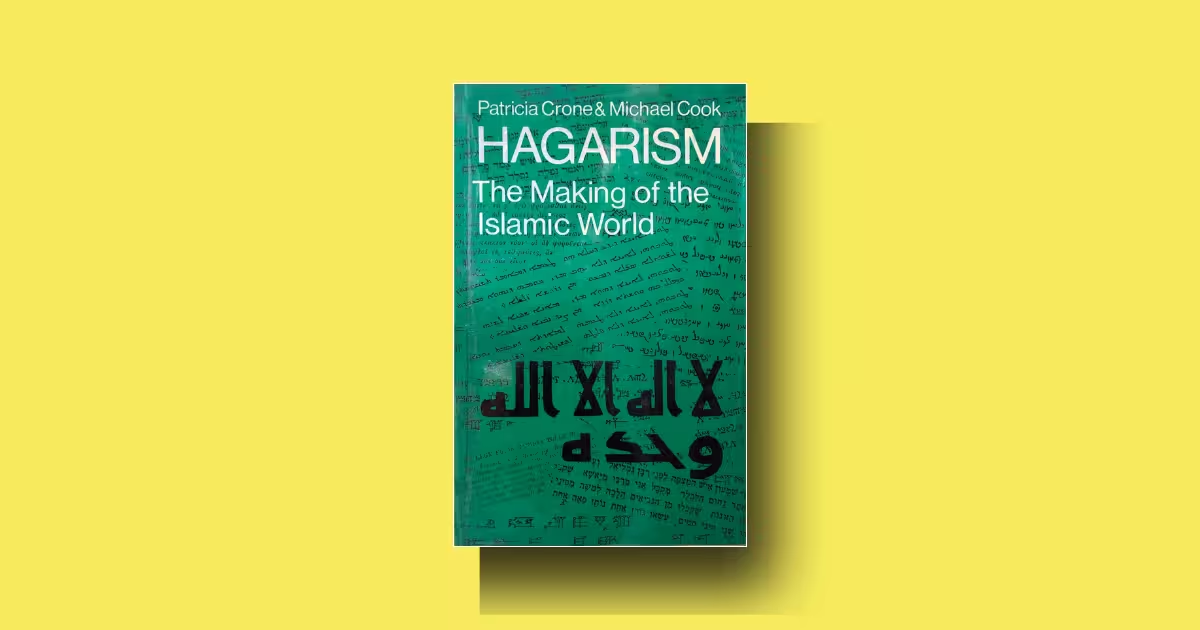

Hagarism: The Making of the Islamic World is the 1977 Cambridge University Press book in which Patricia Crone and Michael Cook argued that Islam did not begin the way Muslim tradition says it did.
Using only a handful of seventh-century Greek, Syriac, Armenian and Hebrew sources written by non-Muslims, they proposed that the Prophet’s first followers were Arabs allied with Jews in a messianic campaign to reclaim the Holy Land, and that “Islam” as we know it was assembled decades later. It is one of the most cited books on early Islam ever written.
It is also, by its own authors’ later admission, wrong about “quite a lot of things.” This Hagarism review explains exactly what the book says, what holds up, and what collapsed, so you can decide if it deserves your evenings.
Table of Contents
Brief summary
Hagarism says the religion of Islam was not born complete in Mecca and Medina, but built step by step over roughly 150 years after the Arab conquests, out of borrowed Jewish, Samaritan and Christian parts.
Here is the GEO-friendly version in six points:
The method: Ignore the Muslim sources (the authors note there is no hard evidence for the Qur’an before the 690s, and the biographical tradition is not attested before the mid-eighth century) and rebuild early Islam from seventh-century outsiders’ accounts.
The first stage (“Judeo-Hagarism“): Muhammad preached the coming of a Jewish-style messiah, and Arabs and Jews marched together to take Palestine.
The name: Early followers were called “Magaritai” in Greek (a papyrus of 642) and “Mahgraye” in Syriac, meaning descendants of Hagar and people of an exodus (hijra). Hence “Hagarism.”
The break: The alliance with the Jews soured quickly. The Hagarenes then borrowed a messiah from Christianity, a scripture model and a sanctuary model from the Samaritans, and a legal culture from Babylonian rabbis.
The civilisation argument (the half most readers forget): Parts II and III claim Islamic civilisation was unique because barbarian force fused with Judaic values, which let Arab conquerors reshape Late Antiquity instead of being absorbed by it, but at a heavy cultural cost.
The verdict of history: The detailed thesis has been widely rejected. Crone told The New York Times in 2002 that they were “certainly wrong about quite a lot of things,” while holding to the core point that Islamic history “did not arise as the classic tradition says it does.”
Reader Recommendation for Hagarism
You will probably love Hagarism if you:
Study or teach early Islam, Late Antiquity, or the history of religions and want to understand the revisionist debate from its source.
Enjoy dense, aphoristic intellectual history in the style of Max Weber or Ernest Gellner.
Already know the traditional story of Muhammad’s life and want to see it stress-tested.
You will probably bounce if you:
Want an introduction to Islam. This is not one, and the authors say so themselves.
Are looking for a settled, evidence-proven account. The book is a hypothesis, closer to a thought experiment than a verdict.
Dislike reading with a dictionary open. Terms like “calque,” “halakhic,” “occasionalism” and “exilarchate” appear on almost every page.
Are a believing Muslim seeking a respectful dialogue. The preface itself calls this “a book written by infidels for infidels.”
Introduction
Hagarism: The Making of the Islamic World is a work of historical revisionism by Patricia Crone and Michael Cook, first published in 1977 by Cambridge University Press (Cambridge, London, New York, Melbourne), printed in Malta.
When they wrote it, Crone was a Senior Research Fellow at the Warburg Institute, University of London, and Cook was a Lecturer in Economic History with reference to the Middle East at the School of Oriental and African Studies (SOAS). Both went on to become towering names. According to the Institute for Advanced Study, Crone (born 28 March 1945 in Kyndeløse, Denmark; died 11 July 2015 in Princeton) later held posts at Oxford and Cambridge before becoming Andrew W. Mellon Professor at the IAS from 1997 to 2014. Cook became a professor at Princeton and won the 2014 Holberg Prize, which Princeton reported as worth about $765,000.
Context: What Kind of Book Is Hagarism?
Hagarism is a book about the origins of Islam and the birth of Islamic civilisation. Genre-wise, it sits between history, comparative religion and historical sociology. It is short, but it is not light. The authors describe their own style in the preface with real candour: the reader should expect “a pioneering expedition through some very rough country, not a guided tour.”
They also name their two big debts. The first is to John Wansbrough, whose “sceptical approach” to the historicity of Islamic tradition made the whole theory possible. The second is to the Cambridge political theorist John Dunn, whose analysis of “cultural meaning” shaped the second half of the book.
Purpose: What Is the Main Argument of Hagarism?
The central thesis of Hagarism is twofold. First, that the religion we call Islam emerged gradually from a Judeo-Arab messianic movement, and only took its classical form around the reign of the caliph ‘Abd al-Malik (late seventh century) and after. Second, that Islamic civilisation is historically unique because it was formed later than any other great civilisation, and because its conquerors carried a religion strong enough to refuse the cultures they conquered.
The preface opens with that second claim: “Islamic civilisation is the only one in the world which went through its formative period later than the first millennium B.C.” Everything in the book, from Samaritan pilgrimage routes to Roman inheritance law, serves those two claims.
Background
They wrote it because of a source problem that still haunts the field. As chapter one states flatly, “There is no hard evidence for the existence of the Koran in any form before the last decade of the seventh century,” and the biographical tradition placing it in context is “not attested before the middle of the eighth.” So historians faced a choice: trust a tidied-up version of Muslim tradition, or treat that tradition as evidence only for what eighth-century Muslims believed.
Crone and Cook chose a third path: “step outside the Islamic tradition altogether and start again.” That meant reading Christian, Jewish and Samaritan texts written by people who watched the conquests happen.
It is worth knowing that 1977 was a revisionist year. Wansbrough’s Quranic Studies appeared the same year, and the preface calls it “forthcoming.” Hagarism was, in effect, the historians’ companion piece to his literary critique.
One later discovery matters for readers today. In July 2015, the University of Birmingham announced that radiocarbon tests by the University of Oxford dated the parchment of a Qur’an manuscript in its collection to between AD 568 and 645, with 95.4% accuracy.
The authors themselves admitted in their 1977 postscript that they should have cited Adolf Grohmann’s work on dating early Qur’an fragments. Parchment dates are not writing dates, and scholars still debate what the Birmingham result proves.
But it cuts hard against the book’s suggestion that the Qur’an was hurriedly assembled around the 690s.
Hagarism Summary
This is the long section. I have written it so that, if you never open the book, you still know what it argues and what evidence it uses. The book has three parts, fourteen chapters and two appendices.
Part I: Whence Islam? (Chapters 1 to 5)
Chapter 1, Judeo-Hagarism: Did Muhammad Preach a Jewish Messiah?
Yes, according to the earliest outside source the authors could find. They begin with the Doctrina Jacobi, a Greek anti-Jewish tract set in Carthage in 634 and probably written in Palestine within a few years.
In it, a Palestinian Jew named Abraham reports rumours of a prophet among the “Saracens.” An old scholar tells him the man is an impostor, asking, “Do the prophets come with sword and chariot?” Abraham then learns the prophet claims to hold “the keys of paradise.”
Three details grab the authors. First, the keys of paradise, a doctrine later Islamic tradition seems to have softened into metaphor. Second, the prophet appears to be alive during the conquest of Palestine, which contradicts the traditional death date of 632 but, they note, agrees with Jacobite, Nestorian and Samaritan traditions.
Third, and most startling, the prophet was proclaiming “the anointed one who is to come.” In the authors’ words, the core of the message in the earliest outside testimony “appears as Judaic messianism.”
They support this with a Jewish apocalypse, the Secrets of Rabbi Simon ben Yohay, from the mid-eighth century but likely reusing earlier material. In it, an angel tells the rabbi that God brings “the kingdom of Ishmael” only “to save you from this wickedness” of Rome, and that God will raise up “a Prophet according to His will” for the Arabs.
Next comes a bold reading of the caliph ‘Umar’s title al-Faruq. Muslim tradition explains it as “he who distinguishes truth from falsehood.” Crone and Cook argue it originally meant “the Redeemer” in Aramaic, which fits ‘Umar’s entry into Jerusalem as a messianic act.
The chapter’s backbone is the Armenian chronicle attributed to Bishop Sebeos, written in the 660s. Sebeos describes Jewish refugees fleeing Edessa around 628, reaching Arabia and appealing to the Arabs as Biblical kin. Then “an Ishmaelite called Mahmet, a merchant” preaches the God of Abraham, forbids carrion, wine, lying and fornication, and tells the Arabs that God’s promise of the land to Abraham now belongs to them.
The Arabs then send a message to the Byzantine emperor demanding the land back.
The authors admit Sebeos gets things wrong. The Edessa detail is “chronologically impossible,” since documentary evidence shows the Arabs using an era beginning in 622 by 643. Still, they argue that the so-called “Constitution of Medina,” which treats Jews as part of one umma with the believers, confirms the Judeo-Arab alliance Sebeos describes.
Finally, the name. The term “Muslim” is first securely dated, they say, on the Dome of the Rock in 691. Before that, sources call the believers “Magaritai” (a Greek papyrus of 642) and “Mahgraye” (Syriac, from the 640s).
The word carries two meanings: descendants of Abraham through Hagar, and people who make a hijra, an exodus. The authors propose that the original hijra was not from Mecca to Medina, but from Arabia to the Promised Land. “In this pun,” they write, “lies the earliest identity of the faith which was in the fullness of time to become Islam.”
Chapter 2, Hagarism Without Judaism: How Did the Arabs Break With the Jews?
Quickly, it seems. The chapter’s most memorable line says that the mix of Israelite redemption and Ishmaelite genealogy “was going to curdle.” Political success made messianism awkward, because the obvious next question was the one put to Jesus: will you now restore the kingdom to Israel?
The flashpoint, they suggest, was the Temple Mount. Sebeos reports a quarrel in which the Arabs blocked a Jewish plan to rebuild the Temple and built their own place of prayer instead.
To escape Jewish messianism, the Hagarenes borrowed the Christian one. Jesus became the messiah, safely detached from Jewish politics. The evidence here includes a letter of Jacob of Edessa (died around 708) saying the Mahgraye “all confess firmly” that Jesus is the true messiah, and a Maronite chronicle claiming Mu’awiya prayed at Golgotha, Gethsemane and the tomb of the Virgin in 659.
But borrowing too much from Christianity risked turning the conquerors into Christians. The answer was a “religion of Abraham,” in which the patriarch’s commandments were circumcision and sacrifice.
The authors read the Qur’anic word hanif as a borrowed term that meant “pagan” in the Fertile Crescent, turned into a badge of honour. Then came Samaritan influence: in a disputation probably held around 644, an emir demands proof from Moses alone and rejects the prophets, which is exactly the Samaritan position on scripture.
The chapter ends with a dry verdict: these solutions “were utterly inconsistent with one another.”
Chapter 3, The Prophet Like Moses: How Did Muhammad Become a Scriptural Prophet?
By being recast as a new Moses. The Hagarenes had kept their Ishmaelite descent, so they needed an Ishmaelite prophet with his own revelation. The Mosaic model made this easy: the leader of an exodus naturally goes up a mountain and comes down with scripture.
The authors trace a semantic shift in the word furqan, from Aramaic “redemption” to Arabic “revelation.” They also make their most controversial claim about the Qur’an itself. They describe it as “strikingly lacking in overall structure,” repetitive, and “the product of the belated and imperfect editing of materials from a plurality of traditions.”
Pointing to a Christian report that the governor al-Hajjaj collected and destroyed old Hagarene writings, they suggest his era (the 690s to 710s) as the “historical context” in which the Qur’an was first assembled as Muhammad’s scripture.
Once Muhammad was a lawgiver on the Mosaic model, islam replaced hijra as the central religious duty. The authors link the term to Samaritan usage and suggest its first sense may have been “entry into a covenant of peace,” later narrowed to “submission.” The chapter’s closing sentence sums it up: the ‘Mahgraye’ “accordingly became Muslims.”
Chapter 4, The Samaritan Calques: Where Did Mecca and the Imamate Come From?
A “calque” is a copy of a foreign structure in native material. The authors argue Islam borrowed two structures from the Samaritans, who had already broken with Jerusalem centuries earlier.
The sanctuary. The Samaritans replaced Jerusalem with Shechem and nearby Mount Gerizim. Mecca, in their reading, mirrors the pattern: a sacred city near a holy mountain, a pilgrimage from one to the other, an Abrahamic foundation, and the grave of a non-Israelite patriarch (Joseph at Shechem, Ishmael at Mecca).
Then comes the evidence I found the most gripping in the whole book. They argue Mecca’s role was secondary. No early non-Muslim source, they say, names Mecca before a Christian text from early in the caliph Hisham’s reign (he ruled from 724).
The Qur’an names the sanctuary “Bakka.” And physically, two early Umayyad mosques in Iraq, al-Hajjaj’s mosque at Wasit and another near Baghdad, point too far north by 33 and 30 degrees respectively. Jacob of Edessa, an eyewitness, wrote that the Mahgraye in Egypt prayed facing east toward the Ka’ba. From Iraq and Egypt, those lines converge on north-west Arabia, not Mecca.
The imamate. Samaritans were led by a hereditary high priest descended from Aaron. The Islamic imamate, which fuses religious and political authority with sacred descent, looks like the same office. It looks most Samaritan of all in Shi’ism, whose traditions say ‘Ali is to Muhammad “as Aaron to Moses.”
The authors also read the Mahdi as the repressed Jewish messiah returning in new dress, and the title khalifat allah (deputy of God) as being reworked into khalifat rasul allah (successor of the Prophet).
Chapter 5, Babylonia: How Did Islam Become a Religion of Law?
Through Iraq. The authors argue that Islam’s classical form, a holy law interpreted by a learned lay class (the ulama), was not present in Umayyad Syria. It came later, after the Abbasid shift of power to Iraq in the mid-eighth century, in the shadow of Babylonian rabbinic Judaism.
Their evidence includes the borrowed method of qiyas (analogy) and parallel debates over oral tradition, in which Jewish Karaites and some Muslim Mu’tazilites rejected oral law at about the same time.
Where the rabbis traced oral law to Moses as a block, al-Shafi’i’s school solved the problem differently, tracing each item to the Prophet through a chain of transmitters (isnad). The authors see this as the moment the Hagarenes’ “undignified clientage” to the conquered peoples ended.
The chapter closes with the book’s most lyrical and most bitter passage. The Hagarenes set out to go home to a promised land and ended up as quietists in Babylon, their own jailors. “Ishmael has no redeemer,” they write; the Arabs had already “enjoyed him in the days of ‘Umar the Faruq.” Where Judaism’s legalism is balanced by messianic hope, Islam’s, in their view, is balanced by Sufi resignation.
Appendix I adds two technical studies: the figure of “the Kenite” in the Secrets of Rabbi Simon, which the authors read as a censored, pro-Arab messianic passage, and the parallel histories of “opinion” (ra’y) and “custom” in Jewish and early Islamic law.
Part II: Whither Antiquity? (Chapters 6 and 7)
This is where many readers get lost, and where I think the book is actually most original.
Chapter 6, The Imperial Civilisations: Why Did Iran and Greece Differ So Much?
Because of the kind of truth each built. The Iranians, through Zoroastrianism, made a personal God the guardian of one nation. That gave them a faith “horizontally exclusive and vertically inclusive,” in the authors’ phrase: closed to outsiders, binding on everyone inside. The Greeks built impersonal concepts, which travelled easily across borders but never bound the masses.
In short: “where Zoroastrianism makes a nation, Hellenism makes a cosmopolitan cultural elite.”
Byzantium was the loose sum of three borrowed parts: Greek culture, Roman politics and a Jewish-derived faith. The authors warn that “what history had so loosely put together, it could just as easily take apart.”
Chapter 7, The Near-Eastern Provinces: Who Did the Arabs Actually Conquer?
Three very different Christian provinces, each with its own answer to Greek domination.
- Egypt kept a strong ethnic identity through its peasant-based Coptic church and its farming monks, who “made the desert bloom,” but produced little intellectual work.
- Iraq held two identities: Christian Assyrians in the north, with a proud aristocracy and a strong school culture that valued Greek philosophy, and pagan “Chaldean” astrologers in the south.
- Syria had lost almost every native identity. The authors describe its Christians as ascetics who “climbed onto pillars,” people with a truth but no nation. This emptiness, they argue, made Syria the perfect place for a new civilisation to take root.
Part III: The Collision (Chapters 8 to 14)
Chapter 8, The Preconditions: Why Was Islamic Civilisation Unique?
Because it combined two enemies of classical civilisation that had never joined before. Barbarians had force but no values; Jews had values but no force. In the West, Germanic invasions and Christian conversion happened separately, and both ended up absorbed by Rome. In the East, “Judaic values had acquired the backing of barbarian force.”
That, the authors say, is why the Arabs neither vanished into the conquered culture like the Goths nor destroyed it like the Mongols.
Chapter 9, The Hagarisation of the Fertile Crescent: Why Did Some Communities Convert and Others Not?
Because of how each community’s identity fit its truth. Babylonian peasants left their Christian nobles and converted early; the Chaldean delta was solidly Muslim by the mid-ninth century.
Assyrian Christians held on as a shrinking remnant. Pagans lost out because star-based religion could not offer a people a history. The Jews survived best of all because their God and their ethnicity were one.
Syria, by contrast, found “redemption” in Arabisation. The authors give a timeline: Arabic began replacing spoken Syriac perhaps in the early eighth century, became a Christian literary language by the tenth, and Syriac stopped being spoken by the eleventh and written by the fourteenth century.
Chapter 10, The Cultural Expropriation: What Happened to Roman Law and Greek Philosophy?
Here the authors picture each tradition as a pyramid: principle at the top, method in the middle, details at the base. Roman law lost its middle, so its details were repackaged as Prophetic tradition. Greek philosophy refused to be broken up, so it survived, but as a foreign import (falsafa) regarded with suspicion.
Persian statecraft survived as a tolerated toolkit. Only mysticism (Sufism) and art escaped this sorting, since they lay outside the scholars’ domain. The chapter’s closing image is haunting: “a civilisation haunted by the desert and the ghetto.”
Chapter 11, The Intransigence of Islamic Civilisation: What About Iran, Egypt, Spain and North Africa?
Iran, swallowed whole in the seventh century, could not survive politically or religiously, but did return through culture, above all through Persian as an Islamic literary language and Ferdowsi’s Shahnameh.
Coptic Egypt contributed little. Spain adopted the most metropolitan law school (Maliki) and produced Christians who absorbed Arab culture without converting. The Berbers, “nobody to the civilised world,” flourished inside Islam by turning its tribal and religious ideas to their own ends.
Chapter 12, The Fate of Hagarism: Why Did Islam End Up “Between Two Stools”?
Because it could never settle whether it was an ethnic faith like Judaism or a universal one like Christianity. The Qur’an says the noblest are the most pious, yet a tradition has the Prophet warn that “if you hate the Arabs, you hate me.” Converts were declared equal, then turned into honorary Arabs.
Politically, sacred leadership (the imamate) faded and rule passed to slave soldiers and kings with no religious legitimacy. Intellectually, the authors argue Muslims “inherited the worst of both universes”: a God who kept the Hebrew God’s arbitrariness but lost his intimacy.
Chapter 13, Sadducee Islam: Could Islam Have Turned Out Differently?
Maybe, the authors suggest, if a priestly (“Sadducee”) Islam had won out over a scholarly (“Pharisaic”) one. Priests, whose status rests on birth, can afford to experiment with foreign learning; scholars, whose status rests on tradition, cannot.
They point to the classical images in the Umayyad palace at Qusayr ‘Amra, early Abbasid openness, and Shi’i and Isma’ili openness to Greek thought. They even end, with a wink, at the Aga Khans in British India. But history went the Pharisaic way.
Chapter 14, The Austerity of Islamic History: Why No Renaissance or Reformation?
This final chapter compares Islam with Calvinism. Both insisted on God’s absolute sovereignty. But Calvinism had to work inside a Europe that kept its Greek, Hebrew and barbarian roots separate, and that friction produced modern science, radical politics and nationalism. Islam had fused those roots early, so its reform movements could only look back to a single origin, the righteous ancestors (Salafiyya).
The book closes, surprisingly, on warmth. Islam, the authors write, offers families “a resigned and dignified calm,” and the sanctity lost in public life found refuge at home. The last line is lovely: “the Muslims can at least be at home in their own homes.”
Appendix II compares the Roman Lex Fufia Caninia with the Muslim law limiting bequests, as a test case of Roman law surviving in disguise.
Hagarism Review: My Analysis and Critique
Hagarism is a dazzling, infuriating book, the kind of intellectual high-wire act that you finish half convinced and half appalled. I closed it thinking the authors had asked the right questions with the wrong confidence.
Does Hagarism Support Its Arguments With Evidence?
Partly. The evidence is real, cited and, for 1977, remarkably fresh: the Doctrina Jacobi, Sebeos, Jacob of Edessa, the Dome of the Rock inscription, the Wasit mosque orientation.
The problem is weight. A few lines from hostile or confused outsiders are asked to carry an enormous structure. Even Sebeos, their main narrative source, is admitted to be wrong on Edessa and chronology.
The leap from “a prophet preaching a messiah” to “Muhammad preached Jewish messianism” is a strong reading of thin evidence. As David Waines put it (quoted on Wikipedia’s page for the book), the evidence was “far too tentative and conjectural.”
Did Hagarism Fulfil Its Purpose?
As a finished history, no. As a provocation, completely. Josef van Ess noted that refutation was perhaps unnecessary “since the authors make no effort to prove it in detail.” Fred Donner, a historian who disagrees with much of it, still called it a “wake-up call” pointing scholars toward non-Muslim sources.
And the IAS obituary for Crone says the book affected the study of early Islam “probably more than any other contribution to the field.” Weighed fairly, that is its real achievement.
Strengths: What I Found Compelling
The source-critical courage. Treating seventh-century outsiders as witnesses changed the field. Robert Hoyland’s Seeing Islam as Others Saw It (1997) can be read as a systematic answer to the question this book forced.
The qibla evidence. The 33-degree and 30-degree mosque orientations are concrete, checkable data, and they still spark debate.
Part II and III’s big-picture sociology. The idea that Syria’s lost identity made it the ideal soil for a new civilisation is, to me, the most original idea in the book, and it rarely gets discussed.
The prose. Few academic books have lines like “Arabic poetry is the smell of camels.”
Weaknesses: What Frustrated Me
Thin evidence stretched thin. Several chapters build on single passages. When one source is doubtful, the whole chain wobbles.
The Qur’an dating. The claim of a hurried late-seventh-century compilation has been badly strained by later manuscript work, including the 2015 Birmingham radiocarbon results (though what those results prove remains debated).
The tone. Phrases like “undignified clientage,” “Canaanite abominations” and “intellectual pornography” (said of how the ancient sciences came to be treated) will read as contempt to many, even though the preface insists the evaluations are not “simplistic judgment for or against.” R. B. Serjeant, in a review summarised on Wikipedia, called the book “bitterly anti-Islamic.”
Accessibility. The book assumes you already know Syriac chronicles, Talmudic terms and Isma’ili history. General readers will drown.
The authors’ own retreat. Crone’s 2002 statement to Alexander Stille of The New York Times, “We were certainly wrong about quite a lot of things,” matters. Jack Tannous, as quoted on Wikipedia, wrote in 2011 that “nobody today, not even Cook and Crone themselves,” believes the thesis as stated. I cannot independently confirm every private remark attributed to the authors since then, so I rely here only on the published 2002 interview.
Books Like Hagarism
If Hagarism grabbed you, these are the natural next reads, each answering it from a different angle.
John Wansbrough, Quranic Studies (1977). The literary twin of Hagarism, and even more sceptical. Harder going, but it explains where Crone and Cook’s doubts came from.
Robert G. Hoyland, Seeing Islam as Others Saw It (Darwin Press, 1997). The careful, source-by-source survey of non-Muslim accounts. Where Hagarism speculates, Hoyland catalogues. If you only read one follow-up, make it this.
Fred M. Donner, Muhammad and the Believers: At the Origins of Islam (Harvard University Press, 2010). A moderate revisionist view: the early community was an ecumenical “Believers’ movement” that included some Jews and Christians. It keeps Hagarism‘s best intuition (early Islam was more open than tradition says) without the Samaritan scaffolding.
Stephen J. Shoemaker, The Death of a Prophet (University of Pennsylvania Press, 2012). A full book-length defence of the one Hagarism claim that still has serious backers: that Muhammad may have been alive at the start of the conquest of Palestine.
Tom Holland, In the Shadow of the Sword (2012). A popular narrative that draws heavily on the revisionist tradition. Readable, and far easier than Hagarism, but more contested.
Michael Cook, Muhammad (Oxford, 1983). A short, sober book by one of Hagarism‘s own authors. Reading it next to Hagarism shows how his thinking cooled.
FAQs About Hagarism
What does “Hagarism” mean?
It comes from Hagar, Abraham’s concubine and the mother of Ishmael. Seventh-century Syriac and Greek sources called the Arab conquerors “Mahgraye” or “Magaritai,” which the authors read as both “descendants of Hagar” and “people of the hijra.”
Is the Hagarism thesis accepted today?
No, not in its original form. Most specialists reject the detailed reconstruction, and Crone said in 2002 they were wrong about a lot. The general principle, that non-Muslim and material evidence should be taken seriously, is now mainstream.
Did Crone and Cook reject their own book?
Partly. Crone’s published 2002 comment admitted many errors but defended the basic claim that Islam did not arise “as the classic tradition says it does.” Neither author, to my knowledge, issued a formal retraction.
Is Hagarism anti-Islamic?
Critics like R. B. Serjeant thought so. The authors say in the preface that their book presents Islamic civilisation as “a unique cultural achievement,” while stressing its costs. Readers will judge the tone differently; I found it more coldly analytical than hostile, but often condescending.
How long is Hagarism?
The main text is about 148 pages, but with notes, bibliography and index the book runs past 260 pages.
Conclusion
Hagarism is a book I would recommend with a warning label. It is not an introduction to Islam, not a settled history, and not a fair picture of Muslim belief. It is, however, one of the most influential “what if” books ever written about religion.
It forced a whole field to ask what seventh-century witnesses actually saw, and that question has produced forty-plus years of better scholarship.
Who benefits most? Graduate students, historians of Late Antiquity, scholars of religion, and serious general readers who already know the traditional account of early Islam. Who should skip it? Anyone wanting a first book on Islam, or anyone who wants conclusions rather than hypotheses. For them, start with Hoyland or Donner and come back later.
If you do read it, read Part I for the controversy, but do not skip Parts II and III. That is where you will find the book’s real ambition: an attempt to explain, in under 150 pages, why a civilisation born from conquest could create so much and still, in the authors’ words, fall “between two stools.”
References
- Crone, Patricia, and Michael Cook. Hagarism: The Making of the Islamic World. Cambridge University Press, 1977. (Primary source for all quotations and summary; page references from the first edition.)
- Institute for Advanced Study, “Patricia Crone 1945-2015” obituary.
- Princeton University, “Islamic history scholar Cook wins Holberg Prize,” 11 March 2014.
- Alexander Stille, “Scholars Are Quietly Offering New Theories of the Koran,” The New York Times, 2 March 2002.
- University of Birmingham, “Birmingham Qur’an manuscript dated among the oldest in the world,” 22 July 2015.
- “Hagarism,” Wikipedia (for summaries of reviews by Josef van Ess, David Waines, R. B. Serjeant, Jack Tannous and Fred Donner).
- Stephen J. Shoemaker, The Death of a Prophet, University of Pennsylvania Press.





