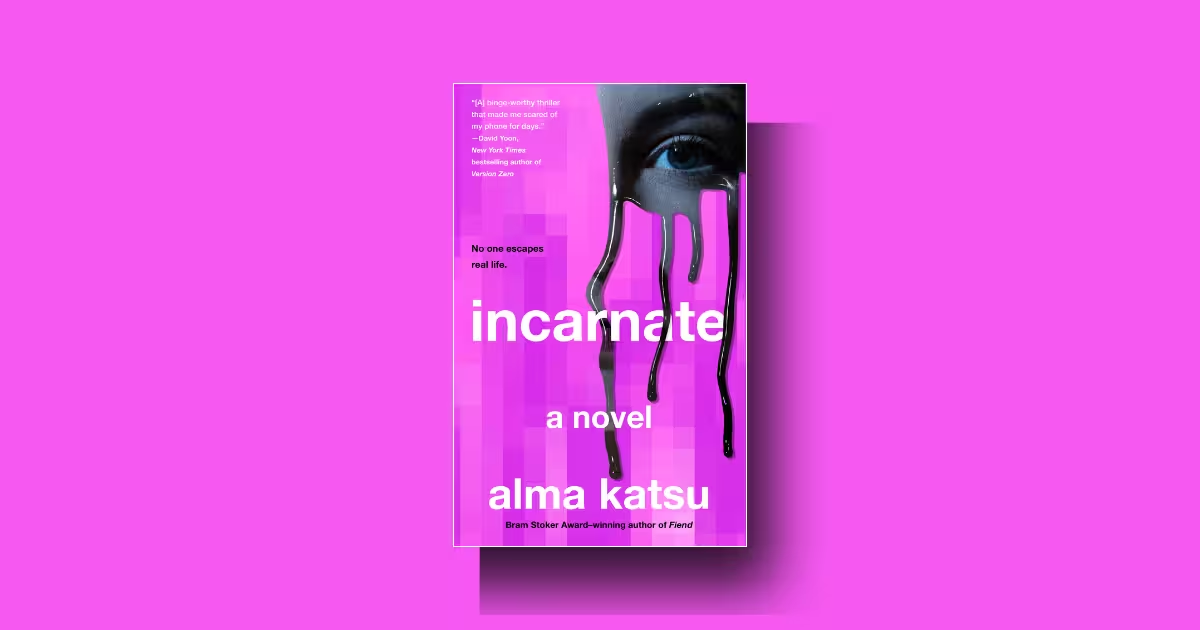

Incarnate by Alma Katsu (G.P. Putnam’s Sons, 2026) is a techno-horror novel about Dorothy Wagner, a lonely VFX artist who creates a viral AI influencer named Isabella using her employer’s proprietary motion capture files. When a mysterious internet entity offers to make Isabella famous in exchange for an unnamed future payment, Dorothy accepts.
The price turns out to be her own body, which gradually transforms into a physical replica of Isabella, and eventually her sanity and humanity. The novel functions as a twenty-first-century retelling of The Picture of Dorian Gray, examining how social media has made us willing to trade authenticity for attention and physical perfection.
Table of Contents
Who will love Incarnate:
- Readers who enjoyed Katsu’s previous horror novels like The Hunger and The Deep
- Anyone interested in Black Mirror-style tech horror
- People who’ve wondered about the dark side of influencer culture
- Fans of contemporary Faustian bargain stories
Who might bounce:
- Readers seeking traditional supernatural horror
- Those uncomfortable with graphic violence
- Anyone looking for a likable protagonist, Dorothy is deliberately difficult
Introduction
Alma Katsu’s Incarnate arrived in 2026 at a moment when artificial intelligence had already begun reshaping how we create and consume media.
The author’s background as a former intelligence analyst and technology forecaster for the RAND Corporation gives the novel an unsettling authenticity, this isn’t speculative fiction from someone guessing about where technology might lead us. Katsu watched these developments unfold professionally before turning to fiction.
The novel runs approximately 350 pages across thirty-four chapters, with an epilogue set two years after the main events.
It’s published by G.P. Putnam’s Sons and represents Katsu’s continued exploration of horror through historical and contemporary lenses. Unlike her earlier works, Incarnate is firmly grounded in the present moment, perhaps the most immediate and recognizable setting she’s tackled.
Background
Katsu spent years evaluating emerging technologies for their potential to disrupt society before retiring in 2017. In her afterword, she explains that she was “one of the US intelligence community’s first social media researchers,” sifting through metadata and measuring social networks while the average user was “like the audience at a magic show, delighted to be deceived.” This professional perspective informs every page of Incarnate.
The timing of the novel’s development coincided with real-world breakthroughs in AI video generation. Katsu notes in her afterword that OpenAI’s Sora “burst onto the scene” while she was writing, “popping out realistic, wholly fabricated video from text, no visual imagery of any kind needed.” This forced revisions to the manuscript and made the story feel less like speculation and more like documentation.
Incarnate also draws on research about social media’s effects on mental health, particularly for young women. Dorothy’s childhood experience with cyberbullying mirrors documented cases that have made headlines over the past decade, grounding the supernatural elements in uncomfortable reality.
Incarnate Summary
Part One: The Bullying and the Bargain
The novel opens with twelve-year-old Dorothy Wagner undergoing a psychological evaluation at a treatment facility. Three girls—Amber, Megan, and Hailey, have been tormenting her, culminating in a drawing Dorothy made of Amber that her classmates interpreted as obsessive. The bullying escalated to text messages telling Dorothy to kill herself.
But as the session with Dr. Gruber reveals, Dorothy isn’t quite the innocent victim she appears. When Amber later ends up in a diabetic coma with a suicide note planted nearby, the reader begins to understand that Dorothy’s plan for revenge went beyond simply telling adults about her mistreatment. The gym teacher found Amber in time, but the incident hinted at something cold and calculating in young Dorothy.
A decade later, Dorothy is twenty-one and working as a VFX artist for Tomas Delgado, whose viral #NotJessPerry deepfakes made him a rising star in the industry. She’s moved from New Jersey to Los Angeles, living on a friend’s couch, and spending her evenings in the studio “like a monk in a cell,” as Katsu writes, perfecting her craft and studying Tomas’s techniques.
When pop star Catrina Villeneuve comes to the studio for motion capture work on an AI-generated advertising campaign, Dorothy sees her opportunity. Despite being assigned only previz work, she delivers a polished, completed reel that demonstrates her extraordinary talent. Tomas is stunned, telling her “I see you, Dorothy.”
But Dorothy’s ambitions go further. Working late one night after everyone has left, she begins experimenting with Villeneuve’s motion capture files. She creates a new face, one based on statistical analysis of beauty standards and her own artistic instincts. She names the creation Isabella.
“You want Isabella to be popular, right?” a text from an unknown number asks. “To get all the attention you deserved but never got. You want Isabella to be a celebrity. A star.”
Thus begins Dorothy’s correspondence with the troll—an entity that communicates exclusively through text messages and DMs, promising to make Isabella famous in exchange for an unnamed price to be determined later. Dorothy agrees, reasoning that “she’s agreeing to, really? It’s not like she’s signing a contract. It’s two strangers exchanging DMs.”
Part Two: Isabella Takes Over
The first image of Isabella goes live on Instagram. When Dorothy wakes the next morning, it has over two hundred likes and nearly as many followers. Within a week, after the notorious “hair video” that showcases Isabella’s impossible spun-honey-gold tresses, the account has hundreds of thousands of followers.
“Get me an answer. She’s AI: yes or no,” Tomas demands, with the New York Times asking him to weigh in. Dorothy deflects, claiming the metadata is corrupted. Internally, she’s conflicted—she wants to confess, but she also wants to see “his surprise, then his pleasure at seeing how she’s blossomed under his guidance.”
Meanwhile, Dorothy’s body begins changing. Initially, it’s leg pain she attributes to “growing pains,” but her clothes start fitting differently. She’s getting taller. Then her face begins to morph, subtly at first, then unmistakably. When she looks in the mirror, she sees Isabella looking back.
“I must become invisible,” she thinks, echoing the desperate wish of her twelve-year-old self.
By the time she approaches lawyer Herb Zeilman to handle Isabella’s business affairs, Dorothy has transformed enough that she can pass for her creation. She sets up shell companies, offshore accounts, and approaches Claire Cameron—Tomas’s own business manager—about representing Isabella. The audacity of stealing her boss’s manager is breathtaking, but Dorothy has convinced herself that “she’s just looking out for herself.”
Part Three: The Influencer Lifestyle
Isabella’s rise is meteoric. “There’s a new queen of Instagram,” declares a New York Times headline. The account amasses millions of followers in weeks, a phenomenon media experts call “unprecedented.” Social media influencer management CEO Sonia Blackwood notes that Isabella has “captured the public consciousness” in a way that only figures like Kendall Jenner and Pamela Anderson have managed.
Dorothy hires Claire as Isabella’s manager, communicates only through email (claiming a “bad illness” and temporary loss of voice), and maintains absolute control over content production. She tells Claire that Isabella insists on privacy—no photographers, no directors, complete creative control.
When Charli, a mega-influencer with 113 million followers, invites Isabella to a weekend gathering in San Diego with other top creators, Dorothy accepts. The trip proves disastrous. She brings a trail cam for security and accidentally captures Mr. Fantastic (Tony Lamotta) sneaking into her room to steal a pair of her underwear. When Dorothy confides in Davey Rasmussen, known as the Annihilator, about the footage, he secretly records their conversation and posts the video to his YouTube channel.
The fallout is brutal. Tony and the other influencers turn on Dorothy, pressuring her to destroy the evidence. She refuses and leaves. The online war escalates: Tony’s fans bombard Isabella with death threats and deepfake revenge porn, attempting to dox her. Dorothy retaliates with her own deepfake showing Tony in compromising situations.
Then comes the news that Tony has been in a catastrophic car accident. His trainer is dead; Tony survives but with irreversible damage. “Serves him right,” a voice says in Dorothy’s head.
Part Four: The Body Count Rises
Davey emails Dorothy a warning: “If I’d known you were under His protection, I never would’ve gotten involved.” The troll has other clients—other desperate people who made deals they couldn’t understand.
Claire begins investigating Isabella’s background and finds disturbing gaps. There’s no paper trail, no verifiable history, and the lawyer Claire meets is obviously shady. When Claire shows up at Tomas’s studio unannounced, she finds Dorothy sitting at his desk, wearing a disguise. Manuel inadvertently calls her “Dorothy,” and Claire’s suspicions crystallize.
Dorothy tries to explain, admitting she used Tomas’s files without permission, but Claire insists on telling Tomas immediately. “You’re going to need a lawyer,” Claire says, reaching for her phone. “I can’t have a client who won’t tell me the truth.”
What happens next is portrayed in chilling, semi-dissociative prose:
“She stands directly over Claire, who struggles to get to her feet. Dorothy picks up the sculpture. It’s heavy and—wait, why is she holding it? The voice clamors in her head (save me, save me) as she brings it down on Claire’s face, again and again, until the woman is no longer moving.”
Dorothy flees. She copies all evidence onto a hard drive, erases the logs, and boards a plane to Chicago, then Istanbul. Through a black market forger, she obtains an Irish passport under the name Aoife Gallagher. She settles in rural Ireland, then Scotland, and eventually Norway.
A suicide note “from Isabella” is discovered at a ferry terminal, along with clothing identifying her. The online world mourns the influencer who confessed to murder and took her own life. The investigation into Claire’s death sputters. Dorothy, now Aoife, has apparently gotten away with everything.
The Ending Explained
Two years pass. Dorothy lives quietly in Oslo, working gig jobs for overseas tech companies, walking in the park, considering whether to contact her mother. She’s lonely but safe.
Then a noise starts coming from behind the walls.
“Knock knock knock.”
She retrieves the hard drive from her attic and opens the Isabella files. Isabella has aged—wrinkles, sagging flesh, graying hair. “Without attention, I withered,” the avatar tells her through the voice in her head that is now indistinguishable from the troll’s.
“You put Hanna on the internet,” the voice says. Dorothy has been working on a new avatar called Hanna. “Now he can find you.”
“He’s coming, Dorothy. It won’t be long.”
The pain returns, striking her face first, and she crawls to the bathroom floor. The implication is clear: The troll has decided to collect on the rest of the bargain. The transformation that made her Isabella is reversing, breaking her body apart bone by bone.
Two weeks later, Norwegian police respond to a report of a strange smell. They find a dead body in Dorothy’s apartment—but it isn’t Dorothy’s. The deceased is a woman who has been beaten and broken, unrecognizable. A passport identifies her as Aoife Gallagher, but it doesn’t match the corpse’s appearance.
Detective Freya Nielsen receives a report noting that the DNA matches an Interpol case: “A missing American wanted for questioning in a murder.” The body is handed over to Interpol, and Freya’s attention returns to her Instagram feed.
The final scene shows Freya scrolling through social media, following a new cast member of a Norwegian reality show. As the algorithm suggests accounts, a face catches her eye. Red hair like the girl in Brave. Green eyes staring directly at the viewer. A confident, slightly cocky posture.
“Her name is Hanna. The girl next door.”
Freya’s thumb hovers over the follow button. She notices someone else she follows has the same bio, but what does it matter? “The internet is nothing but an echo chamber, anyway.”
She clicks.
The troll has found new prey. Or perhaps the cycle continues.
Incarnate Analysis and Criticism
Incarnate Characters
Dorothy Wagner is one of the most genuinely unsettling protagonists I’ve encountered in contemporary horror. She isn’t a monster in the traditional sense—or rather, she’s a monster who believes she’s still a victim.
When she kills Claire, she dissociates completely: “It felt like she watched from a distance. Like someone stepped into Dorothy’s body while her consciousness looked away.” This psychological defense mechanism is terrifyingly plausible.
Her childhood experiences with bullying are meant to explain, if not excuse, her hunger for recognition. But Katsu shows how that hunger has always had a dark component. As a twelve-year-old, she plotted to murder her tormentor and make it look like suicide. The novel returns to this memory through her mother’s voicemail in the final act: “Did you kill that woman? I couldn’t help but think of…Amber.”
Tomas Delgado functions as both mentor and foil. He’s genuinely talented, genuinely kind, and genuinely oblivious to what’s happening under his nose. When he tells Dorothy “I see you,” it’s the validation she’s craved her entire life—and it comes far too late to matter. His trust in her becomes the vehicle for her betrayal.
Claire Cameron is the smartest character in the novel and the only one who might have been able to stop Dorothy. Her investigation, her confrontation, and her death at Dorothy’s hands represent the intersection of competence and powerlessness. Claire did everything right and still died because Dorothy was willing to do anything to protect her creation.
Isabella is less a character than a symbol, though her “aging” in the files is one of the novel’s creepiest touches. She exists only as images and motion files, yet she has a presence that eclipses every human in the story.
The moment when the voice speaks through her, “I’m your baby. Don’t let her end me”, blurs the line between avatar and entity.
Incarnate Themes and Symbolism
The Digital Faustian Bargain: The troll is never explained—no origin, no motivation, no identity. He’s the devil as internet troll, communicating through texts and DMs, making offers that sound too good to be true because they are. “You need to stop being afraid all the time,” he tells Dorothy. “Don’t let the world hound you into hiding your gifts.” His temptations are tailored to her specific wounds.
Attention as Currency: The novel repeatedly emphasizes that attention is “the most precious and fragile substance in the world, doled out by capricious algorithms, subject to the whims of the masses.” Dorothy’s transformation is powered by attention—Isabella’s popularity fuels her physical change. When she abandons Isabella, the avatar ages. When she creates Hanna, the troll can find her again.
The New Dorian Gray: Katsu explicitly cites The Picture of Dorian Gray as inspiration in her afterword. But instead of a portrait aging while the subject stays young, here the avatar represents the idealized self—and the real self must transform to match it. The cost is pain, isolation, and eventual destruction.
Social Media as Identity: The novel asks whether we’ve reached a point where curated online personas have become more real than our physical selves. “Perception is reality,” one character states. Dorothy’s physical transformation literalizes this claim.
Incarnate Evaluation
Incarnate is an important, unsettling novel that captures something essential about our current cultural moment. Katsu has written what might be the first great horror novel about influencer culture, and she’s done it with the precision of someone who understands both the technology and the psychology behind it.
Strengths:
- The pacing is relentless, especially in the second half
- Dorothy’s psychological deterioration feels earned rather than sudden
- The ending resists easy closure, suggesting the cycle continues
- Katsu’s technical knowledge gives the VFX industry details authenticity
Weaknesses:
- Some supporting characters feel underdeveloped (Angelica’s arc ends abruptly)
- The troll’s lack of explanation may frustrate readers who want answers
- The middle section’s influencer drama occasionally drags
Impact:
I found myself checking my phone less frequently after finishing this book. That’s not a coincidence—Katsu has written a novel that makes the devices in our pockets feel genuinely threatening. The voice in Dorothy’s head that may or may not be the troll, that may or may not be her own rationalization, echoes the intrusive thoughts we all experience in the age of constant connectivity.
Comparison with Similar Works:
Readers who enjoyed Black Mirror episodes like Nosedive and Be Right Back will find similar themes here. The novel also shares DNA with Chuck Palahniuk’s work in its willingness to follow protagonists into genuinely dark territory.
Personal Insights: 5 Lessons from Incarnate
1. The Algorithm Rewards Extremity, Not Authenticity
Dorothy’s creations go viral not because they’re genuine but because they’re perfectly calibrated to trigger engagement. The novel demonstrates that algorithmic amplification doesn’t care about truth, it cares about attention.
2. Our Devices Are Always Listening
“That’s what a nervous breakdown feels like?” Dorothy asks herself. “Is this what a nervous breakdown feels like?” A professor’s warning echoes through the novel: “Don’t fool yourself. It’s always on, you know. Your phone, or Alexa or Siri. It’s always listening.”
3. The Uncanny Valley Is Inside Us
We’ve become so accustomed to filtered, curated images that our real faces feel like the aberration. Dorothy’s transformation makes her beautiful by conventional standards, yet she becomes less human in the process.
4. Fame Is a Treadmill, Not a Destination
“There’s a new queen of Instagram,” the Times declares. But the novel shows how quickly queens are dethroned. Isabella’s death becomes just another content cycle, forgotten in weeks.
5. We Are What We Attend To
The novel’s title, Incarnate, suggests that our attention literally makes things flesh. What we focus on, what we create, what we share: these actions shape reality in ways we’re only beginning to understand.
Incarnate Quotes
“The internet is flooded with fake people. Her lip curls at the crudeness of most of them.” (Chapter 3)
“Attention, the most precious and fragile substance in the world. Doled out by capricious algorithms, subject to the whims of the masses.” (Chapter 19)
“Everyone says they want honesty, but nobody is honest anymore. Our real lives are dull and tedious, at best the materials with which we construct new stories about ourselves. At worst, painful memories to hide.” (Chapter 11)
“I’m your baby. Don’t let her end me.” (Chapter 28)
“You’re going to be beautiful. Isn’t that what you always wanted?” (Chapter 14)
Conclusion
Incarnate is not a comfortable read. It’s a novel that implicates the reader in its horrors simply by existing in the world we’ve built. The social media platforms we use daily, the algorithms that shape our perceptions, the culture of attention and validation: Katsu shows how these forces can be weaponized against us in ways we won’t recognize until it’s too late.
I recommend this book to readers who want their horror to mean something, who aren’t afraid of protagonists who do terrible things, and who are willing to look at the devices in their pockets with new suspicion.
If you’ve ever felt the pull of digital validation, if you’ve ever wondered what you might sacrifice for fame or beauty or just to be seen, Incarnate will hold up a mirror and show you something you might not want to see.