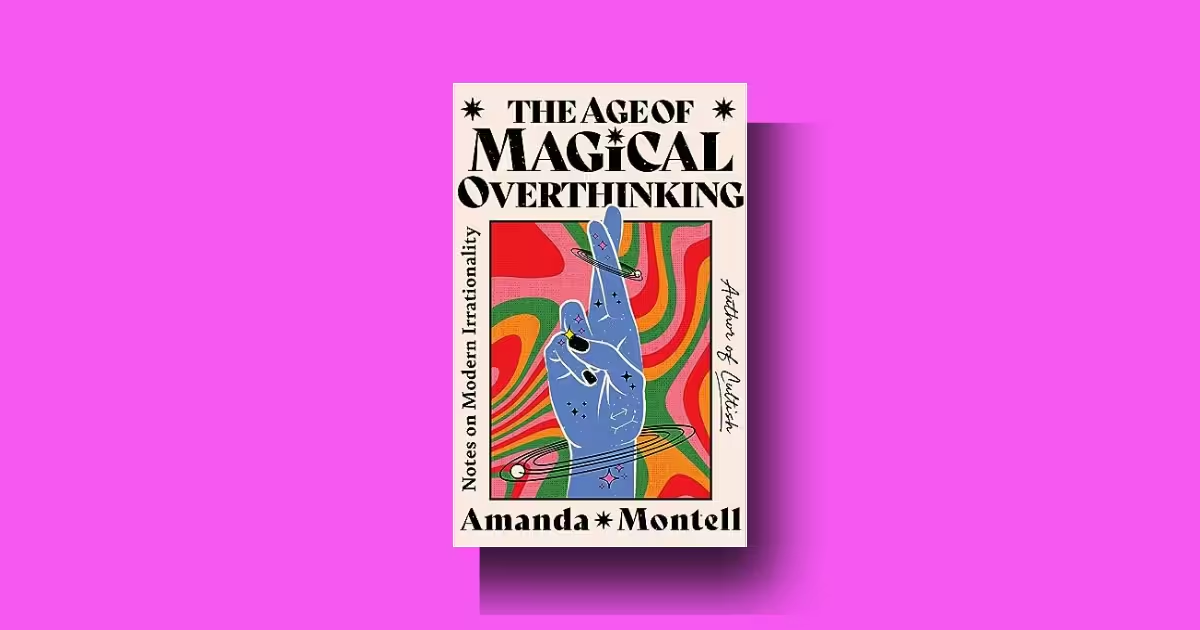

The Age of Magical Overthinking: Notes on Modern Irrationality by Amanda Montell is a blend of cultural criticism, personal memoir, and pop psychology that examines 11 cognitive biases through the lens of the 2020s information age. Montell, a linguist and host of the podcast Sounds Like a Cult, argues that our Stone Age brains are being overwhelmed by digital information overload, turning ancient survival shortcuts into modern self-sabotage.
Each chapter tackles one bias, from the halo effect (why we worship Taylor Swift like a mother) to the sunk cost fallacy (why I stayed with a toxic ex for seven years). The book is funny, self-deprecating, and research-backed, though some critics find it episodic and light on solutions.
It peaked on the New York Times bestseller list and was named a BookPage Best Nonfiction Book of 2024.
Reader Recommendation: Who will actually love this book? If you are a millennial or Gen Z reader who has ever doomscrolled at 2 a.m., felt personally attacked by a Mercury retrograde meme, or wondered why you cannot stop checking your ex’s Instagram, this book will feel like a conversation with a very smart, very chaotic friend.
Who will bounce? Readers seeking a rigorous academic treatise on cognitive science should pick up Daniel Kahneman’s Thinking, Fast and Slow instead. Montell writes for the curious, not the specialist.
If you dislike first-person narrative in nonfiction, you will struggle.
At a Glance: Lessons & Takeaways from The Age of Magical Overthinking
| Bias | Key Lesson |
|---|---|
| Halo Effect | Don’t let one good trait define a whole person. Stan worship, parental idealization, and romantic pedestals all set you up for betrayal and rage. |
| Proportionality Bias | Big events don’t always have big causes. Manifestation culture and conspiracy theories exploit the brain’s desire for dramatic, meaningful explanations. |
| Sunk Cost Fallacy | Staying because you’ve already invested time, money, or love is a trap. Sometimes the real solution is subtraction—leaving, not adding more. |
| Zero-Sum Bias | Another person’s success does not diminish you. Shine Theory: befriend impressive people instead of competing with or shit-talking them. |
| Survivorship Bias | Don’t learn only from survivors. Positive mindset didn’t save everyone, and dropout billionaire myths hide luck, privilege, and the invisible failures. |
| Recency Illusion | New-to-you does not mean new or threatening. Your attention is being hijacked; awe and mindfulness can restore perspective. |
| Overconfidence Bias | Everyone overestimates themselves, not just the ignorant. Aim for humility—accurate self-assessment—not “fake it till you make it” or self-deprecation. |
| Illusory Truth Effect | Repetition makes things feel true. Rhyme, propaganda, and fake headlines exploit this. Pause and verify before believing. |
| Confirmation Bias | You favor evidence that fits what you already believe. More information doesn’t always help; sometimes it just makes you dig in deeper. |
| Declinism | Nostalgia lies. The past wasn’t uniformly better, and “Golden Age” politics often hides xenophobia. The fading affect bias makes old pain disappear faster than old joy. |
| IKEA Effect | We overvalue what we help create. Effort gives meaning—but don’t confuse “I made it” with “it’s objectively great.” Human-made things still matter in an AI age. |
Big-Picture Lessons
- Biases are double-edged swords. They developed because they helped us survive. The goal isn’t to delete them—it’s to notice them.
- The internet dials ancient instincts up to 11. Tribal gossip becomes viral outrage; survival shortcuts become doomscrolling and stan wars.
- Self-awareness beats more information. You can’t think your way out of every bias with more facts. Sometimes you need humility, distance, and awe.
- This is not a self-help book. Montell offers a mirror, not a five-step fix. Understanding the trick is the first step.
- You are not alone in your irrationality. The mess is shared. That’s oddly comforting.
If You Remember Only Five Things
- Your brain takes shortcuts—and those shortcuts can be hijacked.
- Repetition, nostalgia, and confidence all feel like truth but aren’t.
- Leaving is often harder and smarter than adding more.
- Other people’s success isn’t your failure.
- Humility, not certainty, is the closest thing to a solution.
Introduction
The Age of Magical Overthinking is not a self-help book. Nowhere in its pages will you find a five-step plan to rewire your brain or a worksheet for manifesting abundance. Instead, Amanda Montell offers something stranger and more useful: a mirror.
The Age of Magical Overthinking, published in April 2024, is a guided tour through the cognitive biases that make you believe lies, stay in bad relationships, and scream at strangers on the internet.
Montell is a linguist from Baltimore with a degree from NYU and a talent for making social science feel like gossip. She previously wrote Wordslut (2019) and Cultish (2021), and hosts the podcast Sounds Like a Cult. In The Age of Magical Overthinking, she turns her attention inward, asking a question that haunted her during the pandemic: why does life feel like it is making less sense even as our quality of life objectively improves?
Her answer is that our innate irrationalities, which evolved to help us survive a world of predators and scarcity, are being “dialled up to 11” by the culture we built.
The book’s subtitle is “Notes on Modern Irrationality,” and that is exactly what it delivers: notes, fragments, and stories rather than a unified theory. Montell calls cognitive biases “mental magic tricks” that we developed in order to make sense of the world sufficiently to survive it. The natural world was always too much for us to process, she writes.
If we had to catalogue the precise color and shape of every twig in order to understand it, that would take more than a lifetime. So we came up with shortcuts, dozens upon dozens of them, and they help us make decisions without our even noticing.
The problem is that those shortcuts were designed for a world of rustling bushes and tribal gossip, not algorithmic newsfeeds and parasocial celebrity relationships.
The result is what Montell calls The Age of Magical Overthinking: a time when our ancient biases collide with unprecedented information overload, mass loneliness, and a capitalist pressure to “know” everything under the sun. The book is her attempt to understand how we got here, and whether we can think our way out.
Background
Montell started thinking about magical overthinking while researching her previous book, Cultish. She kept noticing that the same psychological mechanisms driving people into cults, conspiracy theories, and extreme fandom were showing up everywhere, from wellness influencers to political movements. She filed a phrase under “notes on irrationality”: “I don’t believe in ghosts, but I do hope to meet one.”
That phrase became the seed for this book.
The timing matters. Between 2020 and 2021, crisis calls to the National Alliance on Mental Illness lifeline were up 251 percent. A CDC survey found that 42 percent of young people felt so sad or hopeless in the previous two weeks that they could not go about their normal days. Montell cites these figures not to alarm but to contextualize.
We are living through what she calls a mental health exigency, and the tools we have for understanding it, like therapy and medication, are either too expensive, too overbooked, or too stigmatized for many people to access.
At the same time, the internet has become a megamall of dissociation. Fringe conspiracy theories went mainstream. Celebrity worship reached what Montell calls a hallucinatory zenith.
Disney Adults and MAGA (Donald Trump’s Make America Great Again) zealots were “blackout drunk on nostalgia, drowned in chimeras of the past.” The only explanation that made sense to her was cognitive biases: self-deceptive thought patterns that developed due to our brains’ imperfect abilities to process information from the world around us.
The Age of Magical Overthinking Summary
Montell structures the book as a series of thematic essays, each anchored to one cognitive bias and illustrated with personal anecdotes, research studies, and cultural criticism. Below is a detailed walkthrough of each chapter. By the end, you will not need to go back to the book, because everything essential is here.
Chapter 1: The Halo Effect (Are You My Mother, Taylor Swift?)
The halo effect is the unconscious tendency to make positive assumptions about a person’s overall character based on one single trait. Montell opens with Taylor Swift’s fandom, specifically the “stans” who worship her like a deity and then turn on her with equal ferocity when she fails to meet their expectations.
She quotes a Swiftie named Amy Long, who documented scandals like “Ticketgate” and “Lavendergate,” where fans accused Swift of betraying them by not being progressive enough, not responding to their demands, or dating the wrong person.
The halo effect, identified in the early twentieth century, explains this cycle. We meet someone with a witty sense of humor and assume they are also well-read and observant. Someone good-looking is presumed to be outgoing and confident.
Montell traces the bias to survival: aligning with a physically strong or attractive person was a wise adaptive strategy, and it was generally fair to assume that one good quality indicated more.
But when we map this instinct onto parasocial relationships with celebrities, it becomes toxic.
Montell is brutally honest about her own halo effect. She worshipped her mother, Denise Montell, a cancer cell biologist with a PhD from Stanford and a mantel full of awards. “My mother actually cured her own cancer,” she writes. “The week before I started sixth grade, when Denise was forty, she was diagnosed with a deadly lymphoma. I wouldn’t learn until she’d been in remission for half a decade that the doctors had told her she was probably going to die. But she didn’t die, in part because she collaborated with her oncologists to help design her own experimental treatment plan.”
Montell put her mother on a pedestal so high that any human fallibility felt like betrayal.
The chapter is not just about celebrities. Montell draws a line from stan culture to parental worship to the way we treat romantic partners. The halo effect makes us see people as one-dimensional, either saints or demons. And when the illusion breaks, we often react with disproportionate rage.
Chapter 2: Proportionality Bias (I Swear I Manifested This)
Proportionality bias is the intuition that big events must have big causes. Montell uses this bias to explain the rise of manifestation culture, wellness influencers, and conspiracy theories.
She profiles a fictionalized figure called “The Manifestation Doctor,” a licensed psychologist turned holistic mental health influencer who built a multimillion-dollar brand by telling followers that traditional therapy and medication are keeping them unwell, and that they can self-heal their way out by learning to make the universe bend in their favor.
The Manifestation Doctor’s message is conspiracy theory rebranded for the mental health crisis. Sick? Poor? Not living your best life? Don’t blame your boss or your ex. Blame your unresolved childhood trauma.
And then, for $26 a month, enlist in the “self-empowerment circle,” where you will learn how to manifest the life you deserve for a fraction of the cost of traditional therapy.
Montell is careful to note that some of this advice is not wrong. Beliefs about yourself do influence outcomes. Spirituality is shown to increase resilience.
But the absolutist framing, the guru-style power dynamic, and the rejection of external care can be dangerous. She interviews a woman named Heather, whose father found The Manifestation Doctor on Instagram, stopped taking his antidepressants, and within six months had entered QAnon waters. “He’s still really disconnected from reality,” Heather says. “That light in his eyes is just gone.”
The chapter also explores the psychology of conspiracy theories more broadly. A 2019 British review found that small, mundane explanations for important events are generally not as satisfying as dramatic ones.
The human mind enjoys harmonious proportions: faces that meet the golden ratio, photography that follows the rule of thirds. The same bias that convinces QAnoners that elites are trafficking children is what pressures prosecutors to bring splashy guilty verdicts for high-profile cases.
Chapter 3: Sunk Cost Fallacy (A Toxic Relationship Is Just a Cult of One)
The sunk cost fallacy is the deeply ingrained conviction that spending resources you cannot get back justifies spending even more. This is the most personal chapter in the book. Montell tells the story of “Mr. Backpack,” her long-term ex, whom she dated from age eighteen to twenty-five.
He was twenty-nine when they met, a charismatic older man with an acerbic wit and steely eyes, her best friend’s eldest sibling. The relationship was cultlike: love-bombing, false promises, harsh punishments, withdrawal from her former life.
Montell stayed for seven years. She moved from New York to Los Angeles for him. She stopped speaking to friends about the relationship because she was convinced that once she put her misadventures on the record, the story would change from one of an extraordinary love to a dumb kid’s choice to tolerate abuse. “I didn’t want that to be my story,” she writes.
She connects her experience to the sunk cost fallacy, but also to a more complex idea from philosopher Ryan Doody: that honoring sunk costs might make you seem more consistent, like you know yourself well and can make shrewd predictions about your happiness. To admit you made a bad bet about your own emotions is humiliating. “It suggests that you aren’t even predictable to you,” Montell writes. “And that won’t exactly inspire confidence in others.”
The chapter is also about the additive solution bias: the tendency to think the solution to a problem is adding something rather than removing something. Montell tried to fix her relationship with bigger apartments and splashy vacations.
What she actually needed was to leave. She quotes a 2021 study from the University of Virginia that found only 20 percent of participants solved a symmetry problem by removing blocks rather than adding them. The bias toward additive solutions is widespread.
Chapter 4: Zero-Sum Bias (The Shit-Talking Hypothesis)
Zero-sum bias is the false intuition that another party’s gain directly means your loss. Montell uses her experience working in the beauty industry to explore this bias.
She spent five years as a beauty editor, surrounded by influencers, brands, and a culture that made her feel like she was in competition with every other woman on the internet. “I felt in my bones that another beauty editor’s blonde only made me more brunette,” she writes. “That each influencer’s follower count personally rendered me irrelevant.”
The chapter is also about shit-talking: the gossip and backstabbing that women are often socialized into as a way of managing insecurity. Montell quotes a 2022 study from Macquarie University in Australia that confirmed a vicious feedback loop of upward social comparison, problematic social media use, depression, and low self-esteem, disproportionately affecting women.
The core features of Instagram and TikTok, addictive design, perfectionistic filters, algorithmic suggestions, and incentives to show only curated highlights, set young women up for psychological failure.
Montell’s solution is not to suppress negative emotions but to break the cycle. She describes “Shine Theory,” a concept coined by journalist Ann Friedman: when you meet a woman who is intimidatingly witty, stylish, and professionally accomplished, befriend her. Surrounding yourself with the best people does not make you look worse by comparison.
It makes you better.
Chapter 5: Survivorship Bias (What It’s Like to Die Online)
Survivorship bias is the tendency to focus on positive outcomes while ignoring accompanying misfortunes. Montell wrote an article for Marie Claire in 2017 about young adults who vlogged their experiences with terminal illness. She interviewed six dying girls. Only two survived. One of them, Racheli, became her best friend.
The chapter explores how survivorship bias distorts our understanding of illness, success, and happiness. When Racheli’s YouTube commenters saw her positive attitude, they assumed that her mindset was what saved her.
But as Racheli herself told Montell, “I know amazing people who did everything ‘right’ and passed away, and I know awful people who did things ‘wrong’ and lived.” Survivorship bias encourages us to read positive causation into patterns where only correlation exists.
Montell also connects this bias to the mythology of tech CEOs who dropped out of college to become billionaires. A 2017 Forbes study found that 84 percent of America’s top billionaires graduated from college, most from Harvard, MIT, or Stanford.
The dropout narratives are sparkly, but they falsely imply that riches are available to anyone with adequate skill and effort, and that failure is the exception rather than the invisible norm.
Chapter 6: Recency Illusion (Time to Spiral)
The recency illusion is the tendency to assume that something is objectively new, and thus threatening, simply because it is new to you. Montell opens with the 2021 60 Minutes segment on Unidentified Aerial Phenomena (UAP), which she watched with her partner Casey.
The segment warned that UFOs were real and could be a national security risk. Montell and Casey scrolled through the comments, watching the internet spiral.
The recency illusion, coined by Stanford linguist Arnold Zwicky in 2007, was first observed in language. People assume that a word or grammatical construction they have never heard before must be a deviant form of slang that entered the lexicon recently and poses a threat to English. Montell gives examples: the singular “they” has been used since the fourteenth century, and “literally” has meant “figuratively” for 250 years.
The chapter is also about attention and time perception. Montell interviews Sekoul Krastev, co-founder of The Decision Lab, who explains that recency is linked to relevance. We think of something recent as more salient. But in the digital age, our attention is constantly being hijacked by headlines and algorithms that frame every event as urgent and hazardous.
Montell quotes Jenny Odell’s How to Do Nothing: “The capitalistic pressure to ‘colonize the self,’ to treat our bodies and minds like productivity machines, is identical to that which colonizes our time with excess news.”
The solution, Montell suggests, is awe. Awe is the humbling wonder associated with immersion in nature, live music, collective dance, spiritual rituals, and psychedelics. It moves people to feel less impatient, less self-focused, and more generous. In 2023, a study published in JAMA Psychiatry reported that people who received just eight weeks of mindfulness lessons enjoyed a decrease in stress comparable to the effects of Lexapro.
Chapter 7: Overconfidence Bias (The Scammer Within)
Overconfidence bias is the tendency to overvalue your actual skills, express excessive certainty in your evaluations, and overcredit yourself with positive outcomes. Montell opens with the story of McArthur Wheeler, who robbed two Pittsburgh banks in 1995 with lemon juice smeared on his face, believing it would make him invisible to security cameras. He was caught immediately.
The chapter explores the Dunning-Kruger effect, the famous finding that people with the least knowledge on a subject are likeliest to overvalue their expertise. But Montell notes that the original study did not prove that knowing very little causes overconfidence. In fact, most people, even experts, systematically overestimate their skills.
David Dunning himself clarified that the lesson of the effect was always about how we should be humble and cautious about ourselves, not an excuse to feel supercilious.
Montell is fascinated by scammer stories, from Elizabeth Holmes to the Tinder Swindler. She admits that overconfidence is a trait American culture celebrates. “Fake it till you make it” is considered a wise proverb. But she also explores the flip side: imposter syndrome. She interviews her friend Rachel Torres, a psychologist who studies imposter syndrome, who says, “I experience imposter syndrome a lot in my work, despite having years of training and all these credentials. I show up to meetings feeling like a fraud.”
The chapter ends with a call for humility, not self-deprecation. The American Psychological Association defines humility as “a low focus on the self, an accurate (not over- or underestimated) sense of one’s accomplishments and worth, and an acknowledgment of one’s limitations, imperfections, mistakes, gaps in knowledge, and so on.”
Chapter 8: Illusory Truth Effect (Haters Are My Motivators)
The illusory truth effect is the tendency to trust a statement as factual simply because you have heard it multiple times. Montell opens with a personal confession: she once repeated a myth on her podcast that medieval brides carried bouquets to mask their body odor because they only bathed once a year.
A medieval historian corrected her: bridal bouquets were made of flowers arranged according to color symbolism, not perfume. Medieval peasants did plenty of grooming, often in communal bathhouses.
The chapter explores why repetition makes things feel true. In 1993, researchers Alice Eagly and Shelly Chaiken argued that when people lack the knowledge, literacy, or motivation to critically evaluate a message, they rely on simple heuristics like “familiar sayings tend to be credible.”
Repetition is like a cognitive Tums, aiding in informational digestion. When you come across a sentiment twice and then three times, you start responding to it more quickly, your brain misinterpreting fluency as accuracy.
Montell connects this to political propaganda, fake news, and the stories we tell ourselves about who we are. She quotes a 2018 Yale study by Gord Pennycook that found if participants had seen a false headline just once before, it made them up to twice as likely to believe it. Headlines from the study included “Mike Pence’s Marriage Was Saved by Gay Conversion Therapy” and “Trump to Ban All TV Shows that Promote Gay Activity Starting with Empire as President.”
The chapter also explores the power of rhyme. Studies have shown that people rate the phrase “woes unite foes” as more truthful than “woes unite enemies,” even though they mean the same thing.
Rhyme creates a sound structure that makes the message feel more sensible. Montell quotes Harvard psycholinguist Steven Pinker: rhyming “purifies the basics” of our highly complicated world.
Chapter 9: Confirmation Bias (Sorry I’m Late, Must Be Mercury in Retrograde)
Confirmation bias is the universal tendency to favor information that validates your existing views and discard that which refutes them. Montell opens with a trip to an animatronic dinosaur exhibit with her friend Kristen, who grew up in a conservative evangelical community that believed dinosaurs lived two thousand years ago and cohabited with Adam and Eve.
When fossil hunters started uncovering prehistoric skeletons in the nineteenth century, inerrant Christians worked backwards from their conclusions about Genesis to make the discoveries line up.
The chapter explores how confirmation bias works in politics, relationships, and astrology. Montell admits that she once spent an evening taking internet quizzes to determine whether she should break up with Mr. Backpack, and only listened to the one result that said “no.”
She quotes a 2007 book, Mistakes Were Made (But Not by Me), which cites a study where participants hooked up to MRIs and presented with data that negated their political views showed decreased activity in the reasoning areas of their brains. Faced with facts they did not like, their prefrontal cortexes essentially stuck their fingers in their ears.
Montell is not immune. She admits to overanalyzing the world to death, spending thousands on therapy to intellectualize her way out of misery. “I will always believe in the material power of words and facts,” she writes. “But I also know there’s a point past which they don’t make you feel any better. The emotional burden of too much information can’t always be quelled by more information.”
Chapter 10: Declinism (Nostalgia Porn)
Declinism is the false impression that things are worse now than they were in the past, and it is all downhill from here. Montell opens with her love of dinosaurs, cottagecore, and vintage toadstool tchotchkes.
She admits to romanticizing the past, even eras she never knew. She quotes the poet and memoirist Maggie Nelson, who suggested that the phenomenon of feminists turned tradwives might have emerged from a generation of women feeling like they were promised a kind of liberation that did not pan out as they hoped.
The chapter explores the psychology of nostalgia.
Cognitive psychology research has revealed that memories of negative emotions dwindle quicker than positive ones, a phenomenon known as the fading affect bias. Because most of us prefer reminiscing about happy times, our cheery revisions grow stronger while bad memories wither away, leading to a general idealization of the past.
Montell connects declinism to populist politics.
Far-right nationalists are known to harken back to their country’s supposed “Golden Age,” hiding xenophobic policies under the promise of restoring the nation to its former glory. Hitler used the slogan “Make Germany Great Again,” which sounds familiar because American presidents including Ronald Reagan, George H. W. Bush, and Bill Clinton also invoked the tagline.
The chapter ends with a more hopeful note. Montell interviews Linda Sanderville, a D.C. therapist, who says she would not want to live in any other time period. “Even with all the challenges of now, I couldn’t tell you another time I’d prefer,” Sanderville says. “I’m not someone who’s like, oh look how wonderful everything is right now, but just look at dying in childbirth. That’s still a major issue in the Black maternal community.”
Chapter 11: The IKEA Effect (The Life-Changing Magic of Becoming a Mediocre Crafter)
The IKEA effect is the tendency to ascribe disproportionately high worth to items we helped create. Montell opens with her discovery of furniture flipping during the pandemic.
She and her best friend Racheli found a dusty seashell lamp at Goodwill for $10, painted it “atrocious Hubba-Bubba-Bubble-Tape pink,” and listed it on Facebook Marketplace for the average price of a bottle of Veuve Clicquot. It sold above asking price within an hour.
The chapter explores the psychology behind the IKEA effect. In 2011, a trio of Ivy League researchers demonstrated that people express willingness to pay more for products they built than for objectively superior versions that arrived pre-assembled.
The effect was first observed in the mid-twentieth century, when General Mills launched Betty Crocker instant cake mixes. Sales eventually slowed because homemakers felt that if all they did was add water, the cake was not truly theirs. General Mills relaunched the mixes with a new slogan: “Add an Egg.” Sales soared.
Montell connects the IKEA effect to the modern DIY renaissance, the meal kit market, crowdfunding, and even TikTok’s interactive culture. She argues that we need the allegorical egg. The egg gives us purpose. The egg tells us we deserve to be here. But what happens when the egg becomes so obsolete that we cannot even pretend to need it anymore?
The chapter ends with a meditation on AI-generated art and music. Montell’s partner Casey is a film composer who worries that AI will make his work feel small.
But Montell argues that a robot could compose the most enchanting concerto of all time, and it would never be as valuable to her as the nightly waltzes Casey improvises on their upright Wurlitzer, for the sheer fact that he is the one making them. “It feels good to paint an old seashell lamp alone,” she writes. “It feels better to have a doting witness.”
The Age of Magical Overthinking Analysis
The Age of Magical Overthinking is an outstanding, messy, and occasionally frustrating book. It is not a definitive treatise on cognitive biases, and it does not pretend to be. What it offers instead is something rarer: a voice.
Montell writes like the smartest person at the party, the one who has read the studies but can also tell you a story about the time she painted a lamp the color of bubble tape and convinced herself it was worth hundreds of dollars.
The book’s greatest strength is its synthesis of research and personal narrative. Montell does not just explain the halo effect; she shows you how it nearly destroyed her relationship with her own mother. She does not just define the sunk cost fallacy; she takes you inside the seven-year relationship that almost swallowed her twenties.
The research is solid. Montell cites studies from the Journal of Experimental Psychology, Nature, Proceedings of the National Academy of Sciences, and dozens of interviews with psychologists and researchers.
She is careful to note when the evidence is mixed, as with the Dunning-Kruger effect, and she avoids the trap of presenting cognitive biases as simple, solvable problems. “Cognitive biases are double-edged swords,” she writes. “If they didn’t have benefits, they wouldn’t have developed.”
Where the book stumbles is in its structure. Several critics have noted that the chapters feel episodic, like a collection of essays rather than a unified argument. A reviewer on The StoryGraph wrote, “Ultimately The Age of Magical Overthinking is an enjoyably written book, but what it has in style, it lacks in substance.”
That is fair. Montell is better at analysis than providing answers, as one critic put it. She believes that a good dose of considered self-awareness can go a long way, but she does not offer a roadmap for getting there.
There is also the matter of Montell’s voice.
She is funny, self-deprecating, and occasionally self-indulgent. Some readers will find her anecdotes charming; others will find them exhausting. A comment on the San Diego Public Library catalog reads, “I powered through to finish since it’s quite an easy read but I didn’t want to because I was so tired of listening to the author’s opinions on herself/everything else.” That is a risk of the first-person nonfiction style, and Montell leans into it hard.
Still, the book fulfills its stated purpose. It helps readers understand their self-sabotaging tendencies more profoundly, as the Boston Globe put it. It does not promise to fix you. It promises to show you the mental magic tricks you are already performing, and that is enough.
Comparison with Similar Works
If you liked The Age of Magical Overthinking, you might also enjoy:
Thinking, Fast and Slow by Daniel Kahneman (2011). The foundational text on cognitive biases. Kahneman is more rigorous and less personal, but if you want the science behind Montell’s anecdotes, this is the book.
Predictably Irrational by Dan Ariely (2008). A lighter, more experimental take on the same themes. Ariely’s studies are clever and surprising, though some of his research has been called into question in recent years.
The Year of Magical Thinking by Joan Didion (2005). Montell cites Didion’s memoir about grief as one of her first exposures to the concept of magical thinking. Didion’s book is not about cognitive biases in the social science sense, but it is a profound exploration of how the mind deceives itself in the face of loss.
Cultish by Amanda Montell (2021). If you enjoyed Montell’s voice, her previous book applies the same lens to cult language and cultlike groups. It is more focused than Magical Overthinking, but less personal.
Trick Mirror by Jia Tolentino (2019). A collection of essays about the internet, self-delusion, and modern life. Tolentino is more literary and less research-driven, but the themes overlap significantly.
Conclusion
The Age of Magical Overthinking is for anyone who has ever wondered why they cannot stop checking their ex’s Instagram, why they believe the headlines they see on Facebook, or why they stayed in a relationship that made them miserable for years. It is for readers who want to understand their own brains without being lectured by a scientist or sold a self-help program.
It is not for readers who want a rigorous academic treatise, a step-by-step guide to overcoming bias, or a book that stays on topic at all times. Montell wanders, digresses, and overshares. That is part of her charm, but it is also part of her limitation.
If you are a millennial or Gen Z reader who spends too much time online and suspects that your brain is not entirely on your side, this book will feel like a conversation with a friend who happens to have read all the studies.
If you are a specialist looking for new research, you will be disappointed. But if you are a human being trying to make sense of a world that feels increasingly senseless, Montell has something valuable to offer: the reminder that you are not alone in your irrationality, and that understanding your biases is the first step toward not being ruled by them.